Quick Takeaways
- The state, particularly the IRGC, uses massive mining farms to generate foreign currency and dodge sanctions.
- Electricity is heavily subsidized for state-linked farms, often costing as little as 0.004 cents per kWh.
- Legal mining requires government licenses, but state-affiliated "cartels" often bypass these rules.
- Excessive energy consumption by these farms has led to severe nationwide blackouts.
- Recent freezes by stablecoin issuers like Tether have forced Iran to shift toward different digital assets.
The Strategic Pivot: Mining for National Survival
The shift toward state-controlled mining didn't happen by accident. Around 2018, the Iranian government realized that cryptocurrency offered a way to move money without needing a Western bank's permission. By officially recognizing mining as a legal industry in July 2018, the administration of Hassan Rouhani opened the door for monitoring the sector and, more importantly, exploiting it. This wasn't about encouraging individual citizens to get rich; it was about creating a mechanism to fight trade embargoes.
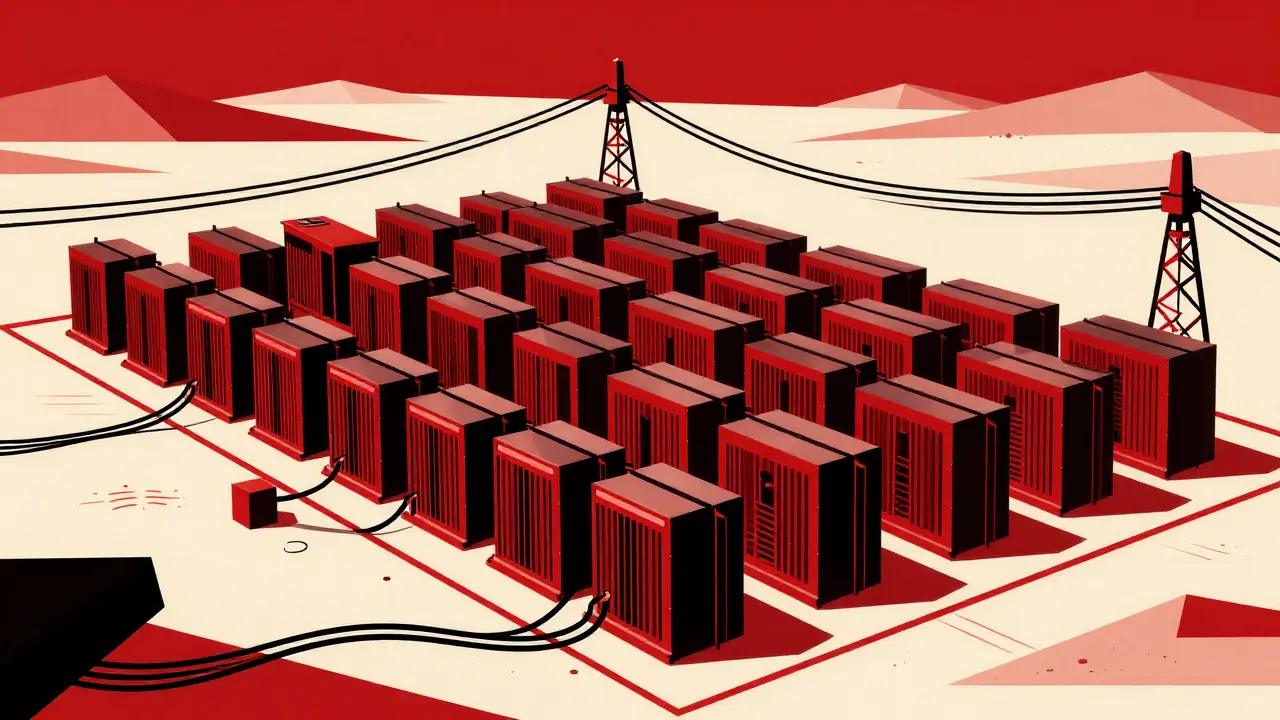
The real power shift happened between 2019 and 2020. This is when the Islamic Revolutionary Guard Corps a branch of the Iranian Armed Forces that also manages significant economic interests (IRGC) and entities tied to the Supreme Leader began aggressively entering the sector. They didn't start small. They partnered with Chinese firms to build industrial-scale operations. One of the most striking examples is a 175-megawatt farm in Rafsanjan, Kerman province. For the IRGC, mining is essentially a money-printing press that operates outside the reach of the US Treasury.
The Energy Paradox: Subsidies and Blackouts
To understand why Iran is so attractive for mining, you have to look at the electricity bills. Most global miners fight for cheap hydro or wind power. In Iran, state-linked operations get electricity at a fraction of the global cost-sometimes as low as 0.004 cents per kWh. That's roughly 1/50th of what a typical commercial miner in North America would pay. This creates an astronomical profit margin when converting mined Bitcoin a decentralized digital currency that uses a proof-of-work consensus mechanism into hard currency.
But this "free energy" comes at a steep price for the average citizen. The national grid simply cannot handle the load of thousands of ASIC Application-Specific Integrated Circuit miners designed specifically for cryptocurrency hashing servers. While a family in Tehran might experience a 14-hour blackout during a 45°C summer heatwave, the state-controlled farms in special economic zones continue to hum along with dedicated power feeds. This has led to a public outcry, with citizens connecting the dots between their dark living rooms and the "crypto cartels" operating on military bases.
| Feature | Legal/Licensed Miners | State-Affiliated (IRGC/Foundations) |
|---|---|---|
| Electricity Cost | ~7 cents per kWh | ~0.004 cents per kWh |
| Hardware Req. | Government-approved models | Latest international high-efficiency gear |
| Regulatory Scrutiny | High (Ministry of Industry) | Minimal to None |
| Power Stability | Subject to rationing/cuts | Dedicated, uninterrupted feeds |
Hiding in Plain Sight: The Infrastructure of Secrecy
Because these operations are often legally gray or aimed at evading international eyes, the infrastructure is frequently hidden. It's not all just warehouses in the desert. In a shocking discovery in May 2025, a massive mining operation was found beneath the Shahid Ghorbani Sports Complex in Ahvaz. The setup included tunnels under a cycling track and repurposed service rooms, running undetected for over two years. This shows that the state isn't just using open farms; they are weaponizing urban infrastructure to hide their hashing power.
The scale is massive. By early 2023, reports indicated the national mining capacity exceeded 1,000 megawatts. For context, this level of power consumption puts Iran among the top mining hubs globally, having once held about 4.5% of the global Bitcoin hash rate. The government's approach is a strange hybrid: they want the tax revenue and the sanctions-evasion capabilities, but they don't want the citizens to have too much financial autonomy.
Sanctions 2.0: The Battle Over Stablecoins
The game changed in July 2025. For years, Iran relied heavily on Tether the issuer of USDT, a USD-pegged stablecoin (USDT) to settle international trades. However, Tether executed its largest-ever freeze of Iranian-linked funds, blocking 42 addresses tied to Nobitex Iran's largest domestic cryptocurrency exchange and IRGC wallets. This was a wake-up call. The state realized that relying on a single, centralized stablecoin issuer was a major vulnerability.
Tehran's response was swift and coordinated. They didn't quit; they adapted. The government began urging users and entities to move their holdings from USDT to DAI a decentralized, collateral-backed stablecoin via the Polygon a scalable sidechain for the Ethereum network network. By switching to decentralized stablecoins, they hope to remove the "off switch" that companies like Tether can flip. It's a high-stakes game of cat and mouse played with billions of dollars in digital assets.
The Regulatory Trap: Taxes and Surveillance
If you're a regular person trying to mine in Iran, the experience is far less glamorous. You'll spend 6 to 8 weeks just waiting for a license from the Ministry of Industry, Mine and Trade. Once you're in, you're forced to use government-approved hardware, which is often 15-20% less efficient than the latest gear available on the global market. It's a system designed to keep private miners small and inefficient while the state-linked giants thrive.
The government is also tightening the noose on the financial side. In early 2025, the Central Bank of Iran the apex bank responsible for monetary policy and regulation in Iran (CBI) blocked all cryptocurrency-to-rial payment gateways. When they partially reopened them, it came with a condition: exchanges had to provide full user data via API. Essentially, if you want to trade crypto for local currency, the government wants to know exactly who you are and what you're doing. This was followed by the August 2025 "Law on Taxation of Speculation and Profiteering," which finally slapped a capital gains tax on crypto trading, treating it like gold or real estate.
The Future of the Digital Rial
While they use Bitcoin to dodge sanctions, the state is also building its own version of a digital currency. The "Rial Currency" is the CBI's attempt to create a state-controlled digital alternative. Unlike Bitcoin, which is decentralized, this would be a Central Bank Digital Currency (CBDC). The goal is simple: maintain the efficiency of digital payments while keeping total control over every transaction. It's the ultimate contrast-using the decentralized nature of Bitcoin to fight the West, while building a hyper-centralized digital rial to monitor its own people.
Why does the Iranian government support crypto mining?
The primary reason is sanctions evasion. By mining cryptocurrency and trading it for foreign currency, Iran can bypass the SWIFT banking system and traditional financial restrictions imposed by the U.S. and EU. It provides a way to generate hard currency that is much harder for international regulators to track or freeze.
How does state mining affect the Iranian public?
It creates a massive energy drain. Because state-linked farms receive heavily subsidized electricity, they consume enormous amounts of power, which often leads to severe electricity shortages and rolling blackouts for residential areas and small businesses, particularly during the summer months.
Is crypto mining legal for ordinary citizens in Iran?
Technically, yes, but it is heavily regulated. You need a license from the Ministry of Industry, Mine and Trade, you must use approved hardware, and you are subject to specific electricity tariffs that are much higher than those given to state-affiliated entities.
What happened with the Tether freeze in 2025?
In July 2025, Tether froze 42 Iranian-linked addresses, including those connected to the Nobitex exchange and the IRGC. This was one of the largest freezes ever and forced the Iranian government to encourage users to move their assets into decentralized stablecoins like DAI on the Polygon network.
What is the 'Rial Currency'?
The Rial Currency is a government-backed digital version of the Iranian rial. Unlike decentralized cryptocurrencies, it is a state-controlled digital asset designed to modernize payments while giving the Central Bank of Iran full visibility and control over financial transactions.
Next Steps for Navigating the Landscape
If you are tracking the Iranian crypto market or looking at the geopolitical implications, keep an eye on these three areas:
- Stablecoin Shifts: Watch for the migration from USDT to DAI. If the state successfully decentralizes its reserves, sanctions will become even less effective.
- Energy Policy: Look for changes in electricity tariffs. If the government raises costs for legal miners while keeping subsidies for the IRGC, the energy crisis will likely worsen.
- CBDC Implementation: The rollout of the digital rial will likely signal a crackdown on private cryptocurrency exchanges as the state tries to force everyone into its own monitored ecosystem.
Comments
7stargee Emmanuel Obani
Typical. They just steal power and laugh at the poor people. 🙄 Just another state scamming its own folks. Lmao.
April 15, 2026 at 04:29
Kelly Cantrell
This is exactly how it starts. First they hide miners under sports complexes, then they'll be using the tech to track every single move we make globally through some back-door agreement. The US needs to stop playing around and completely shut down these nodes before the 'digital rial' becomes a weapon for global surveillance. It's all connected to a larger plot to destabilize the dollar. Wake up!
April 15, 2026 at 19:38
aletheia wittman
omg the part about the tunnels under the cycling track is actualy insane!! like why is it always the sports complexes lol 😭 totaly wild
April 17, 2026 at 19:08
Jason Davis
The move to DAI is a smart play from a technical standpoint. Tether's centralization is a huge risk for any state trying to evade sancitons. Most people dont realize that DAI is over-collateralized, making it way more resilient to arbitrary freezes. Its basically the gold standard for stability in these high-risk environments though it does increase the gas costs on some networks.
April 18, 2026 at 05:20
Prasanna Shembekar
imagine having no lights because the govt wants btc it's just so sad really
April 18, 2026 at 18:03
Lela Singh
Absolutely electric read! ⚡️ This just shows how agility in tech can outsmart old-school blocks. Such a vivid example of digital pivot power!
April 20, 2026 at 10:38
Scott Fenton
It is imperative to consider the ethical implications of such energy disparities. The systematic prioritization of state-affiliated mining operations over the basic residential needs of the citizenry represents a significant failure in public infrastructure management. While the economic strategy for sanctions evasion may be effective for the regime, the social cost is undoubtedly severe. One must examine the correlation between centralized power control and the erosion of civil stability in these regions. Such a disparity in electricity pricing-0.004 cents versus 7 cents-is not merely a market inefficiency but a deliberate tool of state control. Furthermore, the implementation of a CBDC likely serves to finalize the transition from financial evasion to total domestic financial surveillance. This creates a paradoxical environment where the state leverages decentralization for external agility while imposing absolute centralization internally. The transition to DAI further proves that the state is learning rapidly from the vulnerabilities of the current financial system. It is a sobering reminder of how technology can be bifurcated to serve divergent goals: liberation from external constraints and total control over internal populations. The infrastructure of secrecy mentioned, specifically the urban tunnels, suggests a level of clandestine operation that exceeds typical industrial mining. We must remain mindful of how these precedents might be mirrored in other struggling economies. The long-term viability of such a model is questionable, as it relies on the continued suppression of domestic discontent and the ability to outpace international regulatory frameworks. Ultimately, the human cost-manifested as blackouts during extreme heat-is the most critical metric here.
April 21, 2026 at 18:07
Stanly Hayes
Seriously? We're just gonna let them build a secret crypto empire under a sports club? This is exactly why we need to be way more aggressive with these sanctions. They're literally laughing at the global system while their own people sit in the dark. Absolutely pathetic!
April 23, 2026 at 14:46