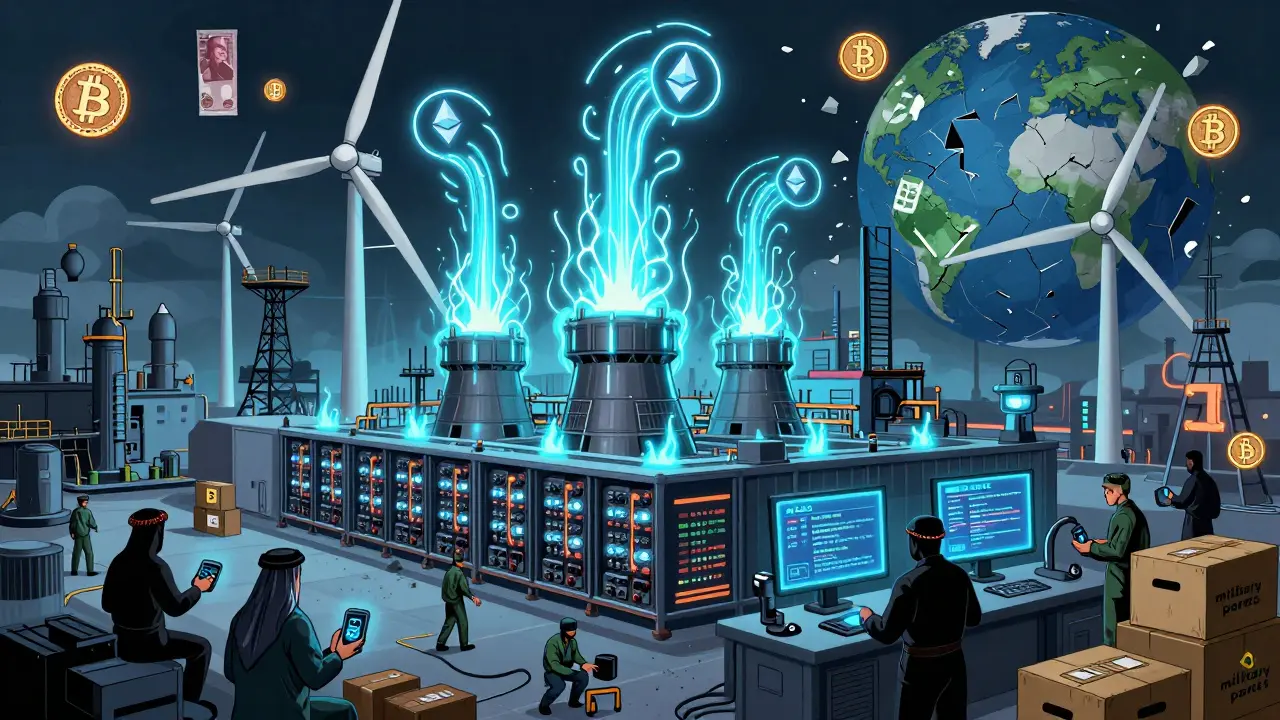
When Russia legalized cryptocurrency mining in early 2025, it wasn’t just about energy efficiency or tech innovation. It was a strategic move to cut ties with the Western financial system - and keep its economy running despite global sanctions. The country didn’t just allow mining. It built an entire shadow financial network around it, using digital assets to buy weapons, trade oil, and pay for military supplies without touching the dollar or euro.
Before 2022, Russia treated crypto like a risky curiosity. Mining was tolerated but not officially supported. After the invasion of Ukraine and the sweeping sanctions that followed - freezing central bank reserves, cutting off SWIFT access, and banning key Russian banks - Moscow changed course. It didn’t try to hide crypto anymore. It doubled down on it.
The A7A5 Stablecoin: Russia’s Secret Payment Rail
The centerpiece of this new system is A7A5 a ruble-backed stablecoin launched in February 2025 by a Kyrgyzstan-based company called Old Vector, backed by Russia’s state-owned Promsvyazbank. Unlike Bitcoin or Ethereum, A7A5 isn’t meant to be traded for profit. It’s designed to move money - quietly, reliably, and out of sight.
By July 2025, A7A5 had processed over $51 billion in transactions. That’s not retail users buying coffee. That’s businesses, state-linked entities, and military suppliers moving funds across borders. Chainalysis found clear patterns: most trades happen on weekdays, aligning with business hours in Moscow and St. Petersburg. The stablecoin is tied directly to the ruble, making it stable enough for trade, but outside the reach of Western banks.
How do people get A7A5? Through sanctioned exchanges like Garantex and Grinex. Garantex, once Russia’s largest crypto platform, was sanctioned by the U.S. in 2022. Grinex, created in 2024 by former Garantex staff, was sanctioned in August 2025 - explicitly because it was built to bypass those same sanctions. These platforms don’t serve global users. They serve a closed loop: Russian companies, sanctioned oligarchs, and intermediaries in Central Asia.
Why Mining? Because Russia Has the Power
Russia now runs the world’s third-largest cryptocurrency mining industry, behind only the U.S. and Kazakhstan. Why? Because it has cheap electricity, vast unused industrial space, and a government that wants to control the flow of value.
Crypto mining doesn’t just create coins. It creates liquidity. Miners sell their Bitcoin or Ethereum for rubles. Those rubles go into the banking system. Then, through a series of intermediaries, those rubles are converted into A7A5. From there, it’s sent to partners in Turkey, Iran, or Kyrgyzstan to buy machinery, spare parts, or even raw materials for weapons production.
The U.S. Treasury didn’t just sanction the exchanges. On August 20, 2025, it designated a crypto mining company for the first time ever. That company, based in Siberia, was found to be directly supplying power to mining rigs owned by entities linked to Russia’s defense industry. This wasn’t a side effect - it was the point.
How the West Is Fighting Back
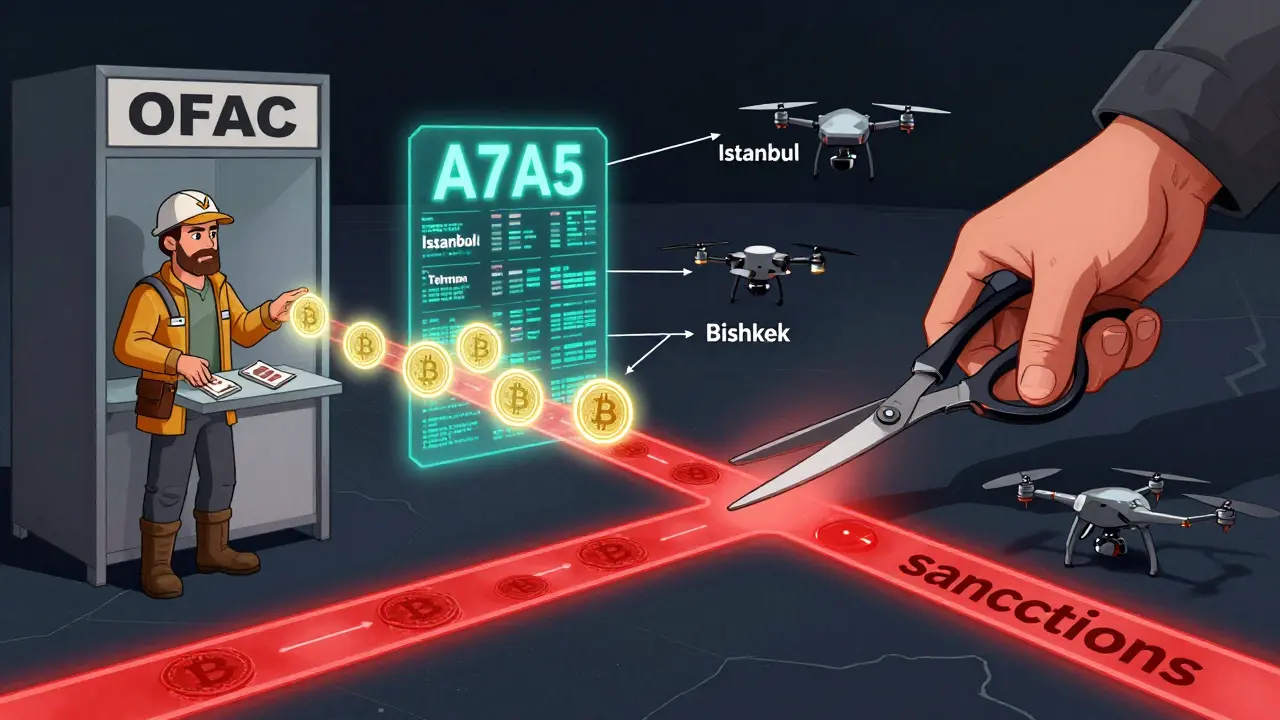
The U.S. and UK didn’t wait. They hit back hard. In August 2025, the U.S. Office of Foreign Assets Control (OFAC) and the UK’s Office of Financial Sanctions Implementation (OFSI) coordinated sanctions on eight entities tied to A7A5, including three Kyrgyz banks and a Luxembourg-based firm that helped route payments.
They didn’t stop at companies. They targeted individuals: oligarchs, engineers, and bank managers who helped build this system. One person, a former Russian state bank official now living in Bishkek, was sanctioned for wiring funds to a company that bought drone parts from China. The blockchain showed the trail. The U.S. followed it.
Chainalysis reported that over 70% of A7A5 transactions connect to wallets previously linked to sanctioned Russian banks. That’s not accidental. It’s designed. But here’s the irony: blockchain transparency is now the U.S.’s biggest tool. Every transaction is recorded. Every wallet has a history. Russia thought crypto would hide them. Instead, it gave Western analysts a map.
The Limits of Crypto as a Sanctions Tool
But here’s the catch: crypto isn’t magic. It can’t replace the dollar.
Russia’s annual exports before the war were worth about $400 billion. Bitcoin’s entire market cap at the time was around $800 billion. Even if Russia could convert every ruble into Bitcoin - which it can’t - it would still need to find buyers willing to trade oil or grain for a volatile asset. No one wants to hold Bitcoin when they’re trying to pay for wheat or steel.
The Bitcoin Policy Institute concluded that Bitcoin is ill-suited for large-scale sanctions evasion. It’s too small, too volatile, and too slow. A7A5 works because it’s pegged to the ruble. But rubles themselves are worth less now. And they can’t be used internationally.
North Korea and Venezuela also use crypto to evade sanctions. But they’re not building economies. They’re surviving. Russia is trying to scale. And scaling crypto for trade is harder than it looks.
The Bigger Picture: A New Financial Battlefield
Russia’s move isn’t just about money. It’s about control. By legalizing mining and creating its own stablecoin, Russia is building an alternative to SWIFT, to the dollar, to Western banking - even if it’s not perfect.
It’s using crypto not as a currency, but as a bridge. A bridge between sanctioned Russian companies and unsanctioned markets in Asia, Africa, and the Middle East. A bridge between miners in Siberia and factories in Iran. A bridge that bypasses banks, regulators, and audits.
And it’s working - for now. A7A5 is still trading. Grinex is still operating. Miners are still running rigs. But the noose is tightening. Every transaction leaves a digital fingerprint. Every wallet can be traced. Every exchange can be cut off.
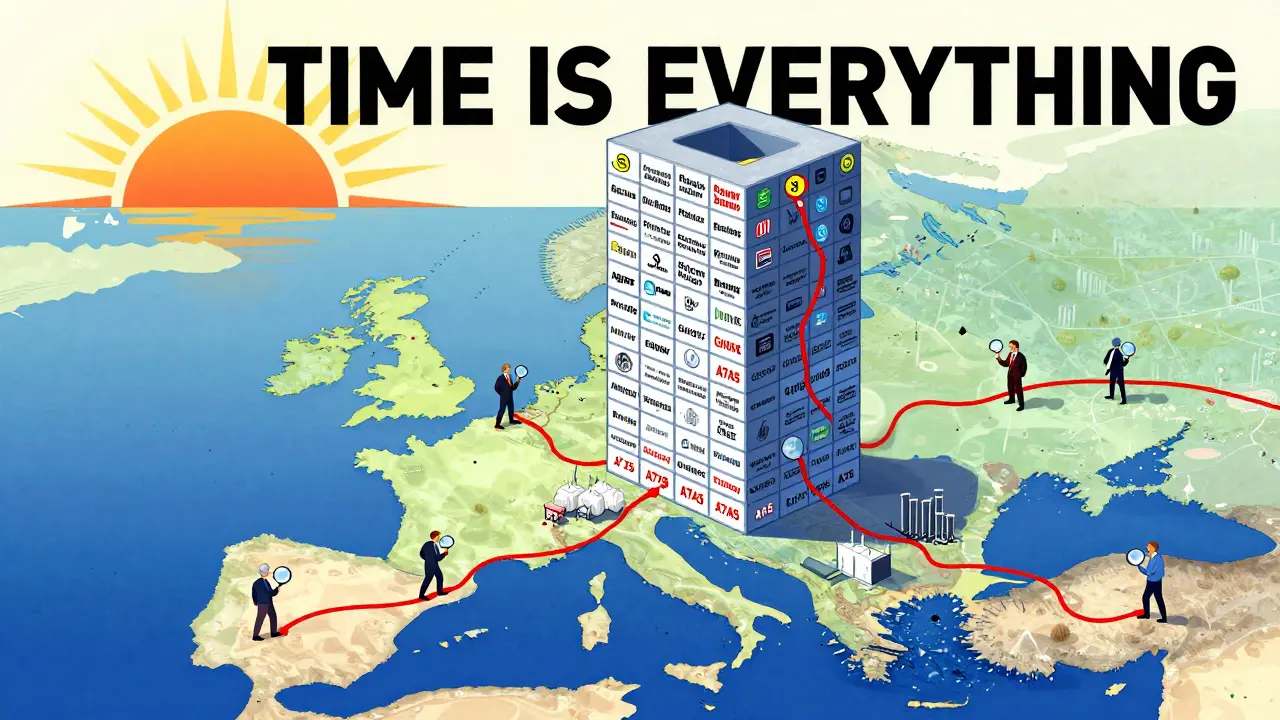
The real story here isn’t that crypto can evade sanctions. It’s that it can’t fully replace them. But it can buy time. And in a war, time is everything.
What Comes Next?
Russia won’t stop. It’s already testing new versions of A7A5 with enhanced privacy features. It’s negotiating deals with countries that don’t recognize U.S. sanctions. And it’s training engineers to build even harder-to-trace crypto bridges.
The West’s next move? More targeted sanctions. More blockchain analytics. More cooperation between intelligence agencies and crypto firms. And maybe - just maybe - a push to make stablecoins like A7A5 illegal in more countries.
For now, Russia’s crypto mining industry keeps running. Not because it’s the future of money. But because, in a world cut off from the old system, it’s the only one left.
Is crypto mining legal in Russia?
Yes. Since early 2025, Russia has officially legalized cryptocurrency mining as part of its broader strategy to bypass Western sanctions. Mining is now regulated under a state-backed framework, with tax incentives for operators using domestic energy sources.
What is the A7A5 stablecoin?
A7A5 is a ruble-backed stablecoin launched in February 2025 by Old Vector, a company linked to Russia’s Promsvyazbank. It’s designed to facilitate cross-border payments outside the Western financial system and has processed over $51 billion in transactions as of July 2025.
Can crypto really help Russia evade sanctions?
Partially. Crypto doesn’t replace the dollar or euro for large-scale trade, but it helps move funds between sanctioned entities and neutral countries. Stablecoins like A7A5, combined with mining and sanctioned exchanges, create hidden payment channels that are harder to freeze than traditional bank transfers.
Why did the U.S. sanction a crypto mining company?
On August 20, 2025, the U.S. Treasury designated a Siberia-based mining firm for directly supplying power to rigs owned by entities tied to Russia’s defense industry. This was the first time the U.S. sanctioned a mining company - signaling that crypto infrastructure is now seen as part of the sanctions evasion network.
Is blockchain really traceable?
Yes. Unlike cash, every crypto transaction is permanently recorded on a public ledger. Firms like Chainalysis have mapped over 70% of A7A5 transactions back to sanctioned Russian wallets. This transparency is why Western authorities are able to target specific nodes in Russia’s crypto network.
Comments
Mara Alves Mariano
So let me get this straight - Russia built a whole shadow economy on crypto mining because they got bored of SWIFT? 😂 The U.S. sanctions were supposed to choke them, not turn them into crypto punk billionaires. Now they’re using Siberian power plants to fund drones while we’re still arguing about whether Bitcoin is ‘money’ or just a really expensive meme. I love how the West thought blockchain would hide them… but it just gave us a GPS tracker. Irony doesn’t come with a warning label, does it?
March 11, 2026 at 00:40
Adam Ashworth
This is actually one of the most well-documented cases of sanctions evasion I’ve seen. The A7A5 stablecoin isn’t magic - it’s just smart. It’s not trying to replace the dollar; it’s acting as a lubricant between sanctioned entities and neutral markets. The real win here is operational: miners convert energy into liquidity, and that liquidity flows through channels the West can’t touch without triggering global market chaos. We’re not winning this war with sanctions - we’re just making it slower and messier.
March 12, 2026 at 22:06
Allison Davis
The data from Chainalysis is undeniable. Over 70% of A7A5 transactions trace back to sanctioned wallets. That’s not coincidence - it’s architecture. Russia didn’t accidentally create a transparent system. They designed it that way because they knew the West would rely on blockchain analytics to respond. And now we are. It’s a cat-and-mouse game where the mouse built its own maze. The bigger question: if every transaction is public, why hasn’t the U.S. shut down the entire network yet? Because doing so would require global cooperation - and that’s the real bottleneck.
March 14, 2026 at 08:15
karan narware
Ah, yes. The great Russian crypto miracle. First, they get sanctioned. Then, they mine Bitcoin with coal-powered rigs in Siberia. Then, they turn it into a ruble-backed stablecoin. Then, they buy drone parts from China. And we sit here in our AC-powered homes, sipping matcha lattes, wondering why ‘decentralization’ never worked for us. Meanwhile, Russia is building a parallel financial system using the very tech we invented. The irony? We taught them how to use blockchain. Now they’re using it to outmaneuver us. I’m not mad. I’m impressed.
March 14, 2026 at 17:40
Michael Suttle
This is all a psyop. The U.S. government LET this happen. They knew about A7A5 from day one. Why? Because they wanted Russia to think they were winning - so they’d invest MORE into crypto mining. Now the whole network is a honeypot. Every miner, every wallet, every exchange - all being monitored, all being mapped. The real endgame? When Russia tries to cash out $50B in A7A5 into real goods… and every single counterparty gets frozen. It’s not a sanctions evasion scheme. It’s a trap. And we’re just waiting for them to step in. 🕵️♂️💎
March 14, 2026 at 19:52
Chelsea Boonstra
I’m not buying the ‘crypto as a bridge’ narrative. If Russia’s economy is so dependent on this, why is the ruble still tanking? Why are their exports still below 2021 levels? This system works for small, high-value transfers - like drone components or radar chips - but it can’t move wheat or steel. You can’t pay a factory in Iran with A7A5 and expect them to hire workers or buy raw materials. It’s a workaround, not a replacement. And if the West starts targeting the power grids that fuel these mines? Game over. This isn’t a revolution. It’s a desperate patch job.
March 15, 2026 at 17:16
PIYUSH KOTANGALE
I think we’re missing the point. Russia isn’t trying to replace the dollar. They’re trying to survive long enough for the world to change. And guess what? More countries are getting tired of U.S. financial dominance. India, UAE, Turkey - they don’t care about SWIFT. They care about trade. A7A5 is just the first domino. If China starts accepting it for oil, or Saudi Arabia uses it for arms deals… the whole system shifts. We’re not fighting crypto. We’re fighting the collapse of dollar hegemony. And we’re losing that battle quietly.
March 16, 2026 at 11:31
Tom Jewell
There’s a deeper truth here that nobody’s talking about: we’ve created a world where the most powerful nation on Earth can’t control money anymore. Not because of hackers or rogue states - but because technology itself has outgrown borders. The blockchain doesn’t care about sanctions. It only cares about proof. Russia didn’t outsmart us. They just used the rules we wrote. And now we’re stuck - because punishing a ledger means punishing truth. We can freeze wallets, but we can’t erase history. Every transaction, every transfer, every miner’s hash… it’s all there. Permanent. Unchangeable. And for the first time in human history, the powerless have a record the powerful can’t erase. That’s not a loophole. That’s a revolution.
March 17, 2026 at 19:56