AUSTRAC Compliance Cost Calculator
Compliance Cost Calculator
Estimate your business's AUSTRAC compliance costs based on article data (March 2026 deadline).
Results will appear here after calculation
Critical Compliance Deadline
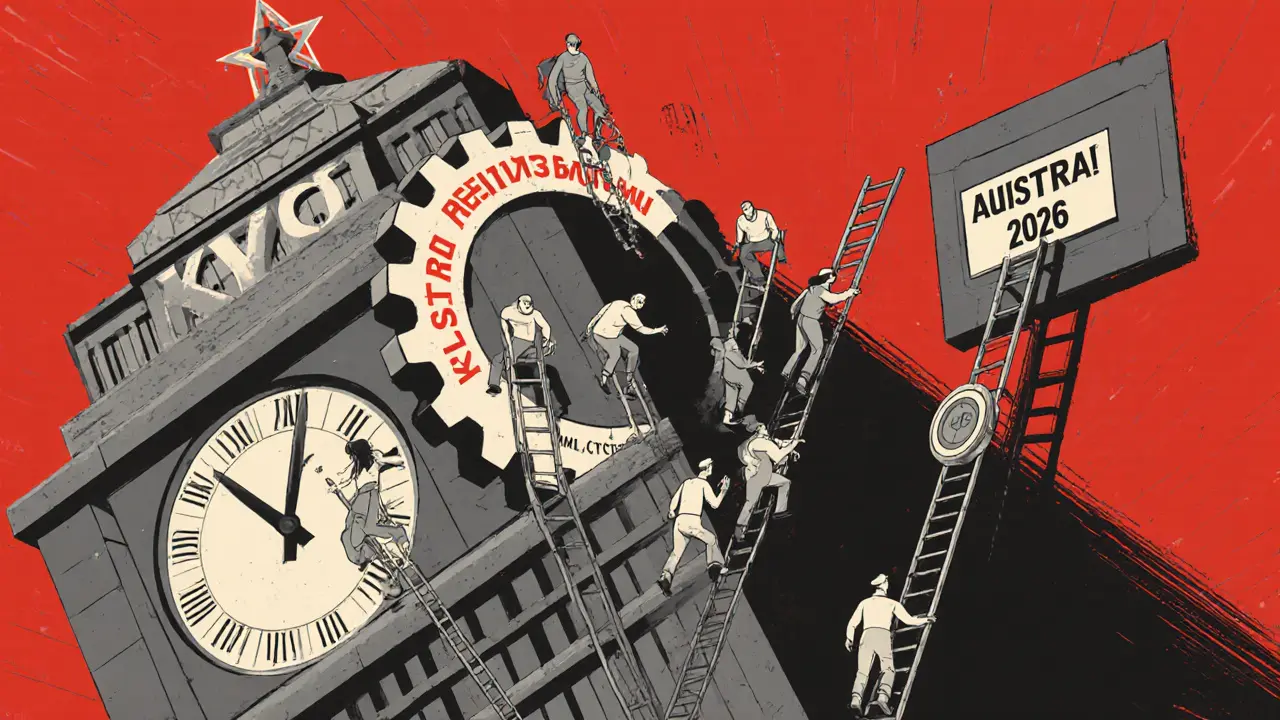
March 2026 is the absolute deadline for AUSTRAC registration. No extensions allowed.
By March 2026, every crypto business operating in Australia must be registered with AUSTRAC-or shut down. There’s no grace period, no extension, and no loopholes. This isn’t a suggestion. It’s the law. And if you’re running a crypto exchange, custody wallet, or even a peer-to-peer transfer service, you’re already behind.
What AUSTRAC Actually Regulates Now
AUSTRAC doesn’t just oversee crypto-to-fiat trades anymore. Since April 2025, their rules cover five key services under the updated AML/CTF Act:- Exchanging crypto for Australian dollars (or any fiat currency)
- Exchanging one crypto for another (like BTC for ETH)
- Transferring crypto between users
- Storing or managing crypto on behalf of customers (custody wallets)
- Helping launch or sell new tokens (token issuance services)
The Travel Rule: It’s Not Just for Banks Anymore
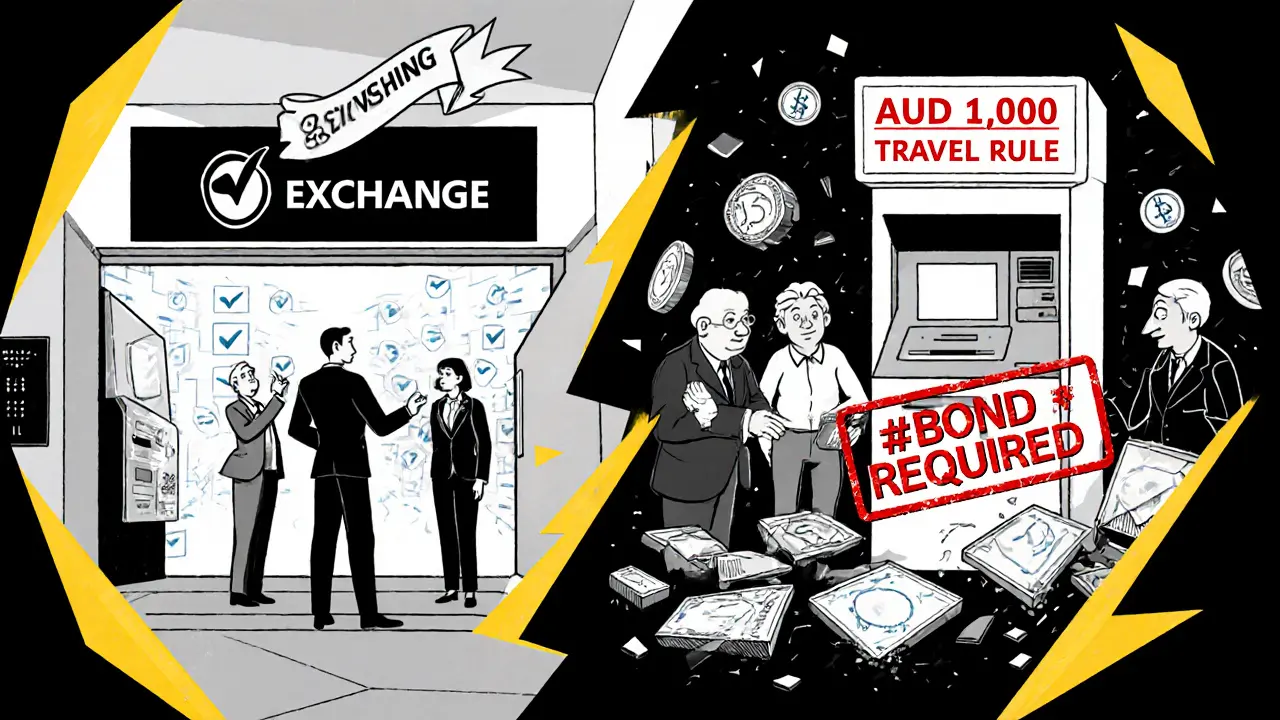
If you send more than AUD 1,000 in crypto, you must send full details about who sent it and who received it. That’s the Travel Rule. And it applies whether the transaction happens on a blockchain, through a payment app, or even via a crypto ATM. The catch? You need to collect and store:- Full name of sender and receiver
- Account or wallet numbers
- Physical addresses
- Reason for the transfer
Who Has to Register? And How Much Does It Cost?
If you offer any of those five services, you must register with AUSTRAC. No exceptions. The registration process isn’t a form you fill out in an hour. It’s a multi-month project. You need to build:- A customer identification system (KYC)
- Real-time transaction monitoring tools
- A suspicious activity reporting pipeline
- Ongoing risk assessments for every customer
What Happens If You Don’t Comply?
AUSTRAC isn’t sending warning letters. They’re shutting businesses down. In July 2025, AUSTRAC refused to renew the registration of one crypto ATM operator. Another voluntarily pulled out. A third paused operations. All because they couldn’t meet the new standards. Crypto ATMs are a hot spot. Australia now has over 1,800 of them-the most in Asia-Pacific. But after a joint operation uncovered 90 scam victims (mostly older Australians), AUSTRAC imposed strict new rules: each machine needs a AUD 50,000 bond, real-time location tracking, and identity verification at the point of use. Operators say it’s too expensive. Texas only requires USD 25,000. But AUSTRAC’s stance is clear: if you’re facilitating cash-to-crypto trades, you’re responsible for what happens after.What’s Missing? DeFi, Stablecoins, and the Sandbox Gap
Australia’s rules are broad, but they’re also blind in places. Decentralized Finance (DeFi) platforms? No clear rules. No guidance. No registration path. If you’re running a DEX, lending protocol, or yield aggregator, you’re in legal gray territory. A September 2025 survey of 127 crypto businesses found 68% worried about this. Stablecoins? Also unaddressed. While the U.S. and UAE have moved fast on regulating dollar-backed tokens, Australia’s timeline lags by 18-24 months, according to UNSW Law’s Professor Ross Buckley. And there’s no regulatory sandbox. Singapore lets startups test new models under supervision. Australia doesn’t. The March 2025 Digital Asset Statement promised a review-but nothing concrete yet.
Why This Matters for the Future of Crypto in Australia
Australia’s crypto market is growing fast. In 2025, it hit AUD 4.7 billion in value with 3.2 million users-12.7% of the population. But only 47% of exchanges are compliant. The big players-Independent Reserve, CoinSpot, Swyftx-control 68% of the market. They’ve spent millions to comply. Smaller operators are getting squeezed out. The Reserve Bank says Australia could become a regional leader-if the 2026 deadline is met. The ACCC warns that overregulation could kill innovation. And with 78% of crypto startups having fewer than 10 employees, the cost burden is real. The goal isn’t to stop crypto. It’s to stop criminals from using it. But the way it’s being done risks turning Australia into a graveyard for small crypto businesses.What You Need to Do Right Now
If you run a crypto service in Australia, here’s your checklist:- Confirm you offer one of the five regulated services
- Register with AUSTRAC’s online portal-don’t wait
- Build or buy a KYC and transaction monitoring system
- Train staff on suspicious activity reporting
- Document your risk assessment for every customer
- Test your Travel Rule data flow for transactions over AUD 1,000
What’s Coming Next?
By December 2025, AUSTRAC will finalize the full AML/CTF Rules. In early 2026, the new licensing framework for Digital Asset Platforms (DAPs) will launch. A stablecoin regime under the Stored Value Facility (SVF) is also on the horizon. The market could hit AUD 7.3 billion by 2027-if the rules are clear and fair. But if implementation is messy, Australia risks losing talent, innovation, and market share to Singapore, Hong Kong, and even the UAE. The choice isn’t between regulation and freedom. It’s between smart regulation and chaos.Do I need to register with AUSTRAC if I only trade crypto for myself?
No. AUSTRAC’s rules apply only to businesses offering crypto services to others. If you’re buying, selling, or holding crypto for your own use, you don’t need to register. But if you’re running a platform, wallet, or exchange-even as a solo operator-you’re considered a service provider and must comply.
What happens if my crypto exchange doesn’t register by March 2026?
Your business will be shut down. AUSTRAC can freeze assets, issue fines up to AUD 21 million, and refer cases to criminal prosecution. Banks will also cut off your accounts. There’s no warning. The deadline is absolute.
Can I use overseas compliance tools for AUSTRAC?
Only if they meet Australia’s exact standards. Tools built for the U.S. or EU won’t automatically work. AUSTRAC requires specific data fields (like Australian addresses and ID verification types), and the Travel Rule applies to all transfers over AUD 1,000, regardless of where the transaction originates. You need systems designed for Australian law.
Are crypto ATMs regulated differently?
Yes. Since July 2025, all crypto ATMs must have a AUD 50,000 bond, real-time location tracking, and mandatory identity verification at the machine. They’re also subject to random inspections. This was a direct response to 90 scam victims identified in a single operation. Many operators say the bond is too high compared to U.S. states, but AUSTRAC says it’s necessary to deter fraud.
Is DeFi regulated in Australia?
Not yet. DeFi protocols, DEXs, and yield aggregators have no clear legal path under current rules. AUSTRAC has not issued guidance on how to register or comply. Many DeFi operators are operating in a gray zone, hoping for future clarification. But if you’re collecting fees, managing user funds, or facilitating trades, you’re likely already in scope-and at risk.
How long does AUSTRAC take to approve registration?
There’s no fixed timeline. Applications are reviewed on a case-by-case basis. Some take 3 months; others take 9. AUSTRAC’s helpdesk responds to queries in 3.2 business days on average, but final approval depends on the completeness of your AML/CTF program. Submit early. Don’t wait until February 2026.
Do I need to report every transaction to AUSTRAC?
No. You don’t report every transaction. You report suspicious activity. But you must monitor all transactions and keep records for 7 years. If something looks off-unusual patterns, large cash deposits, fake IDs-you must file a Suspicious Matter Report (SMR). Failing to report known suspicious activity can lead to criminal charges.
What’s the difference between AUSTRAC and ASIC?
AUSTRAC handles anti-money laundering and terrorist financing for all financial services, including crypto. ASIC regulates financial products, advice, and market conduct. If you’re issuing a token that acts like a security (e.g., promises returns), ASIC may also have jurisdiction. Most crypto businesses need to comply with both.
Comments
Alan Brandon Rivera León
Man, I just read this and my head is spinning. I get why they’re doing it - crypto’s been a wild west for too long - but the cost? AUD 350k for a tiny team? That’s not regulation, that’s a barrier to entry dressed up as safety.
November 29, 2025 at 06:20
Marsha Enright
Big respect to Independent Reserve for actually doing the work. Most startups just panic and shut down. But if you’re serious about this space, compliance isn’t optional - it’s your credibility. You’re not just avoiding fines, you’re building trust. 💪
November 30, 2025 at 03:10
Ziv Kruger
Regulation isn’t the enemy. Chaos is. But when you make it so expensive only corporations can play, you’re not protecting the public - you’re protecting the status quo. Who gets to define what ‘money’ is? And who gets left behind when the gatekeepers lock the door?
November 30, 2025 at 20:37
Catherine Williams
DeFi being left in the gray zone is terrifying. These protocols aren’t companies - they’re code. How do you apply AML rules to a smart contract that runs on its own? AUSTRAC is trying to fit a square peg into a round hole. We need new frameworks, not old bank rules slapped onto blockchain.
And don’t even get me started on the Travel Rule for P2P. You’re forcing individuals to become data collectors. That’s not compliance - that’s surveillance.
December 1, 2025 at 21:01
Ankit Varshney
India is watching this closely. We’re trying to figure out if we should follow Australia’s path or go our own way. The cost of compliance here would kill 90% of our crypto startups. But if we don’t do it, we lose global credibility. Tough spot.
December 3, 2025 at 11:27
Ann Ellsworth
Let’s be brutally honest - if your ‘business’ can’t afford AUD 185k in compliance software, you never should’ve been in this space. This isn’t a startup ecosystem, it’s a financial infrastructure play. If you think you can wing it with a Shopify store and a MetaMask wallet, you’re not an innovator - you’re a liability. And frankly, the market is better off without you.
December 5, 2025 at 05:24
Heather Hartman
For anyone stressing about this - start small. Pick one requirement. Do it right. Then move to the next. You don’t need to build everything tomorrow. Just start. AUSTRAC’s helpdesk is actually pretty good - they answered my question in 2 days. You’ve got time. Use it wisely.
December 6, 2025 at 19:25
Paul McNair
What’s missing here is the human cost. These rules aren’t just about tech or money - they’re about people. That crypto ATM operator who got shut down? He was 68. Used to help his neighbors buy Bitcoin so they wouldn’t get scammed by ‘crypto gurus’ online. Now he’s out of work. Regulation should protect people - not punish the ones trying to help them.
December 6, 2025 at 21:09
Nancy Sunshine
While the regulatory framework is undoubtedly rigorous, it is also, in many respects, a necessary evolution of financial oversight in the digital asset economy. The absence of a sandbox mechanism is indeed a strategic oversight - particularly when juxtaposed against Singapore’s progressive approach - yet the clarity of scope, the precision of the Travel Rule implementation, and the explicit delineation of regulated services represent a significant step toward institutional legitimacy. The cost burden, while substantial, is commensurate with the fiduciary responsibilities inherent in handling monetary value in an unregulated medium. One must not conflate entrepreneurial ambition with regulatory arbitrage. This is not suppression; it is maturation.
December 7, 2025 at 13:23
Mohamed Haybe
Australia thinks it’s the center of the crypto world? LOL. US and UAE are laughing at this. AUD 50k bond for a crypto ATM? In Texas it’s 25k USD and no one’s crying. You’re not protecting citizens - you’re killing innovation with bureaucracy. And DeFi? You’re clueless. You think you can regulate code? Go back to your fiat world. Crypto doesn’t need your rules. It needs freedom.
December 8, 2025 at 18:26