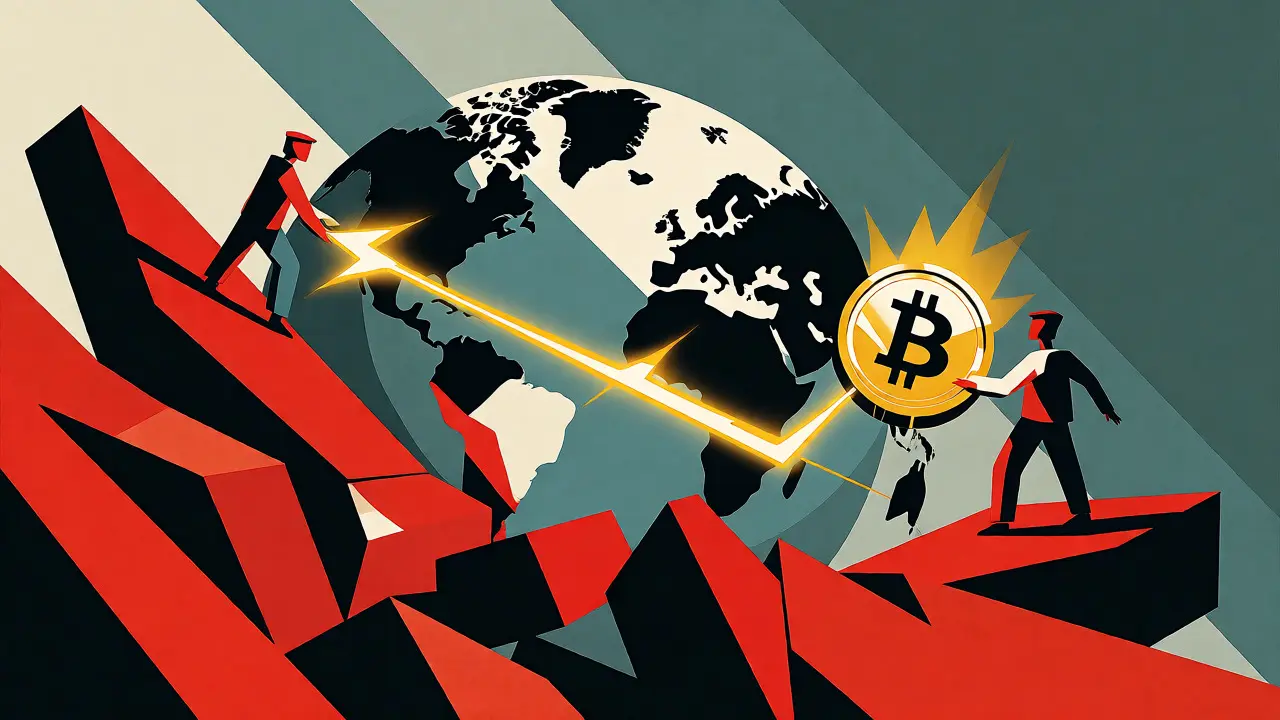
You might think Bitcoin is just a digital gold bar sitting in a vault, but that view is outdated. In 2025, Bitcoin became a serious payment rail. Transaction volumes surged by 45% according to the TRM Labs Crypto Adoption Report. Why? Because it solves real problems that traditional banks and credit cards ignore. It offers finality without chargebacks, works across borders instantly, and costs less than sending money via Western Union. If you run a business or send money home, this shift matters.
The Cost Advantage for Global Transfers
Sending money internationally used to be expensive and slow. Traditional services like SWIFT or wire transfers often take days and eat up significant fees. The World Bank’s Q2 2025 data shows that Bitcoin remittances cost an average of 3.5%, compared to 6.3% for traditional methods. For someone sending $1,000 to family in Venezuela, this difference saves real cash. One user on Reddit noted saving 82% compared to Western Union fees. Beyond fees, speed is the other killer feature. A bank transfer can take 2-5 business days to settle. Bitcoin settles in 10-60 minutes. This isn't just convenient; it improves cash flow for businesses waiting on international suppliers. You don't wait for a bank to verify your identity three times before releasing funds. The network verifies the transaction through cryptographic proof, not human intermediaries.
Lightning Network Makes Micro-Payments Viable
Critics often point out that Bitcoin's base layer is slow. They are right if you look at the main chain, which handles about 7 transactions per second (TPS). Visa handles 24,000 TPS. But looking only at the base layer misses the bigger picture. The Lightning Network is a secondary layer built on top of Bitcoin that enables instant, near-free transactions. As of August 2025, it processes 1.2 million transactions daily across 65,000 active nodes. This technology changed the game for retail. Buying a coffee with Bitcoin used to mean paying a $1.27 fee. With Lightning, fees drop to roughly $0.0003. That makes micro-payments practical. You can buy a digital article, tip a creator, or pay for a meal without losing value to network fees. The Taproot upgrade in 2021 also improved privacy and smart contract capabilities here, making these off-chain transactions more flexible and secure.
| Feature | Bitcoin (Base + Lightning) | Traditional Banking/Cards |
|---|---|---|
| Settlement Time | Minutes to Hours | Days |
| Cross-Border Fees | ~3.5% | ~6.3% |
| Chargeback Risk | None (Irreversible) | High (1.2% fraud rate) |
| Accessibility | Anyone with internet | Requires bank account |
Merchants Love the Finality
If you own a small business, you hate chargebacks. Credit card companies side with customers almost automatically. If a buyer claims they didn't receive goods, the merchant loses the money and the product. Bitcoin payments are irreversible. Once the transaction is confirmed on the blockchain, it cannot be reversed. This eliminates fraud risk for merchants. According to CoinLaw’s 2025 analysis, 50% of small and medium enterprises (SMEs) now accept Bitcoin or stablecoins. This is a huge jump from previous years. Merchants aren't just accepting it for hype; they are using tools like BitPay or Coinbase Commerce to convert Bitcoin to fiat currency instantly. This protects them from price swings while keeping the benefits of low fees and no chargebacks. Setup time has dropped dramatically too. What used to take two weeks now takes under two hours for most e-commerce platforms.

Institutional Backing Validates the Use Case
For a long time, big companies ignored Bitcoin as a payment tool. They saw it as speculative. That changed in 2025. Business inflows into Bitcoin hit $12.5 billion between January and August alone, exceeding all of 2024. Companies now hold 1.30 million BTC, which is 6.2% of the total supply. This isn't just speculation; it's treasury management. MicroStrategy, for example, holds over 214,000 BTC. Their strategy proves that holding Bitcoin can appreciate in value, offsetting any volatility risks during transactions. Cathie Wood of Ark Invest stated that Bitcoin's $380 billion annual payment volume represents its first legitimate use case beyond being a store of value. When institutions use it for interbank settlements, it signals stability. Nick Szabo, a computer scientist, noted that the payment layer has achieved sufficient robustness for mainstream commercial use. When experts who helped design smart contracts say it works, you listen.
Regulatory Clarity Removes Barriers
Fear of regulation held many back. Is it legal? How do I report taxes? By Q2 2025, 68 countries had established clear cryptocurrency payment guidelines. In the US, the Accounting Standards Update 2024-06 provided clear rules for how companies should treat Bitcoin on their balance sheets. This clarity allows CFOs to approve Bitcoin payments without worrying about sudden legal changes. However, volatility remains a concern. Nouriel Roubini warned that 30-day price swings still average 18.7%. While this is better than the 65% swings seen in 2021, it requires careful management. Most merchants solve this by converting to fiat immediately upon receipt. This hybrid approach lets them enjoy the speed and security of Bitcoin while avoiding the risk of holding a volatile asset overnight.
User Experience Has Improved Dramatically
You don't need to be a coder to use Bitcoin anymore. Wallet integration is present in 87% of mobile payment apps. Point-of-sale systems require no blockchain expertise. The learning curve flattened significantly. Average merchant onboarding time decreased from 14 days in 2020 to 3.2 days in 2025. Support infrastructure is robust, with 24/7 enterprise assistance available from major processors. Community sentiment reflects this ease. On Reddit’s r/Bitcoin, 78% of payment-related discussions show positive sentiment. Users praise the borderless nature and the lack of gatekeepers. Trustpilot reviews for processors like BitPay average 4.3/5 stars. Complaints usually center on tax reporting complexity, not the technical difficulty of sending money. Tools are getting better at handling those reports, further smoothing the experience.
Where Bitcoin Payments Fit Best
Bitcoin doesn't replace everything. Stablecoins dominate merchant payments where price stability is critical for inventory pricing. However, Bitcoin excels in specific niches. It dominates peer-to-peer transactions with a 67% market share. It shines in high-value transactions above $10,000 where fraud risk is high. It is the go-to for cross-border remittances where banking infrastructure is weak or expensive. The future looks bright. Projections suggest Bitcoin could process $1.2 trillion annually by December 2025. Upgrades like MAST (Merkelized Abstract Syntax Trees) scheduled for 2026 aim to reduce transaction sizes by another 35%, lowering costs even further. The ecosystem is maturing from a niche experiment to a backbone of modern finance.
Are Bitcoin payments safe for merchants?
Yes, primarily because transactions are irreversible. Unlike credit cards, there are no chargebacks. This protects merchants from fraud. Additionally, multi-signature wallets are used by 63% of enterprise processors to add extra security layers against theft or unauthorized access.
How fast are Bitcoin payments?
On-chain transactions settle in 10-60 minutes depending on network congestion. However, using the Lightning Network, payments are near-instantaneous, often completing in seconds. This makes it suitable for retail environments where waiting an hour is impractical.
What happens if the price of Bitcoin changes during a sale?
Most merchants use payment processors like BitPay or Coinbase Commerce that convert Bitcoin to local currency (fiat) instantly upon receipt. This eliminates exposure to volatility for the merchant. The customer pays in Bitcoin, but the merchant receives dollars, euros, or their local currency immediately.
Is it hard to set up Bitcoin payments for my business?
No. Modern payment processors offer plugins for Shopify, WooCommerce, and physical POS terminals. Setup typically takes under two hours for e-commerce and requires no coding knowledge. The average onboarding time for merchants has dropped to 3.2 days.
Why choose Bitcoin over stablecoins for payments?
Bitcoin offers greater decentralization and censorship resistance. Stablecoins are issued by centralized entities that can freeze assets. Bitcoin is neutral and permissionless. For cross-border transfers where trust in central issuers is low, Bitcoin provides a more reliable settlement layer.