Have you ever clicked on a crypto ticker, only to find two completely different projects fighting for your attention? That’s exactly what happens with $REI. You might see it listed as a low-cap Layer 1 blockchain or as a popular token on the Base network. Confusing? Absolutely. But understanding the difference is crucial if you want to avoid buying the wrong asset.
In this guide, we’re going to separate fact from fiction. We’ll look at what REI Network actually is, where it came from (hint: it used to be called something else), and why its promise of "zero fees" sounds too good to be true until you understand the mechanics. We’ll also clear up the mess with the Base chain token so you know exactly what you’re holding.
The Origin Story: From GXChain to REI Network
To understand REI Network, you have to look back at its predecessor. This project didn’t start from scratch; it evolved from GXChain (GXC). If you were around in the earlier days of blockchain data economies, you might remember GXC. The team decided that the original architecture wasn’t keeping up with modern demands, specifically the need for Ethereum Virtual Machine (EVM) compatibility.
Rather than launching a brand-new coin from zero, they executed a direct conversion. For every 1 GXC token you held, you received 10 REI tokens. This 1:10 ratio was baked into the ledger by major market trackers. It wasn’t just a rebrand; it was a technical refactoring. The goal was to move away from a heavy, specialized data chain to a lightweight, high-performance public chain that developers could actually use for decentralized applications (dApps).
This migration is central to the project’s identity. The official social media presence still carries the tagline “From #GXChain!” to remind users of this continuity. It’s not a fork; it’s an upgrade. However, this history means that any analysis of REI Network must account for the legacy of GXChain’s focus on internet data transparency and real-world data verification.
Technical Specs: Lightweight and EVM-Compatible
So, what makes REI Network tick under the hood? The biggest selling point is its compatibility with the Ethereum Virtual Machine (EVM). Why does this matter? Because if you are a developer who has written smart contracts in Solidity for Ethereum, Polygon, or BNB Chain, you can port them to REI Network with minimal code changes. It supports standard Ethereum RPC and WebSocket interfaces, meaning tools like MetaMask and web3.js libraries work out of the box.
But compatibility isn’t enough. Performance is key. REI Network claims an average block time of about 3 seconds. Compare that to Ethereum’s ~12 seconds or Bitcoin’s 10 minutes, and you see the speed advantage. More importantly, the network boasts a throughput of over 3,000 transactions per second (TPS). While giants like Solana claim much higher numbers, 3,000 TPS is more than enough for most consumer-facing dApps, gaming platforms, and micro-transaction systems.
The architecture is described as “lightweight.” It’s rebuilt to run smoothly across different devices using mainstream programming languages like Node.js. This simplicity is intentional. Many open-source blockchains become bloated with complex features that slow down development. REI aims to be streamlined, reducing resource consumption while maintaining robust performance. For a user, this translates to faster confirmations and a smoother experience when interacting with apps built on the chain.
The Controversial "Zero-Fee" Model
Here is where things get interesting-and slightly controversial. REI Network advertises itself as a “no-fee” or gas-free blockchain. In the world of crypto, “free” usually comes with a catch. How do validators get paid if there are no transaction fees?
The answer lies in its tokenomics. Instead of paying gas fees for every single interaction, users stake their REI tokens to access network resources. Think of it like a subscription model rather than a pay-per-use utility bill. By staking REI, you gain the right to transact without paying marginal costs for each action. This is designed to lower the barrier to entry for small users and enable high-frequency interactions, such as in-game moves or IoT data feeds, where paying even $0.01 per transaction would kill the user experience.
This model relies on a hybrid consensus mechanism: Delegated Proof of Stake (DPoS) combined with Byzantine Fault Tolerance (BFT). DPoS allows token holders to vote for validators who produce blocks. BFT ensures that these blocks are finalized quickly and securely, even if some validators act maliciously. This combination provides fast finality (seconds) and energy efficiency, moving far away from the wasteful Proof-of-Work models of the past.
However, keep in mind that “zero fee” refers to the gas cost. You still need to acquire and stake the REI token, which involves market risk. If the price of REI drops, your “subscription” loses value. It’s a trade-off between upfront capital allocation and ongoing transaction costs.
Wait, There Are Two $REI Tokens!
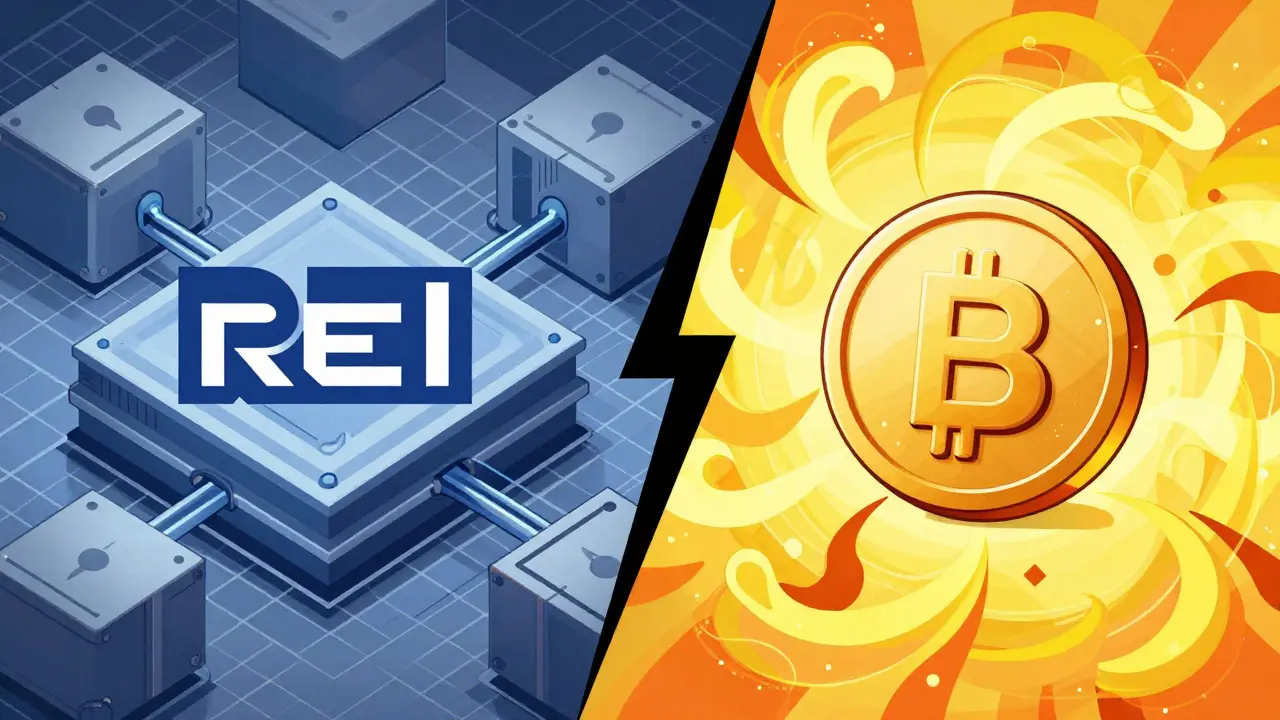
This is the most critical part of this article. If you search for “$REI” on Google or CoinGecko, you will likely see two distinct assets. One is the REI Network L1 we’ve been discussing. The other is a token simply called Rei (REI) running on the Base chain (an Ethereum Layer 2).
Do not confuse them. They are unrelated projects sharing the same ticker symbol. Here is how to tell them apart:
| Feature | REI Network (L1) | Rei (REI) on Base |
|---|---|---|
| Blockchain | REI Network (Independent L1) | Base (Ethereum L2) |
| Market Cap (Approx.) | $2.5 - $3.0 Million | $185+ Million |
| Price Range | $0.0026 - $0.0031 | $0.18 - $0.20 |
| Primary Use Case | Infrastructure, Data, dApps | Speculative Trading / Meme-like |
| All-Time High | Feb 2026 | July 2025 (~$0.20) |
The Base chain version of Rei has seen significant volatility, hitting an all-time high of roughly $0.20 in July 2025. It trades heavily on decentralized exchanges like Uniswap V3 on Base. Coinbase lists it as an “unreviewed asset,” which is a red flag for due diligence. It behaves more like a speculative meme coin or community-driven token.
In contrast, the REI Network L1 token is a smaller-cap infrastructure play. As of early 2026, it hovers around $0.003 with a market cap near $3 million. It ranks around #1415 on CoinMarketCap. If you are interested in the technology, the staking model, and the GXChain heritage, you want the L1 token. If you are chasing short-term hype on Base, you want the other one. Always check the contract address before swapping.
Ecosystem and Real-World Applications
Technology is useless without adoption. So, what is being built on REI Network? Given its roots in GXChain, the ecosystem leans heavily toward data integrity and real-world asset (RWA) adjacent use cases. The project highlights partnerships with initiatives like KarPak, which turns real-world parking activity into verifiable on-chain mobility data. This aligns with the broader industry trend of bringing off-chain data onto the blockchain for transparency.
Because it is EVM-compatible, developers can also build standard DeFi protocols, NFT marketplaces, and gaming apps. The “zero-fee” structure is particularly attractive for gaming, where players might make hundreds of transactions per session. Imagine a game where every sword swing or item pickup is recorded on-chain without draining the player’s wallet with gas fees. That is the vision REI Network is pitching.
However, the ecosystem is still young. The social media footprint includes around 130,000 followers on X (Twitter), which is decent for a small-cap project, but it lacks the massive developer grants and institutional backing seen in larger ecosystems like Avalanche or Fantom. Most of the current activity is driven by the core team and early adopters exploring the staking mechanics.
How to Buy and Store REI Network (L1)
If you decide to invest in the L1 version of REI, here is how you typically go about it. Since it is a smaller-cap asset, you won’t find it on every major exchange. However, it is listed on platforms like Gate.io and Kraken. On Gate, you can trade the REI/USDT pair. On Kraken, you can buy spot REI with USD or other cryptos.
If your preferred exchange doesn’t list it, you might need to use a peer-to-peer (P2P) marketplace or a decentralized exchange (DEX) that supports cross-chain bridges, though this adds complexity. Once you have the tokens, you should store them in a wallet that supports EVM networks. MetaMask is a popular choice. You will need to add the REI Network RPC details manually to your wallet to interact with the chain directly.
Remember the staking aspect. To utilize the “zero-fee” benefit, you likely need to delegate your REI to validators through the official interface. This locks up your tokens for a period, providing security to the network in exchange for transaction privileges. Always verify the official website links from trusted sources to avoid phishing sites, especially given the confusion with the Base chain token.
Risks and Considerations
Let’s be realistic. REI Network is a small-cap cryptocurrency. Its market cap is under $3 million, which means it is highly volatile. A large buy or sell order can significantly impact the price. Unlike Bitcoin or Ethereum, there is no deep liquidity pool protecting you from sudden swings.
The “zero-fee” model is innovative but unproven at scale. If the network grows massively, will the staking rewards remain sustainable? Will inflation dilute the value of staked tokens? These are questions that only time will answer. Additionally, the competition is fierce. There are dozens of EVM-compatible chains promising high speed and low fees. REI needs to differentiate itself beyond just marketing slogans.
Finally, the confusion with the Base chain token poses a reputational risk. New investors often mistake the two, leading to accidental purchases of the wrong asset. Until the branding clarifies this distinction further, you must exercise extreme caution. Do your own research, check the contract addresses, and never invest more than you can afford to lose.
Is REI Network the same as the Rei token on Base?
No, they are completely different. REI Network is an independent Layer 1 blockchain with a market cap around $3 million. The Rei token on Base is a separate asset on the Ethereum Layer 2 network with a market cap over $180 million. They share the ticker $REI but have different technologies, teams, and use cases.
How did REI Network evolve from GXChain?
REI Network is the upgraded version of GXChain. The project migrated from GXC to REI at a fixed ratio of 1 GXC = 10 REI. This was done to improve performance, add EVM compatibility, and reduce fees, transforming it from a data-focused chain into a general-purpose high-performance blockchain.
What does "zero-fee" mean for REI Network?
Instead of paying gas fees for each transaction, users stake REI tokens to access network resources. This staking acts as a subscription, allowing for effectively free transactions. It is designed to support high-frequency applications like gaming and IoT without costing users money per interaction.
Can I use MetaMask with REI Network?
Yes, because REI Network is EVM-compatible. You can add the REI Network RPC endpoints to MetaMask to connect your wallet. This allows you to interact with dApps, send transactions, and manage your REI tokens just like you would on Ethereum or Polygon.
Where can I buy REI Network (L1) tokens?
You can buy REI Network tokens on centralized exchanges like Gate.io and Kraken. Look for the REI/USDT or REI/USD trading pairs. Be careful to verify you are buying the L1 token and not the Base chain version, as prices and market caps differ significantly.
Comments
ravi mahla
lol the confusion between these two is hilarious. one is a serious chain, the other is a meme coin on base. people really just buy whatever ticker they see without checking the contract address. classic.
June 13, 2026 at 01:34
Annemarie Fitzgerald
i have been following this since the gxchain days and honestly it feels like we are going in circles. the tech is fine but the marketing is so confusing that nobody knows what to do with it. why change the name if you keep the same problems? it is just another rebrand hoping for a pump. i staked my rei and now i am stuck watching it dip while the base token flies away. typical crypto nonsense where the smart money always knows better than us retail investors who actually read the whitepapers. the zero fee model sounds nice in theory but in practice it just means your principal is at risk because you have to lock it up. it is a trap wrapped in a shiny package.
also the typo in my comment above was intentional because i am tired of typing correctly for projects that dont care about their users anyway.
June 13, 2026 at 06:36
Kenneth Riley
let me tell you something about this so called zero fee model. it is a complete scam designed to drain liquidity from small holders. the validators get paid through inflation which dilutes your stake value over time. meanwhile the team holds massive bags of unlocked tokens ready to dump on you when the hype dies. look at the market cap difference. three million vs one hundred eighty five million. the market has already spoken. the base token is the real play because it has volume and attention. this l1 chain is a ghost town with no developers and no users except bots. stop falling for the evm compatibility lie because every other chain claims that too. you are holding a bag of nothing but air and broken promises. wake up sheeple before you lose everything else you have left in this bear market.
June 14, 2026 at 22:01
Grace Newman
There is clearly a coordinated effort to mislead the public regarding the distinction between these assets. The similarity in tickers is not coincidental but rather a calculated psychological manipulation by entities seeking to harvest liquidity from unsuspecting participants. One must question the motives behind such ambiguous branding strategies which serve only to obfuscate the true nature of the underlying technology. It is imperative that individuals exercise extreme caution and conduct thorough due diligence before engaging with any platform that exhibits such deceptive characteristics. The convergence of these narratives suggests a deeper conspiracy aimed at destabilizing trust within the decentralized ecosystem. I urge everyone to remain vigilant and skeptical of all official communications from these organizations as they likely contain hidden agendas.
June 15, 2026 at 10:53
Abby Sivertsen
hey guys i think we need to be more inclusive here. some people might not know the difference between l1 and l2 yet. its okay to make mistakes. i bought the wrong one once too and lost some money but i learned from it. lets support each other instead of calling names. the community should be welcoming to newbies who are trying to understand this complex space. maybe we can create a guide together to help others avoid these pitfalls. kindness goes a long way in crypto.
June 16, 2026 at 12:24
Benjamin Eisen
i guess the staking part is interesting though. if you hold it long term maybe the rewards offset the price drop? i am not sure if i have enough patience for that. also does anyone know if metamask works smoothly or if there are bugs? i tried adding the rpc once and it failed. maybe i did it wrong. would love to hear from someone who actually uses it daily. thanks for sharing the info here it helps a bit.
June 17, 2026 at 17:06
Nick Rice
You all need to focus on the fundamentals rather than getting caught up in the drama. The EVM compatibility is a genuine advantage for developers who want to deploy quickly without rewriting code. Yes, the market cap is small, but that also means high potential for growth if adoption increases. The zero-fee model is an experiment, and like all experiments, it carries risk. However, dismissing it outright shows a lack of understanding of blockchain economics. If you believe in the vision of low-cost transactions for IoT and gaming, then REI Network offers a viable path forward. Do your own research, verify the contract addresses, and make informed decisions based on data, not fear. We are here to learn and grow together in this space.
June 17, 2026 at 17:38