Imagine holding cash in your pocket that grows while you sleep. No bank account needed. No complex staking setups. Just a digital token sitting in your wallet, quietly earning interest every single day. That is exactly what Origin Dollar, known by its ticker OUSD, promises to do.
OUSD isn't just another copy of USDT or USDC. It was built from the ground up as the first self-custodial, yield-generating stablecoin. Launched on September 23, 2020, it solved a major pain point for crypto users: the choice between safety and growth. Usually, if you wanted stability, you parked your funds in a boring stablecoin. If you wanted yield, you had to riskier assets or manually manage decentralized finance (DeFi) positions. OUSD merged these two worlds.
As of May 3, 2026, OUSD maintains a strict $1.00 peg to the US Dollar while offering an average annual percentage yield (APY) of around 5.37%. But how does it actually work? And is it safe enough for your savings? Let's break down the mechanics, the risks, and why this token has become a staple for many Ethereum holders.
How Origin Dollar Generates Yield Automatically
The magic of OUSD lies in its "set it and forget it" design. When you buy OUSD, you don't have to move those tokens to a lending platform or stake them in a smart contract. The yield generation happens automatically in the background.
Here is the simple process:
- You hold OUSD: You keep the tokens in any standard Ethereum wallet like MetaMask or Ledger.
- The Protocol Works: The Origin Protocol team deploys the underlying collateral into trusted, low-risk DeFi strategies.
- Yield Compounds: As the protocol earns interest, new OUSD tokens are minted and sent directly to your wallet address.
This means your balance of OUSD increases over time, even though the price per token stays at $1.00. It’s like having a savings account where the bank credits interest daily, but instead of a bank, it’s code running on the blockchain.
The current trailing 30-day APY sits at roughly 5.37%. This number fluctuates based on market conditions and the performance of the underlying strategies. The protocol uses tools like Morpho for yield optimization and Curve Finance for liquidity provision. These are considered "blue-chip" DeFi protocols, meaning they are well-established and audited, reducing the risk of failure compared to newer, untested platforms.
Collateral Backing: What Holds the Value?
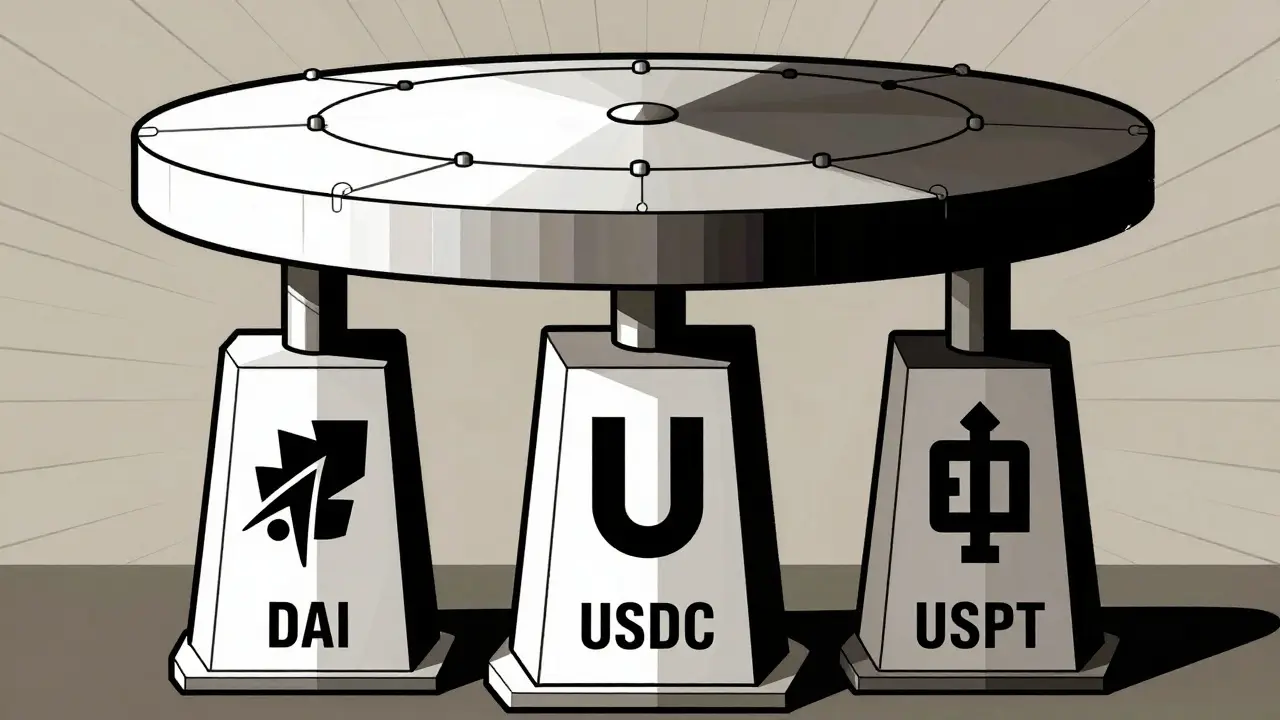
A common question is: "If OUSD earns yield, what backs its value?" Unlike fiat money backed by government promise, OUSD is fully collateralized. Every single OUSD token is backed 1:1 by a basket of established stablecoins.
The primary reserves include:
- DAI: A decentralized stablecoin popular in the Ethereum ecosystem.
- USDC: A regulated stablecoin issued by Circle.
- USDT: The largest stablecoin by market cap, issued by Tether.
This diversified backing ensures that OUSD remains stable regardless of fluctuations in any single asset. If USDC faces regulatory pressure, the protocol can rely on DAI and USDT. This diversification is a key security feature. The Net Asset Value (NAV) is maintained at $1.00, ensuring that when you redeem OUSD, you get back exactly one dollar's worth of value.
Fees and Economic Model
Nothing is free in finance, and OUSD is no exception. However, its fee structure is designed to align incentives with users. Here is how the costs break down:
- Management Fee: 0%. You pay nothing just for holding the token.
- Performance Fee: 20%. The protocol takes a cut only when it successfully generates yield.
This model is crucial. Many traditional financial products charge management fees regardless of performance. With OUSD, the Origin Protocol team only makes money if they earn money for you. If the yield drops to zero, their fee also drops to zero. This encourages the team to constantly optimize strategies and seek out the best returns without charging you for idle capital.
Security and Governance
Security is the most important factor in DeFi. Origin Dollar employs a multi-layered approach to protect user funds.
First, the code undergoes regular audits by leading cybersecurity firms. Second, there are active bug bounty programs that reward white-hat hackers for finding vulnerabilities before malicious actors can exploit them. Third, all transactions are transparent and recorded on the Ethereum blockchain. Anyone can verify the reserves and the health of the protocol at any time.
Governance is handled by the Origin DeFi DAO. Holders of the OGV governance token can vote on proposals related to OUSD. This includes decisions on which strategies to use, fee adjustments, and protocol upgrades. This decentralized control means no single company or individual can pull the rug on the project. It is owned and controlled by a global community.
| Feature | Origin Dollar (OUSD) | USDT / USDC | DAI |
|---|---|---|---|
| Yield Generation | Automatic (in wallet) | No (requires manual staking) | No (requires manual staking) |
| Backed By | Basket of Stablecoins | Fiat Reserves | Crypto Collateral |
| Management Fees | 0% | N/A | N/A |
| Complexity | Low (Hold & Earn) | Medium (Need DeFi knowledge) | High (Manual management) |
| Blockchain | Ethereum | Multi-chain | Ethereum |
Market Performance and Liquidity
As of May 2026, OUSD has established itself as a significant player in the stablecoin market. While it may not have the massive market cap of USDT, its utility is unique. The Total Value Locked (TVL) stands at approximately $4.9 million, indicating steady user trust. The circulating supply hovers around 7.6 to 9.2 million tokens, depending on the exchange reporting lag.
Liquidity is generally good on major exchanges like Kraken and through decentralized platforms. However, availability varies. For instance, Crypto.com has noted that OUSD is not yet tradable on their specific interface, highlighting that support is still expanding across all centralized exchanges. For most users, the easiest way to acquire OUSD is directly through the Origin Protocol website using an Ethereum wallet, swapping ETH or other supported tokens.

Risks to Consider
No investment is without risk. While OUSD is designed to be low-risk, you must understand the potential downsides:
- Smart Contract Risk: Although audited, bugs can exist. If a vulnerability is found in the core protocol or the underlying strategies (like Morpho or Curve), funds could be at risk.
- Counterparty Risk: OUSD is backed by USDT, USDC, and DAI. If one of these issuers fails or gets banned, it could impact the stability of OUSD temporarily until rebalancing occurs.
- Regulatory Uncertainty: Governments worldwide are still figuring out how to regulate DeFi. While Origin Protocol aims for compliance, sudden regulatory changes could affect the ability to trade or redeem OUSD in certain jurisdictions.
- Impermanent Loss: In rare cases of extreme market stress, the redemption value might briefly dip below $1.00 due to slippage in the underlying markets, though the protocol aims to mitigate this.
Who Should Use OUSD?
OUSD is ideal for several types of crypto users:
- Passive Investors: People who want to park their stablecoins and earn interest without learning complex DeFi strategies.
- Ethereum Holders: Users who already have ETH and want to hedge against volatility while still earning yield.
- DeFi Veterans: Experienced users who want a simplified, automated way to access blue-chip yields without managing multiple wallets and positions.
If you are looking for high-risk, high-reward gambling, OUSD is not for you. It is a tool for preservation and slow, steady growth. It shines when you need your money to be safe, liquid, and productive all at once.
Is Origin Dollar (OUSD) safe?
OUSD is considered relatively safe compared to other DeFi investments because it is backed 1:1 by trusted stablecoins like USDC, USDT, and DAI. It undergoes regular security audits and uses established protocols like Curve and Morpho. However, all DeFi carries some smart contract risk, so never invest more than you can afford to lose.
Does OUSD lose value over time?
No, OUSD is designed to maintain a $1.00 peg. Instead of the price increasing, the number of tokens in your wallet increases as yield compounds. So, your total portfolio value in USD grows, while the price per token stays stable.
Can I withdraw my OUSD anytime?
Yes, OUSD is fully redeemable. You can swap it back for ETH, USDC, or other cryptocurrencies at any time through the Origin Protocol interface or supported exchanges. There are no lock-up periods.
What is the current APY for OUSD?
As of May 2026, the trailing 30-day APY is approximately 5.37%. This rate fluctuates daily based on market conditions and the performance of the underlying DeFi strategies.
Do I need to stake OUSD to earn yield?
No. One of the main features of OUSD is that it is self-custodial. You simply hold the tokens in your Ethereum wallet, and the yield is distributed automatically. No staking or locking is required.