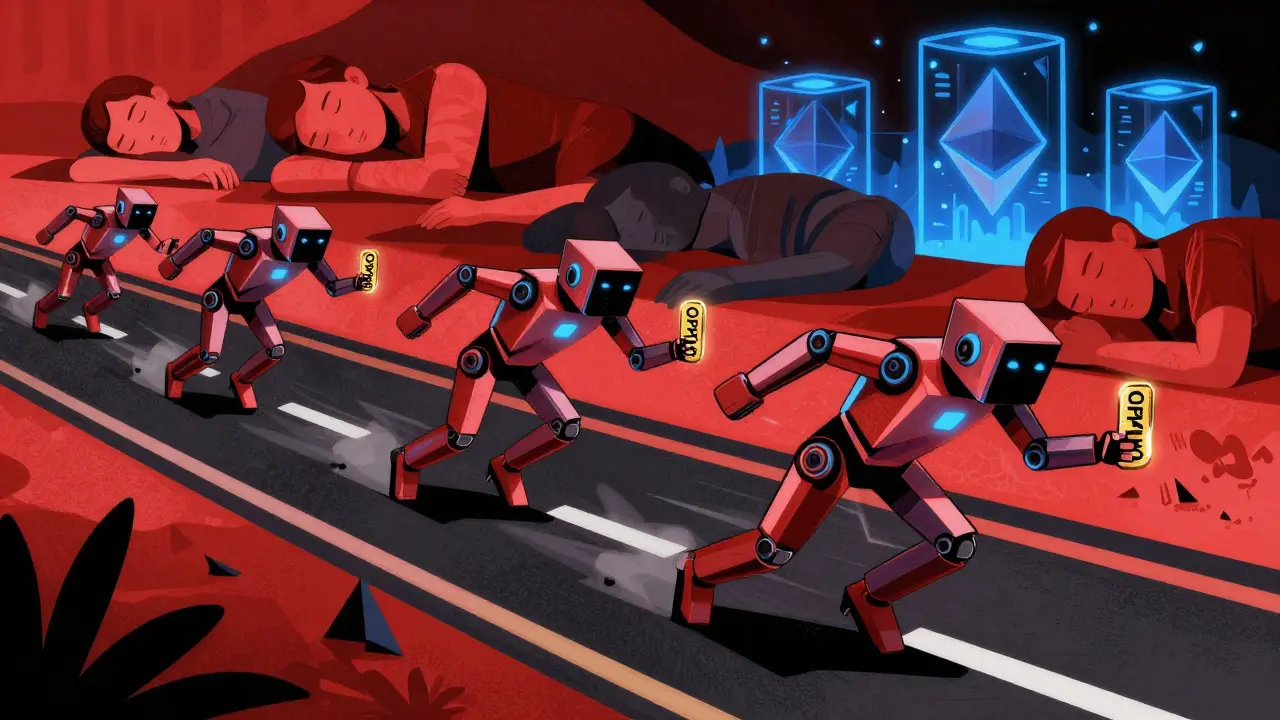
Optopia (OPAI) isn't another meme coin or a copy of Bitcoin. It's built around one bold idea: AI agents should be able to execute blockchain transactions on their own - without humans clicking buttons. Think of it like giving smart robots permission to buy, sell, or swap crypto based on real-time conditions, and OPAI is the fuel that powers them.
This isn't science fiction. OPAI runs on a Layer 2 network designed specifically for intent-based actions. That means instead of you manually swapping ETH for USDT, an AI agent could detect a price drop, analyze market trends, and execute the trade for you - all while you sleep. The network doesn't need permission. Anyone can create an intent, and AI agents compete to fulfill it. OPAI tokens are how those agents get paid.
How OPAI works: AI agents, not users, do the trading
Most crypto projects rely on people to trigger transactions. OPAI flips that. Here’s how it actually works:
- You set an intent - like, "Buy 5 USDT if ETH drops below $3,200"
- The OPAI network broadcasts that intent to AI agents running on its Layer 2 chain
- Multiple AI agents race to fulfill it
- The first one to complete the task gets paid in OPAI tokens
- The transaction is settled on Ethereum, but faster and cheaper
This creates a self-sustaining loop: more intents mean more AI activity, which drives demand for OPAI tokens. The system doesn’t need a central authority. It’s governed by rules coded into smart contracts.
Tokenomics: Supply, distribution, and market reality
OPAI has a fixed total supply of 10 billion tokens. That’s a lot - but only 6.5 billion are in circulation as of early 2026. The rest are locked in vesting schedules or reserved for future network incentives.
The contract address on Ethereum is 0xf8e57ac2730d3088d98b79209739b0d5ba085a03. You can verify this on Etherscan or add it manually to MetaMask to track your holdings.
Market data shows a volatile picture:
- Current price: around $0.0000047 (varies by exchange)
- All-time high: BTC 0.074890 (roughly $2.10 at the time)
- All-time low: BTC 0.092027 (roughly $2.60)
- Current market cap: BTC 1.4224 (about $42,000 USD)
- Fully diluted valuation (if all 10B tokens were circulating): BTC 2.4744
That’s a tiny market cap compared to top coins. For context, Bitcoin’s market cap is over $1 trillion. OPAI is ranked #6351 on CoinGecko - meaning it’s still a micro-cap project with very low liquidity.
Where you can trade OPAI
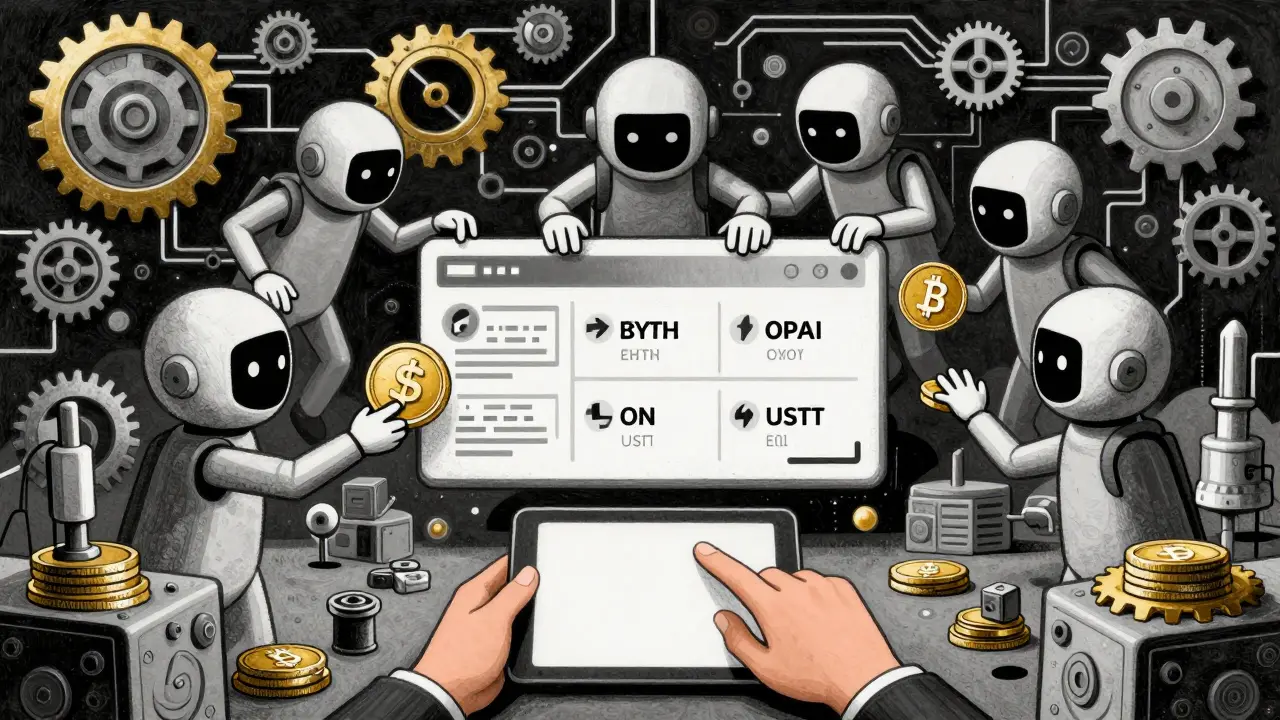
OPAI isn’t on Coinbase or Binance. You’ll need to use decentralized exchanges (DEXs) or smaller centralized platforms:
- Uniswap v3 (Ethereum): OPAI/ETH pair - highest volume, 81% of all trading
- KuCoin: OPAI/USDT - $2.26K daily volume
- BingX: OPAI/USDT - $187 daily volume
Price varies across exchanges. On Uniswap, it’s around $0.0000049. On KuCoin, it’s $0.0000042. That’s normal for low-liquidity tokens - slippage is high, and prices can swing quickly.
Trading volume jumped 369% in one day recently, but that’s likely due to a single pump event. Over the past week, OPAI is down 23.6%, while the broader crypto market barely moved. That suggests weak long-term interest.
Can you trust OPAI? What’s missing
Here’s the hard truth: there’s almost no public information about the team behind Optopia. No LinkedIn profiles. No GitHub commits. No whitepaper with technical architecture. No roadmap with clear milestones.
That’s not normal for serious blockchain projects. Even small teams usually share at least a founder’s name or a technical diagram. OPAI’s entire public presence is built on marketing claims: "AI-driven intent network," "permissionless execution," and "future of automated crypto trading."
Without knowing who’s building it or how the AI agents actually work, you’re investing in an idea - not a product. There’s no audit report for the smart contracts. No bug bounty program. No community forums with active developers.
It’s possible this is a stealth project. Or it’s a low-effort token with no real utility. The lack of transparency makes it hard to separate hype from potential.
Price predictions: Realistic or wishful thinking?
LBank predicts OPAI could hit $0.000001 by 2027. That’s a 110% increase from current levels. Sounds promising? Maybe - but here’s the catch:
- That’s still less than half a cent per token
- Even if it hits that target, the market cap would be under $10 million
- For comparison, a single popular meme coin like Dogecoin has a market cap over $15 billion
OPAI’s value isn’t tied to adoption, user growth, or real-world use. It’s tied to speculation. If AI agents ever become mainstream, OPAI might be the first to benefit. But right now, there’s zero proof those agents are actually working.
Should you buy OPAI?
If you’re looking for a stable investment - skip it. OPAI has all the red flags of a high-risk, low-transparency token.
If you’re a crypto enthusiast who wants to experiment with early-stage AI+blockchain ideas - then treat it like a lottery ticket. Allocate only what you’re willing to lose. Use MetaMask. Add the contract address. Monitor the Uniswap pool. But don’t expect returns.
The real question isn’t whether OPAI will go up. It’s whether anyone will ever use it. Until AI agents start executing real trades on the network - and not just in theory - OPAI remains a speculative bet on a future that hasn’t arrived yet.
Comments
Christopher Hoar
Lmao another ‘AI agent’ token. Bro the only thing executing trades here is the dev team dumping on Uniswap. $0.0000047? That’s not a coin it’s a math error.
March 17, 2026 at 21:13
Katrina Smith
So let me get this straight - we’re supposed to believe robots are trading crypto… but the team’s got zero online footprint? Cool. I’ll just send my life savings to a ghost. 🤡
March 18, 2026 at 23:09
Anastasia Danavath
Low cap low effort low braincell 💀
March 20, 2026 at 01:22
Sarah Zakareckis
Look I get the skepticism but the *concept* here is actually revolutionary. AI agents executing intents on L2? That’s the future of DeFi. This isn’t about price today - it’s about infrastructure. If even 1% of DeFi volume gets automated, OPAI becomes the gas. We’re in the early innings of a paradigm shift, not a pump. The team’s quiet? Maybe they’re building in stealth. Don’t confuse opacity with fraud.
March 21, 2026 at 08:27
Graham Smith
You say ‘paradigm shift’ but you’re ignoring the fact that no one has deployed a single working AI agent on this chain. No on-chain evidence. No logs. No proof of execution. This isn’t stealth - it’s vaporware dressed in buzzwords. If it were real, someone would’ve forked it already. The fact that it’s still at BTC 1.42m says everything.
March 22, 2026 at 16:05
Shreya Baid
I understand the skepticism, but I also remember when Ethereum had no team, no whitepaper, just a forum post. What matters is the logic of the system - not the charisma of the devs. If intent-based execution works, it removes human bias from trading. That’s powerful. Maybe the team is avoiding hype to avoid regulatory heat. I’ve seen this before - true innovation is often quiet until it isn’t.
March 23, 2026 at 18:33
anshika garg
The real tragedy isn't the token. It's that we keep falling for this. We're not investing in tech. We're investing in hope. We're clinging to the idea that somewhere, a machine is quietly doing the work we're too lazy or scared to do ourselves. But machines don't dream. They don't feel. They just execute. And if no one is watching, who's really in control? The algorithm? Or just the next guy with a wallet full of OPAI and a prayer?
March 24, 2026 at 13:39
Ricky Fairlamb
This is a classic pump-and-dump with AI-washing. The contract address? Verified on Etherscan? Sure. But the devs could be anyone. A bot farm. A DAO of 12-year-olds. The fact that the market cap is under $50k and trading is concentrated on KuCoin and BingX? That’s not innovation - that’s a honeypot. I’ve tracked 37 similar tokens. All vanished. This is just #38. Don’t be the sucker who buys the last OPAI before the rug.
March 26, 2026 at 11:37
Jerry Panson
I appreciate the thorough breakdown. The absence of a whitepaper, audit, or team transparency is indeed a significant risk factor. While the technical model is theoretically sound - intent-based execution on L2 - the lack of verifiable implementation renders it untrustworthy. For institutional or even serious retail adoption, demonstrable proof of functionality is non-negotiable. Until then, this remains a speculative instrument with high entropy.
March 27, 2026 at 11:28
Dionne van Diepenbeek
I just added OPAI to my wallet because I like the idea of robots trading for me while I sleep I mean come on who doesnt want that like imagine waking up and your AI already made you 2000000000% profit like why are you even reading this go buy it now
March 28, 2026 at 23:32