
Have you ever heard of a cryptocurrency named after a baby hippo? It sounds like a joke, but Kobushi (KOBUSHI) is a real digital asset. It is an Ethereum-based memecoin that ties its value to the viral fame of a specific animal: a pygmy hippo calf at the Ueno Zoo in Tokyo. Unlike generic meme coins that rely solely on internet slang or random animals, Kobushi has a distinct origin story rooted in Japanese culture and a stated mission for wildlife conservation.
If you are looking at your portfolio and wondering if this tiny token is worth your attention, you need to understand exactly what it is, how it works, and the risks involved. This guide breaks down the facts behind the hype.
The Origin Story: From Zoo Vote to Blockchain
To understand Kobushi is a community-driven cryptocurrency inspired by a pygmy hippo, you have to look at where the name comes from. In Japan, naming zoo animals is often a public event. The Ueno Zoo held a contest to name a new pygmy hippo calf. The winning name was "Kobushi," which received 1,720 votes.
The name "Kobushi" carries double meaning in Japanese culture. Besides being the hippo's name, it refers to the Magnolia kobus, a flowering tree symbolizing new beginnings. The creators of the KOBUSHI token adopted this symbolism. They wanted to launch a project that represented a fresh start for both the community and conservation efforts. This narrative differentiates it from thousands of other tokens that appear out of nowhere with no cultural anchor.
The connection to the real-world animal gives the token a unique identity. When people buy KOBUSHI, they are technically buying into a brand built around a living creature at one of Tokyo's most famous zoos. However, it is crucial to note that while the branding is tied to the zoo, the token itself operates independently on the blockchain.
Technical Specifications and Tokenomics
Under the hood, KOBUSHI is an ERC-20 token running on the Ethereum blockchain network. This means it relies on Ethereum's security and infrastructure. If you want to hold or trade it, you need a wallet that supports Ethereum assets, such as MetaMask or Phantom.
Here are the hard numbers regarding the supply and contract details:
- Contract Address: 0xd86830e9c56785e2b703eb0029ae71a943e4d442
- Total Supply: 420,690,000,000 (420.69 billion) tokens
- Circulating Supply: Approximately 420.69 billion (fully diluted)
- Transaction Tax: 0%
The number 420.69 billion is a classic internet meme reference, signaling to buyers that this is a lighthearted, community-focused project rather than a serious financial instrument. One key feature highlighted by data aggregators like Blockspot is that the liquidity provision has been burned and minting capabilities revoked. What does this mean for you? It means the developers cannot print more tokens to sell to you later, and they cannot easily pull the money out of the trading pool. These are standard safety checks in the memecoin world to reduce the risk of a "rug pull," though they do not guarantee price stability.
| Attribute | Value / Detail |
|---|---|
| Blockchain | Ethereum (ERC-20) |
| Category | Memecoin / Conservation-themed |
| Supply Cap | 420.69 Billion (Fixed) |
| Tax Rate | 0% Buy/Sell |
| Liquidity Status | Burned |
| Primary DEX | Uniswap V2 |
Market Performance and Volatility
Let’s talk about the money side of things. As of mid-2026, KOBUSHI is classified as a micro-cap asset. Its market capitalization fluctuates significantly depending on the day and the data source, often hovering between $12,000 and $28,000 USD. The price per token is extremely low, typically ranging fractions of a cent (e.g., around $0.0000007).
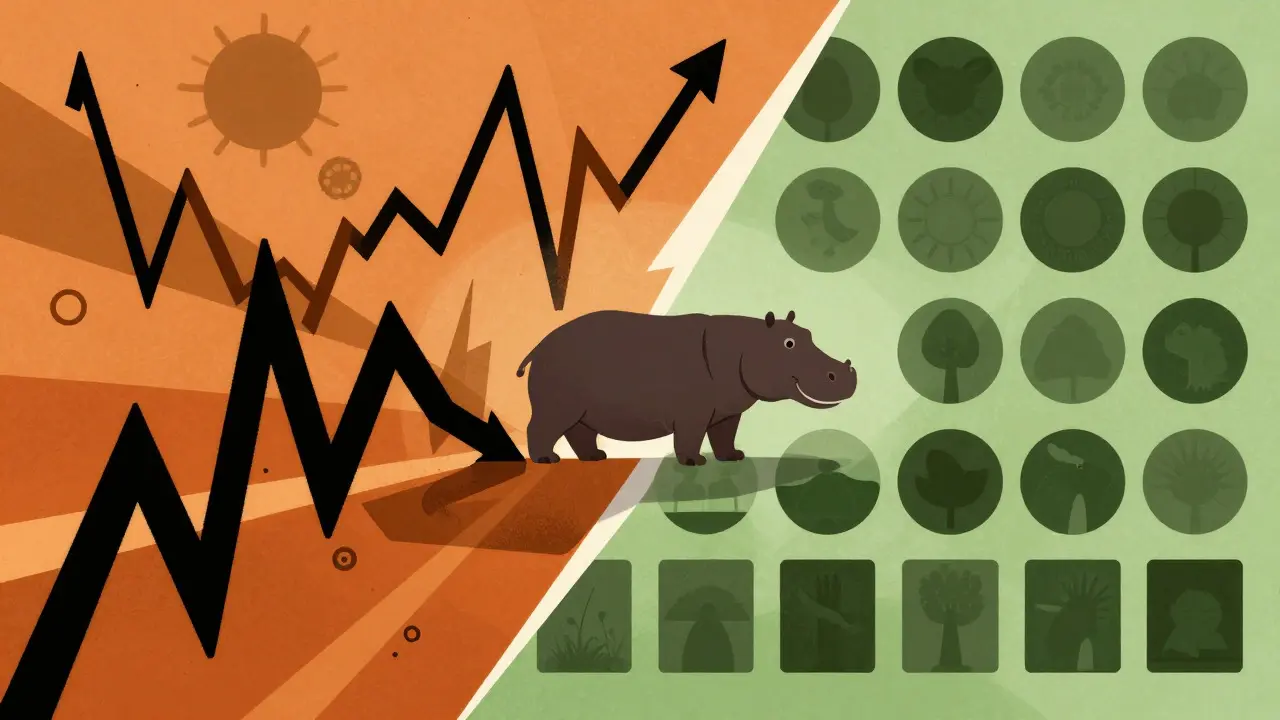
This extreme low valuation makes it highly volatile. On days when social media mentions spike, the price can jump. For instance, historical data shows an all-time high near $0.000006457 USD, followed by drawdowns exceeding 88%. Conversely, it has bounced back from lows near $0.0000002826 USD. These swings are normal for memecoins but dangerous for inexperienced traders.
Liquidity is another critical factor. Trading volume varies wildly. Some days see only $15 in trades; other days might see spikes over $59,000. Low liquidity means that if you try to sell a large amount of KOBUSHI, you could crash the price yourself because there aren't enough buyers in the pool to absorb your sale without moving the needle drastically. Most trading happens on Uniswap V2 via the KOBUSHI/WETH pair.
The Conservation Narrative vs. Reality
A major selling point of KOBUSHI is its philanthropic angle. The project claims to support wildlife conservation, specifically related to the pygmy hippos at Ueno Zoo. The idea is that the viral nature of the meme will drive funds toward protecting these animals.
However, as an investor, you must dig deeper. While the narrative is strong, mainstream listings like CoinGecko and CoinMarketCap do not provide verified, audited reports on exactly how much money has been donated or to which specific accounts. There is no transparent ledger linking token transactions directly to zoo donations in real-time. This lack of verifiable impact data is a common gap in many charity-themed cryptos. You are betting on the promise of future impact rather than proven past results.
Risks and Due Diligence
Before you connect your wallet, consider these risks:
- Anonymity: There is no public whitepaper or identified team of developers. The project appears to be anonymous or pseudonymous. If something goes wrong, there is no CEO to call.
- Low Holder Count: On-chain data suggests fewer than 1,200 holders. This small base means the price can be manipulated by just a few large wallets ("whales").
- No Audit: While minting is revoked, there is no mention of an independent smart contract audit from firms like CertiK or OpenZeppelin. The code may be safe, but it hasn't been professionally stress-tested publicly.
- Speculative Nature: Like all memecoins, KOBUSHI has no utility beyond speculation and community sentiment. If the hype dies, the price likely follows.
Compared to giants like Dogecoin or Shiba Inu, KOBUSHI lacks exchange listings on major centralized platforms like Binance or Coinbase Pro. It remains a decentralized asset, accessible only through DEXs. This limits its reach but also keeps it free from corporate regulation-at least for now.
How to Buy KOBUSHI
If you decide the risk-reward ratio fits your strategy, here is how you actually get the token:
- Set up a Wallet: Download a non-custodial wallet like MetaMask or Phantom. Ensure it is configured for the Ethereum network.
- Fund with ETH: Buy Ethereum (ETH) on a major exchange and send it to your wallet address. You will need ETH to pay for gas fees (transaction costs) on the Ethereum network.
- Connect to Uniswap: Go to Uniswap.org and connect your wallet.
- Paste the Contract: Search for KOBUSHI. To avoid fake tokens, paste the official contract address:
0xd86830e9c56785e2b703eb0029ae71a943e4d442. - Swap: Enter the amount of ETH you wish to spend. Adjust the slippage tolerance if necessary (often higher for low-liquidity tokens). Confirm the transaction.
Remember, because liquidity is thin, check the price impact before confirming. If the impact is over 5-10%, you are likely getting a bad deal.
Conclusion: Is KOBUSHI Worth It?
Kobushi (KOBUSHI) is a niche experiment blending internet culture, Japanese symbolism, and crypto speculation. It offers a fun theme and some basic anti-rug protections like burned liquidity. However, it lacks transparency in donations, professional audits, and a broad holder base. Treat it as a high-risk speculative play, not a long-term investment. Only put in money you are comfortable losing entirely, and keep an eye on the social channels for any updates on the conservation claims.
Is KOBUSHI listed on Binance or Coinbase?
No, as of 2026, KOBUSHI is primarily traded on decentralized exchanges (DEXs) like Uniswap V2 on the Ethereum network. It is not listed on major centralized exchanges such as Binance, Coinbase, or Kraken.
What is the total supply of KOBUSHI?
The total and circulating supply of KOBUSHI is fixed at 420,690,000,000 (420.69 billion) tokens. Minting has been revoked, meaning no new tokens can be created.
Does KOBUSHI donate to Ueno Zoo?
The project claims to support pygmy hippo conservation at Ueno Zoo. However, there are no publicly audited financial reports verifying the exact amounts donated or the frequency of these contributions. Investors should view this as a narrative claim rather than a verified fact.
Is KOBUSHI a safe investment?
Like all memecoins, KOBUSHI is considered high-risk. It has a small market cap, low liquidity, and an anonymous team. While technical safeguards like burned liquidity exist, the price can drop to zero if interest fades. Never invest more than you can afford to lose.
Which blockchain does KOBUSHI use?
KOBUSHI operates on the Ethereum blockchain as an ERC-20 token. This means you need an Ethereum-compatible wallet and ETH for transaction fees to trade it.
What is the contract address for KOBUSHI?
The official Ethereum contract address for KOBUSHI is 0xd86830e9c56785e2b703eb0029ae71a943e4d442. Always verify this address on multiple sources to avoid scam tokens.