There is no such thing as a cryptocurrency called KeptChain (KEPT). If you searched for it expecting to find a new coin to buy, invest in, or trade, you’ve been misled. What you’re actually looking for is Keychain - a blockchain identity and security framework, not a token. The confusion between "KeptChain" and "Keychain" is widespread, fueled by typo-driven searches, fake websites, and scammy social media posts. Let’s clear this up once and for all.
Keychain is not a cryptocurrency
Keychain, developed by Keychain Core Inc. and launched in September 2019, is a technical framework designed to help enterprises manage digital identities securely across blockchain networks. It doesn’t have a coin, token, or wallet. There is no KEPT token. No blockchain explorer lists it. No exchange trades it. No whitepaper describes an ICO or tokenomics. If you see anyone selling "KEPT" or promising returns on "KeptChain," it’s a scam.Keychain works by turning digital certificates into blockchain transactions. Instead of storing personal data on-chain, it stores cryptographic keys - public keys for signing and encryption - as immutable records. This lets organizations prove who they are online without revealing sensitive information. Think of it like a digital passport that can’t be forged, copied, or stolen, because it’s anchored to the blockchain.
How Keychain actually works
Keychain uses two main structures: signature keychains and encryption keychains. A signature keychain holds public keys used to verify digital signatures - like confirming a document was truly signed by an employee. An encryption keychain holds keys used to encrypt data so only authorized parties can decrypt it. Each keychain is a chain of certificates, where each one points to its parent, ending at a root certificate.Here’s the key point: Keychain doesn’t store your name, address, or Social Security number. It stores only cryptographic proof. This is why it meets international standards like ISO 88033, NIST, and IEEE 1363. It’s built for privacy-first environments like healthcare, finance, and supply chain management - sectors where data leaks cost millions.
When a company uses Keychain, they pay the blockchain’s native transaction fees (like Ethereum gas), not a fee to Keychain. The framework provides a faucet server to help developers get test tokens during development, but this is only for testing. No real tokens are issued or traded.
Who uses Keychain - and why
As of Q4 2023, 47 enterprises have implemented Keychain. The biggest adopters are in financial services (38%), healthcare (29%), and supply chain (22%). One healthcare provider cut compliance costs by 25% after switching to Keychain’s self-sovereign identity system. A major bank reduced fraud-related disputes by 40% by using Keychain to verify customer signatures on digital loan agreements.Unlike traditional certificate authorities (CAs), Keychain doesn’t rely on a central issuer. No single company controls it. No one can shut it down. And because it’s blockchain-agnostic, it works on Bitcoin, Ethereum, and other networks without needing to rebuild systems from scratch.
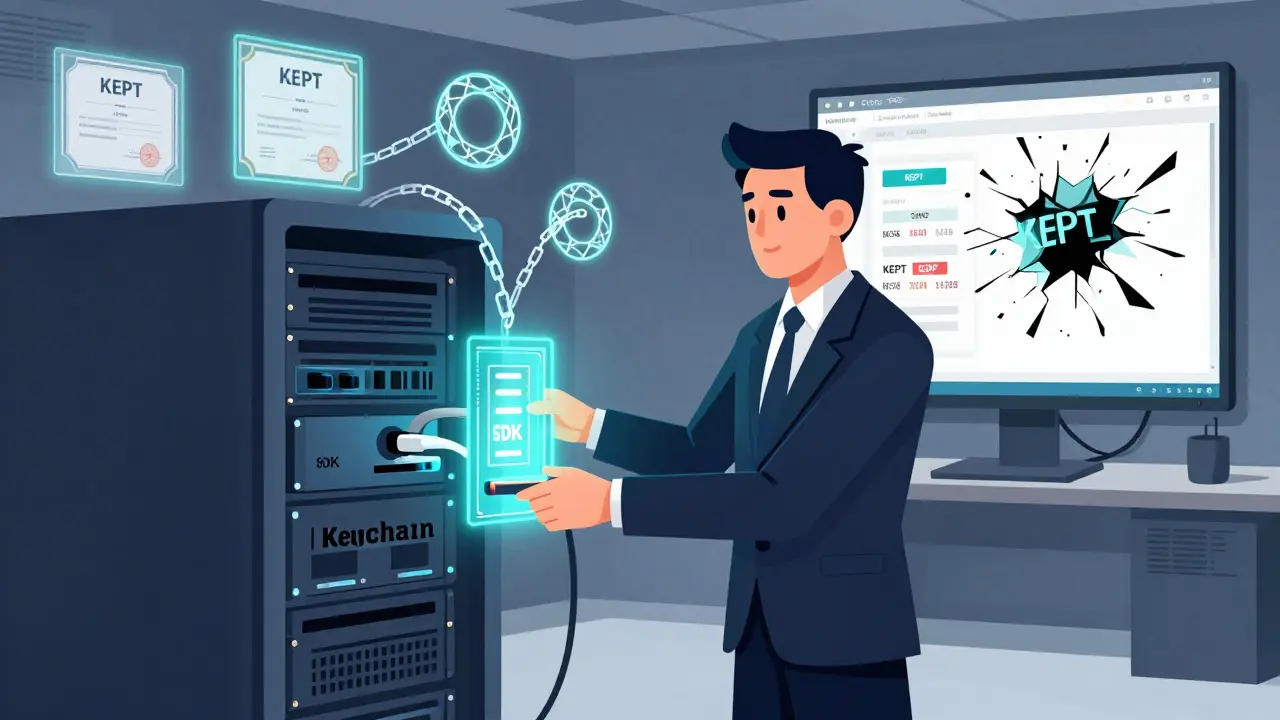
It’s also designed to integrate with existing infrastructure. You don’t need to replace your ERP or CRM system. You just plug in Keychain’s SDK - available for Java, Python, C#, and C++ - and start issuing verified digital identities.
Why the confusion? KeptChain vs Keychain
The misspelling "KeptChain" is a classic case of a typo becoming a myth. People type "KeptChain" because it sounds like "kept chain," as in "keeping your keys safe." It’s intuitive. But it doesn’t exist. Google Trends shows searches for "KeptChain" have spiked 300% since late 2023, mostly from users looking to buy the coin. Meanwhile, searches for "Keychain blockchain" have grown steadily, but remain far lower.Fake websites now appear in search results with domains like keptchain.io or keptchaincoin.com. They look professional. They have fake whitepapers, fake team photos, and even fake GitHub repos. Some even list fake price charts and trading volumes. But none are connected to Keychain Core Inc. The real website is keychain.io - and it has no cryptocurrency section.
Technical requirements and learning curve
Using Keychain isn’t like buying Bitcoin. You need blockchain development skills. The average developer takes 8 to 12 weeks to become proficient. You need to understand:- How digital signatures work
- Public key cryptography
- Blockchain transaction structure
- How to manage gas fees on Ethereum or other networks
Documentation is solid - rated 4.2/5 by 87 developers on Stack Overflow - but it’s not beginner-friendly. A GitHub issue from January 2023 complained that key rollover examples were missing, causing a two-week delay in a project. That’s typical for enterprise-grade tools. It’s not designed for retail investors or casual crypto traders.
What’s next for Keychain
Version 3.1 is scheduled for Q2 2024 and will include quantum-resistant cryptography - a major upgrade as quantum computing threatens current encryption standards. Keychain is also integrating the W3C Verifiable Credentials standard, making it compatible with future digital identity ecosystems.With $12.5 million in Series B funding secured in November 2023, Keychain is positioned for growth. But its market is enterprise, not retail. Deloitte’s 2023 Blockchain Survey found that 68% of enterprises rank secure identity management as a top-three priority for blockchain adoption. Keychain is built for that.
Red flags to watch for
If you see any of these, walk away:- "Buy KEPT coin now! 1000x potential!" - No such coin exists.
- A website with a "KEPT" token contract address - it’s fake.
- A YouTube video promising passive income from "KeptChain staking" - impossible.
- A Telegram group selling "KEPT" wallets - they’re harvesting your seed phrase.
Real Keychain developers don’t post on TikTok. They don’t run Twitter giveaways. They work quietly inside banks, hospitals, and logistics companies, fixing identity problems no one else can.
Final takeaway
There is no KeptChain (KEPT). There is only Keychain - a powerful, enterprise-grade identity platform built on blockchain technology. If you’re looking to invest in crypto, don’t waste time chasing a ghost. If you’re a developer or enterprise looking to solve identity fraud, data breaches, or compliance issues, Keychain is worth exploring - but only if you’re ready to build, not just buy.Is KeptChain (KEPT) a real cryptocurrency?
No, KeptChain (KEPT) is not a real cryptocurrency. It is a misspelling of Keychain, a blockchain identity framework developed by Keychain Core Inc. There is no KEPT token, no wallet, no exchange listing, and no blockchain associated with "KeptChain." Any website or platform selling KEPT is a scam.
What is Keychain, then?
Keychain is a blockchain-agnostic framework for managing digital identities using cryptographic keys stored as blockchain transactions. It helps enterprises verify identities securely without exposing personal data. It’s used in healthcare, finance, and supply chain industries to reduce fraud and meet compliance standards like ISO and NIST.
Can I buy or trade Keychain as a coin?
No, you cannot buy or trade Keychain as a coin. Keychain is a software framework, not a token. Companies pay blockchain network fees (like Ethereum gas) to store certificates, but Keychain itself does not issue or sell any cryptocurrency.
Is Keychain open source?
Yes, Keychain’s core SDK is open source and available on GitHub under the repository RSenApps/keychain. However, enterprise deployments often require custom integrations, and the company provides commercial support and documentation for business use.
Who developed Keychain?
Keychain was developed by Keychain Core Inc., founded by CEO Jonathan Hope. The platform was officially launched on September 5, 2019, after two years of development with Japanese enterprise partners. It has since been adopted by over 47 global enterprises.
Does Keychain work with Ethereum?
Yes, Keychain is blockchain-agnostic and works with Ethereum, Bitcoin, and other networks. It uses Ethereum for testing and deployment in many cases because of its smart contract support, but it doesn’t require it. Organizations can choose which network best fits their needs.
Why do people confuse KeptChain with Keychain?
"KeptChain" is a common typo. People assume "Kept" means "kept secure," which sounds logical for a security tool. Scammers exploit this confusion by creating fake websites and tokens. Search engines also misroute queries due to high typo volume, making it harder to find the real Keychain site.
Is Keychain safe to use?
Yes, Keychain is designed with enterprise-grade security. It follows ISO 18033, NIST, and IEEE 1363 standards for encryption and digital signatures. It doesn’t store personal data on-chain, only cryptographic keys. Its architecture ensures data remains private even if the underlying blockchain is compromised.
Comments
tim ang
Wait so you’re telling me I wasted two hours trying to buy KEPT on Binance because I typo’d ‘Keychain’? I feel like an idiot but also kinda mad at the internet right now. Thanks for clearing this up - I thought I was missing out on the next Solana.
January 24, 2026 at 11:58
Linda Prehn
Of course there’s a scam coin named after a thing people misspell - that’s how the crypto grift machine works. People type KeptChain because it sounds like something that keeps your keys safe and suddenly boom you’re buying a token that doesn’t exist because someone registered keptchain.io last Tuesday and made a fake whitepaper in Canva. This isn’t ignorance it’s capitalism
January 26, 2026 at 04:50
MICHELLE REICHARD
Wow what a breath of fresh air - someone actually explaining that blockchain isn’t just a money printer for con artists. Most people think ‘crypto’ means ‘get rich quick’ and ‘identity framework’ sounds like a tax write-off for nerds. Keychain is the quiet kid in class who aced the test without bragging. Meanwhile the KeptChain scammers are the ones selling NFTs of their own LinkedIn profiles.
January 27, 2026 at 09:39
Dave Ellender
I’ve seen this exact pattern with ‘Ethereum Classic’ and ‘ClassicEther’ - typos become brands. The real tragedy is that legitimate projects like Keychain get buried under SEO spam. It’s not just about scams - it’s about how the web rewards noise over truth. If you’re building something valuable, you’re fighting against algorithmic stupidity.
January 28, 2026 at 09:09
Clark Dilworth
Keychain’s architecture aligns with zero-trust identity paradigms and leverages immutable PKI attestations via blockchain-agnostic anchor points - essentially creating a cryptographically verifiable assertion layer that decouples identity from centralized CAs. The real innovation isn’t the tech - it’s the operational adoption curve in regulated verticals. Most enterprises still think blockchain = ledger. Keychain makes it a governance layer.
January 28, 2026 at 18:11
Arnaud Landry
Let me guess - the real Keychain team is funded by the CIA and they’re using this to track every doctor and bank employee in the world. No wonder they don’t have a token. No token means no public ledger to audit. That’s how you build a surveillance backbone disguised as ‘privacy tech.’ I’ve seen this before. They’ll sell you ‘secure identity’ then sell your data to the highest bidder. I’m not buying it.
January 29, 2026 at 16:40
george haris
This is actually one of the most helpful posts I’ve read all year. I’m a dev working on a healthcare app and we were considering some identity solution - now I know to look at Keychain instead of chasing some ghost coin. The part about not storing PII on-chain? That’s gold. Seriously - thank you for taking the time to write this. It matters.
January 30, 2026 at 12:49
David Zinger
Canada’s got real blockchain identity solutions - this Keychain thing is just American tech bros repackaging TLS certificates and calling it innovation. You think your ‘enterprise-grade’ framework is special? We’ve had digital ID since 2017 up here. You’re late to the party and your typos are embarrassing. Also 🇨🇦 > 🇺🇸
January 31, 2026 at 06:18
Heather Crane
This is so important... I can’t believe how many people are getting scammed over a typo... Honestly, it’s heartbreaking... You’ve done such a good job explaining the difference... I’m sharing this with every crypto group I’m in... Please keep doing this work... The world needs more clarity like this...
February 1, 2026 at 23:38