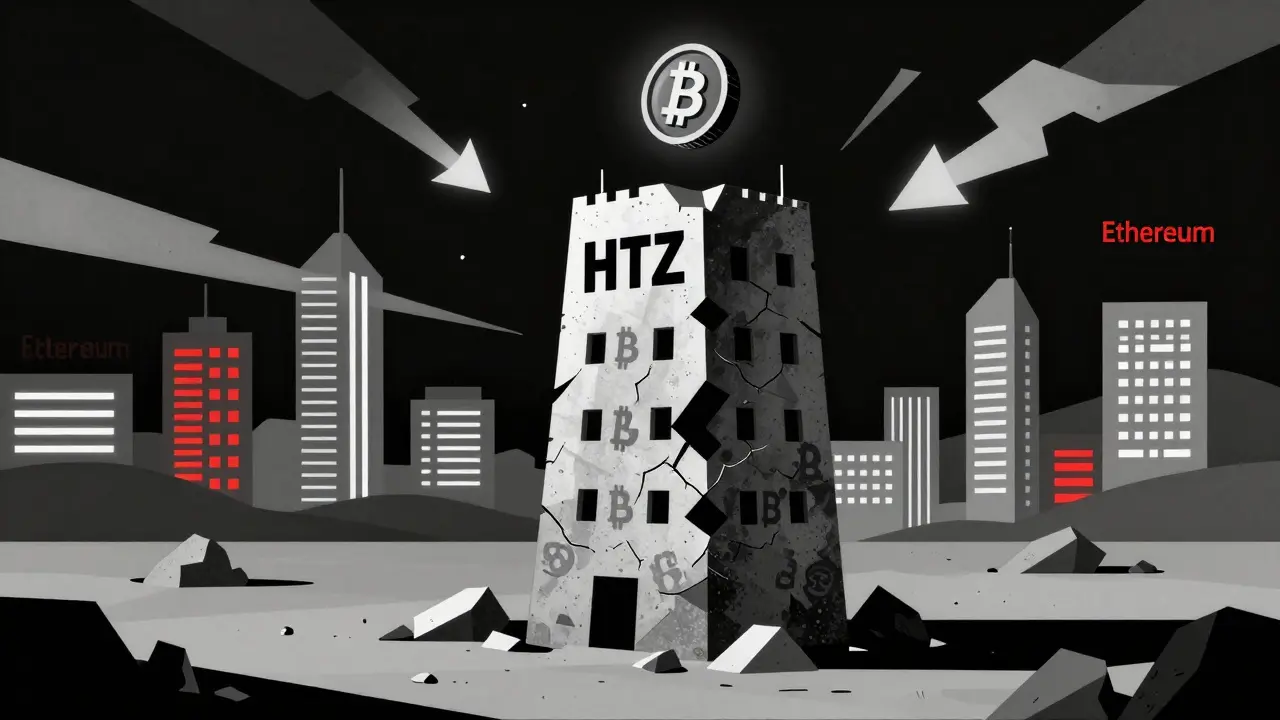
The name Hertz Network (HTZ) might sound like it belongs in a list of serious cryptocurrencies, but the reality is far different. If you're wondering whether HTZ is a legitimate investment, a growing project, or even a functioning blockchain - the answer is no. Hertz Network is not a project. It's a dead asset. A token with no users, no development, and no future.
As of October 2025, HTZ’s market cap hovered around $13,286 according to CoinMarketCap. That’s less than the cost of a used laptop. For comparison, Bitcoin’s market cap is over $578 billion. Ethereum is at $230 billion. Even the 1,000th largest crypto has a market cap over $600 million. HTZ is more than 43,000 times smaller than that. This isn’t a micro-cap. This is an ultra-micro-cap - the kind that barely registers on any blockchain explorer.
HTZ operates on two blockchains: Ethereum and BNB Smart Chain. That might sound technical and impressive, but here’s the catch - there’s zero activity on either chain. The last transaction recorded on Etherscan was on June 14, 2022. On BscScan, it’s the same story. No swaps. No transfers. No smart contract interactions. Just a ghost address with a few hundred million tokens sitting idle. The contract addresses exist, but they’re empty shells.
Trading volume? Almost non-existent. LiveCoinWatch reported a daily volume of just $5. Crypto.com and Coinbase show slightly higher numbers - around $175. But even that’s misleading. Those numbers come from a handful of trades on decentralized exchanges like PancakeSwap. One user on Dextools.io noted that the HTZ/BNB liquidity pool had only $37 in total. Try to buy $10 worth of HTZ? You’ll get slippage over 50%. That means the price moves violently with every trade. It’s not a market. It’s a trap.
And there’s no exchange support. HTZ is not listed on Coinbase, Binance, Kraken, or any major platform. You can’t buy it through an app. You can’t trade it with your bank. The only way to get it is through obscure DeFi platforms where liquidity is thinner than a sheet of paper. And even then, transactions often fail. Reddit user u/CryptoSkeptic92 described trying to buy $10 of HTZ - and failing three times in a row.
Who created HTZ? No one knows. There’s no whitepaper. No team. No website. The official domain, hertznetwork[.]io, is a parking page. No content. No contact info. Just a placeholder. The GitHub repo linked to the project has one commit from 2021 - a basic ERC-20 token template. No updates. No improvements. No code commits since then. It’s like someone downloaded a free token generator, typed in “Hertz Network,” and walked away.
Community? Nonexistent. The Twitter account @HertzNetworkHTZ has 127 followers. The last tweet? June 2022. Telegram and Discord channels? Deleted or never created. On Bitcointalk.org, a user from July 2022 called it “a scam operation” because the domain was about to expire. That was two years ago. It expired. No one renewed it.
What about the tokenomics? HTZ has a max supply of 14 billion coins. About 5.24 billion are in circulation. Sounds reasonable? Not when 99.3% of those coins are held in just a few wallets - likely controlled by the original creators. Chainalysis wallet clustering shows almost no distribution. No public holders. No staking. No utility. This isn’t a decentralized network. It’s a centralized dump of tokens waiting for someone to take the last few dollars from a sucker.
Even the price data is inconsistent. LiveCoinWatch says HTZ hit an all-time high of $0.001499. CoinLore says $0.000551. Coinbase says $0.000736. These aren’t rounding errors. They’re signs of a market so thin that a single trade can swing the price by 200%. One platform reports a +22% surge. Another says -1.2%. There’s no consensus because there’s no market.
Experts don’t mention HTZ. CoinDesk, Cointelegraph, The Block - none have covered it. Weiss Ratings, CryptoRating, Messari - they don’t even include it in their databases. Michael van de Poppe, a well-known crypto analyst, said on Twitter: “Tokens with sub-$20K market caps and single-digit dollar trading volumes should be considered non-functional assets rather than investable cryptocurrencies.” That’s HTZ. Not an investment. Not a project. A non-functional asset.
And here’s the kicker: CryptoCompare’s 2023 study found that 98.7% of tokens with market caps under $20,000 fail within 18 months. HTZ has been inactive for over two years. It’s not coming back. It’s not being revived. It’s dead.
So why does it still show up on CoinMarketCap? Because listing a token costs nothing. Anyone can submit a token with a name, a contract address, and a fake website. CoinMarketCap doesn’t verify legitimacy. It just displays what’s submitted. That’s why HTZ is still there - not because it’s alive, but because no one bothered to remove it.
If you’re thinking of buying HTZ, ask yourself: Why would anyone spend money on a token with no use, no team, no exchange support, no liquidity, and no future? The answer is simple: they won’t. The only people buying HTZ are either confused newbies or scammers trying to pump and dump. There’s no real demand. No real value. Just noise.
HTZ isn’t a cryptocurrency. It’s a cautionary tale. A reminder that not every coin with a ticker symbol is worth your time - or your money. The crypto market is full of real innovation: DeFi, Layer 2s, tokenized assets, real-world use cases. HTZ isn’t part of that. It’s part of the graveyard.
Don’t waste your time. Don’t waste your money. HTZ is gone.
Is Hertz Network (HTZ) a real cryptocurrency project?
No. Hertz Network (HTZ) is not a real project. It has no team, no whitepaper, no active development, and no community. The website is a parking page. The GitHub repo hasn’t been updated since 2021. The token exists only as a smart contract with no usage or purpose.
Can I buy HTZ on Coinbase or Binance?
No. HTZ is not listed on Coinbase, Binance, Kraken, or any major exchange. The only place it’s traded is on decentralized exchanges like PancakeSwap - and even there, liquidity is so low that trading more than $5 can cause extreme price swings.
What is the current price of HTZ?
Prices vary wildly across platforms due to lack of trading volume. As of late 2025, HTZ ranged from $0.0000025 to $0.000004. These numbers are meaningless because the market is so thin that a single trade can move the price by 20% or more.
Is HTZ a good investment?
No. HTZ has zero chance of becoming valuable. With a market cap under $15,000, no liquidity, no development, and no users, it’s not an investment - it’s a risk. Experts like Michael van de Poppe and CryptoCompare classify tokens like this as non-functional assets. Don’t put money into it.
Why does HTZ still appear on crypto trackers?
Crypto data sites like CoinMarketCap allow anyone to submit a token. They don’t verify if a project is real, active, or legitimate. HTZ is listed because someone submitted it - not because it’s alive. Many dead tokens remain on these platforms for years.
What happened to the Hertz Network team?
There was never a verified team. No names, no LinkedIn profiles, no public announcements. The project launched with zero transparency. All signs point to a one-time token creation with no intention of ongoing development - a classic pump-and-dump setup.
Comments
Maggie House
honestly i just stumbled on this and thought it was some new hertz rental car thing lol
im so confused why anyone would even make a coin called hertz network
like its not even clever its just weird
and now im lowkey scared i bought some of this by accident
who even names a crypto after a car rental company
February 22, 2026 at 06:34
Dana Sikand
oh my god this is the most accurate breakdown of a dead coin ive ever read
ive seen this pattern so many times
token drops on dex with a flashy name and a fake website
someone pumps it for a week then vanishes
the contract sits there like a tombstone
and somehow it still shows up on coinmarketcap like its alive
its not a scam its worse its a ghost
and people still trade it like its a lottery ticket
why do we keep letting this happen
February 22, 2026 at 12:25
Elizabeth Smith
the fact that this still exists on any exchange is a moral failure
no one is checking these listings
its like letting a dead body stay in a public park because no one filed a report
crypto is supposed to be the future but we’re still letting dead tokens float around like digital litter
someone needs to take responsibility
not just the creators the platforms too
they’re complicit
February 22, 2026 at 17:01
Robert Kromberg
im not saying we should delete every low-cap coin
but there has to be some kind of minimum activity threshold before a token stays listed
if no one has traded it in over two years
if the liquidity pool has less than $50
if the github is a single template commit
then maybe it should be flagged as inactive
not just left there to confuse newbies
its not fair to people who are just trying to learn
February 23, 2026 at 07:01
Curtis Dunnett-Jones
While I acknowledge the compelling evidence presented in this analysis, I must respectfully posit that the continued existence of HTZ on public blockchain explorers may not constitute negligence, but rather a reflection of the immutable nature of decentralized ledger systems.
Furthermore, the absence of commercial adoption does not inherently equate to functional obsolescence; it may simply indicate a lack of market demand.
One might argue that the preservation of such artifacts serves an educational purpose, providing a case study in the pitfalls of speculative token creation.
Therefore, while I concur with the practical conclusion, I urge a more nuanced philosophical perspective on the ontological status of digital assets.
February 24, 2026 at 19:02
Felicia Eriksson
so basically this is the crypto version of a forgotten garage sale item
someone made it once
no one wanted it
but it’s still sitting there
and now people are trying to sell it for $175
just let it rest lol
February 25, 2026 at 14:08
Patrick Streeb
It is my considered opinion that the persistence of HTZ on cryptocurrency tracking platforms is a systemic oversight that undermines the credibility of the entire ecosystem.
Given the absence of verifiable development activity, community engagement, or liquidity provision, the token ought to be formally classified as dormant.
Recommendation: Implement a tiered de-listing protocol based on transaction frequency, liquidity thresholds, and contract interaction metrics.
Transparency and accountability are not optional in this space; they are foundational.
February 25, 2026 at 17:03
Tracy Whetsel
this is why i dont trust any coin that doesnt have a real team with faces 😔
if you cant find a single person behind it
just walk away
you’re not missing out
you’re saving yourself
❤️
February 26, 2026 at 10:44