Have you ever stumbled upon a coin that sounds promising on paper but feels suspiciously quiet in practice? That’s exactly what happens when you look into Eurocoin (EUC), a digital currency launched in July 2015. On its surface, it claims to be a decentralized alternative for seamless transactions. But if you dig deeper into the data from early 2026, the picture changes drastically. This isn’t just another altcoin guide; it’s a reality check on a project that has largely faded from the active crypto scene.
The Origins and Core Concept of Eurocoin
To understand where Eurocoin stands today, we first need to look at why it was created. Launched in mid-2015, during the first major wave of Bitcoin forks, Eurocoin aimed to offer a community-based standard of value. The core promise was simple: "no one owns or controls Eurocoin." It sought to operate as a pure peer-to-peer (P2P) network where anyone could participate without central authority intervention.
Technically, the project built itself on familiar foundations. It uses the SHA-256 hash function, the same cryptographic algorithm used by Bitcoin. This choice made it compatible with existing mining hardware but also meant it faced intense competition from the world’s largest cryptocurrency. Unlike many modern tokens that rely on smart contracts or complex utility apps, Eurocoin’s primary function remains basic transaction settlement. It was designed to eliminate intermediaries, offering instantaneous settlement over the internet without the wait times associated with traditional credit card processing.
How Eurocoin Mining and Consensus Work
If you are curious about how new coins enter circulation, Eurocoin relies on a hybrid consensus mechanism. It combines Proof-of-Work (PoW) and Proof-of-Stake (PoS). However, the dominant method for obtaining EUC is through mining.
Mining Eurocoin involves solving SHA-256 hashes to verify transactions and add them to the blockchain. This process is computationally intensive. It requires significant computing power and electricity consumption, similar to early Bitcoin mining days. The protocol sets a fixed daily limit on how many coins can be mined to prevent inflation-a common issue in fiat currencies controlled by central banks. Currently, the total maximum supply is capped at 20 million EUC. As of early 2026, approximately 12.42 million coins are in circulation, meaning about 62% of the total supply has been released. The remaining coins will continue to drip out slowly via mining, assuming there is still enough miner interest to keep the network alive.
Market Reality: Price, Volume, and Liquidity in 2026
Here is where the story takes a sharp turn. If you are looking for investment opportunities, the numbers for Eurocoin in May 2026 paint a concerning picture. The coin trades at a fraction of a cent. Data aggregators show slight variations due to low volume, but the general range sits between $0.000983 and $0.001413 USD.
| Metric | Value / Status |
|---|---|
| All-Time High | $0.10 (Jan 6, 2018) |
| Current Price Range | $0.0009 - $0.0014 |
| Market Cap | ~$7,700 - $15,000 USD |
| 24-Hour Volume | $0.004 - $3 USD |
| Primary Exchange | YoBit |
Notice the trading volume. We are talking about single-digit dollars in daily turnover. This indicates severe illiquidity. In practical terms, this means if you tried to buy or sell a large amount of EUC, you would likely crash the price or fail to execute the trade entirely. The market capitalization, hovering around $10,000 to $15,000, places Eurocoin near rank #6,500 among cryptocurrencies. It is effectively invisible to institutional investors and most retail traders who focus on top-tier assets.
Why Has Eurocoin Declined So Sharply?
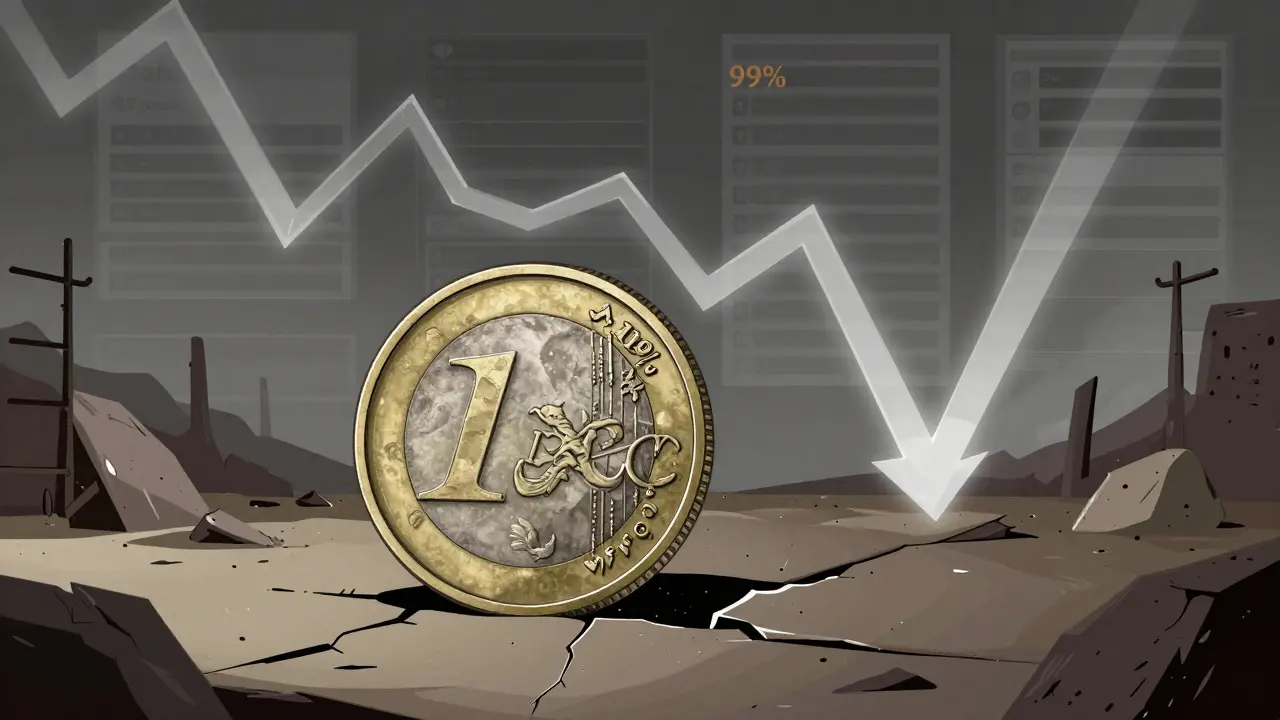
You might wonder how a project went from an all-time high of $0.10 in January 2018 to less than $0.002 in 2026. That is a decline of over 99%. Several factors contribute to this steep drop:
- Lack of Development Activity: There is no evidence of recent updates, roadmap announcements, or active community engagement. The project appears dormant.
- Minimal Utility: Without real-world adoption for payments or services, the coin lacks intrinsic demand drivers.
- Exchange Delisting: Most major exchanges have removed EUC from their platforms. Trading is now restricted primarily to YoBit, a smaller exchange known for listing obscure or legacy altcoins.
- Competition: Since 2015, thousands of new blockchains have emerged with faster speeds, lower fees, and better security. Eurocoin’s technology, while functional, is outdated compared to modern Layer-1 solutions.
The dramatic price collapse suggests that investor confidence has evaporated. When a coin loses 98% of its value and shows no signs of recovery, it often signals that the underlying project has failed to gain meaningful traction.
Is Eurocoin Still Mineable?
Technically, yes. Because Eurocoin operates on Proof-of-Work, miners can still run nodes and attempt to solve blocks. However, the economic viability is questionable. With such a low coin price, the revenue from mining rewards likely does not cover the cost of electricity and hardware wear-and-tear. Unless you already have specialized ASIC miners sitting idle, starting a new Eurocoin mining operation in 2026 would result in immediate financial losses. For hobbyists interested in blockchain history, it might serve as a curiosity, but not as a income source.
Risks and Considerations for Potential Buyers
If you are considering buying Eurocoin despite these warnings, you must understand the risks. This asset exhibits characteristics of a "zombie" or abandoned cryptocurrency. Here is what you need to watch out for:
- Liquidity Risk: You may buy EUC but find it impossible to sell later because there are no buyers on the order books.
- Security Concerns: Dormant projects often stop updating their software. Unpatched vulnerabilities could leave funds exposed to attacks, though the low value makes it an unlikely target for sophisticated hackers.
- No Customer Support: With no active development team, there is no one to help if your wallet gets corrupted or you lose access keys.
- Opportunity Cost: Capital tied up in EUC cannot be used in more vibrant ecosystems like Ethereum, Solana, or even stablecoins.
Automated trading bots exist for EUC, integrating with platforms like bitcoinup.io, but these tools are useless without liquidity. Algorithms cannot create value where none exists; they simply execute trades based on price movements, which are currently negligible.
Conclusion: A Historical Artifact Rather Than an Investment
Eurocoin serves as a reminder of the volatile nature of the early crypto era. While it started with noble goals of decentralization and fast transactions, it has not kept pace with technological advancements or market demands. In 2026, it remains a functional but irrelevant piece of the blockchain landscape. For researchers or historians of digital currency, it offers insight into pre-2018 fork dynamics. For investors, however, it represents a cautionary tale about the importance of active development, community support, and real-world utility.
Can I still buy Eurocoin (EUC) in 2026?
Yes, but only on limited exchanges like YoBit. Be aware that liquidity is extremely low, meaning you may face difficulty selling your coins later. The price is also highly susceptible to manipulation due to thin order books.
Is Eurocoin mining profitable?
No. Given the current price of under $0.002 per coin, the electricity costs for SHA-256 mining far exceed the potential earnings. It is not economically viable for new miners.
Why did Eurocoin’s price drop so much?
The price dropped over 99% from its 2018 peak due to lack of development, minimal adoption, delisting from major exchanges, and intense competition from newer, more efficient blockchain technologies.
What is the total supply of Eurocoin?
The maximum supply is capped at 20 million EUC. Approximately 12.42 million are currently in circulation, with the remainder being mined slowly over time.
Is Eurocoin a scam?
It is not necessarily a scam in the sense of a fraudulent launch, but it behaves like an abandoned project. The open-source code is available, and the blockchain still runs, but there is no active team driving growth or utility, making it a poor investment choice.
Where can I store Eurocoin safely?
You should use a secure hardware wallet or a reputable desktop wallet that supports SHA-256 coins. Avoid keeping large amounts on exchanges like YoBit due to security risks associated with smaller platforms.
Does Eurocoin have any real-world use cases?
Currently, no. There are no known merchants, services, or applications accepting Eurocoin for payments. Its utility is limited to speculative trading among a very small group of enthusiasts.