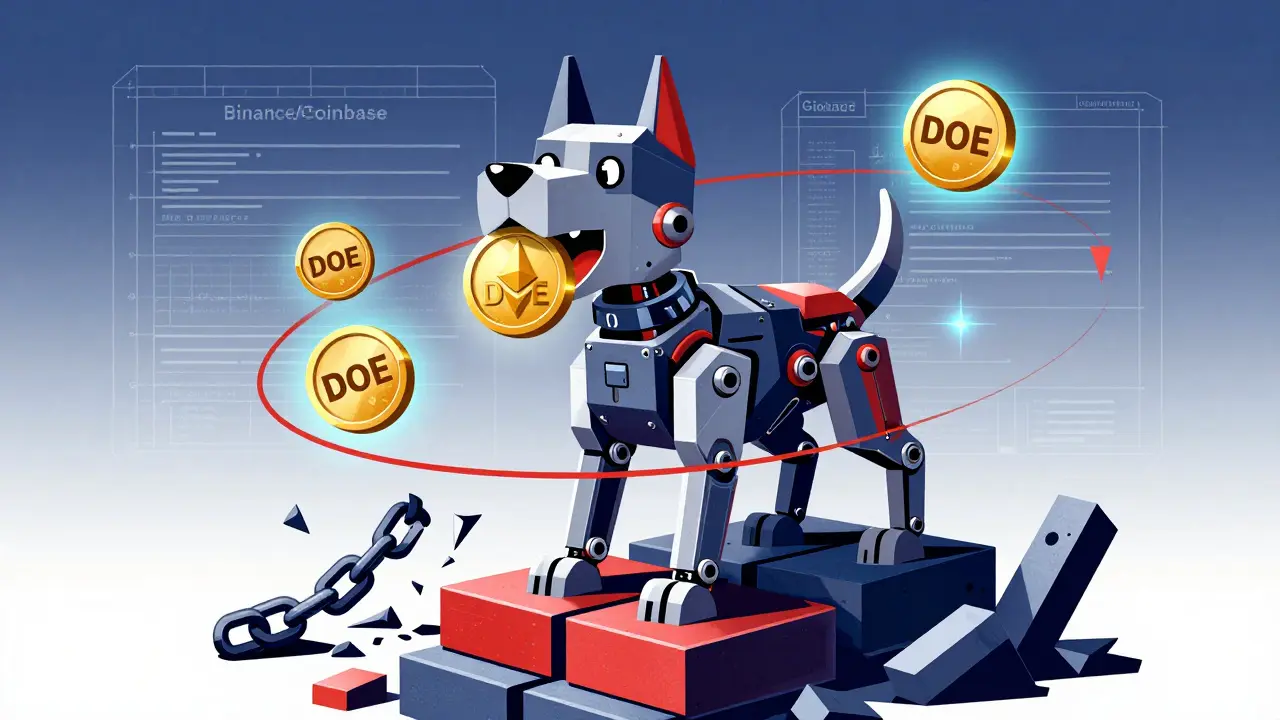
Ever heard of Dogs of Elon (DOE)? It’s not another Dogecoin copy - it’s a token built on Ethereum with a clear link to NFTs, staking rewards, and a fixed supply. But here’s the catch: it’s not on Coinbase. It’s not even on Binance. And if you’re thinking of buying it, you need to know what you’re getting into.
DOE isn’t just a coin. It’s part of a bigger system: the Dogs Of Elon NFT collection. Think of it like this - you buy an NFT, you get access to a staking pool where you earn not just DOE, but also Dogecoin (renDOGE) and Shiba Inu (SHIB). Sounds cool? Maybe. But the numbers tell a different story.
Fixed Supply, No Minting - But Is That Enough?
Unlike Dogecoin, which pumps out 5 billion new coins every year, DOE has a hard cap: exactly 1 billion tokens. No more, no less. The smart contract doesn’t even have a mint function. That means the total supply is locked forever. That’s rare for a meme coin. Most of them inflate endlessly, diluting your holdings. DOE doesn’t. That’s a win on paper.
And the team didn’t stop there. They renounced ownership of the staking contracts after depositing all the reward tokens. That means no one - not even the creators - can change the reward rules, freeze your tokens, or drain the pool. That’s a level of transparency most projects skip. It’s not just marketing. It’s code.
How Staking Actually Works (And What You Earn)
If you hold DOE, you can lock it up in a staking pool. You don’t need to do anything fancy. Connect your wallet - MetaMask, Trust Wallet, anything Ethereum-compatible - and stake your tokens. The rewards come every day. But here’s the twist: you don’t just earn DOE.
You also earn renDOGE and SHIB. That’s right. Your staking rewards are split three ways. So if you stake 10,000 DOE, you might get back 12 DOE, 0.05 renDOGE, and 3 SHIB over 30 days. The mix changes slightly based on pool activity, but it’s always distributed. This isn’t just about holding a token. It’s about earning multiple assets at once.
But here’s the reality: most people who stake DOE aren’t doing it for the long haul. They’re chasing quick flips. The average staking period is under 14 days. Why? Because the price keeps dropping.
Price, Volatility, and Liquidity - The Real Problems
As of October 2025, DOE was trading at $0.0001381. That sounds cheap. But look closer. The 50-day moving average was $0.0001803. The 200-day was $0.0001660. The current price is below both. That’s a classic bearish signal. The market thinks it’s overvalued.
And the volatility? 11.29%. That means on any given day, the price can swing over 11%. In a 30-day window, only 12 days were green. That’s a 40% win rate. Not great.
Then there’s liquidity. The 24-hour trading volume? Just $1.2 million. Compare that to Shiba Inu’s $1.8 billion. When you try to sell 50,000 DOE, the order book vanishes. Users report slippage of 8.7% on trades over $500. That means if you want to sell $1,000 worth, you might only get $913 after fees and price slippage. That’s not a bug - it’s a feature of low liquidity.
Where You Can Buy DOE (And Why It’s Hard)
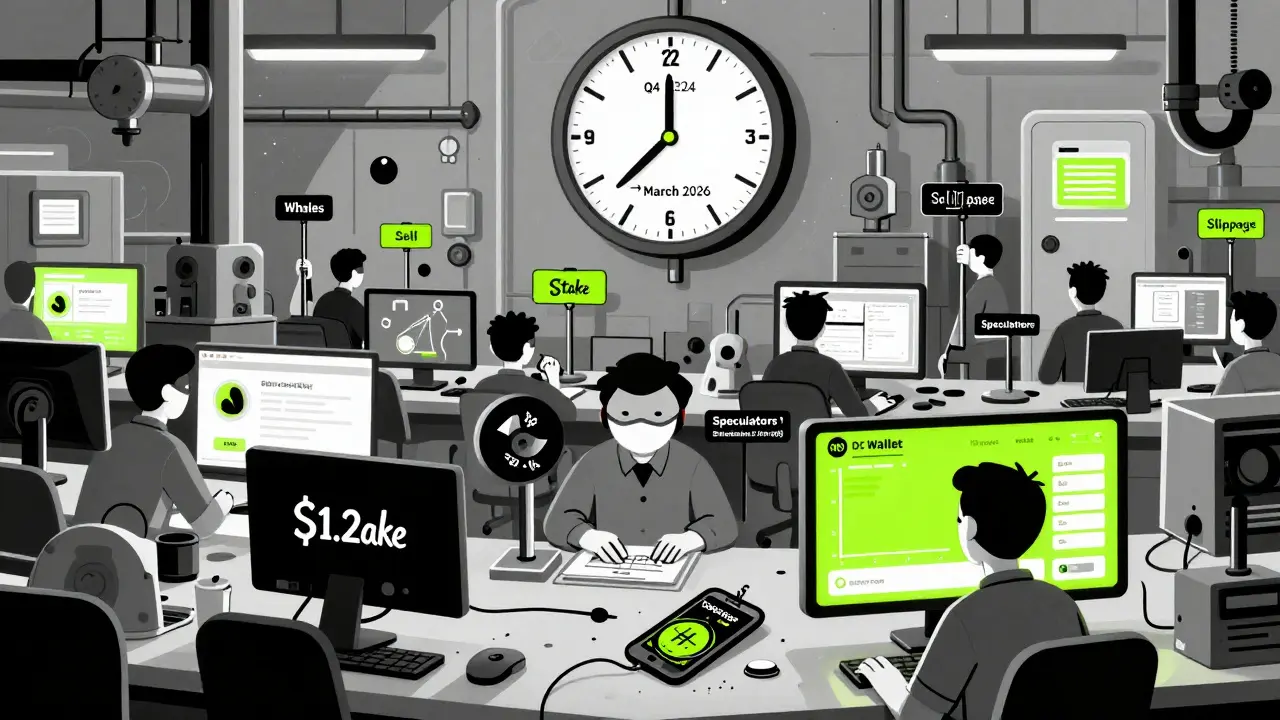
You won’t find DOE on Coinbase, Kraken, or Binance. It’s only on decentralized exchanges: Uniswap, PancakeSwap, and a few others. That means you need to use a Web3 wallet, swap ETH or USDT for DOE, and pay Ethereum gas fees - which average $3.27 per transaction. For beginners, this is a 2- to 3-hour learning curve.
And forget mobile apps. The promised DOE wallet app? Still not out. The team announced it for Q4 2024. It’s now March 2026. No update. No explanation. That’s a red flag.
The NFT Connection - Utility or Just Hype?
The whole DOE ecosystem is tied to the Dogs Of Elon NFT collection. There are 10,000 unique NFTs. Owning one gives you extra staking rewards. But here’s the thing: only about 8,400 unique wallets hold DOE. That’s less than 1% of the NFT supply. Most NFT owners aren’t even staking. So what’s the point?
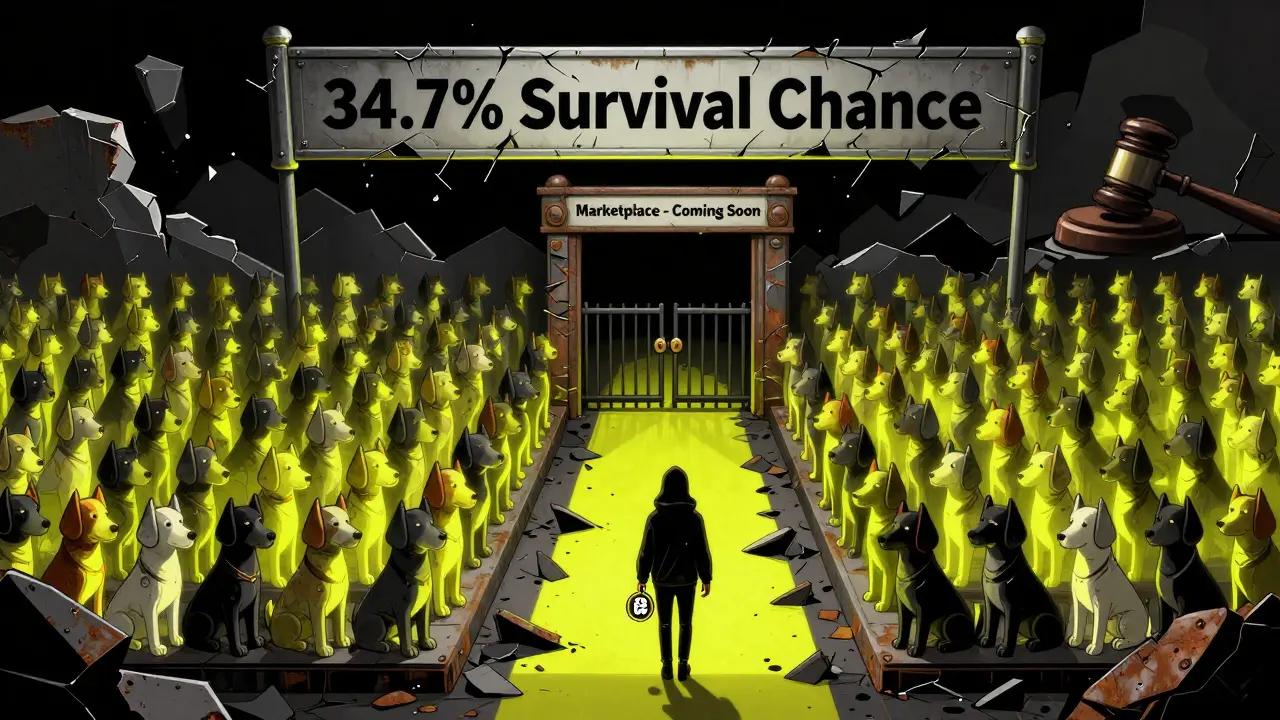
Some say the NFTs are just a marketing tool. Others say they’re the future. But right now, there’s no marketplace. No trading. No clear use case beyond “you get more rewards if you own one.” That’s not utility. That’s speculation.
What the Experts Say - And Why They’re Divided
Dr. Elena Rodriguez from Delphi Digital put it bluntly: “Tokens with dual NFT/crypto utility face significant adoption challenges unless they establish clear utility beyond speculation, which DOE has yet to demonstrate at scale.”
On the flip side, PricePrediction.net claims DOE could hit $0.0277 by 2026. That’s a 20,000% jump. But WalletInvestor says $0.0106. TradingBeast says $0.0061. Those aren’t forecasts - they’re guesses.
Meanwhile, CryptoRank gives DOE a 34.7% chance of surviving past 2028. That’s not great. Most meme coins die within 18-24 months. DOE’s been around less than a year. It’s already in the danger zone.
Community Feedback: Real Users, Real Complaints
Reddit threads are full of mixed signals. One user bragged about earning 1.2 DOE after staking 50 tokens. Another said: “Tried selling 50k DOE - order book disappeared.”
Trustpilot reviews average 2.8/5. The good? “Easy staking.” “Active Discord.” The bad? “Low liquidity.” “Marketing over substance.”
Twitter sentiment? 63% negative. Common posts: “Another meme coin without real use case.” “Whale manipulation is obvious.”
And here’s the kicker: the Discord server has over 12,000 members. But the average response time to a support question? 47 minutes. That’s not community support. That’s noise.
Regulatory Risk - The Silent Threat
The SEC hasn’t touched DOE yet. But they’re watching. Staking rewards are under scrutiny. Perkins Coie LLP warned in Q3 2025 that tokens offering passive income in other cryptocurrencies could be classified as securities under the Howey Test. If that happens, DOE could be forced to shut down staking. Or worse - face legal action.
Right now, it’s a gray area. But in crypto, gray areas don’t last.
Final Verdict: Is DOE Worth It?
DOE has some real strengths: fixed supply, renounced contracts, multi-token rewards. But it also has fatal flaws: low liquidity, no real marketplace, missing roadmap items, and zero merchant adoption.
If you’re a speculator with a high-risk tolerance and you believe in the NFT + meme coin combo, maybe you buy a small amount. But don’t go all-in. Don’t stake your life savings. Don’t expect it to be the next Dogecoin.
If you’re looking for a crypto with utility, transparency, and real adoption - DOE isn’t it. It’s a gamble wrapped in smart contracts. And right now, the odds aren’t in your favor.
Is Dogs of Elon (DOE) available on Coinbase or Binance?
No, DOE is not listed on any major centralized exchange like Coinbase, Kraken, or Binance. It’s only available on decentralized exchanges such as Uniswap and PancakeSwap. To buy it, you need a Web3 wallet like MetaMask, ETH or USDT, and you must pay Ethereum gas fees. This makes it inaccessible to most beginners.
Can I stake DOE tokens, and what do I earn?
Yes, you can stake DOE tokens in the official staking pool. Rewards are distributed daily and include three cryptocurrencies: additional DOE tokens, renDOGE (a Dogecoin variant), and SHIBA Inu (SHIB). The staking contract has been audited and ownership has been renounced, meaning the team cannot change the reward structure or access your funds. However, rewards are small - most users report earning less than 2% annually in total value.
Is DOE a good long-term investment?
Based on current data, DOE is not a strong long-term candidate. It has a fixed supply and some technical safeguards, but it lacks real-world utility, merchant adoption, or a working marketplace. Its liquidity is extremely low, and its price has been in a bearish trend since launch. CryptoRank estimates only a 34.7% chance it survives past 2028. Most meme coins fail within two years - DOE is already in that window.
Why is DOE’s liquidity so low?
DOE’s liquidity is low because it’s not listed on major exchanges, has no institutional backing, and is promoted mostly by online communities rather than serious investors. As of October 2025, only 8,400 unique wallets held DOE. The 24-hour trading volume hovered around $1.2 million, compared to Shiba Inu’s $1.8 billion. This makes large trades nearly impossible without massive price slippage - often over 8%.
Does DOE have a roadmap, and have they delivered on promises?
Yes, the team published a roadmap including a marketplace for Dogs Of Elon NFTs, a governance token launch in Q1 2026, and Layer 2 integration to cut gas fees. But as of March 2026, the NFT marketplace still doesn’t exist. The promised mobile wallet was announced for Q4 2024 and never launched. No official update has been given. This pattern of missed deadlines erodes trust and suggests the project lacks the development resources to deliver.
Is DOE a security under SEC rules?
It could be. The SEC is actively reviewing crypto projects that offer staking rewards in other tokens, especially if they promise passive income. Perkins Coie LLP warned in mid-2025 that tokens like DOE may meet the Howey Test criteria for being classified as investment contracts. If the SEC takes action, staking could be shut down, or DOE could be forced to register as a security - which would likely kill its current model.