The Shift from Licensing to Ownership
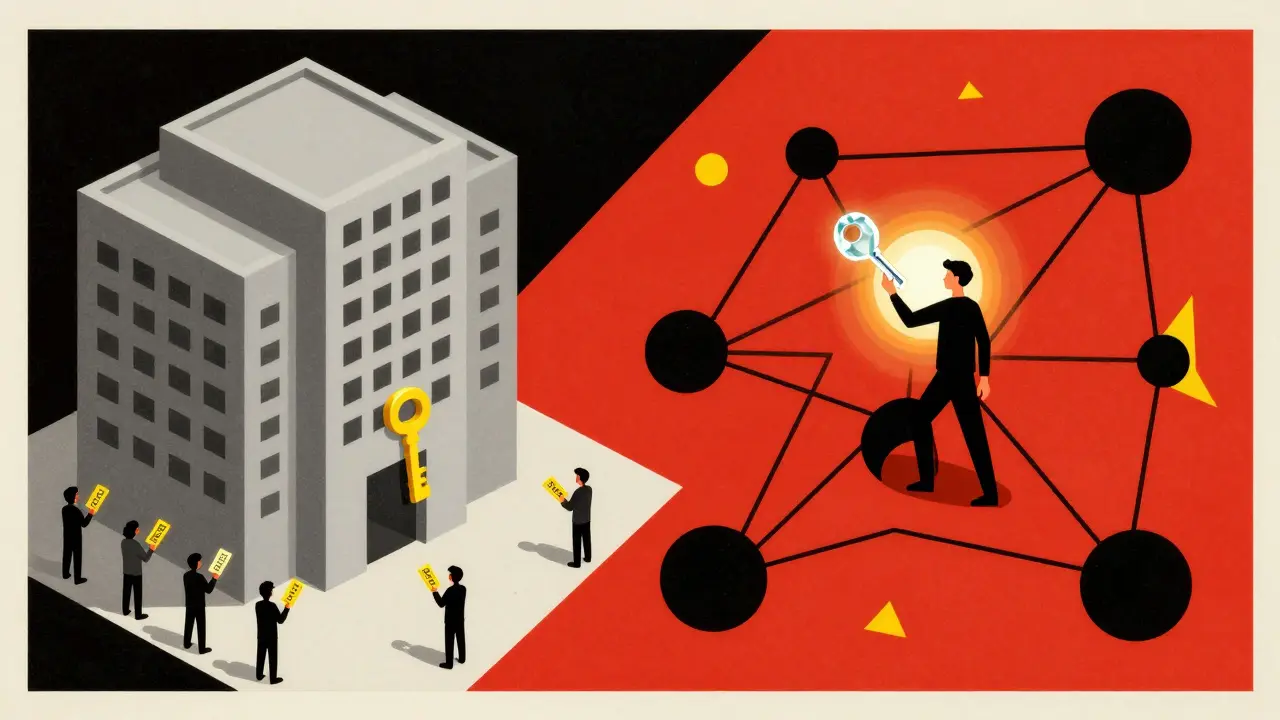
For decades, we've lived in a Web2 ecosystem where companies like Google, Facebook, and Spotify act as gatekeepers. They hold the keys to your data and your assets. If you buy a skin in a traditional video game, that item exists only in the game's database. You can't sell it on an open market or move it to another game because the developer owns the database. Blockchain changes this by creating a decentralized ledger. Instead of a company saying "User A owns this item," a network of thousands of computers agrees on who owns what. This means your ownership is immutable-it can't be erased or changed by a single CEO's whim. You hold the private keys, which means you hold the power. This isn't just a technical tweak; it's a paradigm shift in how we define value and property in the internet age.The Tech Stack Powering Your Assets
To make digital ownership work, the system relies on a few key pieces of technology working together. It's not just one thing, but a combination of tools that ensure you can't be cheated out of your assets.First, there are Smart Contracts, which are self-executing pieces of code that automatically enforce the rules of an asset's ownership and transfer without a middleman. Think of them as digital vending machines: if you provide the correct payment, the contract automatically sends the asset to your wallet. These contracts can handle complex rules, like automatically sending a 5% royalty payment back to the original artist every time a piece of digital art is resold.
Then we have Digital Signatures. These provide the mathematical proof that you are who you say you are. When you transfer an asset, your digital signature proves you have the authority to move it, making the transaction secure and verifiable without needing a bank to vouch for you.
Finally, Blockchain Networks (like Polkadot) act as the foundation. They provide the infrastructure where these records are stored. Because these networks are decentralized, no single party has authority over the system, ensuring that your ownership record remains transparent and impenetrable.
NFTs: The Gold Standard of Unique Ownership
When people talk about digital ownership, Non-Fungible Tokens (or NFTs) usually come up first. To understand these, you have to understand "fungibility." A dollar bill is fungible-if I swap mine for yours, we both still have a dollar. It's interchangeable. An NFT is the opposite. It is a unique, indivisible digital asset. Whether it's a piece of art, a music track, or a virtual plot of land, an NFT serves as a deed of ownership. Unlike a JPEG that anyone can right-click and save, the NFT is the official record on the blockchain that proves who owns the original. This tokenization makes assets fraud-resistant and freely transferable. You can move your NFT from one marketplace to another, and the world knows it's still yours.| Feature | Traditional Licensing | Blockchain Ownership |
|---|---|---|
| Control | Centralized (Platform owned) | Decentralized (User owned) |
| Transferability | Locked to one platform | Cross-platform / Interoperable |
| Persistence | Can be revoked by provider | Immutable / Permanent |
| Value Capture | Platform takes most of the cut | Directly to the creator/owner |
Real-World Applications and Industry Shifts
This isn't just theoretical. We're seeing massive shifts in how businesses operate because of true digital property rights.- Gaming: The industry is moving from selling game copies to selling tradeable items. In some virtual economies, rare digital items now sell for more than actual physical houses because the players-not the developers-own the assets.
- Retail & Loyalty: Brands like Boba Guys are reimagining loyalty programs. Instead of a punch card that lives in a company's database, they use blockchain-based ownership to create a direct relationship with customers, giving them assets they actually control.
- Digital Identity: We're seeing the rise of self-custody domains. Using extensions like .satoshi or .hodl, users can own their online identity. This allows you to log into sites without passwords by using your wallet, and you control all the metadata tied to that identity.
The Risks: With Great Power Comes Great Responsibility
True ownership means you are your own bank. While this is liberating, it also means there is no "Forgot Password" button if you lose your keys. If you lose access to your wallet, your assets are essentially gone forever-a process sometimes called "burning" the asset. There are other dangers too. Phishing attacks are common, where scammers send fake approval links to trick you into signing a smart contract that gives them permission to drain your wallet. To fight this, tools like Revoke.cash have become essential. They allow you to see which smart contracts have permission to move your assets and let you cancel those permissions instantly. Another risk involves time-limited assets. Some Web3 domains, like those from the Ethereum Name Service (ENS), require renewal. If you forget to renew your domain with cryptocurrency, it can expire and be snatched up by someone else. This is a stark reminder that while the blockchain is immutable, the rules written into the smart contracts are absolute.Does owning an NFT mean I own the copyright to the image?
Not necessarily. In most cases, you own the token (the deed), but the creator retains the copyright unless the smart contract explicitly transfers those legal rights to the buyer. Always check the specific terms of the NFT's contract.
Can a company take away my blockchain assets?
If the assets are truly decentralized and you hold the private keys in a self-custody wallet, no company can take them. However, if your assets are stored on a centralized exchange (like Coinbase or Binance), the exchange technically controls them and could freeze your account.
What happens if the blockchain network goes down?
Because blockchain networks are decentralized across thousands of nodes worldwide, it is nearly impossible for the entire network to "go down." As long as some nodes are running, the record of your ownership remains intact.
Is digital ownership legal in the real world?
The legal landscape is still catching up. While the blockchain provides a technical record of ownership, courts in different countries are still deciding how to treat these records in legal disputes. It's a rapidly evolving area of law.
How do I protect my digital assets from theft?
The gold standard is using a hardware wallet (cold storage) to keep your private keys offline. Additionally, use tools like Revoke.cash to manage your smart contract permissions and never share your seed phrase with anyone.