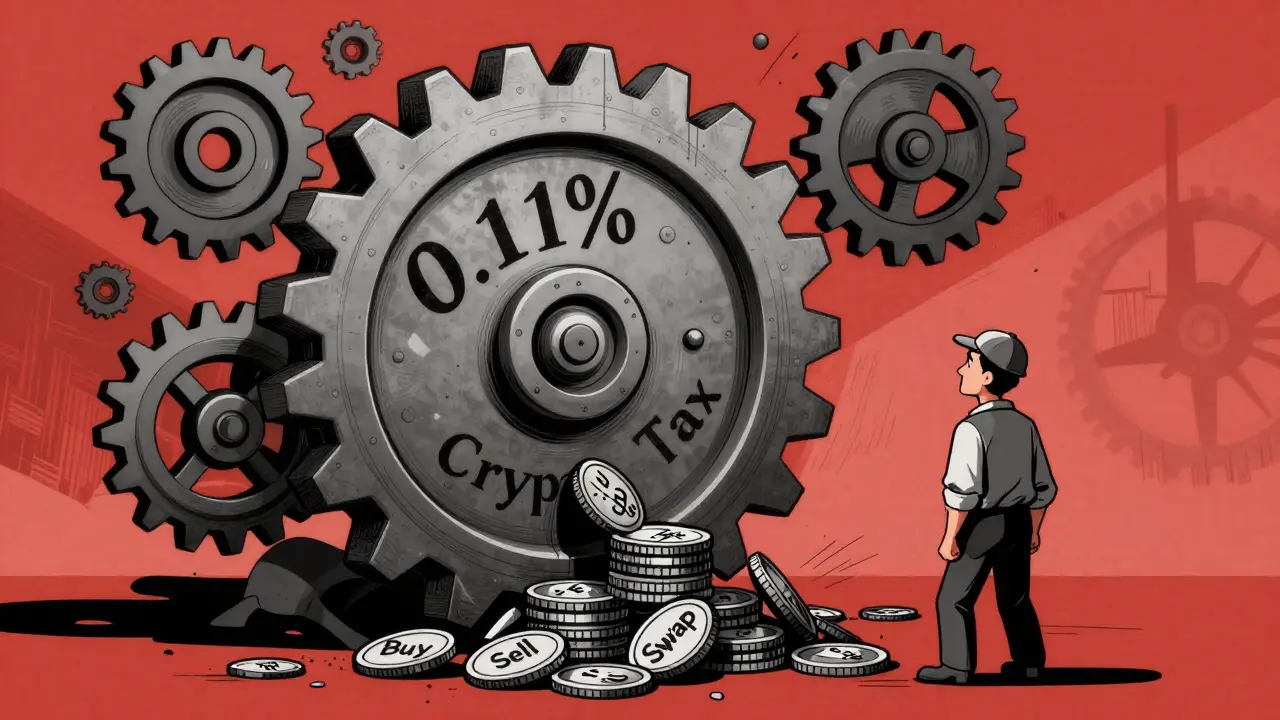
When Vietnam announced a proposed 0.1% tax on every cryptocurrency transaction, it didn’t just add another rule to the books-it shook the foundation of how millions of people trade crypto in the country. This isn’t a vague idea floating around in government meetings. It’s a formal proposal backed by law, tied to the Digital Technology Industry Law a landmark legislation passed in June 2025 that officially defines crypto assets under Vietnamese law, and it’s set to take effect in early 2026. For the 17 million Vietnamese citizens who own crypto, this isn’t just about paying taxes. It’s about whether their trading habits, profits, and even their access to markets will survive this change.
How the 0.1% Tax Actually Works
The tax isn’t applied to profits. It’s applied to every single trade-no matter if you made money or lost money. Buy $1,000 worth of Bitcoin? Pay $1. Sell it for $1,200? Pay another $1. Swap Ethereum for Solana? Another $1. The tax hits every transfer, every swap, every order filled. That’s different from how most countries tax crypto, which usually only taxes gains when you convert to fiat. Vietnam’s approach mirrors how stock trades are taxed, but with a twist: it’s based on gross value, not net profit.
This matters because most retail traders don’t make big profits on single trades. They rely on volume. A trader doing 100 small trades a day, each worth $500, would pay $50 in taxes daily. That’s $1,500 a month. Even if they break even on all those trades, they’re still losing money to tax. And that’s before accounting for trading fees, which are already around 0.1% to 0.2% on most exchanges. Add the tax, and you’re paying 0.2% to 0.3% per trade-more than what market makers typically earn.
Why This Tax Could Hurt Liquidity
Market makers are the invisible engines that keep prices stable and orders filled. They buy low, sell high, and make tiny profits on each trade-often less than 0.01% per transaction. The 0.1% tax is ten times higher than their profit margin. That means they can’t afford to keep offering tight spreads. If market makers pull back, trading spreads widen. That means you pay more to buy and get less when you sell. Retail traders suffer the most.
Binance raised this exact concern in October 2025, formally asking Vietnam’s Ministry of Finance to reconsider. Their analysis showed that if the tax stays, many automated trading bots and liquidity providers will simply stop operating in Vietnam. That’s not speculation-it’s math. When similar taxes were tried in other countries, order book depth dropped by 30% to 50% within months. Prices became more volatile. Trading volume fell. Investors noticed.
What Else Is Taxed? The Full Picture
The 0.1% transaction tax is just one piece of a much bigger puzzle. Vietnam’s full crypto tax framework includes:
- 20% capital gains tax on profits from selling crypto for Vietnamese dong or USD
- 5% to 35% progressive tax on income from mining, staking, and airdrops
- 20% corporate income tax for businesses running crypto exchanges or mining operations
- 10% VAT on exchange service fees
- Annual reporting required by March 31 for individuals
- Quarterly reporting for businesses
There’s one small relief: the first 10 million VND ($400) in annual crypto gains are tax-free. That helps small investors who aren’t actively trading. But if you’re trading regularly-even with small amounts-you’ll quickly hit that limit. And the penalties for non-compliance start at 2 million VND ($80) or 2% of unpaid tax. That’s not a warning. It’s an enforcement signal.

Who’s Behind This? The Bigger Strategy
This isn’t just about money. Vietnam’s leadership has been clear: Party Resolution No. 07-NQ and National Assembly Resolution No. 23/2021 call for expanding the tax base to include digital assets. The government sees crypto as a growing economic force. With a market value over $100 billion and 17 million users, the potential tax revenue is massive. The Vietnam Blockchain Association estimates $800 million per year-enough to fund public infrastructure projects or reduce reliance on traditional tax sources.
The Ministry of Finance isn’t acting alone. They’re working with the State Security Commission, major exchanges like Bybit, and international experts to build a system that tracks crypto flows, prevents money laundering, and ensures compliance. This is a coordinated, multi-agency effort. It’s not rushed. It’s deliberate. And it’s designed to last.
The Pilot Program: A Slow Rollout
Here’s the key detail most people miss: the tax won’t launch nationwide on day one. The government is running a pilot program. A small group of exchanges and users will be selected to test how the tax works in practice. They’ll monitor trading volume, liquidity, compliance rates, and revenue collection. If the pilot shows that liquidity crashes or traders flee, the rules can be adjusted before full rollout.
This is smart. Countries like South Korea and Japan saw massive outflows when they slapped heavy crypto taxes on without testing. Vietnam is trying to avoid that. The pilot gives them room to tweak the rate, add exemptions, or delay implementation. It also gives traders time to prepare.

What Traders Should Do Now
If you’re trading crypto in Vietnam, here’s what you need to do:
- Track every transaction. Use a crypto tax tool like Koinly or CoinTracker. Manual tracking won’t cut it-too many trades, too much data.
- Know your gains. The first 10 million VND in annual profit is tax-free. Keep records so you can prove it.
- Prepare for reporting. You’ll need to file an annual report by March 31. Start organizing your transaction history now.
- Watch the pilot. If major exchanges like Binance or Bybit announce changes to their services in Vietnam, pay attention. That’s a signal the tax is affecting market structure.
- Don’t assume you’re invisible. The government is already working with exchanges to access user data. Tax evasion won’t work.
What’s Next? Possible Changes
The government is still considering adjustments. Some experts are pushing for:
- A 10% corporate tax break for crypto exchanges in their first five years
- VAT exemptions on crypto trades to encourage liquidity
- A 1-5% withdrawal fee for foreign investors
- A 5-10% tax on NFT sales
These aren’t final. But they show the government is listening. They want revenue, but they also want Vietnam to remain a hub for crypto innovation. The real question isn’t whether the tax will happen-it’s whether it will be designed to work with the market, or against it.
Final Thoughts
This tax isn’t a crackdown. It’s a normalization. Vietnam is treating crypto like stocks, real estate, or rental income-something that generates income and should be taxed. The 0.1% rate isn’t outrageous on paper. But in practice, it could make trading unprofitable for small investors and drive liquidity offshore.
The real test will come in the next 12 months. Will traders adapt? Will exchanges adjust? Will the government listen and tweak the rules? For now, the message is clear: crypto isn’t a loophole anymore. It’s part of the economy. And like everything else, it’s going to be taxed.
Is the 0.1% crypto tax in Vietnam confirmed to launch in 2026?
The tax is part of a draft law tied to the Digital Technology Industry Law, which takes effect on January 1, 2026. However, the government is running a pilot program before full rollout. While the legal foundation is set, the exact timing and structure of implementation may be adjusted based on pilot results.
Do I pay tax on every crypto trade, even if I lose money?
Yes. The 0.1% tax applies to the gross value of every transaction, regardless of profit or loss. Buying, selling, swapping, or transferring crypto triggers the tax. This is different from capital gains tax, which only applies to profits.
How much tax will I pay if I trade $5,000 worth of crypto per week?
If you trade $5,000 per week, that’s $260,000 per year. At 0.1%, your total tax would be $260. This is separate from capital gains tax on profits. If you made $50,000 in profits, you’d pay an additional 20% ($10,000) on that amount, minus the first 10 million VND ($400) exemption.
Can I avoid this tax by using offshore exchanges?
Technically, yes-but it’s risky. Vietnam’s tax authority is working with exchanges to access user data. Even if you use an offshore platform, you’re still legally required to report global crypto income. Failure to report can lead to fines, audits, or penalties. The government is building systems to track cross-border flows.
What happens if I don’t report my crypto earnings?
Penalties start at 2 million VND ($80) or 2% of unpaid tax, whichever is higher. Repeated non-compliance can lead to audits, frozen bank accounts, or legal action. The government has already begun collaborating with major exchanges to identify users with large transaction volumes.
Will this tax make Vietnam less attractive for crypto traders?
It already has. Some traders have moved operations to Thailand, Singapore, or Malaysia, where taxes are lower or clearer. If the tax reduces liquidity and increases trading costs, more users may follow. The government’s goal is to balance revenue with market growth-but the outcome depends on how flexible the rules become after the pilot.
Comments
jay baravkar
Bro this is wild but also kinda fair? I mean yeah 0.1% per trade adds up, but if you're trading like 100 times a day you're already playing a game where the house takes a cut anyway. At least now the government's not pretending crypto doesn't exist. I've seen too many people try to dodge taxes and then get wrecked by audits. Just use Koinly, track it, and move on. Life's too short to stress over pennies. 🙌
March 7, 2026 at 09:22
Ian Thomas
So let me get this straight-Vietnam just decided to tax the act of moving money between digital assets like it’s a toll booth on a highway to nowhere. You don’t profit? Still pay. You break even? Still pay. You’re just swapping one coin for another because you think Solana’s mooning? Pay. It’s like the state said, ‘We don’t care if you’re winning or losing, we just want a slice of the motion.’ The real tragedy? This isn’t about revenue. It’s about control. And the people who’ll suffer most? The ones who can’t afford to stop trading. The ones who thought crypto was their way out. Now they’re just paying to play in someone else’s game.
March 9, 2026 at 01:20
Bonnie Jenkins-Hodges
LMAO so now vietnam is taxing crypto? good. they should tax it 10% and make it illegal. why should some guy in Hanoi get rich off digital garbage while real people pay taxes on their jobs? this is why america is better. we don't let people cheat the system with crypto nonsense. if you want to trade, go to singapore. we don't need this in vietnam. 🇺🇸💥
March 10, 2026 at 22:40
Melissa Ritz
I mean, I read the whole thing. It was... thorough. Like, *so* thorough. I almost got a PhD in crypto taxation just by skimming. But honestly? The 0.1% tax feels like a Band-Aid on a hemorrhage. You’re not fixing systemic issues-you’re just slapping a fee on activity that’s already dying from friction. And the pilot program? Cute. Like testing a new flavor of kombucha before launching it nationwide. Meanwhile, real traders are already bailing. I just... I don’t know. I’m tired. I’ll just stick to Bitcoin and pretend this isn’t happening. 🥱
March 11, 2026 at 23:07
Cerissa Kimball
The proposed 0.1 percent transaction tax under the Digital Technology Industry Law represents a significant regulatory development in Vietnam’s digital asset ecosystem. While the intent to formalize crypto taxation is commendable, the structural impact on retail liquidity may be underestimated. Market makers operating on sub-0.01 percent margins are structurally unable to absorb this cost without reducing bid-ask spreads or withdrawing entirely. Historical precedents from South Korea suggest a 30 to 50 percent decline in order book depth within six months of similar implementation. Additionally, the cumulative effect of this tax alongside capital gains, VAT on fees, and reporting obligations creates a compliance burden that disproportionately affects small-scale traders. The tax-free threshold of 10 million VND is a necessary but insufficient mitigation. Without a volume-based exemption or differential rates for micro-transactions, the policy risks accelerating capital flight and undermining Vietnam’s ambition to become a regional crypto hub. The pilot program is prudent but must include real-time liquidity metrics and user feedback loops to avoid irreversible market distortion.
March 13, 2026 at 16:40