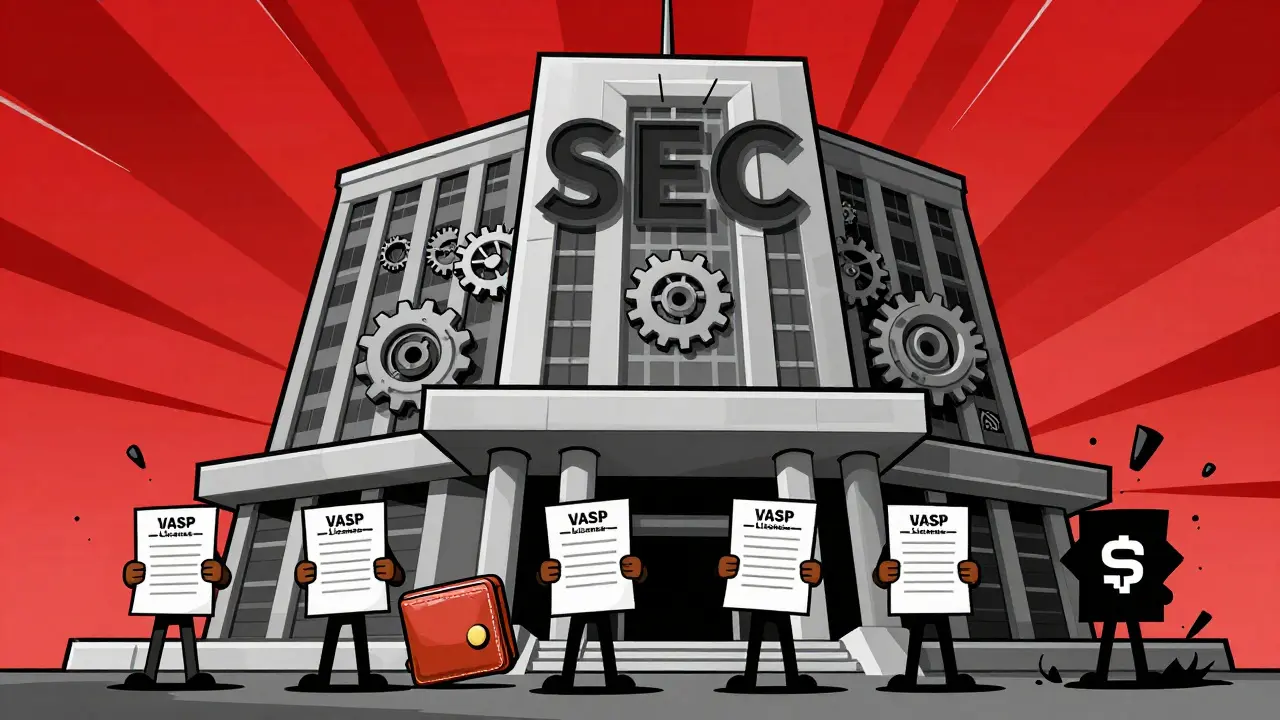
Before 2025, running a crypto business in Nigeria was like driving without a license - technically illegal, but nobody was stopping you. Now, if you’re operating a cryptocurrency exchange, wallet service, staking platform, or even doing airdrops in Nigeria, you must have a VASP license from the Securities and Exchange Commission (SEC). There’s no gray area anymore. The Investments and Securities Act 2025 made it clear: virtual assets are securities, and anyone handling them is now a regulated financial institution.
What Exactly Is a VASP?
A Virtual Asset Service Provider (VASP) is any company that offers services involving digital assets. That includes buying, selling, or trading cryptocurrencies like Bitcoin and Ethereum. But it’s more than just exchanges. VASPs also cover:
- Digital wallet providers (custodial and non-custodial)
- Staking services where users earn rewards by locking up crypto
- Token issuance platforms (like ICOs or STOs)
- Crypto payment processors for merchants
- Mining operations with commercial scale
- Airdrop distribution platforms
If your business touches any of these, you’re a VASP under Nigerian law. And if you’re operating without a license? You’re breaking the law. The SEC has been actively shutting down unregistered platforms since late 2025.
Minimum Capital Requirement: N500 Million
This is the biggest hurdle for most startups. To even apply for a VASP license, you need N500,000,000 (about $325,000 USD) in paid-up capital. This isn’t a loan or a line of credit - it must be actual cash or assets fully owned by the company, verified by an auditor.
Why so high? The SEC wants to filter out fly-by-night operators. They’ve seen too many crypto firms disappear overnight after collecting user funds. This capital buffer ensures that even if things go wrong, the company can cover losses, refunds, or regulatory fines. For context, this requirement is higher than what’s needed in many EU countries and matches the financial stability standards of major financial hubs.
Small businesses or solo operators? Forget it. This rule alone eliminates 90% of informal crypto ventures. It’s not meant for hobbyists. It’s for institutions.
Corporate Structure and Physical Presence
You can’t register a VASP from a garage in Lagos or a co-working space in Abuja. The SEC requires:
- Legal incorporation with the Corporate Affairs Commission (CAC)
- A physical office in Nigeria - not a PO box, not a virtual address
- A director or managing officer who is a Nigerian resident
This means international crypto firms can’t just set up a website and serve Nigerian users. They must establish a local legal entity, hire a local director, and open a physical office. The SEC wants someone they can hold accountable - face to face.
Many foreign companies are partnering with Nigerian fintech firms or hiring local executives to meet this requirement. It’s not just a formality - it’s a strategic shift. Nigeria is building a domestic crypto industry, not just regulating foreign ones.
Documentation You Must Submit
The paperwork is intense. Here’s what you need to send to the SEC:
- Certificate of Incorporation from CAC
- Memorandum and Articles of Association (MEMART)
- Latest audited financial statements (or audited statements of affairs for new companies)
- Proof of physical office lease or ownership
- Details of all directors and key personnel (including CVs and background checks)
- A detailed business model explaining how your service works
- Full KYC and AML procedures - including how you verify identities and monitor transactions
- Technical infrastructure specs: cybersecurity systems, data encryption, backup protocols
- Internal rules covering investor protection, conflict of interest, and dispute resolution
- Sworn undertakings signed by directors committing to comply with SEC rules
Missing one document? Your application gets rejected. No second chances. The SEC doesn’t play around.

Two Paths to Licensing: Standard vs. ARIP
The SEC offers two ways to get licensed:
1. Standard Registration
This is the full route. You submit everything, wait 6-12 months for review, and if approved, you get your license. It’s slow, expensive, and requires full compliance from day one.
2. Accelerated Regulatory Incubation Program (ARIP)
This is the smarter option for startups. ARIP lets you start operating under SEC supervision before you’ve completed every requirement. Here’s how it works:
- Submit an initial application with your corporate docs and business plan
- Receive preliminary approval in principle
- Begin operations under SEC oversight - you can accept users and process transactions
- Submit quarterly progress reports
- At the 10-month mark, the SEC reviews your progress and gives feedback
- At 12 months, you either complete full registration or shut down
ARIP is designed for companies that are serious but still building their systems. It’s a sandbox with teeth. If you’re not making real progress, you’re out. But if you’re moving fast and following the rules? You can launch faster and avoid the long wait.
Compliance: KYC, AML, and Record Keeping
Once licensed, you’re not done. You’re now under constant watch. The SEC and Central Bank of Nigeria (CBN) require strict compliance with:
- Know Your Customer (KYC): You must verify every user’s identity using government-issued IDs, facial recognition, and live video checks. No exceptions.
- Anti-Money Laundering (AML): All transactions are monitored. Any unusual activity - large transfers, rapid deposits and withdrawals, or connections to blacklisted wallets - must be reported within 24 hours.
- Record Retention: You must keep all customer data, transaction logs, and communication records for seven years. That’s longer than most banks.
- Tax Compliance: You must register with the Federal Inland Revenue Service (FIRS) and report crypto income as taxable.
Failure to report suspicious activity? Fines up to N50 million. Repeated violations? License revoked. The SEC doesn’t just want compliance - they want proof of it.
Technology Requirements: Security Is Non-Negotiable
The SEC doesn’t just care about your paperwork. They care about your servers.
You must have:
- Multi-factor authentication for all staff and user accounts
- End-to-end encryption for data at rest and in transit
- Regular penetration testing by accredited cybersecurity firms
- Cold storage for 95% of customer crypto assets
- Disaster recovery plans with backup data centers
- System logs that can’t be altered
One licensed VASP lost its license in late 2025 after a hacker stole $12 million because they were using outdated software. The SEC said: “You didn’t meet the minimum security standard.” No appeal.

Why This Matters: The Bigger Picture
Nigeria isn’t trying to kill crypto. They’re trying to tame it.
Before 2025, the Central Bank banned banks from serving crypto firms. That forced users into risky peer-to-peer deals. Now, licensed VASPs can open bank accounts, access payment rails, and operate like real businesses. This has already brought in over $2 billion in new investment into Nigerian crypto firms.
But it’s not easy. The compliance costs are high. A mid-sized exchange now spends over $1.2 million a year just on compliance, security, and legal fees. Those costs are being passed to users - transaction fees are up 30% since licensing began.
Still, the benefits are real. Licensed platforms now have trust. Users feel safer. Investors are stepping in. And the government? They’re collecting taxes from a sector that was once invisible.
What Happens If You Don’t Get Licensed?
Unlicensed VASPs are being shut down. Bank accounts are frozen. Domains are seized. Executives are being investigated.
One major peer-to-peer platform, which had 800,000 users, was raided in January 2026. Their CEO was arrested for operating without a license. The SEC didn’t give a warning. They didn’t ask nicely. They acted.
If you’re still operating without a license, you’re playing Russian roulette with your business - and your freedom.
Final Thoughts
VASP licensing in Nigeria isn’t a hurdle. It’s a gate. And the gate is wide open - if you’re ready to play by the rules.
The requirements are tough. The paperwork is heavy. The costs are high. But the reward? Legitimacy. Access. Growth. And the chance to be part of Africa’s most advanced crypto regulatory system.
If you’re serious about building a crypto business in Nigeria, don’t try to bypass the system. Join it. Prepare. Invest. Comply. And get licensed - before it’s too late.
Can a foreign company get a VASP license in Nigeria without a local partner?
No. Foreign companies must incorporate a legal entity in Nigeria with a Nigerian resident director and a physical office. You cannot operate remotely. Most international firms partner with local fintech companies or hire Nigerian executives to meet these requirements.
Is the N500 million capital requirement flexible for startups?
No. The N500 million paid-up capital is non-negotiable. Even under the Accelerated Regulatory Incubation Program (ARIP), you must still meet this requirement before receiving preliminary approval. The SEC views this as a filter for serious operators with real financial backing.
How long does the VASP licensing process take?
Under the standard process, it takes 6 to 12 months. Under the ARIP program, you can begin operating in 2-3 months, but full licensing still takes up to 12 months. The timeline depends on how complete your documentation is and how quickly you respond to SEC requests.
What happens if my VASP license is revoked?
If your license is revoked, you must immediately cease all virtual asset activities. You are required to return customer funds within 30 days. Failure to do so can lead to criminal charges. Your directors may be barred from holding future positions in regulated entities. The SEC publishes revoked licenses publicly.
Do I need separate approvals from the Central Bank of Nigeria (CBN)?
You don’t need a separate license from the CBN, but you must comply with their AML/CFT guidelines. The SEC coordinates with the CBN and FIRS. If you violate CBN rules - like failing to report suspicious transactions - the SEC can suspend or revoke your license.
Comments
Jessica Beadle
Let’s cut through the noise: the N500M capital requirement isn’t regulatory diligence-it’s a barrier to entry designed to protect incumbents. The SEC is effectively corporatizing crypto by forcing startups into a financial straitjacket. This isn’t about investor protection; it’s about consolidating power under a handful of well-funded entities with legal teams that can navigate the labyrinth. Meanwhile, legitimate DeFi protocols and peer-to-peer liquidity providers are being criminalized for lack of balance sheet depth. The irony? The same regulators who claim to champion innovation demand you come in with a Fortune 500 balance sheet. That’s not regulation. That’s rent-seeking dressed as compliance.
March 19, 2026 at 23:05
Brenda White
soo like if u dont have 500 mil u cant even try? lol. i thought crypto was about disintermediation. now its just another bank with more paperwork. the sec is just scared of ppl making money without them. also why do u need a physical office? my whole biz runs on a laptop and a vpn. they want to control the address not the tech. dumb.
March 21, 2026 at 08:39
Tobias Wriedt
Finally! Someone in Africa is getting serious about crypto! 🙌 This is exactly what the industry needs-real accountability, real security, real consequences. Too many people treat crypto like a casino and then cry when they lose. Now, if you’re serious, you show up, you play by the rules, and you build something that lasts. No more sketchy wallets, no more rug pulls, no more ‘I didn’t know’ excuses. This is how you build trust. This is how you earn legitimacy. Kudos to Nigeria for having the guts to lead. 🇳🇬💪
March 21, 2026 at 22:27
Ernestine La Baronne Orange
Oh, I’m so tired of this. The SEC says ‘N500 million’-fine. But then they demand a physical office? In Lagos? In 2026? Who’s going to pay rent for that? Who’s going to pay the electric bill? Who’s going to pay the security guard who might just be a ghost? And don’t get me started on the ‘seven-year retention’-do they think we have warehouses full of paper? And the ‘sworn undertakings’? Please. I’ve seen more legally binding promises on a TikTok influencer’s ‘I’ll send you 10% if you send me 1 BTC’ than I have in actual Nigerian regulatory filings. This isn’t regulation-it’s a performance. A spectacle. A tax on ambition. And the worst part? It’s all so theatrically, painfully, hilariously bureaucratic. I’m not even mad. I’m just… exhausted.
March 23, 2026 at 05:26
Manali Sovani
It is commendable that the Nigerian Securities and Exchange Commission has taken a structured and formal approach to the regulation of virtual asset service providers. The requirement for paid-up capital, physical presence, and comprehensive documentation reflects a mature regulatory framework that aligns with international best practices. While the thresholds may appear stringent, they are necessary to ensure systemic stability and to prevent the recurrence of financial irregularities observed in unregulated markets. The emphasis on KYC, AML, and cybersecurity protocols is particularly prudent, given the global rise in digital asset-related fraud. This model may serve as a template for other emerging economies seeking to integrate digital finance within a lawful and transparent ecosystem.
March 23, 2026 at 17:31
Sarah Hammon
I get the need for oversight, but the N500M requirement is a brick wall for anyone who isn’t already wealthy. I’ve seen so many African crypto founders with brilliant ideas get crushed under this weight. What about the guy in Port Harcourt who built a wallet for farmers to get paid in crypto? He’s not a bank-he’s a lifeline. ARIP is a good start, but if you still need the capital upfront to even apply… it’s not really an alternative. Maybe a tiered system? Micro-VASPs? Community-backed licenses? The SEC is trying to build a skyscraper, but we’re still laying the foundation. Let’s not forget who we’re supposed to be serving.
March 23, 2026 at 18:21
iam jacob
so like… i’m just saying… if you’re gonna make us get a license, at least let us do it from our moms’ basement. why do we need a physical office? i run my whole operation outta my bedroom. i have a printer. i have a chair. i have a cat. that’s my office. they want to ‘hold someone accountable’? cool. i’m right here. i’m not hiding. but i’m also not paying 10k/month for rent in Abuja just so i can ‘look legit’. this isn’t compliance. this is performance art.
March 25, 2026 at 07:24
Jesse Pals
Look, I’ve been in fintech for a decade and this is one of the most balanced regulatory frameworks I’ve seen. The SEC isn’t trying to kill crypto-they’re trying to make it grow up. The capital requirement? Yeah, it’s steep, but it weeds out the grifters. The physical office? It means someone’s actually home when the regulator knocks. The 95% cold storage? That’s not optional-it’s common sense. And ARIP? Genius. It’s not a loophole-it’s a runway. If you’re building something real, this gives you room to breathe. If you’re just here to flip tokens and vanish? Then yeah, you’re gonna get crushed. And honestly? Good. Let the market decide who deserves to stay.
March 26, 2026 at 22:30
Diane Overwise
Oh, Nigeria. You’ve done it again. You’ve taken the wild west of crypto and turned it into… a corporate boardroom with Wi-Fi. Who knew the future of African finance would be… a 12-month application form? I’m genuinely impressed. The fact that you’ve managed to make blockchain feel like tax season is a kind of dark art. And yet-somehow-it’s working. Users are safer. Investors are stepping in. Even the SEC’s ‘sworn undertakings’ have a certain… poetry. Like a medieval knight signing his oath in blood. Except here, it’s ink. And notarization. And seven years of digital records. I don’t know whether to applaud or cry. But I’m definitely watching.
March 27, 2026 at 07:22
Ann Liu
One critical oversight in the post: the requirement for audited financial statements applies only to companies with existing operations. For new entities, the SEC accepts audited statements of affairs, which are based on projected capital and liabilities-not historical performance. This distinction is often misunderstood. Additionally, the SEC explicitly permits the use of third-party custody providers for cold storage, as long as they’re licensed and audited under the same framework. This reduces the burden on startups that can’t afford to build their own infrastructure. The regulatory architecture is more nuanced than it appears.
March 28, 2026 at 03:41