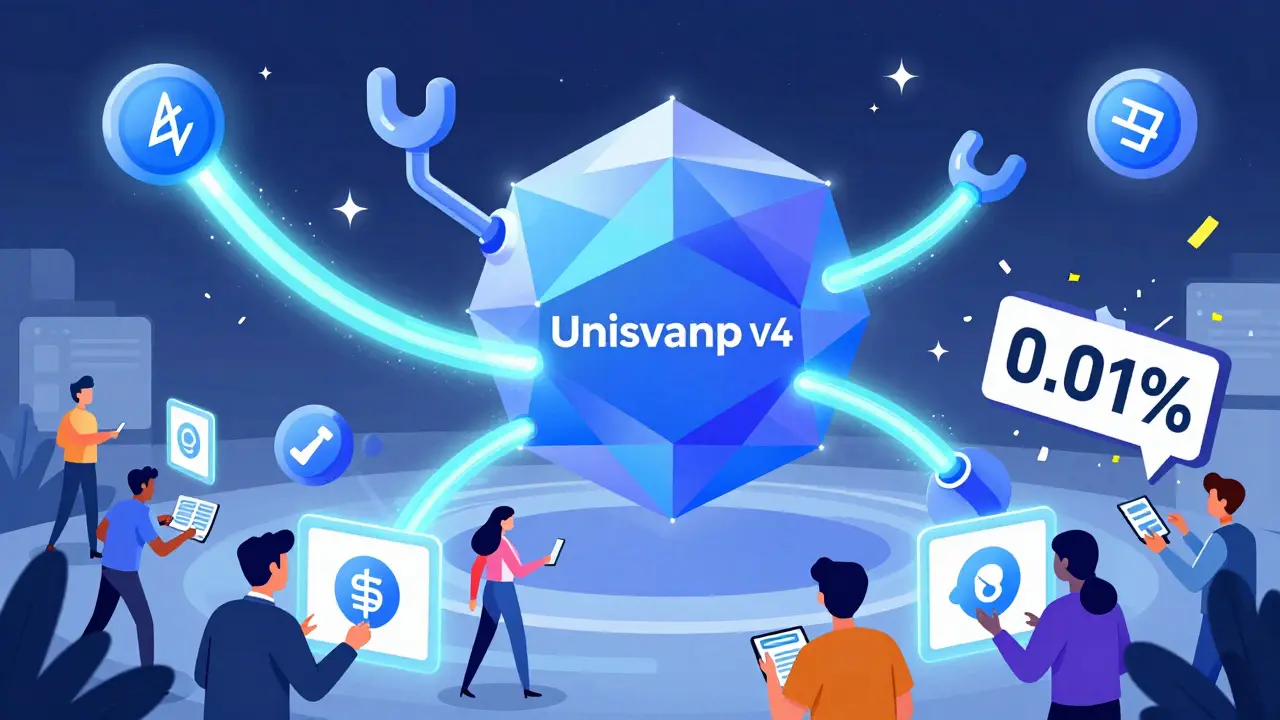
Uniswap v4 on Polygon isn’t just another upgrade-it’s a game-changer for anyone trading crypto on a budget. If you’ve ever paid $5 in gas fees to swap a few tokens on Ethereum, you already know why this matters. On Polygon, Uniswap v4 slashes costs by nearly 100%, makes trades faster than ever, and lets developers build custom trading pools that adapt to real market conditions. This isn’t theory. It’s live, used, and actively reshaping how people trade crypto in 2026.
What Makes Uniswap v4 Different?
Uniswap v4 doesn’t just improve on v3-it rebuilds the foundation. Before v4, every new liquidity pool required its own smart contract. That meant high deployment costs, slow setup, and wasted gas. Now, with the Singleton architecture, every pool runs inside one contract. This cuts deployment fees by 99.99%. For example, creating a new ETH-USDC pool used to cost over $500 in gas on Ethereum. Today, on Polygon, it’s under $0.10.
The real breakthrough? Hooks. These are modular plugins that let developers inject custom logic directly into liquidity pools. Think of them like apps for your trading pool. Need dynamic fees that rise when volatility spikes? There’s a hook for that. Want automated liquidity rebalancing? Another hook. Over 150 hooks are already live, and new ones pop up daily. This turns Uniswap from a static exchange into a living DeFi platform where pools can behave differently based on market needs.
Why Polygon Is the Perfect Match
Polygon isn’t just another Layer 2-it’s the ideal home for Uniswap v4. While Ethereum’s gas fees can hit $10-$50 per trade, Polygon averages less than $0.01. Transactions confirm in under 2 seconds. For traders who swap daily, that’s not a convenience-it’s a profit margin. A liquidity provider who deposits $10,000 into a pool on Ethereum might lose $300 a year just in gas. On Polygon? That drops to $0.30.
Uniswap v4 on Polygon also supports native ETH and MATIC trading without wrapped token friction. You don’t need to convert ETH to WETH anymore. The protocol handles it automatically. This reduces complexity and lowers the risk of mistakes. For new users, this matters. One wrong token approval can drain your wallet. Simplicity is security.
Fee Flexibility You Won’t Find Anywhere Else
Uniswap v3 fixed fees at 0.01%, 0.05%, or 1%. v4 throws that out. Fees can now range from 0% to 100%. Pool creators decide. A stablecoin pair like USDC-USDT might run at 0.01%. A new meme coin? Maybe 5% or even 10% to filter out noise and reward early liquidity providers. This isn’t just flexibility-it’s economic intelligence.
And here’s the kicker: Uniswap Labs charges 0% interface fee on its official site. You only pay the protocol fee (set by the pool creator) and Polygon’s gas. No hidden cut. No middleman. Compare that to centralized exchanges that take 0.1-0.5% per trade. On Uniswap v4, you’re paying less and getting more control.
How Trading Works on Uniswap v4 (Polygon)
Here’s what actually happens when you swap:
- Connect your wallet (MetaMask, Trust Wallet, etc.) and switch to Polygon network.
- Go to app.uniswap.org-the official interface.
- Choose your token pair. If it’s not listed, the router will auto-find the best path through USDC, ETH, or other bridges.
- Click swap. The system checks all v2, v3, and v4 pools across Polygon and other chains to find the lowest slippage.
- Confirm the transaction. It takes 1-3 seconds. You’re done.
For example, swapping 100 DAI for 0.05 WETH might seem direct. But if liquidity is thin, the router splits it: DAI → USDC → ETH → WETH. You still get the best price. You don’t even notice the hops.

Liquidity Provision: Smarter, Cheaper, Faster
If you’re providing liquidity, v4 changes everything. You no longer have to lock capital across wide price ranges. With concentrated liquidity, you set a narrow band-say, between $1,800 and $2,000 for ETH. Your capital works harder. You earn more fees per dollar deposited.
On Polygon, deploying liquidity takes seconds. You don’t wait hours for confirmation. You don’t pay $20 to get started. And with hooks, you can build automated strategies: auto-reinvest fees, adjust ranges based on volatility, or pause liquidity during black swan events. This used to require coding. Now, it’s a toggle.
Security: Audits, Bounties, and Proven Track Record
Uniswap v4 didn’t just launch. It was stress-tested. Nine independent audits were completed. OpenZeppelin, Spearbit, and ABDK Consulting all signed off. Then came the $15.5 million bug bounty-the largest ever for a DeFi protocol. No hacks on v2 or v3 in over $2.75 trillion traded. That’s not luck. It’s engineering.
Polygon’s own security record is clean. No major breaches. No frozen funds. The combination of Uniswap’s code and Polygon’s network creates one of the most secure DEX environments today.
UniswapX: Reducing MEV and Front-Running
On traditional DEXs, your trade sits in a public mempool. Bots scan it, front-run you, and steal profits. This is called MEV (Maximal Extractable Value). Uniswap v4 on Polygon integrates UniswapX, which routes trades off-chain. Your intent is matched privately. Bots can’t see it. You get better prices. Slippage drops. This is especially helpful for small traders who can’t afford to lose 1-2% to sandwich attacks.

Who Is This For? Who Should Skip It?
Best for:
- Traders who swap daily-gas savings add up fast.
- Liquidity providers wanting to maximize capital efficiency.
- DeFi users who want exposure to multiple chains without switching platforms.
- Developers building custom DeFi tools-hooks open endless possibilities.
Not for:
- People who want customer support. No one calls you back. No refunds.
- Those who don’t manage their own keys. If you lose your seed phrase, your funds are gone.
- Users who avoid self-custody. This isn’t Coinbase. It’s direct blockchain access.
How to Get Started (Step-by-Step)
- Install MetaMask or another wallet that supports Polygon.
- Add the Polygon network manually if it’s not already there (RPC: https://polygon-rpc.com).
- Buy a small amount of MATIC to cover gas (less than $1).
- Go to app.uniswap.org and connect your wallet.
- Swap your first token. Try ETH for USDC or DAI for WMATIC.
- Try adding liquidity to a pool. Pick a pair, set your price range, and deposit.
Within 5 minutes, you’re trading like a pro on one of the cheapest, fastest DEXs on the planet.
What’s Next for Uniswap v4 on Polygon?
Hook development is accelerating. New pool types are emerging: time-weighted liquidity, fee-capped pools, and even NFT-backed collateral pools. Cross-chain bridges are improving, letting you swap from Polygon to Arbitrum or Base without leaving the interface. By late 2026, Uniswap v4 on Polygon could handle over 40% of all DeFi spot volume on Layer 2s.
The trend is clear: cost efficiency + customization = dominance. Uniswap v4 isn’t just the best DEX on Polygon. It’s becoming the backbone of decentralized trading.
Is Uniswap v4 on Polygon safe?
Yes, but only if you manage your own security. Uniswap v4 has undergone nine audits and has a $15.5 million bug bounty. Polygon has no major hacks. However, you’re responsible for protecting your wallet. Never share your seed phrase. Double-check token contracts before swapping. Avoid phishing sites. There’s no customer support-once you send funds, they’re gone if you make a mistake.
How much does it cost to trade on Uniswap v4 on Polygon?
You pay two things: the protocol fee (set by the pool-usually 0.01% to 1%) and Polygon gas (typically $0.005-$0.02 per transaction). Uniswap Labs charges 0% interface fee. For comparison, a single trade on Ethereum Mainnet might cost $5-$15. On Polygon, you’re paying 99% less.
Can I use Uniswap v4 on Polygon with my phone?
Yes. The Uniswap interface works in mobile browsers like Chrome or Safari. You’ll need a mobile wallet like MetaMask or Trust Wallet. Switching networks can be clunky at first, but once set up, swapping and providing liquidity takes under 30 seconds. Most users do this daily without issues.
Do I need to convert ETH to WETH on Polygon?
No. Uniswap v4 on Polygon handles native ETH automatically. You can deposit ETH directly into a pool. The protocol converts it internally to WETH if needed. This reduces steps and lowers the chance of errors. You still see ETH as ETH in your wallet.
What’s the difference between Uniswap v3 and v4 on Polygon?
v3 uses separate contracts per pool, which is expensive and inflexible. v4 uses one contract (Singleton) and supports hooks-custom logic you can plug in. v4 allows dynamic fees (0-100%), better multi-hop routing, and automated liquidity strategies. On Polygon, v4 is cheaper, faster, and more powerful. If you’re using v3 today, upgrading to v4 is a no-brainer.
Comments
Beth Trittschuh
i just swapped some dai for weth and honestly? 🤯 like... it was faster than loading my instagram feed. and the fee? $0.01. i cried a little. this is what web3 was supposed to be. no more choosing between 'i want to trade' and 'i can afford to trade'. thank you, uniswap v4 on polygon. you saved my portfolio sanity.
February 14, 2026 at 14:46
Benjamin Andrew
While the cost efficiency is statistically compelling, one must interrogate the underlying assumption that decentralization is inherently superior to centralized liquidity provision. The removal of intermediary fees does not equate to increased market integrity. In fact, the proliferation of hooks introduces an unregulated vector for algorithmic manipulation. The 0-100% fee structure, while theoretically flexible, is a regulatory nightmare. This is not innovation-it is fragmentation with a veneer of progress.
February 15, 2026 at 12:24
Donna Patters
Honestly? It’s adorable how people think this is ‘democratizing finance.’ You’re still trading on a blockchain. You still need a wallet. You still need to know what a smart contract is. This isn’t for the masses. It’s for the 0.1% who can read a JSON RPC endpoint. And yet somehow, everyone’s acting like this is the new Facebook. Please.
February 16, 2026 at 19:17
Michelle Cochran
i’ve been watching this space for years. and honestly? this feels like the first time the tech actually serves the people. not the devs. not the whales. the people. the fact that you can set a 0.01% fee on usdc-usdt and not get rug-pulled by some greedy dev? that’s not just engineering. that’s ethics. and if you’re still using centralized exchanges? you’re not trading crypto. you’re just renting a casino.
February 16, 2026 at 22:49
Peggi shabaaz
i started with just $5 and swapped matic for dai. didn’t even know what a hook was. just clicked swap. it worked. i didn’t lose anything. i didn’t have to read 10 blog posts. it just… worked. and now i’m hooked. literally. like, i check the app every morning like it’s my coffee. it’s quiet. it’s simple. it’s mine. thanks for making this feel human.
February 18, 2026 at 04:24
Kaz Selbie
you say it’s cheap? cool. i tried it. got front-ran by a bot because i didn’t use uniswapx. turned a 0.5% gain into a 2% loss. so yeah. ‘cheap’ doesn’t mean ‘safe’. if you’re not using the off-chain routing, you’re basically throwing money into a blender. and yes, i’m still mad.
February 18, 2026 at 15:45
Robbi Hess
i read the whole thing. then i closed the tab. too much tech. too many buzzwords. too many ‘hooks’ and ‘singletons’ and ‘economic intelligence.’ just tell me if i can swap eth for usdc without losing half my balance to gas. because i don’t care about your ‘living platform.’ i care about my wallet.
February 20, 2026 at 11:04
Keturah Hudson
i’m from nigeria. i use this every day. my sister sends me naira for groceries. i convert to matic. i swap to usdc. i send it to my wallet. i withdraw to my local bank. no bank fees. no delays. no ‘we’re processing.’ this isn’t crypto. this is survival. and honestly? it’s beautiful.
February 20, 2026 at 15:20