
Imagine trying to fit a thousand people through a single revolving door at the same time. That is exactly what happens when millions of users try to send transactions on a main blockchain network. The result? Massive traffic jams and fees that make a simple transfer feel like a luxury purchase. This is where rollup technology is a Layer-2 scaling solution that batches multiple transactions off-chain and submits a single summary to the main blockchain comes in. By moving the heavy lifting away from the main network, we can finally stop paying exorbitant fees for basic tasks.
The Core Logic: How Rollups Actually Work
To understand where this tech is going, we need to look at how it functions today. Most blockchains suffer from a data bottleneck; they can only store a tiny amount of information per block. Rollups solve this by splitting the process into two parts: off-chain aggregation and on-chain verification.
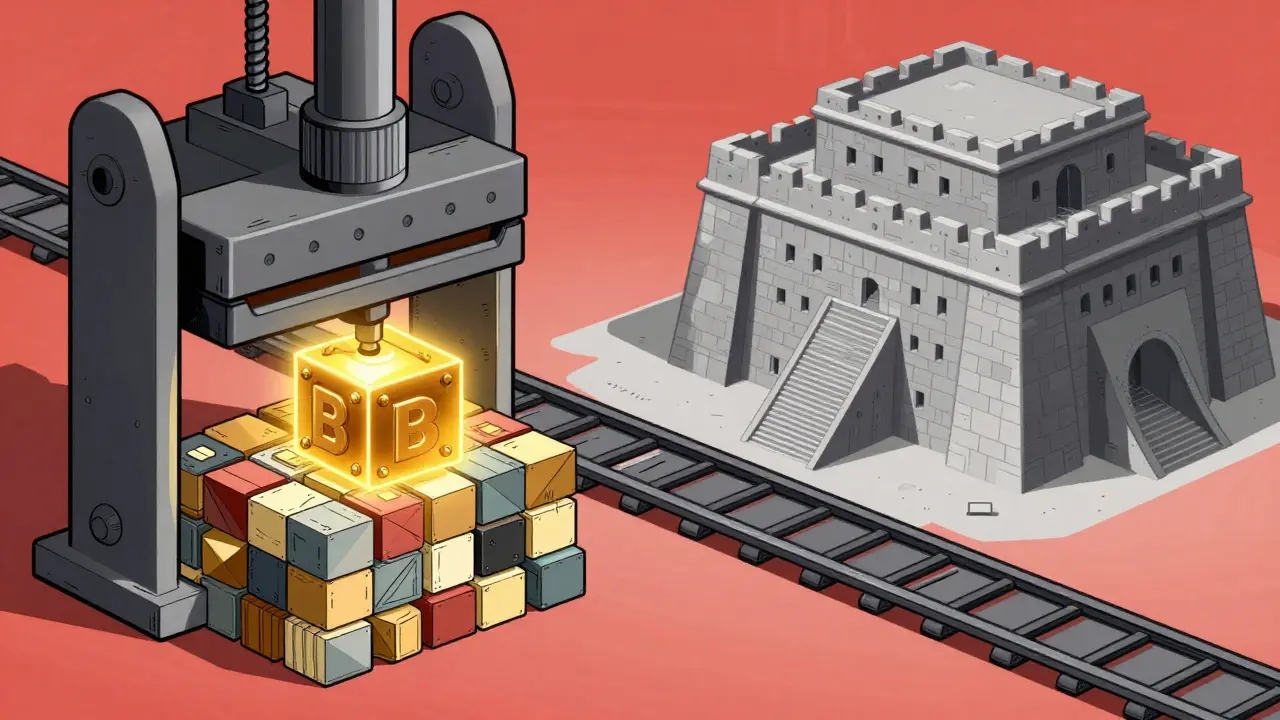
First, a rollup operator collects a bundle of transactions. Instead of sending each one to the mainnet, they process them on a separate, high-speed chain. Once the state changes are calculated, the operator compresses this data into a compact proof. This proof is then sent back to the Layer-1 (L1) chain. The L1 doesn't need to re-run every single transaction; it just verifies the proof and updates the balance. Think of it like a company submitting one summarized expense report to an accountant instead of a thousand individual receipts.
The Great Divide: Optimistic vs. Zero-Knowledge
Right now, the world of rollups is split into two main philosophies. Each handles trust and security differently, which dictates how they will evolve in the coming years.
Optimistic Rollups are based on a "guilty until proven innocent" logic-or rather, "innocent until proven guilty." They assume all transactions are valid by default. This makes them incredibly fast to execute. However, they require a dispute period where other users can challenge a transaction using fraud proofs. If someone proves a transaction was fake, the operator is penalized. The trade-off here is the delay in finality; you often have to wait a few days to withdraw funds back to the mainnet.
On the flip side, ZK-rollups (Zero-Knowledge Rollups) use complex math called zero-knowledge proofs to prove validity instantly. They don't guess; they provide a cryptographic certainty that the transaction is correct. This means there is no waiting period for withdrawals. While they are more computationally expensive to generate, they offer superior privacy and efficiency because they send even less data to the main chain.
| Feature | Optimistic Rollups | ZK-Rollups |
|---|---|---|
| Verification Method | Fraud Proofs (Assumption of validity) | Validity Proofs (Math-based) |
| Withdrawal Speed | Slow (Challenge period) | Fast (Instant verification) |
| Computational Cost | Low | High |
| Data Efficiency | Moderate | Very High |
Why This Matters for the Average User
If you have ever tried to move a small amount of crypto and realized the gas fee is 20% of your total value, you have experienced the scalability problem. Rollups change the math. In a traditional on-chain transfer, every single user pays the full cost of the network's attention. With rollups, users share the cost of the single on-chain transaction.
For example, a standard Bitcoin on-chain transfer might cost 5,000 satoshis. By using a rollup, that cost can plummet to just 50 satoshis. This shift transforms blockchain from a place where only whales operate into a viable system for micropayments. Imagine paying a few cents for a single news article or tipping a creator a fraction of a penny-things that are currently impossible on Layer-1 networks due to costs.
Expanding Beyond Ethereum
While Ethereum has been the primary laboratory for these solutions, the future of rollup technology is expanding. We are seeing a massive surge in Bitcoin-based scaling. While Bitcoin was originally designed just to move money, the introduction of rollups allows it to support more complex decentralized applications (dApps) and smart contracts without bloating the original chain.
The Lightning Network is a primary example of this evolution, acting as a payment channel that behaves similarly to a rollup by bundling transactions. As these tools mature, we will likely see a "multi-chain" world where the main blockchain acts as a secure vault (the settlement layer), while rollups act as the high-speed highways where the actual daily activity happens.

What is Next? The Road to Seamless Scaling
The next few years will likely focus on removing the "friction" of Layer-2. Right now, users often have to manually bridge their assets from the main chain to the rollup, which is a clunky and sometimes scary process. The future is abstracted scaling. This means the user won't even know they are using a rollup; the wallet will handle the routing in the background.
We can also expect the convergence of the two rollup types. "Hybrid rollups" are already being discussed, combining the speed and ease of Optimistic systems with the security and fast finality of ZK-proofs. Additionally, as hardware for generating ZK-proofs (like ASICs) becomes more common, the high computational cost of ZK-rollups will disappear, making them the gold standard for all scaling.
Do rollups compromise the security of the main blockchain?
No, that is the primary advantage of rollups over "sidechains." While a sidechain has its own security rules, rollups inherit the security of the Layer-1 network. Because the final proof is posted to the main chain, the L1 remains the ultimate source of truth and security.
Why are withdrawals slower in Optimistic Rollups?
Optimistic rollups assume transactions are valid to save time. To prevent fraud, there is a mandatory "challenge period" (usually 7 days) during which anyone can submit a proof that a transaction was invalid. This window ensures the network remains honest before funds are released.
Can ZK-rollups handle any kind of smart contract?
Historically, ZK-rollups struggled with complex smart contracts due to the difficulty of creating proofs for non-deterministic code. However, the rise of zkEVMs (Zero-Knowledge Ethereum Virtual Machines) allows them to support the same complex applications that run on Ethereum.
What is the difference between a rollup and a sidechain?
A sidechain is a completely separate blockchain with its own consensus mechanism. If the sidechain's validators collude, your funds are at risk. A rollup, however, posts its transaction data or proofs to the main chain, meaning the main chain's security protects the rollup's users.
Will rollups eventually replace the main chain?
Not replace, but re-position. The main chain (Layer-1) will shift from being a place where everyone transacts to being a "Settlement Layer." It will act as the ultimate judge and secure record-keeper, while rollups handle 99% of the actual traffic.
Next Steps for Users and Developers
If you are a user, start by exploring Layer-2 ecosystems. Instead of interacting directly with the mainnet, look for networks that utilize ZK or Optimistic technology to save on fees. For developers, the focus should shift toward "cross-rollup communication." As the ecosystem fragments into many different rollups, the ability to move data and assets between them seamlessly will be the biggest competitive advantage.
Keep an eye on the development of proof-generation hardware. Just as GPUs revolutionized AI, specialized chips for zero-knowledge proofs will likely trigger the next massive wave of blockchain adoption by making the "invisible' scaling of rollups a reality for everyone.
Comments
Robert Smith
Finally some cheap gas 🚀✨
April 30, 2026 at 22:11
Lex Harley
The l2 transition is wild but the bridgeing ux is still totaly mid. Honestly if we dont get better account absraction soon the on-ramping is gonna be a nightmare for the next billion users. we need a way to hide the gas fee logic entirely or just use paymasters to handle it for the end user so they dont even see the eth mainnet interacton. its crazy that we still have to manually bridge funds when we're talking about mass adoption. the liquidity fragmentation across different rollups is also a huge red flag for defi efficiency. we need a unified liquidity layer or some sort of cross-chain interoperability protocol that doesnt rely on risky third party bridges. otherwise we're just trading one bottleneck for a hundred smaller ones. plus the data availability problem is still looming over our heads. if we can't ensure that the data is actually available for everyone to reconstruct the state then the whole security promise of rollups is basically a lie. we need a robust DA layer like Celestia or Avail to actually scale this thing properly. the technical debt is piling up and most people just see the shiny low fees without realizing the fragility of the current setup. basically we are building a skyscraper on a foundation of sand until we solve the interop and DA issues. its a bold move but the execution is still very clunky.
May 2, 2026 at 14:06
Lloyd I
That is a great point about the user experience! We can definitely work together as a community to push for better abstraction. Let's keep the energy high and support the devs making this happen!
May 2, 2026 at 18:29
Felix Eduardo Velasquez
The conceptual shift from L1 as an execution environment to a settlement layer is the most critical part of this evolution. It reflects a broader pattern in computer science where the core layer provides security and consensus while the periphery handles the high-throughput operations. We must consider the philosophical implication of trust: we are essentially moving from a world of global trust to a world of modular trust.
May 3, 2026 at 19:51
Bevon Findley
Quite an elementary breakdown. :)
May 5, 2026 at 09:07
Emily A
The comparison table is helpful, but it fails to mention the critical nuances of the prover's role in ZK-rollups. Specifically, the computational overhead is not just "high," but exponentially dependent on the complexity of the circuit being proven. It is a common mistake for novices to ignore the prover's centralization risk.
May 7, 2026 at 06:48
Kristi Swartz
People only care about the money but they ignore the ethics of centralization in these operators it is just wrong and we should focus on true decentralization instead of just speed
May 7, 2026 at 15:49
Arti Jain
India will lead the ZK-tech revolution. US is too slow.
May 9, 2026 at 01:06
VIVEK SINGH
Oh look, another "revolution" in the making. I'm sure the "next billion users" will be absolutely thrilled to wait seven days to get their money back from an Optimistic rollup while the operators play games with their funds. Truly a masterpiece of efficiency.
May 10, 2026 at 00:12
Veronica Bago
Everything sounds so complicated but the low fees part is a win for everyone.
May 11, 2026 at 13:05
Lex Harley
exactly why we need zk-rollups to go mainstreem so the wait times vanish
May 13, 2026 at 09:09