
Imagine waking up to find your portfolio down 20% because of a sudden market swing while you were asleep. It's a nightmare for any trader, but in the world of blockchain and high-volatility assets, it's a common Tuesday. The difference between those who survive these crashes and those who wipe out usually comes down to one thing: a disciplined stop-loss strategy. This isn't about predicting the future; it's about deciding exactly how much you're willing to lose before you get out of the way.
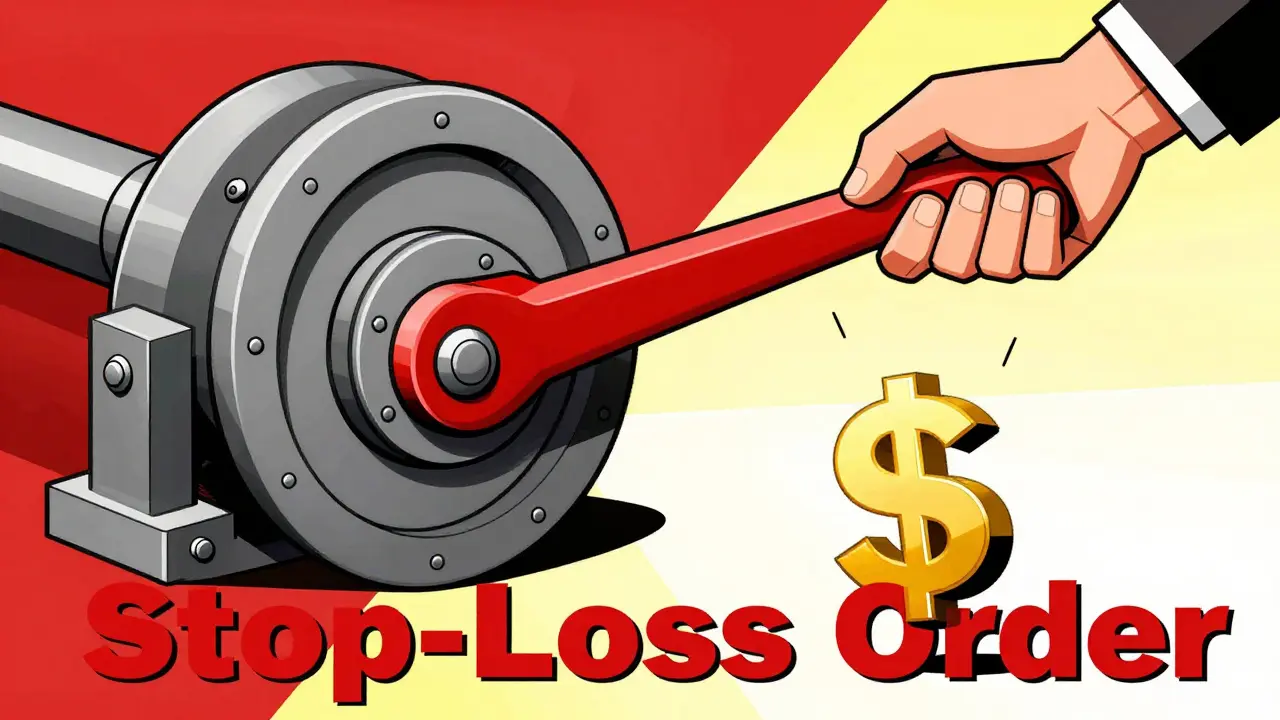
A Stop-Loss Order is a predetermined exit point that automatically triggers a sell order when an asset hits a specific price. Think of it as an emergency brake for your investments. During the March 2020 crash, data from Vanguard showed that traders with these protections limited their losses to around 15-20%, while those flying blind lost 30-40%. That is the difference between a bad month and a ruined year.
The Mechanics of the Exit: How it Actually Works
When you set a stop-loss, you're giving your broker a conditional instruction. Once the market price hits your "stop price," the order converts into an active market order. However, there is a catch that every trader needs to understand: Slippage. Slippage occurs when the execution price differs from the trigger price due to high volatility or low liquidity. In a flash crash, your stop might be at $100, but if the price gaps down instantly to $90, you'll be filled at $90. FINRA noted that during extreme volatility, some orders executed 20% away from their intended trigger point.
If you can't stomach the idea of slippage, you might look into stop-limit orders. Here, you set both a trigger price and a minimum price you're willing to accept. The downside? If the market crashes past your limit price too quickly, your order might never execute, leaving you holding a crashing asset.
Choosing Your Weapon: 6 Stop-Loss Types
Not all stops are created equal. Depending on whether you're day trading or holding for the long term, different tools work better.
| Strategy Type | How it Works | Best For... | Main Drawback |
|---|---|---|---|
| Fixed Stop | Static price point | Beginners | Doesn't adapt to trends |
| Trailing Stop | Moves up as price rises | Trend Following | Vulnerable to "whipsaws" |
| Percentage-Based | X% below entry | General Risk Control | Ignores specific volatility |
| Volatility-Based | Based on ATR metrics | Swing Traders | More complex to set up |
| Time-Based | Closes after X hours/days | Short-term Scalping | May exit a winning trade |
| Manual Stop | Human-triggered exit | Active Managers | Execution lag (1.7-3.2s) |
Mastering Volatility with ATR-Based Stops
If you use a fixed 5% stop in a market that normally swings 10% a day, you'll get "stopped out" constantly, only to watch the price rocket back up. This is the "whipsaw" effect. To fight this, professional traders use the Average True Range (or ATR), which is a technical indicator that measures market volatility by decomposing the entire range of an asset's price for a given period.
Instead of picking an arbitrary percentage, you set your stop at 1.5 to 2 times the ATR. For example, if an asset has an ATR of $2, you set your stop $3 to $4 below the current price. This gives the asset "room to breathe." Traders on platforms like Reddit's r/algotrading have reported reducing premature exits by up to 40% by switching to this method. It shifts your strategy from guessing to using actual market math.
Step-by-Step Implementation Framework
Setting a stop-loss isn't just about picking a number; it's a process. If you just slap a 10% stop on a trade without calculating your size, you're still gambling.
- Measure Volatility: Check the ATR or standard deviation. If the market is wild, your stop needs to be wider.
- Calculate Position Size: Only risk 1-2% of your total capital on a single trade. If you have $10,000, don't lose more than $200 if your stop is hit.
- Pick Your Stop Type: Use trailing stops for assets in a strong uptrend to lock in profits, or volatility-based stops for sideways markets.
- Execute the Order: Program the stop into your platform. Ensure you select "Good-Till-Canceled" (GTC) if you're holding overnight.
- Backtest and Review: Look at previous volatile periods (like the 2022 rate hikes) to see if your chosen percentage would have saved you or kicked you out too early.
- Journal the Result: Note why you were stopped out. Was it a true trend reversal or just noise?
The Psychology of the "Stop Hunt"
You'll often hear traders complain about "stop loss hunting," where the price dips just low enough to trigger a cluster of stop orders before bouncing back up. While it feels like a conspiracy, it's usually just Liquidity Seeking. Large institutional buyers need a lot of sell orders to fill their own large buy positions. When a lot of retail stops are clustered at a round number (like $1.00 or $50.00), the market naturally drifts toward that liquidity.
To avoid this, stop placing your orders exactly on round numbers. Placing a stop at $49.72 instead of $50.00 can sometimes keep you in a trade that would have otherwise been liquidated by a brief spike.

Common Pitfalls and How to Avoid Them
The biggest mistake new traders make isn't where they place the stop, but how they size their position. Vanguard data suggests that 68% of stop-loss failures are actually position-sizing failures. If you risk 5% of your account per trade, five bad trades in a row wipe out 25% of your portfolio, regardless of where your stops were.
Another danger is psychological rigidity. Some traders become so obsessed with their rules that they refuse to move a stop even when the fundamental reason for the trade has completely changed. Remember: a stop-loss is a tool for risk management, not a set-and-forget magic spell. If the news changes the landscape, your stop should reflect that.
What is the best stop-loss percentage for crypto?
There is no single "best" percentage because volatility varies by asset. However, research from Quant-Investing suggests 8-12% often optimizes the risk-reward ratio. For highly volatile tokens, using 2x the Average True Range (ATR) is generally more effective than a fixed percentage.
Does a stop-loss guarantee I won't lose more than my set price?
No. Because stop-loss orders become market orders once triggered, you can experience slippage. In a gap-down scenario (where the price jumps from $100 to $80 instantly), your order will be filled at the next available price, which could be significantly lower than your stop.
What is a trailing stop-loss?
A trailing stop is a dynamic order that follows the price as it moves in your favor. If you set a 10% trailing stop and the asset rises from $100 to $120, your stop price automatically moves up to $108. If the price then drops, the stop stays at $108, locking in a portion of your gains.
How do I avoid being "whipsawed" out of a trade?
The best way to avoid whipsaws is to widen your stops based on volatility. Using the ATR indicator allows you to set stops outside the "normal noise" of the market, reducing the chance of being triggered by a temporary dip before a rally.
Should I use stop-limit orders instead of stop-loss orders?
Stop-limit orders prevent slippage by ensuring you don't sell below a certain price. However, the trade-off is that in a fast-moving crash, the price may blow past your limit, and your order will never trigger, potentially leading to much larger losses.
Next Steps for Your Trading Plan
If you're just starting, keep it simple: use a fixed percentage stop while you learn the ropes. As you get more comfortable with technical analysis, start integrating ATR to refine your exits. If you're managing a larger portfolio, consider a multi-layered approach-a tight "primary stop" to handle volatility and a wider "emergency stop" to protect against a total trend reversal.
Regardless of the method, the most important habit is the trading journal. Record every stop-out and ask yourself: "Did this save me from a crash, or did I just panic-sell the dip?" That data is the only way to truly calibrate your strategy for the next market swing.
Comments
vijendra pal
Actually ATR is basic stuff bro!! 📈 Most pro traders use a combo of ATR and Volume Profile for way better results lol. If you just use ATR you are basically trading with one eye closed 🙈. Always check the order flow before settng your stops or you'll just get eaten alive by the whales 🐳💰
April 4, 2026 at 14:57
Arlen Medina
Listen, the real winners are using US-based platforms that actually have the liquidity to handle these orders. Half these 'strategies' are useless if you're using some sketchy offshore exchange that freezes during a crash. Stick to the domestic giants if you actually want your stop-loss to trigger. Period. 🇺🇸
April 5, 2026 at 05:42
david head
totally agree with the position sizing part!! 💯 its honestly the only way to actually survive the long run without losing your mind haha 😊
April 6, 2026 at 08:19
Alexandra Lance
Oh honey, imagine thinking the 'market' just naturally drifts toward liquidity 🙄. It's so cute that people still believe the official narrative. Those 'stop hunts' are literally programmed by AI algorithms owned by three banks in Switzerland to shake out retail investors before the big pump. But sure, just put your stop at $49.72 and pretend you're outsmarting the New World Order 🤡💅✨
April 7, 2026 at 07:26
Taylor Meadows
I can see the desperation in this approach. You're trying to use math to shield yourself from the inherent chaos of your own poor decision-making. Most people reading this are just terrified of losing their last few dollars because they have no real intuition for risk. Your obsession with ATR is just a psychological crutch to avoid admitting you have no idea why you're even in the market. It's honestly exhausting to watch people cling to these technicalities while their financial foundation is crumbling. You aren't managing risk, you're managing your anxiety, and frankly, it's transparent.
April 7, 2026 at 17:10