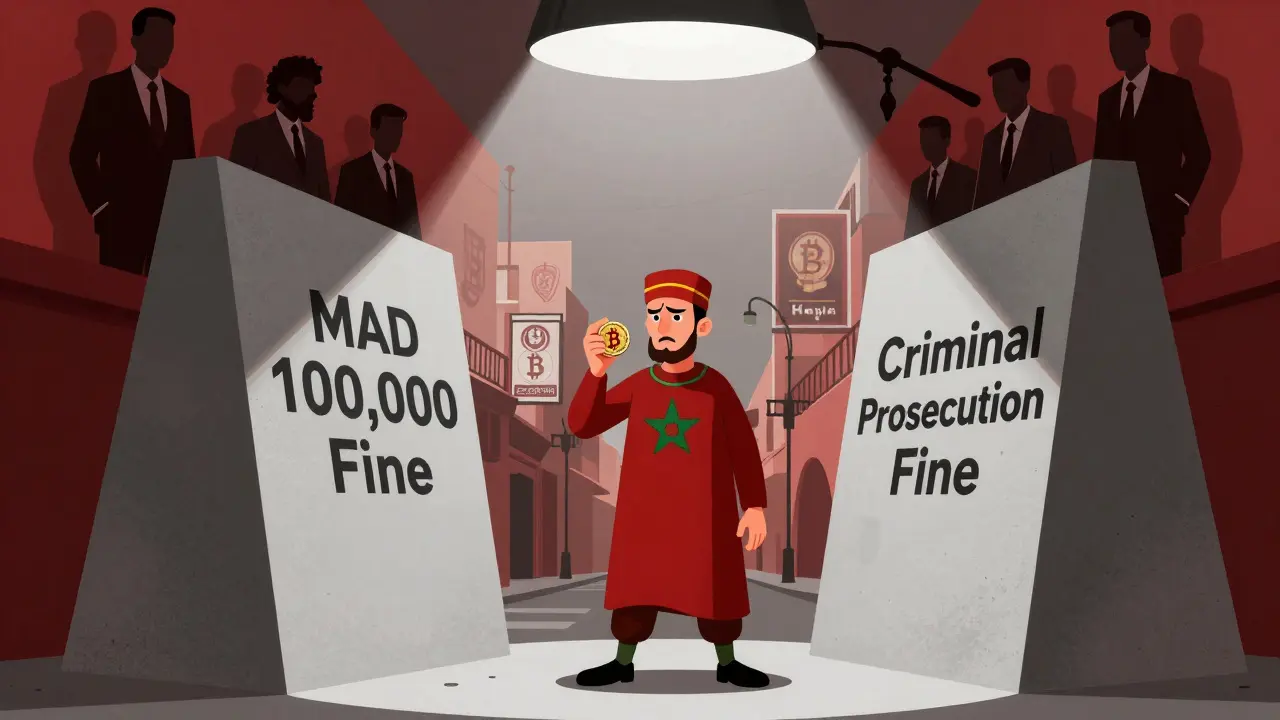
If you’re trading cryptocurrency in Morocco, you’re playing with fire-literally. Even though millions of Moroccans use Bitcoin, Ethereum, and other digital assets, the law doesn’t recognize it. In fact, doing so could land you in serious legal trouble. The penalties aren’t just a slap on the wrist. They’re designed to scare people away. And until recently, there was no legal way out.
What Happens If You Trade Crypto in Morocco Right Now?
Since November 2017, Morocco has banned all cryptocurrency transactions under its foreign exchange laws. That means buying, selling, or exchanging Bitcoin, Tether, or Litecoin through any platform-whether it’s Binance, Coinbase, or a peer-to-peer app-is illegal. The government doesn’t care if you’re just holding it or using it to pay for something. If you’re involved, you’re breaking the law.The fines are steep. For individuals, the penalty ranges from MAD 20,000 to MAD 100,000 (about $2,000 to $10,000 USD). That’s more than the average annual salary in many parts of the country. For businesses? The fines jump to MAD 500,000 (around $50,000 USD). These aren’t theoretical numbers. In February 2025, Moroccan authorities started cracking down on people who used crypto to buy property. They tracked Bitcoin and Ethereum transfers linked to real estate deals, then hit those buyers with the maximum fines.
It gets worse if you repeat the offense. The law allows prosecutors to open criminal cases. That means jail time isn’t off the table. While most cases so far have ended in fines, the government has made it clear: they’re watching. And they’re not afraid to use the full force of the law.
Who’s Getting Targeted?
The crackdown isn’t random. Moroccan financial authorities are focused on three main areas:- Unlicensed crypto exchanges-any platform operating in Morocco without Bank Al-Maghrib’s approval is a target. Even if the server is overseas, if Moroccans are using it, the government can go after the users.
- Businesses using crypto for payments-if you’re a shop owner accepting Bitcoin for goods, or a freelancer getting paid in Ethereum, you’re violating payment regulations. Traditional banking channels are the only legal way to receive international payments.
- Property buyers using crypto-this became a major focus in early 2025. Authorities noticed a spike in crypto-to-real-estate transactions, often used to move money out of the country illegally. They’re now cross-referencing blockchain data with land registry records.
Even peer-to-peer trading-like buying Bitcoin from someone in a café-is technically illegal. The law doesn’t make exceptions for small-scale users. So while many people do it, they’re doing so at risk.
Why Is Morocco So Strict?
Morocco’s central bank, Bank Al-Maghrib, has always been wary of cryptocurrencies. Their main concerns? Money laundering, capital flight, and losing control over the national currency. Morocco has strict foreign exchange rules to protect its economy. Crypto, with its anonymity and borderless nature, undermines all of that.Before 2017, there were reports of Moroccans using Bitcoin to bypass currency controls and send money abroad. Some used it to buy foreign assets, like cars or property, without going through official banking channels. That’s exactly what the government wanted to stop.
They also feared unregulated platforms would scam ordinary people. Without oversight, investors had no recourse if a platform vanished. That’s why the Moroccan Capital Market Authority (AMMC) now monitors any token sales or ICOs-even though they’re still illegal-just to identify potential fraud.

The Big Shift: What’s Changing in 2025-2026?
Here’s the twist: Morocco is about to change its mind. In November 2024, Abdellatif Jouahri, governor of Bank Al-Maghrib, announced a draft law to legalize and regulate cryptocurrency. This isn’t a rumor. It’s a formal proposal being reviewed by parliament. If passed, it will be the biggest shift in Moroccan financial policy in a decade.The new rules will require:
- All crypto exchanges to get a license from Bank Al-Maghrib
- Strict Anti-Money Laundering (AML) and Counter-Terrorism Financing (CFT) checks for every user
- Full reporting of crypto transactions to the Moroccan Tax Administration (DGI)
Instead of fines for trading, you’ll face taxes. Capital gains from crypto will be taxed between 15% and 30%, similar to stocks. If you’re an individual, your income from crypto trading will be added to your personal tax bracket-ranging from 10% to 38%. Businesses will pay 20% to 31%, depending on profits.
But here’s the catch: these new rules aren’t law yet. Until they are, the old penalties still apply. That means right now, you’re either breaking the law-or waiting for it to change.
What Happens If You Don’t Pay Taxes After Legalization?
Once the new law passes, failing to report your crypto gains won’t just mean a fine. It’ll be treated as tax evasion. That’s a criminal offense under Moroccan law. Penalties could include:- Back taxes plus interest
- Fines up to 50% of the unpaid amount
- Criminal prosecution for repeated or large-scale evasion
Think of it like this: if you made $10,000 from trading Bitcoin and didn’t report it, you could owe $3,000 in taxes plus a $5,000 penalty. And if the tax office finds out you’ve been doing it for years? The penalties stack up fast.
How Is the Government Tracking Crypto?
Morocco isn’t blind in the digital world. Bank Al-Maghrib has been working with international financial intelligence units since 2023. They’re using blockchain analysis tools to trace transactions linked to Moroccan wallets. They’ve also partnered with banks to flag unusual transfers that match crypto patterns.In 2024, they started testing a central bank digital currency (CBDC), with full pilot testing scheduled for 2026-2027. That’s not just about innovation-it’s about control. If the government can issue its own digital currency, it won’t need to fear Bitcoin or Ethereum. It can replace them.

Is Crypto Still Popular in Morocco?
Despite the risks, crypto use is growing. According to U.S. State Department reports, Morocco has one of the highest crypto adoption rates in North Africa. The market is projected to hit $278.7 million in 2025 and $292.4 million in 2026.Why? Because the alternatives are worse. The local currency is unstable. Bank transfers are slow. Remittances from abroad cost too much. Crypto offers a faster, cheaper way to move money-even if it’s illegal.
Most users aren’t speculators. They’re ordinary people: students sending money home, freelancers getting paid in dollars, small business owners avoiding high bank fees. They know the risks, but they’re willing to take them.
What Should You Do Right Now?
If you’re in Morocco and trading crypto:- Don’t assume you’re safe-enforcement is increasing, especially around property and business payments.
- Keep records-even if it’s illegal now, the new tax system will require proof of income and purchases. Start tracking your trades now.
- Don’t use unlicensed platforms-they’re the first targets. Stick to well-known exchanges, but understand they’re still illegal in Morocco.
- Watch for the new law-it’s expected to pass in 2025. Once it does, you’ll have a short window to register, report, and get compliant.
The bottom line: Morocco is moving from punishment to regulation. The penalties you face today won’t be the same tomorrow. But until the law changes, you’re still breaking it. And the government is watching.
What’s Next for Crypto in Morocco?
The country is at a crossroads. It could keep trying to ban something that’s already everywhere-or it can take control, tax it, and turn it into a regulated part of the economy. The signs point to the latter.By 2027, Morocco might have its own digital currency, licensed crypto exchanges, and a working tax system for digital assets. That could make it one of the first African nations to successfully integrate crypto into its financial system.
But until then? Trade at your own risk. The fines are real. The enforcement is real. And the law isn’t on your side.
Is it illegal to buy Bitcoin in Morocco?
Yes. Since November 2017, all cryptocurrency transactions have been banned under Morocco’s foreign exchange laws. Buying, selling, or exchanging Bitcoin, Ethereum, or any other digital asset is illegal, whether done through an exchange, peer-to-peer, or mobile app. Violators face fines between MAD 20,000 and MAD 100,000.
Can I get jailed for trading crypto in Morocco?
Yes, if you’re a repeat offender or involved in large-scale operations. While most cases result in fines, Moroccan law allows criminal prosecution for violations of financial regulations. Authorities have the power to pursue jail time, especially if crypto is used to evade taxes, launder money, or move capital illegally.
Are there any legal crypto exchanges in Morocco?
No. As of early 2026, there are no licensed crypto exchanges operating in Morocco. All platforms-whether local or international-are considered illegal until the new regulatory law passes, expected in 2025. Once approved, exchanges must apply for a license from Bank Al-Maghrib and comply with AML/CFT rules.
Will I have to pay taxes on crypto in Morocco soon?
Yes. Once the new regulatory law is passed (expected in 2025), crypto gains will be taxed. Individuals will pay between 10% and 38% depending on income level, and capital gains will be taxed at 15%-30%. Businesses will pay 20%-31%. Failure to report could lead to tax evasion charges.
Can I use crypto to pay for goods or services in Morocco?
No. Using cryptocurrency for commercial payments is strictly prohibited. Businesses must use traditional banking channels for all transactions, including international payments. Even accepting Bitcoin for a product or service is considered a violation of Morocco’s financial regulations and can result in heavy fines.
Is Morocco planning to launch its own digital currency?
Yes. Bank Al-Maghrib has been testing a central bank digital currency (CBDC) since 2024, with full pilot testing scheduled for 2026-2027. The goal is to create a government-backed digital currency that offers the benefits of crypto without the risks of decentralization, giving the state full control over transactions and monetary policy.
Comments
Shaun Beckford
Morocco’s crypto ban is just a desperate power move by central bankers who can’t handle decentralized money. They’re terrified their fiat monopoly is crumbling, so they slap fines on students and freelancers instead of fixing their broken economy. Classic.
January 19, 2026 at 03:56
Nishakar Rath
lol morocco thinks banning bitcoin will stop people from using it they dont even have the tech to track half the transactions and yet they act like theyre the IMF
January 20, 2026 at 19:55
Patricia Chakeres
Let me guess-this ‘regulation’ is just a backdoor for the IMF to install a digital surveillance state under the guise of ‘financial stability.’ CBDCs aren’t innovation, they’re control. They’ll track every coffee you buy with crypto, then tax you for breathing too hard.
January 21, 2026 at 22:51
Ashlea Zirk
The transition from prohibition to regulation is inevitable, and Morocco’s approach is actually one of the more thoughtful ones in the region. The emphasis on AML/CFT compliance and tax alignment with existing financial frameworks shows a serious attempt to integrate without destabilizing the economy. It’s not perfect, but it’s pragmatic.
January 23, 2026 at 06:02
Anthony Ventresque
I’ve got a friend in Casablanca who’s been buying ETH for two years through P2P. He says the local crypto community is tight-knit, almost like a secret society. Everyone knows someone who got fined, but nobody stopped trading. People just got smarter-smaller trades, cash meets, burner wallets. The law’s out of touch.
January 23, 2026 at 10:22
Jason Zhang
So let me get this straight. They fine people for using crypto, then they’re building their own digital currency to replace it? Sounds like the government’s just trying to monetize the rebellion they created. Classic.
January 23, 2026 at 23:18
Liza Tait-Bailey
imagine being so scared of tech that you fine people for using it instead of learning how to make it work for you. morocco’s gonna be left behind while the rest of africa moves on. also why is everyone acting like this is new? crypto’s been everywhere here for years.
January 24, 2026 at 10:42
Alexis Dummar
There’s a deeper question here: Is money a tool of the people or a tool of the state? Morocco’s crackdown isn’t just about crypto-it’s about who controls value. If the state can issue a digital currency and track every transaction, then freedom of exchange becomes a privilege, not a right. The fines are just the surface. The real penalty is the erosion of economic autonomy.
And yet… the people are still trading. Not because they’re rebels, but because they’re rational. When the system fails you, you adapt. That’s not lawbreaking-it’s survival.
Maybe the real story isn’t Morocco banning crypto. Maybe it’s crypto outlasting Morocco’s fear.
January 25, 2026 at 10:30
Pat G
Stop coddling crypto users. If you’re breaking the law to avoid taxes and move money out of the country, you deserve every fine and jail sentence you get. This isn’t about freedom-it’s about theft disguised as innovation. Morocco’s doing the right thing by protecting its economy from foreign-backed chaos.
January 27, 2026 at 07:27