You send Bitcoin to a friend. They forward it to an exchange. The exchange moves it to a cold wallet. Then it vanishes into the ether. Or does it? If you know how to read the ledger, that money never really disappears. It just changes shape and location. On-chain crypto transaction tracing is the art of following those digital footprints across public ledgers. It’s not magic; it’s pattern recognition at scale.
Most people think cryptocurrency is anonymous. It’s not. It’s pseudonymous. Your name isn’t on the block, but your address is. And once that address touches a regulated entity-like a bank or a KYC-compliant exchange-the veil lifts. This guide breaks down how investigators, traders, and compliance officers actually trace funds. We’ll look at the tools, the heuristics, and the limits of what we can see.
The Core Problem: Pseudonymity vs. Anonymity
Let’s clear up the biggest misconception first. Bitcoin and Ethereum do not hide who you are; they hide your identity behind a string of alphanumeric characters. This is pseudonymity. If I know your address, I know every transaction you’ve ever made from it. I don’t need to know your name to see your net worth or your spending habits.
Tracing works because of this transparency. Every transaction is recorded permanently. The challenge isn’t finding the data-it’s interpreting it. A single coin might hop through ten different wallets in three seconds. Why? Maybe it’s a user moving funds between their own devices. Maybe it’s a mixer trying to break the trail. Maybe it’s a bot sniping a new token launch. Distinguishing these scenarios requires more than just looking at the numbers.
This is where blockchain analytics comes in. These platforms ingest raw chain data and apply layers of intelligence. They tag known entities (like Binance or Coinbase), cluster related addresses, and flag suspicious patterns. Without these tools, manual tracing is like trying to find a needle in a haystack while the haystack is constantly growing.
Heuristic-Based Tracing: The Foundation
Before AI took over, tracing relied on heuristics-simple rules of thumb that often hold true. These methods are cheap, fast, and surprisingly effective for basic investigations.
The most common heuristic is wallet clustering. This technique groups multiple addresses that likely belong to the same entity. How do we know? One method is "common input ownership." In Bitcoin, if two addresses provide inputs to the same transaction, they almost certainly share a private key. Another is "change address identification." When you spend part of your balance, the leftover change goes back to one of your existing addresses. By tracking these patterns, analysts build clusters representing exchanges, merchants, or individuals.
Another powerful heuristic is identifying peel chains. Criminals often split large amounts into tiny fractions to avoid detection thresholds. For example, sending 10 BTC by making fifty transactions of 0.2 BTC each. Automated scripts detect this rapid splitting behavior. Nansen reported a 92% detection rate for peel chains in their 2025 analysis. It’s not perfect-legitimate users sometimes batch payments-but it’s a strong signal.
- Common Input Ownership: Multiple inputs in one transaction imply shared control.
- Change Address Analysis: Identifying which output is change helps map internal wallet structures.
- Peel Chain Detection: Spotting rapid splitting of funds into smaller units.
- Dusting Attacks: Tiny transactions sent to many addresses to link them together.
Rule-Based Systems and Compliance Flags
Heuristics tell you what *might* be happening. Rule-based systems tell you what *should* have happened. Financial institutions use these to enforce Anti-Money Laundering (AML) laws. They define "normal" behavior and flag deviations.
For instance, a rule might state: "If a wallet receives funds from a sanctioned address, freeze it." Or, "If a user sends more than $10,000 in a day without prior activity, trigger a review." These rules rely on external data feeds. The system needs to know which addresses are linked to North Korea, which are darknet markets, and which are legitimate DeFi protocols.
This approach is rigid but reliable. It’s why your bank freezes your account if you suddenly buy 5 ETH after years of no crypto activity. The rule doesn’t care about your intent; it cares about the pattern. According to TRM Labs, these systems achieve high accuracy for straightforward cases within a single chain. But they struggle when funds jump networks.
Cross-Chain Tracing: The Hard Part
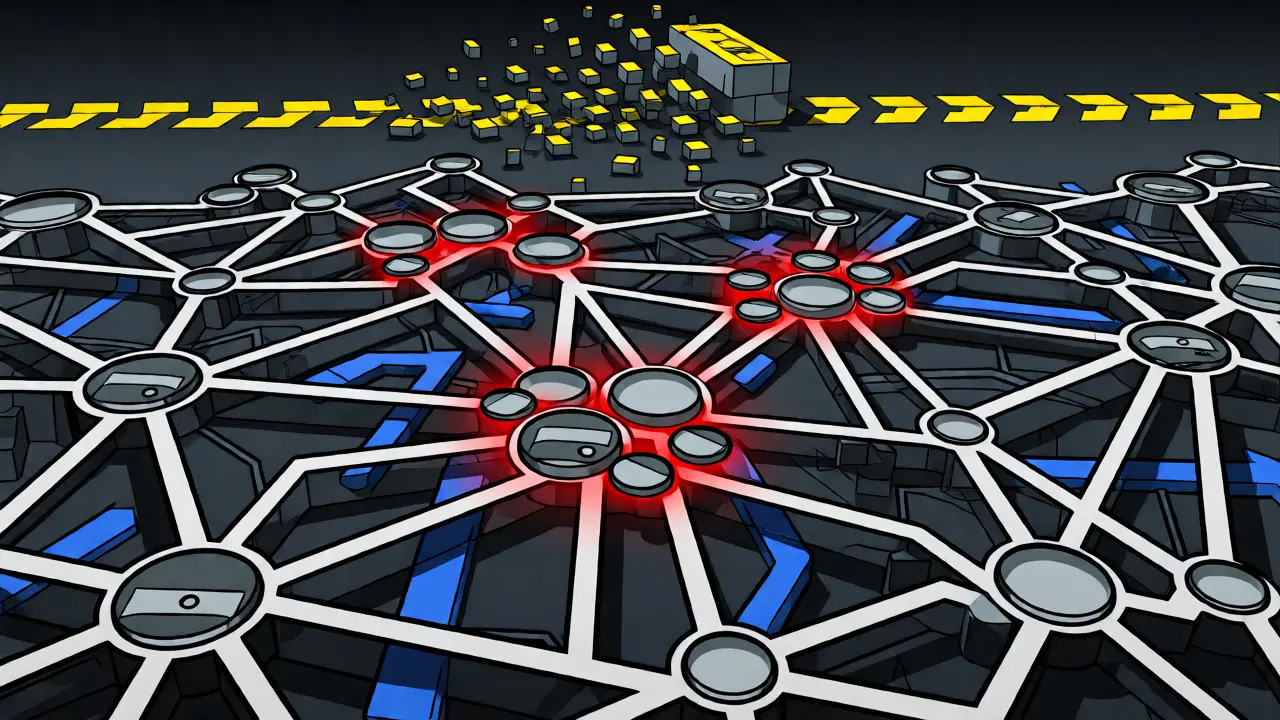
Here’s where things get messy. Users rarely stay on one blockchain. They bridge assets from Ethereum to Solana, swap on Uniswap, then move to Arbitrum. Each hop introduces noise. You’re no longer following a linear path; you’re navigating a web of bridges and swaps.
To trace cross-chain, you need to understand bridge mechanics. Most bridges work on a lock-and-mint model. You lock ETH on Ethereum, and a wrapped version appears on Polygon. The original ETH stays in a smart contract. Tracing requires linking the source transaction hash to the destination mint event. If the bridge uses a centralized custodian, this is easy. If it’s decentralized, like Hop Protocol or Across, you have to match timing and amounts across disparate ledgers.
| Methodology | Best Use Case | Accuracy Estimate | Limitations |
|---|---|---|---|
| Heuristic-Based | Single-chain clustering, basic attribution | ~89% (Ethereum) | Fails with complex mixing, privacy coins |
| Rule-Based | Compliance, sanctions screening | High for defined rules | Rigid, misses novel patterns |
| Graph Learning (AI) | Multi-hop, cross-chain, anomaly detection | ~85% (Multi-chain) | High compute cost, black-box results |
Accuracy drops significantly here. While single-chain tracing might hit 89% accuracy, cross-chain efforts often fall to 63%. Why? Because every bridge adds uncertainty. Did the user wait five minutes or five hours? Was there a slippage tolerance issue? Matching these details manually is tedious. Advanced tools now automate this, using time-window matching and amount correlation to stitch chains together.
Advanced Graph Learning and AI
The frontier of tracing is machine learning. Instead of hard-coded rules, these systems learn from historical data. They treat the blockchain as a massive graph, where nodes are addresses and edges are transactions. Neural networks analyze this structure to identify communities and anomalies.
Companies like Merkle Science and Elliptic use these techniques to spot laundering rings that humans miss. For example, an AI might notice that 500 seemingly unrelated wallets all interacted with a specific obscure contract within a 10-minute window. That’s a coordinated attack or a wash-trading scheme. Traditional rules wouldn’t catch it because no single transaction looked suspicious.
These models require vast training data. They also demand significant computational power. As of 2025, enterprise-grade solutions cost between $15,000 and $50,000 annually per seat. For individual traders, free tiers on platforms like Arkham or Etherscan offer limited graph visualization, but deep forensic analysis usually requires a paid subscription.

Obfuscation: The Cat-and-Mouse Game
Tracers aren’t working against static targets. Bad actors actively try to break the trail. The simplest method is using mixers, like Tornado Cash. You deposit ETH, wait, and withdraw to a new address. The link between deposit and withdrawal is broken probabilistically. In 2024, decentralized mixers accounted for 18.3% of illicit transaction volume.
Privacy coins like Monero take it further. Unlike Bitcoin, Monero hides the sender, receiver, and amount by default. Tracing Monero requires advanced statistical methods and often relies on metadata leaks rather than direct on-chain links. Zcash offers similar privacy but allows for "view keys," which let auditors see transactions without revealing the full picture to the public.
Then there are dust attacks. Attackers send tiny amounts of crypto to thousands of addresses. If those addresses later consolidate their balances, the attacker learns they belong to the same person. It’s a low-cost way to de-anonymize clusters. Investigators counter this by ignoring dust outputs under a certain threshold.
Practical Tools and Workflow
If you want to start tracing, you don’t need a PhD. You need curiosity and the right tools. Start with a blockchain explorer. Etherscan for Ethereum, Blockstream Explorer for Bitcoin. Look at a transaction. See the inputs and outputs. Click the addresses. Where did the funds come from? Where did they go?
Next, upgrade to an analytics platform. Nansen, Dune Analytics, and Arkham Intelligence allow you to visualize flows. You can create dashboards that show inflows and outflows for specific entities. For compliance work, tools like Chainalysis Reactor or TRM Labs provide risk scoring. They assign a score to each address based on its history. High-risk addresses get flagged automatically.
Remember, tracing is iterative. You follow a lead, hit a dead end, pivot, and try again. Sometimes the trail ends at a cold wallet that hasn’t moved in five years. Other times, it leads straight to a known exchange account. The goal isn’t always to find a name; it’s to establish confidence in the flow of funds.
Is Bitcoin completely anonymous?
No, Bitcoin is pseudonymous. Transactions are linked to addresses, not names. However, if an address is linked to a real-world identity (e.g., via an exchange KYC check), all past and future transactions associated with that address become traceable to that individual.
How accurate is on-chain tracing?
Accuracy varies by method and complexity. Heuristic methods achieve around 89% accuracy on single chains like Ethereum. Cross-chain tracing is harder, with accuracy dropping to approximately 63% due to the complexity of bridging and swapping across multiple networks.
What are peel chains?
A peel chain is a sequence of transactions where a large amount of cryptocurrency is split into smaller fractions repeatedly. This technique is often used by launderers to evade detection thresholds or to distribute funds to multiple recipients simultaneously.
Can privacy coins like Monero be traced?
Yes, but it is much more difficult. Privacy coins hide transaction details by default. Tracing them often requires analyzing metadata, timing correlations, and interaction points with transparent exchanges. It is less definitive than tracing Bitcoin or Ethereum.
Why do exchanges use blockchain analytics?
Exchanges use these tools for regulatory compliance (AML/KYC). They screen incoming deposits for connections to sanctioned entities, darknet markets, or ransomware addresses. If a deposit is flagged as high-risk, the exchange may freeze the account or request additional documentation.