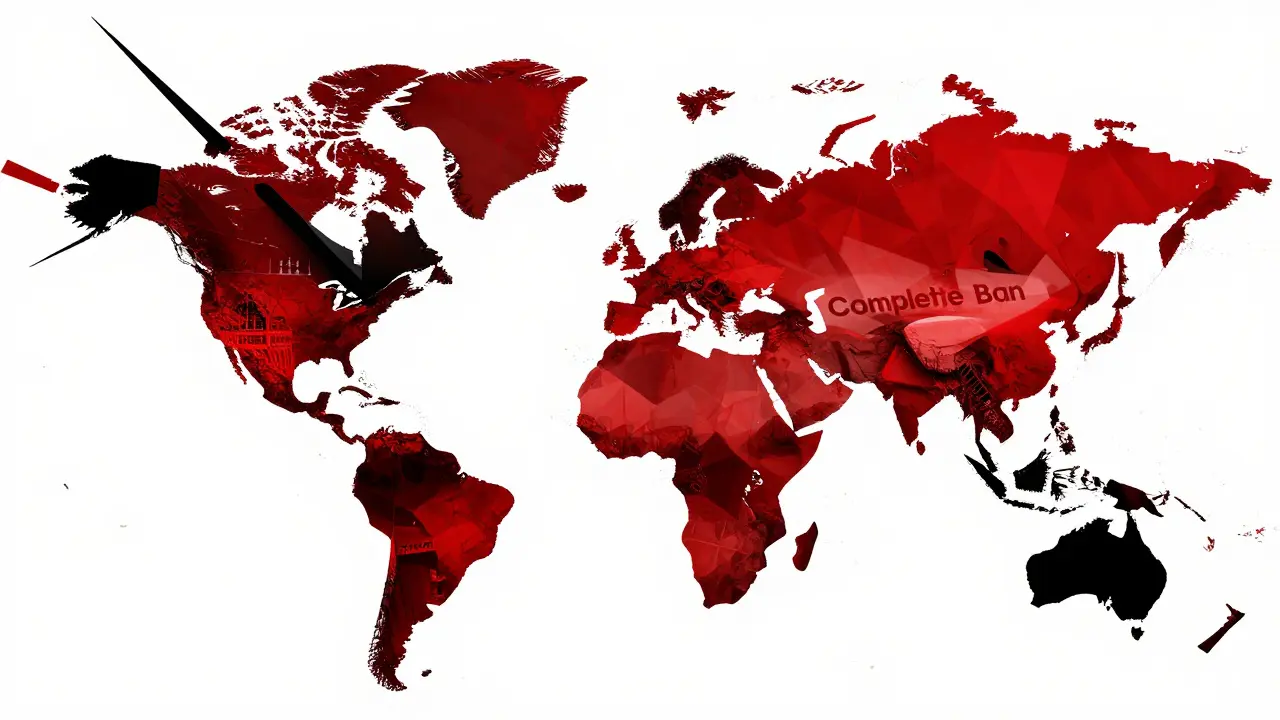
Trying to sign up for a crypto exchange only to hit a "service not available in your region" message is incredibly frustrating. If you're looking at OKX is a global cryptocurrency exchange founded in 2017 that provides spot trading, futures, and Web3 products , you've likely noticed that the experience varies wildly depending on where you live. One person gets full access to leverage trading, while another can't even open an account.
These hurdles aren't random. They are the result of a complex dance between the platform and global regulators like the Office of Foreign Assets Control a US agency that administers economic and trade sanctions and the EU's MiCA guidelines. Depending on your passport, you might be completely banned, restricted to basic trading, or welcomed with open arms. Here is the breakdown of where OKX stands and why your account might be limited.
The Three Tiers of OKX Restrictions
OKX doesn't just "block or allow." They use a tiered system to manage risk and stay compliant with local laws. This means your access depends on which bucket your country falls into.
Tier 1: The Complete Ban
In these regions, you cannot use the platform at all. If you try to sign up, you'll likely be blocked at the IP level or rejected during the ID check. This list includes the United States, Canada, Malaysia, Singapore, the Bahamas, and the United Kingdom. It also covers countries under heavy international sanctions like Iran, North Korea, Syria, and Cuba, as well as the Crimea, Donetsk, and Luhansk regions.
Tier 2: Partial Territory Restrictions
This tier is a bit more nuanced. It often applies to specific territories or countries with fluctuating regulatory statuses. For example, U.S. territories like Puerto Rico, Guam, and the U.S. Virgin Islands are restricted. Other countries in this group include Bangladesh, Bolivia, and Malta.
Tier 3: Feature-Specific Limitations
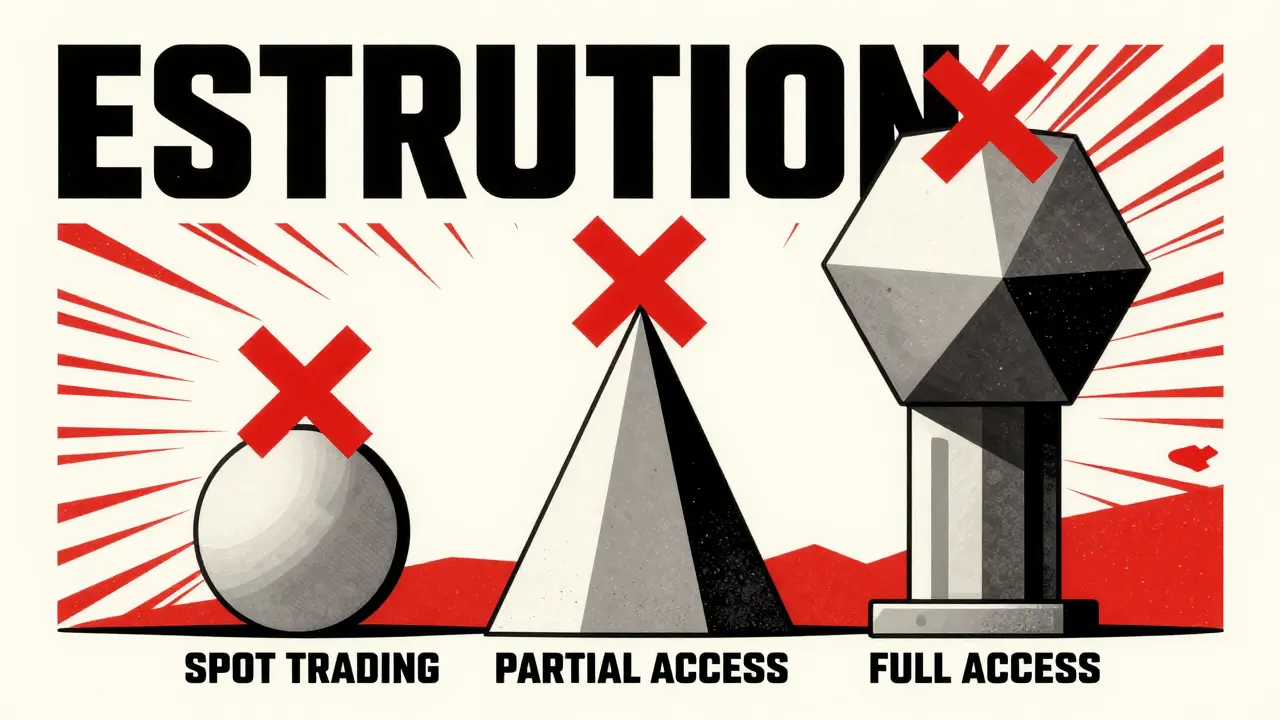
This is where things get confusing. You can open an account and trade "spot" (buying the actual coin), but you can't touch derivatives, futures, or perpetual contracts. If you live in Australia, Brazil, or South Korea, you're likely in this group. The platform lets you hold assets but blocks the high-risk tools that regulators in those countries find dangerous.
| Restriction Level | What's Blocked? | Example Countries |
|---|---|---|
| Full Ban | Everything (Account creation blocked) | USA, Canada, UK, Iran |
| Partial Ban | Regional/Territory specific blocks | Puerto Rico, Bangladesh, Malta |
| Feature Limited | Derivatives, Futures, Leverage | Australia, Brazil, South Korea |
How OKX Stops Users from Bypassing Blocks
You might be tempted to fire up a VPN and pretend you're in Germany to access those missing features. While it seems like a quick fix, OKX has some of the toughest detection tools in the industry. They don't just check your IP address; they use a combination of device fingerprinting and IP geolocation, which is reported to be over 99% accurate.
The biggest wall, however, is KYC is the "Know Your Customer" process where users must provide government-issued identification to verify their identity . Since January 2023, OKX has made KYC mandatory for almost all core functions. Even if a VPN hides your location, your passport won't. If you upload a U.S. passport while using a Japanese VPN, the system will flag the discrepancy immediately. In fact, thousands of accounts are closed every month for "geolocation fraud." Trying to trick the system usually ends with a permanent account ban and locked funds.
The "Singapore Paradox" and Regional Entities
If you've seen Singapore on the banned list but then heard about OKX Singapore, you're not crazy. This is a strategy called "multi-entity regulation." To avoid being shut down entirely, OKX creates separate legal companies for different markets.
The global OKX platform might block Singaporean residents, but the local OKX Singapore entity-regulated by the Monetary Authority of Singapore the central bank and financial regulatory authority of Singapore-serves specific local users who meet certain criteria. The same logic applies to OKX Europe and OKX Japan. This allows the exchange to maintain high liquidity globally while playing by the specific rules of each local government.
Comparing OKX to Other Giant Exchanges
Every exchange handles restrictions differently. Some are restrictive by nature, while others try to play a game of cat-and-mouse with regulators. When you compare OKX to players like Binance or Coinbase, the difference in philosophy is clear.
- Coinbase takes a "compliance first" approach, operating only in countries where they have full legal standing. They don't try to operate in the "gray area."
- Binance has historically been more reactive, often blocking countries only after receiving a warning or fine from a government.
- OKX sits in the middle. They are more proactive than Binance-blocking derivatives in the UK and Australia before they were forced to-but more flexible than Coinbase by using regional entities.
This "middle ground" approach helps them keep a massive user base (mostly in Asia and Europe) while avoiding the multi-billion dollar fines that hit other exchanges for ignoring regional laws.
What to Expect for the Future
The map of restricted countries changes almost monthly. For instance, recently we've seen derivatives access expand into Thailand and Vietnam, while services were pulled from Nepal and Bangladesh. The big question remains: will the U.S. ever be open?
There are whispers that OKX is working on a fully compliant U.S. entity, but the regulatory environment in America is currently a minefield. With the SEC actively suing other major exchanges, OKX is likely to remain cautious. For now, if you're in a restricted zone, your best bet is to look for local, regulated alternatives rather than trying to bypass the system.
Can I use a VPN to access OKX from the USA?
While a VPN might let you see the website, it won't let you trade. OKX requires mandatory KYC (Know Your Customer) verification. When you upload your ID, the platform will identify your nationality and residence, resulting in an account ban for violating the Terms of Service.
Why can I trade spot but not futures in my country?
This happens because your country is in OKX's "Third-Tier" of restrictions. Many regulators (like those in Australia or Brazil) view derivatives and leverage trading as too risky for retail investors, so OKX disables those specific features to stay legal in your region.
How long does the KYC verification take?
For most users in permitted countries, standard KYC verification takes between 2 to 4 hours. Once verified, your transaction limits are set based on the level of documentation you provide.
Is OKX legal in Europe?
Generally, yes, through OKX Europe. However, following the implementation of the EU's MiCA regulations, certain products like derivatives have been restricted for EU residents to comply with regional law.
What happens if my account is flagged for geolocation fraud?
If OKX detects that you are bypassing country restrictions via a VPN or fake documentation, they typically terminate the account. Depending on the severity, they may freeze funds until identity can be proven or the account is permanently closed.
Next Steps and Troubleshooting
If you've run into a restriction, here is how to handle it based on your situation:
- If you moved to a permitted country: Don't just change your settings. You will need to undergo a new KYC process and provide proof of residency (like a utility bill) for your new location to unlock the features associated with that region.
- If you are in a "Feature Limited" region: If you specifically need derivatives, you may need to look for an exchange that is fully licensed for those products in your specific country, as OKX will not lift these blocks for individual users.
- If you were blocked by mistake: If you live in a permitted country but are getting a restriction message, clear your browser cache, disable any active VPNs, and contact OKX support with a photo of your ID and a recent proof of address.
Comments
vijendra pal
Honestly, everyone just uses a DEX if they want to avoid this nonsense 🙄 Why even bother with CEXs when you can just swap on Uniswap or PancakeSwap and be done with it! 🚀💰 Plus the fees are way better if you know what you're doing. Most people are just too lazy to learn about wallets lol!! 😂
April 6, 2026 at 10:49
Trish Swanson
Exactly!!! Use a DEX!!!
April 6, 2026 at 23:24
sekhar reddy
Omg the drama with these regulators is just too much!! Like, why is the US always such a nightmare for crypto? It is absolutely tragic that we have to jump through hoops just to trade some coins. The absolute audacity of these agencies to block everything while the rest of the world just moves ahead!! 😱
April 7, 2026 at 18:32
Joshua Aldrich
it's basically a game of cat and mouse. if u really wanna avoid the KYC trap, look into non-custodial options. the philosophy of crypto was always about decentralization but now we're just replacing old banks with new digital ones that have better apps but the same restrictions. its kinda ironic if u think about it... though i reckon most people just want the ease of use and dont care about the theory behind it. just be careful with vpn's because like the post says, they can see your hardware ID too, not just the IP. i've seen ppl lose thousands cuz they tried to be clever and got their accounts frozen during a withdrawal. total nightmare scenario.
April 8, 2026 at 23:27
Diana Martín Prieto
For those who are actually moving to a new country, definitely make sure you have a physical utility bill or bank statement in your name at the new address. The KYC teams are very strict about the date on the document, usually requiring it to be less than three months old. If you're struggling with the verification, try taking the photo in natural light to avoid glares on your ID, as that's the most common reason for rejection.
April 10, 2026 at 11:17
shubhu patel
I completely agree with the points made here and I think it is quite helpful to have this detailed breakdown because many of us in India have seen the rules change so many times that it becomes quite exhausting to keep track of what is actually allowed and what might get our accounts suspended unexpectedly in the future. It is very interesting how they use the multi-entity strategy for places like Singapore and Japan because it shows that the companies are willing to adapt to local laws to keep their business running, which is probably the only way they can survive in such a volatile regulatory environment across different continents.
April 12, 2026 at 02:14
Susan Payne
It is truly lamentable that some users still believe a simple VPN can circumvent sophisticated institutional security. The lack of basic technical literacy is astounding. One does not simply hide their identity from a multi-billion dollar entity that specializes in data tracking and regulatory compliance. Attempting to defraud these systems is not only foolish but practically guaranteed to end in financial lockout.
April 13, 2026 at 11:50
Suzanne Robitaille
Oh, the sheer tragedy of a frozen account! Imagine the heartbreak of seeing your funds just... gone... because of a little IP discrepancy. It feels like a digital prison where the rules are rewritten every single Tuesday! It's just so heartbreaking that the dream of a borderless financial system is being crushed by the weight of a thousand different government mandates!
April 15, 2026 at 03:47
Brooke Herold
This is a very clear summary of the current state of affairs.
April 16, 2026 at 18:20