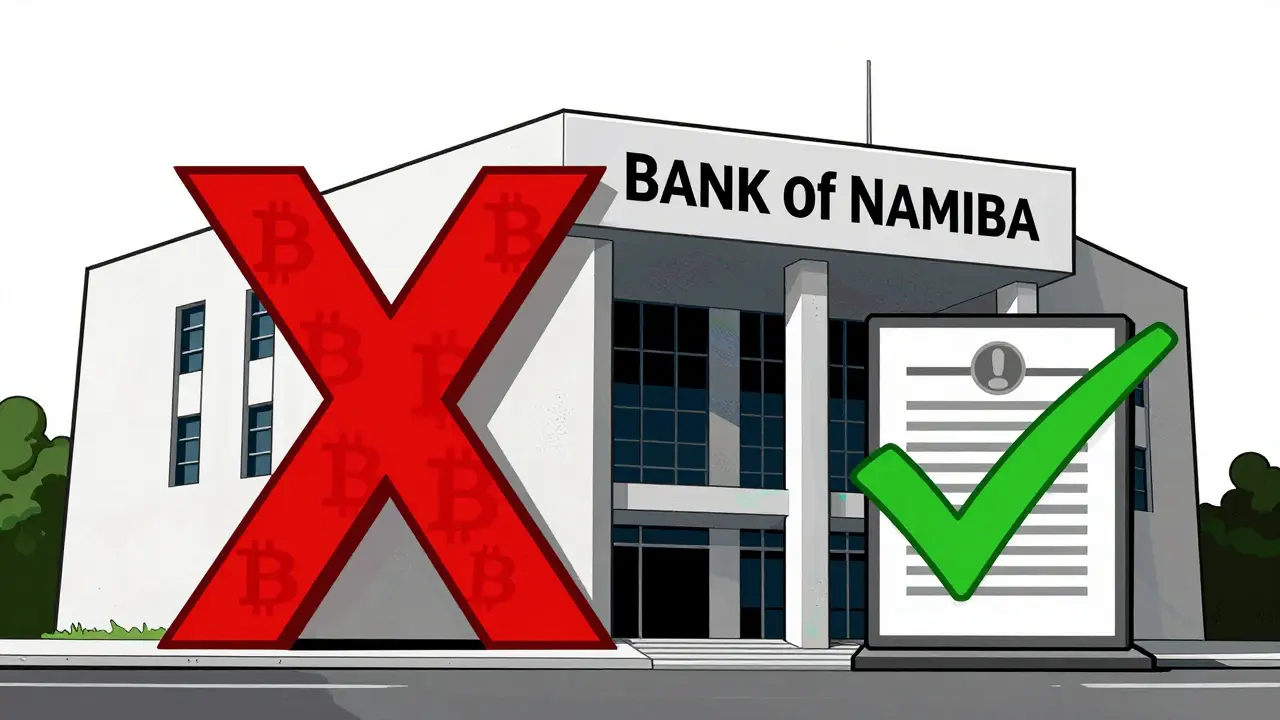
In Namibia, crypto restrictions create a confusing landscape where businesses can get provisional licenses but individuals still can't legally trade cryptocurrency. This article explains what's really happening with banking rules, licensing, and why this situation matters to you in 2026.
How Namibia's Crypto Stance Evolved
The Bank of Namibia (BON) is the central bank responsible for monetary policy and financial regulation. It initially took a strict stance against crypto in 2018 but has since shifted toward regulated acceptance. first made its position clear in May 2018 with an official statement declaring cryptocurrency isn't legal tender and the bank won't protect users from losses. They specifically said they "opposed using cryptocurrencies as a payment method" and "do not currently recognise cryptocurrencies as a commodity." This meant if you lost money trading Bitcoin, you had no legal recourse.
Things started shifting in 2022 when BON allowed merchants to accept Bitcoin as payment, though it still wasn't official legal tender. The real change came in June 2023 when Namibia passed the Virtual Assets Act of 2023 is Namibia's comprehensive law regulating digital assets. It requires all Virtual Asset Service Providers (VASPs) to register with NAMFISA and comply with strict anti-money laundering rules. (Act No. 10 of 2023). This law created a framework for regulating digital assets, but it didn't make cryptocurrency legal for general public use.
Current Business Licensing Rules
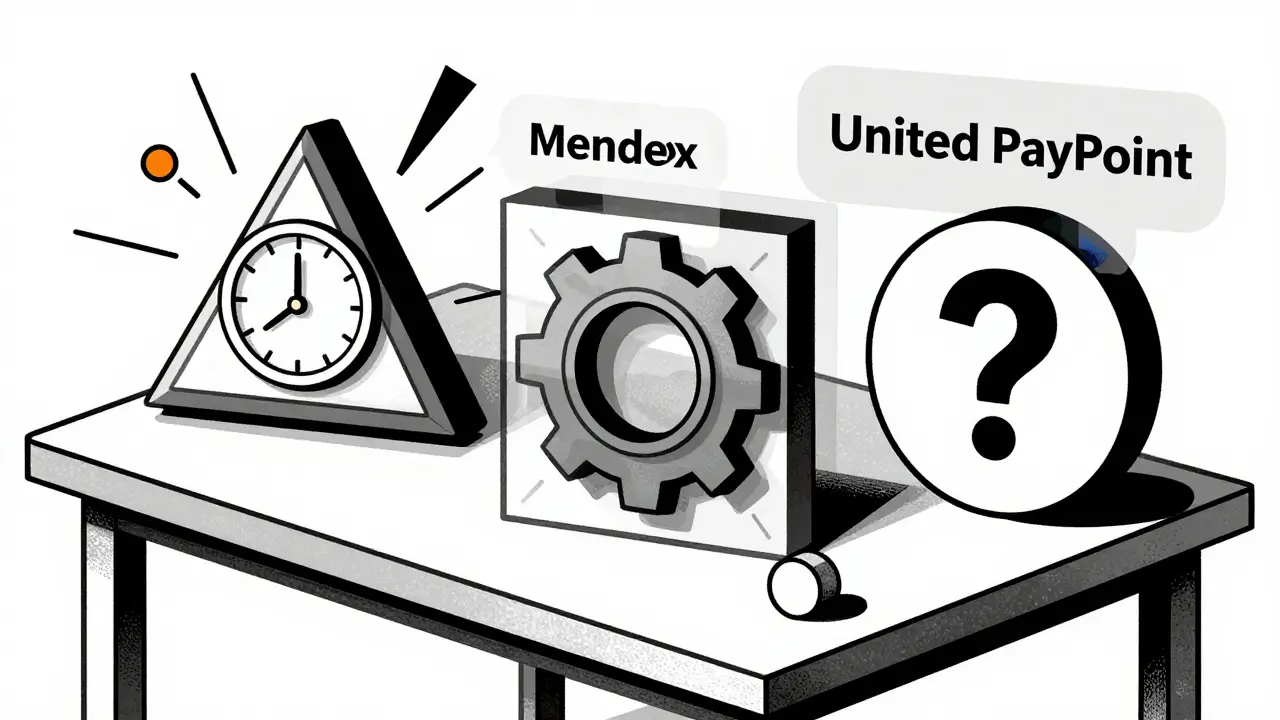
Under the Virtual Assets Act, all Virtual Asset Service Providers (VASPs) are businesses that handle cryptocurrency transactions. They must obtain licenses from NAMFISA and follow strict compliance procedures. must register with the Namibia Financial Institutions Supervisory Authority (NAMFISA) is the regulatory body overseeing financial institutions and virtual asset service providers in Namibia. It handles licensing and compliance monitoring for crypto businesses. (NAMFISA). In January 2025, BON granted provisional licenses to three companies: Landifa Bitcoin Trade CC, United PayPoint (Pty) Ltd, and Mindex Virtual Asset Exchange. These companies can't operate in Namibia yet-they're in a six-month testing period to prove they meet all compliance requirements.
| Company | Provisional Start | Extension Date | Status |
|---|---|---|---|
| Landifa Bitcoin Trade CC | January 2025 | July 31, 2025 | Requesting extension |
| United PayPoint (Pty) Ltd | January 2025 | May 13, 2025 | Requesting extension |
| Mindex Virtual Asset Exchange | January 2025 | November 21, 2025 | Under review |
Two of these companies asked for extensions. Landifa wants until July 31, 2025, and United PayPoint until May 13, 2025. Mindex got an extension until November 21, 2025. BON spokesperson Kazembire Zemburuka explained: "The bank is currently conducting due diligence to assess compliance with the conditions attached to the provisional authorisations." These companies must prove they have proper infrastructure, staff, and security systems before getting full approval.
Individual User Restrictions
While businesses work on getting licenses, regular people face serious problems. Legal experts report cases where individuals using cryptocurrency were blocked from their bank accounts. Major banks like NedBank is a major South African bank operating in Namibia that has restricted accounts linked to cryptocurrency activities. and Standard Bank is a major South African bank operating in Namibia that has restricted accounts linked to cryptocurrency activities. in Namibia froze accounts of people involved in crypto investment clubs. This happens even though the Virtual Assets Act doesn't give BON direct power to restrict individual accounts. Lawyers argue BON is overstepping by enforcing rules without clear legal backing.
Travel Rule Details
Namibia follows international standards with its Travel Rule requires VASPs to collect and share sender/receiver details for transactions over NAD 20,000 (about USD 1,000).. For any cryptocurrency transaction over NAD 20,000 (roughly USD 1,000), VASPs must collect and share personal information like names, ID numbers, and account details. This helps track suspicious activity and prevent money laundering. Banks and crypto businesses must monitor transactions in real-time and report anything unusual to regulators.
The Crypto Trading Paradox
Here's the confusing part: Namibia has a law regulating crypto businesses but still says cryptocurrency trading is illegal. BON continues to state it "does not recognize cryptocurrencies, such as Bitcoin, as legal tender" and remains "reluctant to allow the implementation of blockchain." This creates a situation where licensed companies can operate under strict rules, but ordinary citizens can't legally buy or sell crypto. The Payment System Management Act 2023 works with the Virtual Assets Act to provide comprehensive oversight of traditional and digital payment services. (Act No. 14 of 2023) adds another layer of oversight, but it doesn't change the core problem-individuals still can't use crypto legally.
What's Next for Namibia's Crypto Scene
As of October 2025, Namibia's approach is cautious but progressive. The government is trying to balance innovation with security. They've added more licensed entities like Finatic Technologies (Pty) Ltd is a fintech company licensed for payment services under Namibia's new regulatory framework. for payment services, showing expansion beyond pure crypto. However, the timeline for full market opening remains unclear. Many businesses and users are stuck waiting for BON to finalize licensing decisions. If the current provisional licenses succeed, Namibia could become a regional hub for regulated crypto activity. If not, it might stay stuck in this restrictive middle ground.
Is cryptocurrency legal in Namibia?
No, cryptocurrency trading remains technically illegal in Namibia as of 2026. The Bank of Namibia continues to state it "does not recognize cryptocurrencies as legal tender" and "does not support trading on financial markets." However, licensed Virtual Asset Service Providers (VASPs) can operate under strict supervision, creating a gray area where businesses have permission but individuals don't.
Can I use Bitcoin to pay for goods in Namibia?
Merchants can accept Bitcoin at their discretion since 2022, but it's not legal tender. This means businesses can choose to take it as payment, but they aren't required to, and you can't use it for government services or taxes. The Bank of Namibia still doesn't recognize it as official currency.
Why did my bank account get restricted for crypto activity?
Banks like NedBank and Standard Bank in Namibia have restricted accounts linked to cryptocurrency. This happens despite the Virtual Assets Act not giving BON direct authority to block individual accounts. Legal experts say this enforcement is questionable since the central bank lacks law-making power and should go through courts for direction.
What's the Travel Rule for crypto in Namibia?
For transactions over NAD 20,000 (about USD 1,000), Virtual Asset Service Providers must collect and share sender and receiver details, including names, ID numbers, and account information. This helps track suspicious activity and prevent money laundering, aligning with international standards.
When will Namibia fully legalize cryptocurrency?
There's no clear timeline. BON and NAMFISA are moving slowly, focusing on licensing businesses first. The central bank's reluctance to recognize crypto as legal tender suggests full legalization isn't coming soon. Experts say Namibia's cautious approach means individual crypto trading will likely remain restricted for years unless regulatory changes happen.
Comments
Sharon Lois
This is all a setup. The Bank of Namibia is just a puppet for the global elite. They'll never let real crypto thrive. #TinfoilHat
February 6, 2026 at 00:33
Josh Flohre
Your assertion about globalist control is entirely unfounded. The Bank of Namibia's stance is grounded in financial stability and anti-money laundering protocols. Do not spread baseless conspiracy theories.
February 6, 2026 at 20:14
aryan danial
The current regulatory landscape in Namibia regarding cryptocurrency is a fascinating study in bureaucratic inertia and policy inconsistency. The Virtual Assets Act of 2023, while a step in the right direction, fails to address the fundamental issue of individual access to crypto markets. By permitting only licensed VASPs to operate while explicitly denying ordinary citizens the right to trade, the government has created a paradoxical situation where the system is both open and closed at the same time. This inconsistency not only hampers innovation but also raises serious questions about the true intentions behind the regulations. The Bank of Namibia's refusal to recognize cryptocurrencies as legal tender, despite allowing businesses to accept them for payments, further complicates matters. It appears that the central bank is attempting to walk a tightrope between embracing technological progress and maintaining control over the financial system. However, this approach is inherently flawed. Without clear guidelines for individual users, the market remains in a state of uncertainty that discourages legitimate participation. Moreover, the reported instances of banks freezing accounts for crypto-related activity, despite the lack of legal basis for such actions, suggest that enforcement is being carried out in an arbitrary and potentially illegal manner. Legal experts have pointed out that the Bank of Namibia does not have the authority to unilaterally restrict individual accounts without proper legislative backing, yet this continues to happen. This situation is emblematic of a broader trend where regulatory bodies attempt to control emerging technologies through outdated frameworks, leading to unintended consequences. It is imperative that policymakers recognize the need for a comprehensive approach that balances security, innovation, and individual rights. Until such time, Namibia's crypto ecosystem will remain stunted, unable to realize its potential as a driver of economic growth. The current state of affairs is not just inefficient-it is actively harmful to the nation's future prospects.
February 7, 2026 at 01:26
Alisha Arora
Banks freezing accounts is messed up. They shouldn't do that. The law doesn't let them, so why are they? People are getting hurt. This is bad.
February 7, 2026 at 02:30
Michael Sullivan
Aryan, you're spot on. Namibia's crypto policy is a joke. 😂 They're stuck in the past. The Travel Rule is fine, but banning individuals? Total nonsense. #CryptoIsFuture
February 7, 2026 at 07:14
Reda Adaou
It's important to balance innovation and security. Licensed VASPs can operate safely while regulations protect users. Let's work together to find solutions.
February 7, 2026 at 19:37
perry jody
Yes! Let's keep pushing for progress! 💪 Licensed businesses are doing great, and soon individuals will have access too. Keep the faith!
February 8, 2026 at 22:30
Paul Jardetzky
The key is clear regulations. With proper oversight, crypto can thrive. Let's support the licensed VASPs and push for individual rights. 🚀
February 10, 2026 at 05:32
Udit Pandey
National security must come first.
February 11, 2026 at 05:57