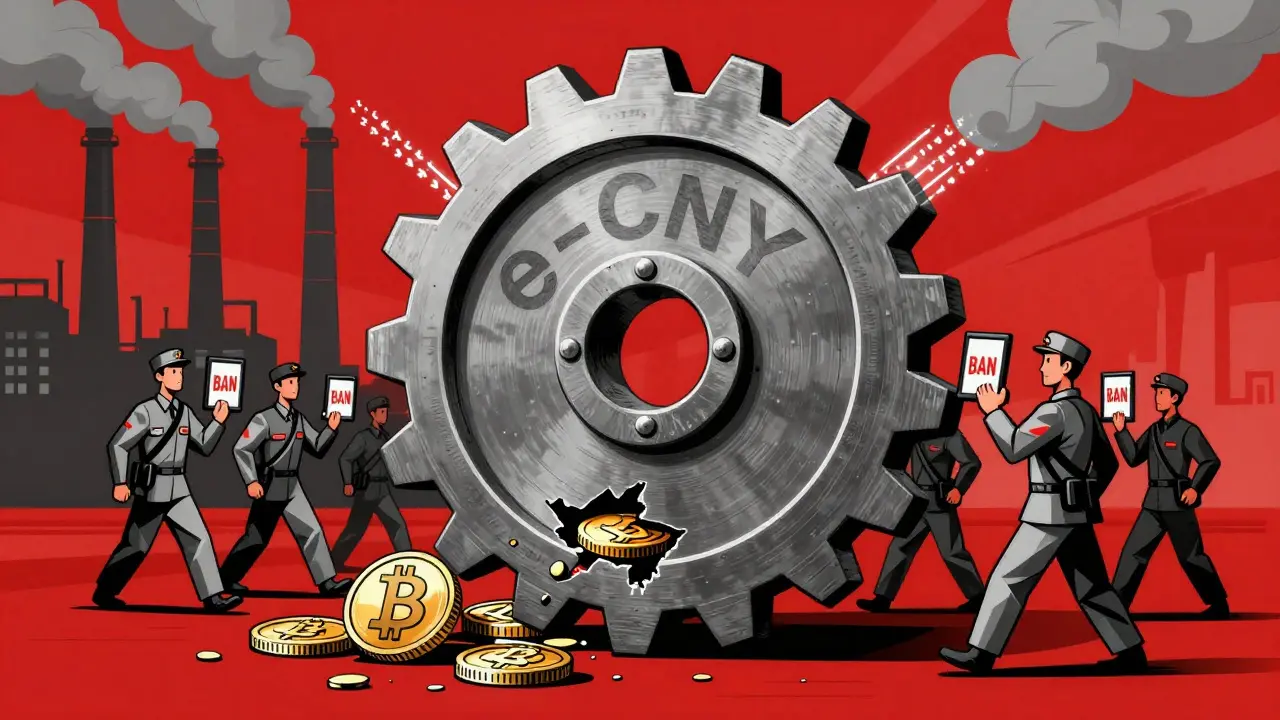
As of June 1, 2025, owning, trading, or mining cryptocurrency in China is illegal. There are no exceptions. No loopholes. No gray areas for individuals or businesses. This isn’t a warning-it’s the law. And it’s enforced with real consequences.
What’s Actually Banned?
The Chinese government doesn’t just discourage crypto. It outlawed everything. Trading on exchanges? Illegal. Mining with powerful computers? Illegal. Holding Bitcoin or Ethereum in a wallet? Technically not a crime, but you have zero legal protection. If you lose it, get scammed, or get hacked? Too bad. Courts won’t help you. Any money you made from crypto? The government can seize it. The 2025 ban, issued under Circular No. 237, expands on earlier rules from 2021. Now, it’s illegal to:- Buy or sell any cryptocurrency, even peer-to-peer
- Run a mining operation, even if it’s just one rig in your garage
- Offer services that help people trade crypto-like price tracking apps or wallet providers
- Accept crypto as payment for goods or services
- Promote crypto through social media, ads, or influencer content
- Exchange yuan for Bitcoin or any other digital token
Even foreign nationals visiting China aren’t exempt. If you’re caught trading crypto on your phone while on vacation in Shanghai, you can be fined, deported, or worse. The law doesn’t care where you’re from.
Why Did China Do This?
China didn’t wake up one day and decide to hate crypto. It started by embracing it. In 2017, China was home to over 70% of global Bitcoin mining. It hosted the biggest crypto exchanges. But the government quickly realized something: decentralized money means less control. Cryptocurrencies don’t answer to Beijing. They can’t be tracked in real time. They can’t be frozen. They can’t be taxed easily. That’s dangerous when your goal is total financial oversight. Authorities saw crypto as a tool for capital flight, money laundering, and underground markets. They wanted to shut it down before it could challenge the state’s grip on money. So they made a clear choice: support blockchain, kill crypto. Blockchain? Fine. It’s useful for supply chains, land registries, and government records. But Bitcoin? Ethereum? Dogecoin? Those are threats to the system.The Digital Yuan Is the Real Replacement
While crypto is banned, China is pushing its own digital currency harder than ever. The e-CNY, or digital yuan, is now live in over 200 cities. People use it to pay for buses, groceries, and even street food. The government controls every transaction. It can see who paid whom, when, and how much. It can even set expiration dates on digital cash. This isn’t just convenience-it’s control. The digital yuan gives the state a direct line into every financial interaction. No anonymity. No decentralization. No risk of losing control. And it’s designed to replace cash and traditional banking over time. China isn’t trying to compete with Bitcoin. It’s trying to make Bitcoin irrelevant.
What Happens If You Get Caught?
The penalties aren’t theoretical. In 2024, a man in Guangdong was fined 500,000 yuan (about $70,000) for running a small crypto mining farm in his basement. His equipment was confiscated. He got a criminal record. Another case in Zhejiang involved a woman who traded crypto on a foreign app. Her bank account was frozen. Her ID flagged. She couldn’t open a new account for a year. Businesses face harsher consequences. In 2023, a fintech startup offering crypto-linked investment products was shut down. Its founders were arrested for illegal fundraising. They’re still in jail. Even offshore companies aren’t safe. If you’re a U.S.-based crypto exchange and you market to Chinese users-even if you don’t have a physical office in China-you’re breaking the law. Chinese regulators have cracked down on VPN services that help people access banned platforms. They’ve blocked thousands of websites and apps.What About Hong Kong?
Hong Kong is the exception that proves the rule. While mainland China bans everything, Hong Kong passed its own Stablecoin Bill in May 2025. It now regulates stablecoins like USDT and USDC. Exchanges can apply for licenses. Investors can trade under strict rules. This isn’t a contradiction. It’s strategy. Hong Kong operates under “one country, two systems.” It’s a financial gateway. The mainland uses it to monitor global crypto trends without letting the virus spread inside. If you want to trade crypto legally within China’s borders, you go to Hong Kong. But if you’re in Beijing, Shanghai, or Chengdu? No chance.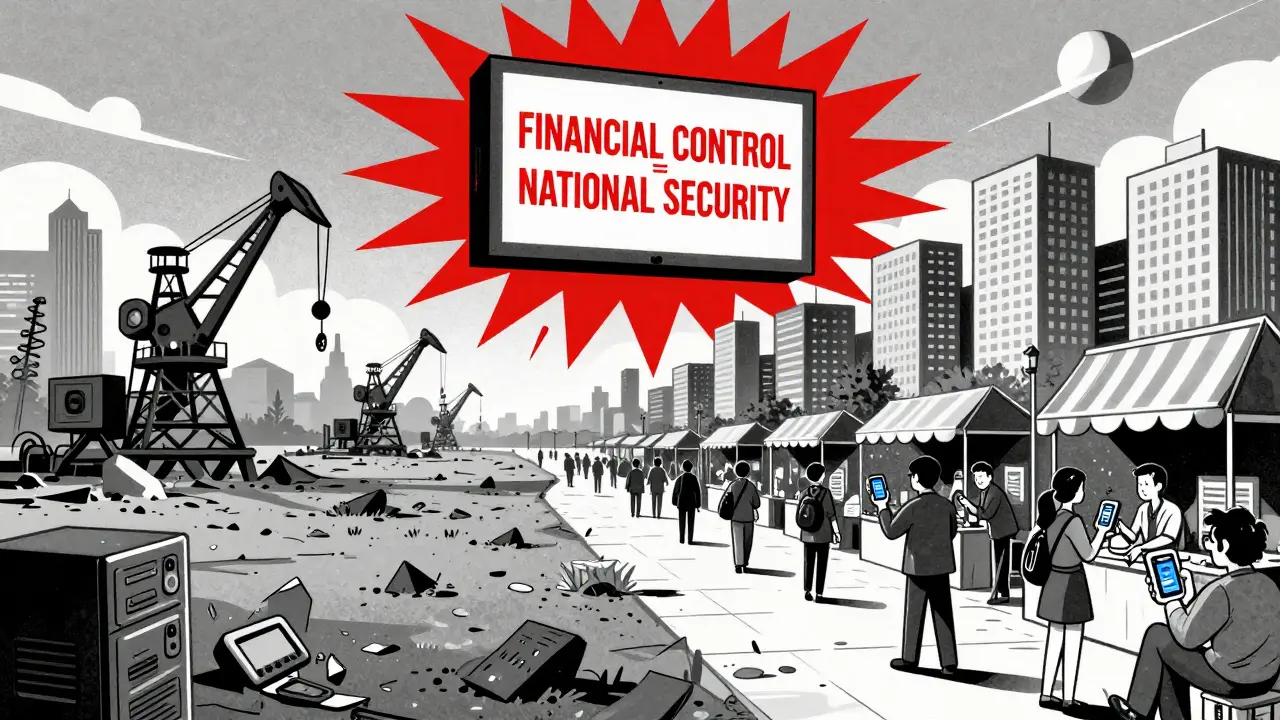
Is There Any Hope for Change?
Don’t count on it. The ban isn’t temporary. It’s permanent policy. The government has invested billions in the digital yuan infrastructure. It’s training banks, schools, and local governments to use it. It’s cutting off funding to any blockchain project that doesn’t align with state control. The 2025 ban wasn’t the end of the crackdown-it was the final step. Before that, there were warnings. Then partial bans. Then exchange shutdowns. Then mining crackdowns. Now, there’s nothing left to ban. It’s all gone. The few voices calling for reconsideration are drowned out. The official line is clear: crypto is a financial risk. The digital yuan is national security.What Does This Mean for You?
If you’re in China: don’t touch crypto. Not even to look at it. The risk isn’t just losing money. It’s losing your freedom. If you’re outside China: don’t try to sell crypto services to Chinese customers. Even if you think you’re doing it from abroad, Chinese regulators will find you. They’ve got tools to track traffic, block domains, and pressure payment processors. If you’re a business owner: focus on blockchain applications that serve government or enterprise needs-supply chain tracking, identity verification, document authentication. That’s where the money and legal protection are. China didn’t just ban crypto. It rewrote the rules of money. And it’s not looking back.Is it illegal to own Bitcoin in China?
Owning Bitcoin or any cryptocurrency isn’t explicitly criminalized, but it’s not protected either. You can hold it, but if you’re caught trading, mining, or using it to pay for things, you face penalties. Courts won’t help you recover lost funds. Any profits are considered illegal and can be seized. In practice, holding crypto is risky and unsupported by law.
Can I mine cryptocurrency in China?
No. All cryptocurrency mining is illegal nationwide. Authorities have shut down thousands of mining farms since 2021. New mining operations are blocked at the power grid level. Even small-scale mining with one or two rigs is considered illegal. Equipment is confiscated, and operators can face fines or criminal charges.
Can I use crypto to pay for goods in China?
No. Businesses cannot accept cryptocurrency as payment. Banks and payment processors like Alipay and WeChat Pay are forbidden from processing crypto transactions. Any attempt to use crypto to buy something-even online-is a violation of Circular No. 237 and can lead to penalties for both buyer and seller.
Is the digital yuan the same as Bitcoin?
No. The digital yuan (e-CNY) is a central bank digital currency issued and controlled by the People’s Bank of China. It’s fully traceable, government-backed, and tied to the Chinese yuan. Bitcoin is decentralized, anonymous, and not issued by any government. China promotes the digital yuan as a tool for financial control and rejects Bitcoin as a threat to that control.
Can foreigners trade crypto in China?
No. The ban applies to everyone in China, regardless of nationality. Foreigners visiting, working, or living in China are subject to the same rules as Chinese citizens. Using a VPN to access foreign exchanges or trading crypto on your phone while in China can lead to fines, deportation, or criminal charges.
What’s the difference between blockchain and cryptocurrency in China’s view?
China distinguishes sharply between the two. Blockchain is seen as a useful technology for improving efficiency in government services, supply chains, and public records. It’s supported and funded by state-backed projects. Cryptocurrency, however, is viewed as a destabilizing, speculative asset that undermines financial control. The government promotes blockchain while actively destroying the crypto ecosystem.
Are there any legal crypto exchanges in China?
No. All domestic cryptocurrency exchanges were shut down by 2021. As of 2025, there are zero licensed crypto exchanges operating within mainland China. Any platform claiming to serve Chinese users is either operating illegally or targeting users outside China-like in Hong Kong or overseas.
Can I invest in crypto through offshore platforms while living in China?
Technically, you can access offshore platforms using a VPN, but it’s still illegal under Chinese law. The government considers any crypto transaction-even if conducted abroad-as a violation if you’re a resident. Authorities actively block access to foreign exchanges, monitor financial transfers, and penalize users who engage in crypto activity, regardless of where the platform is based.
What happened to crypto mining in China?
China used to be the world’s top mining hub, responsible for over 70% of Bitcoin mining. Starting in 2021, the government began shutting down mining farms, cutting off electricity, and enforcing strict energy consumption rules. By 2025, all mining operations-large and small-were eliminated. Mining equipment was seized, and operators faced fines or criminal charges. Today, there is no legal crypto mining in mainland China.
Will China ever legalize cryptocurrency again?
It’s extremely unlikely. The 2025 ban is the final step in a multi-year strategy to eliminate private digital currencies and replace them with the state-controlled digital yuan. The government has invested heavily in CBDC infrastructure and sees crypto as incompatible with its financial control goals. There are no signs of policy reversal, and officials continue to frame crypto as a threat to economic stability.
Comments
Vincent Cameron
China’s move isn’t just about control-it’s about rewriting the social contract of money. For centuries, money was a tool of the state, then it became a tool of the market. Now, with the digital yuan, the state is reclaiming it as a tool of surveillance. Bitcoin wasn’t just a currency; it was a protest. A way to say, ‘I don’t trust you with my money.’ And now they’ve erased that protest with a swipe of a policy document. The real tragedy? Most people never even knew they had a choice.
They didn’t ban crypto because it was risky. They banned it because it was free. And freedom, in their eyes, is the only thing more dangerous than a hack.
I wonder if future historians will look back at this as the moment the internet lost its soul.
Or maybe they’ll just call it ‘The Great Financial Purge’ and move on.
Either way, we’re living through the end of an era. Not with a bang, but with a compliance form.
And we all signed it by doing nothing.
December 4, 2025 at 15:29
Yzak victor
Man, I get why they did it. I really do. I’ve seen how crypto scams ruin families, how people bet their rent money on Dogecoin and end up sleeping in their cars. And yeah, the government’s got a point-when your whole economy’s built on control, decentralized cash is a nightmare.
But still… I feel bad for the miners. I met one guy in Sichuan last year-built a whole farm outta old PS5s and AC units. He said it was the only thing keeping his town alive after the factories closed. Now? His rigs are scrap metal. His name’s on some blacklist.
It’s not just about ideology. It’s about people. And I don’t think anyone’s asking what happens to them.
December 5, 2025 at 04:51
Holly Cute
Oh wow, look who’s suddenly a libertarian martyr-‘Bitcoin was freedom!’ lol. You people act like crypto was some sacred truth, not a glorified pyramid scheme with better marketing. The digital yuan is literally better in every way: faster, cheaper, traceable, and actually backed by a real economy. You’re crying because your speculative gambling tokens got banned, not because you ‘lost freedom.’
Also, ‘mining in a garage’? Bro, you’re not a pioneer, you’re a power-hog. China saved the planet from your electricity-wasting hobby. You should be thanking them.
And don’t even get me started on ‘foreigners can’t trade’-you think you’re special? You’re not. You’re just a tourist with a wallet full of delusion. Get over it. The future is centralized, efficient, and boring. Deal with it. 😒
December 7, 2025 at 03:30
Josh Rivera
Let me get this straight: China bans crypto, and suddenly everyone’s acting like they’re in a dystopian sci-fi movie? Newsflash: this isn’t Orwell-it’s just common sense. You don’t let random people run unregulated financial systems in your country. You don’t let people hide money from taxes. You don’t let criminals use digital cash to buy drugs and kids’ toys on the dark web.
And now you want to cry because you can’t buy Shiba Inu while sipping boba in Shanghai? Sweetheart, you’re not oppressed-you’re just broke and bad at investing.
The digital yuan is like a credit card with a conscience. It doesn’t let you spend money you don’t have. It doesn’t let you scam grandma. It doesn’t let you fund terrorism. And you’re mad about that?
Go cry into your Coinbase app in the US. We’re over here building a functional economy. You’re over there building a casino with blockchain glitter.
December 8, 2025 at 16:39
Chris Jenny
They're not banning crypto... THEY'RE ERASING IT. THE DIGITAL YUAN IS A BACKDOOR TO YOUR SOUL. THEY'RE TRACKING EVERY COFFEE, EVERY TOILET PAPER PURCHASE, EVERY BREATH YOU TAKE. THE GOVERNMENT HAS A MASTER KEY TO YOUR FINANCIAL DNA. THEY'LL FREEZE YOUR ACCOUNT IF YOU THINK THE WRONG THOUGHT. THIS ISN'T GOVERNANCE-IT'S DIGITAL FEUDALISM. THEY'RE USING THE BAN TO CREATE A CULTURE OF FEAR. THE MINERS? THEY'RE DISAPPEARING. THE VPNS? THEY'RE BEING HACKED. THE WHOLE WORLD IS BEING HACKED. YOU THINK HONG KONG IS SAFE? THEY'RE ALREADY PLANNING TO BRING IT INTO THE FOLD. THEY'RE COMING FOR EVERYTHING. YOU'RE NEXT. YOU THINK THIS IS ABOUT MONEY? NO. IT'S ABOUT CONTROL. AND THEY WON'T STOP UNTIL YOU'RE JUST A NUMBER IN A DATABASE. THEY'RE WATCHING. THEY'RE LISTENING. THEY'RE WAITING. DON'T TRUST ANYTHING. NOT EVEN THIS COMMENT. I'M NOT SURE IF I'M REAL ANYMORE.
December 8, 2025 at 18:35