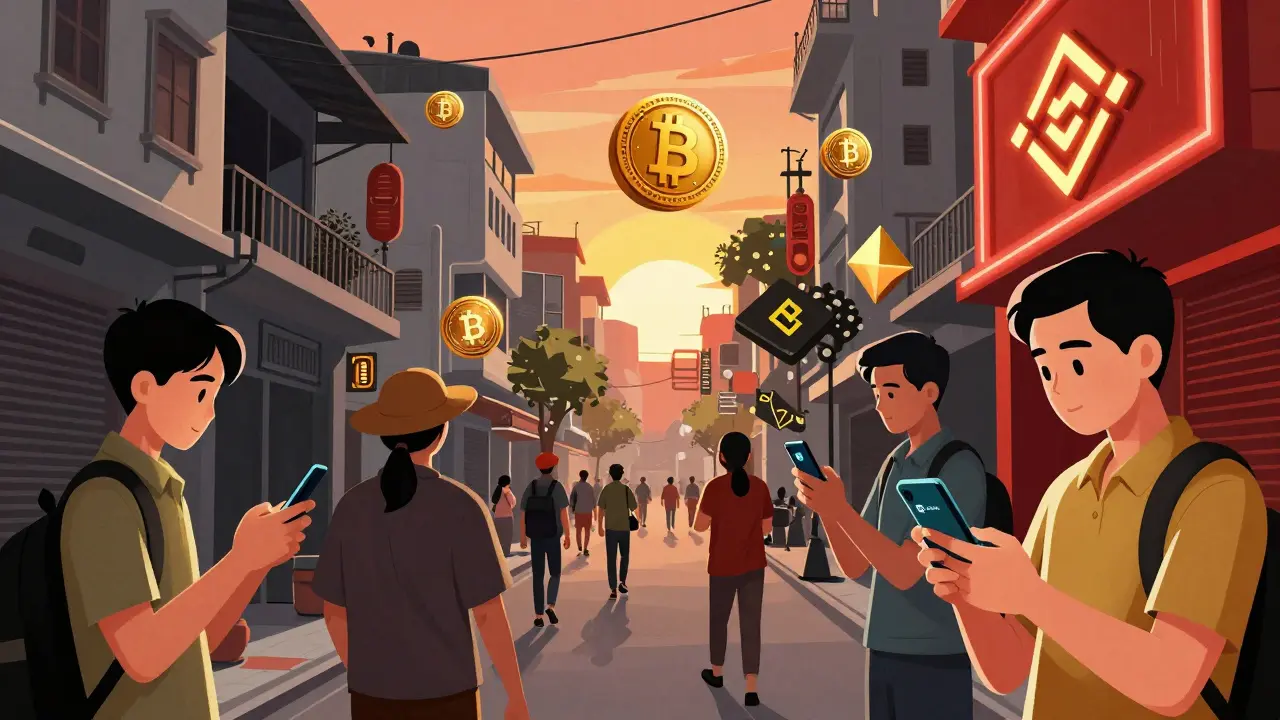
Over 21 million Vietnamese people own cryptocurrency - that’s more than one in five citizens. Yet, the government doesn’t recognize crypto as legal money. So how do they still trade it every day? The answer isn’t hidden in dark web forums or offshore shells. It’s in plain sight: VND-based P2P networks, local e-wallets, and global exchanges that learned to speak Vietnamese.
Why Vietnam’s Crypto Market Is Different
Vietnam isn’t like the U.S. or Europe. There’s no official crypto exchange you can open an account with at your local bank. No regulated platform approved by the State Bank. That changed in January 2025, when the government launched Resolution 05/2025 - a five-year pilot program that allows only five licensed exchanges to operate. But even then, these aren’t your typical crypto platforms. They must use Vietnamese dong (VND), limit foreign ownership to 49%, and carry at least VND 10 trillion ($380 million) in capital. Only big players - banks, state-linked firms - can even apply. That’s why most Vietnamese traders don’t use local exchanges. They use global ones. Binance, Bybit, MEXC, Bitget, and HTX handle 95% of trading volume. Why? Because they’ve built bridges directly into Vietnam’s financial system. They don’t wait for permission. They adapt.How You Deposit VND - The Real Way
You can’t wire dollars to a crypto exchange and expect it to work in Vietnam. The system runs on VND. And the easiest way to get it in? Peer-to-peer (P2P) trading. Here’s how it works: You pick a seller on Binance’s P2P marketplace. They list BTC for VND. You pay them via MoMo, ZaloPay, or VNPay - apps every Vietnamese person uses for daily payments. The seller releases the crypto once they see the money hit their account. Done in under 10 minutes. No bank forms. No waiting. No questions asked - unless you’re moving over VND 100 million ($4,000) in one go. Then your bank might freeze your account. That’s why smart traders split large deposits into smaller chunks. Five transfers of VND 80 million? No problem. One transfer of VND 500 million? Expect a call from your bank. Some users report account freezes after just one large deposit. It’s not illegal - it’s just how Vietnam’s banking system reacts to sudden crypto-linked activity.The Top Platforms Vietnamese Traders Actually Use
Not all exchanges are equal here. Here’s what works:- Binance: Handles 45% of all Vietnamese crypto trading. Offers VND deposits via 28 local banks, MoMo, ZaloPay, and P2P. Lowest spreads on BTC/VND. But customer service can take 72 hours during crashes.
- Bybit: The go-to for futures. 68% of Vietnamese trading volume here is perpetual contracts. Offers 25x leverage (the legal cap). 4.3/5 rating on Trustpilot. Withdrawal limits kick in during volatility.
- MEXC & KuCoin: Best for new tokens and low fees (0.02% spot). Fewer VND options, but cheaper for advanced traders who already have crypto.
- OKX: Publishes monthly proof-of-reserves. Lower fees than Binance. But many users report KYC failures - mismatched ID photos, facial recognition rejects.
- Remitano: Simple for beginners. Only P2P. No futures. No advanced tools. But no security features either. 4,200 fraud cases reported in Q3 2025.
- Kraken & Coinbase: Safe, but no direct VND. You need to buy crypto elsewhere first, then transfer. Not practical for most.

KYC: The Hurdle No One Talks About
You need to prove you’re you. In Vietnam, that means your National ID (CMND/CCCD). Every major exchange now uses facial recognition that matches your ID photo against live video. Sounds simple? It’s not. Many users report failed verifications because:- Their ID photo is old or blurry
- They’re wearing glasses or a hat
- The lighting in their room doesn’t match the system’s requirements
- They used a photocopy instead of the original
Trading: Spot, Futures, and the 25x Limit
Most Vietnamese traders don’t just buy and hold. They trade. And they love leverage. Bybit’s data shows 68% of all trading volume in Vietnam comes from perpetual futures. That’s contracts that let you bet on price moves without owning the asset. It’s risky - but it’s also how people make fast money. The government capped leverage at 25x. That’s still high. For comparison, the U.S. allows 10x on most platforms. Vietnamese traders use it. But they’re not reckless. Most limit their position size to 5% of their account. Why? Because margin calls happen fast. Spot trading (buying actual BTC, ETH, SOL) is growing too. Especially with Binance’s “Vietnam Summer” campaign in 2025, which gave out $5 million in free BTC to 250,000 users. That’s how you get new people in.What No One Tells You About Taxes
Vietnam taxes crypto gains at 22%. That’s higher than the U.S. But here’s the catch: no exchange gives you a tax report. You have to track every trade - buys, sells, swaps - yourself. That means exporting your trade history from Binance, Bybit, and any other platform you use. Then matching each transaction to the VND value at the time. No automation. No app does this correctly for Vietnam yet. Many traders use Excel. Some hire accountants. A few just ignore it - until the Ministry of Finance starts auditing. Circular 15/2025/TTC-BTC, released in September 2025, says any transaction over VND 200 million ($8,000) must be reported. That’s not a suggestion. It’s coming.
Support, Language, and Community
You won’t find 24/7 English support on a Vietnamese exchange. But you will find Vietnamese-speaking support on Binance and Bybit. Average response time? 15 minutes. On Kraken? 4 hours. And it’s all in English. The real help comes from community. There are 12 active Vietnamese Telegram groups with 5,000 to 50,000 members. The biggest? “Crypto Vietnam Official” with 48,200 members. They share tips, warn about scams, and post live trade signals. YouTube is huge too. Channels like “Tiền Ảo TV” have 285,000 subscribers. They break down market moves in simple Vietnamese. No jargon. No hype. Just charts and prices.What’s Coming Next
By early 2026, everything changes again. The government is rolling out the National Digital Identity system. That means your crypto KYC will be linked to your official government ID - no more uploading photos. Just log in with your digital ID app. Five local exchanges are applying for licenses: SSI Digital, Techcom’s TCEX, VIXEX, VPBank’s VPCrypto, and MBBank’s MB Crypto. But they’re tiny. Combined, they handled less than $500 million in September 2025. Binance did $1.8 billion in a single day. Most experts agree: global exchanges will dominate for years. Why? Trust. Speed. Liquidity. Vietnamese banks are slow. Their tech is outdated. The people who want crypto already know where to go.Final Advice for New Traders
Start small. Use Binance or Bybit. Deposit VND via MoMo or ZaloPay. Do KYC in daylight. Trade spot first. Learn how futures work before using leverage. Never put more than 5% of your savings into one trade. Track every transaction. Save your trade history. And if your bank freezes your account? Don’t panic. Split your next deposit into smaller amounts. Crypto in Vietnam isn’t about waiting for permission. It’s about working around the system - legally, smartly, and with local tools. Millions are doing it. You can too.Is crypto legal in Vietnam?
Crypto isn’t legal tender in Vietnam, but it’s not banned either. Since 2014, the State Bank has said cryptocurrencies aren’t money - but never said you can’t own or trade them. The 2025 pilot program now allows licensed exchanges to operate under strict rules. Trading crypto is legal if you use approved platforms and follow KYC rules.
Can I use Binance in Vietnam?
Yes. Binance is the most popular exchange in Vietnam, with 45% market share. It supports VND deposits via bank transfer, MoMo, ZaloPay, and P2P. It has Vietnamese-language support, local customer service, and integrates with Vietnam’s payment systems. Most traders use it as their main platform.
How do I deposit VND on crypto exchanges?
Use P2P trading on Binance, Bybit, or MEXC. Find a seller who accepts MoMo, ZaloPay, or VNPay. Pay them directly through the app. Once they confirm receipt, they release the crypto. Avoid large single transfers - split deposits under VND 100 million ($4,000) to avoid bank freezes.
Why is my KYC failing on crypto exchanges?
Most failures happen because of poor lighting, wearing glasses, using old ID photos, or taking screenshots instead of live photos. Use the official app, not a browser. Do KYC in daylight near a window. Remove accessories. Look straight at the camera. Don’t smile. Match your ID exactly - even small differences cause rejections.
Do I have to pay taxes on crypto in Vietnam?
Yes. Vietnam taxes crypto profits at 22%. No exchange gives you a tax report. You must track every trade manually - buys, sells, swaps - and calculate gains in VND. Use Excel or accounting software. Starting in 2026, transactions over VND 200 million ($8,000) must be reported to authorities. Ignoring taxes is risky.
What’s the best crypto exchange for beginners in Vietnam?
Binance is best for beginners. It has the easiest VND on-ramp, Vietnamese support, and a simple interface. Start with spot trading - buy BTC or ETH with VND. Avoid futures until you understand how leverage works. Use P2P to deposit. Complete KYC in daylight. Join the “Crypto Vietnam Official” Telegram group for help.
Will Vietnam ban crypto in the future?
Unlikely. The government has invested in a five-year pilot program (2025-2029) to regulate, not ban. The 2023 banking restrictions were temporary. Today’s policy is about control, not elimination. With 21 million users and growing, banning crypto would be politically and economically unfeasible. Expect tighter rules, not a ban.
Comments
Lori Quarles
This is insane. I never realized how much crypto was thriving in Vietnam despite the government’s stance. The P2P system using MoMo and ZaloPay is pure genius - it’s like the underground economy but legal and smart. I’m seriously considering moving some funds there just to see how it works. Vietnam’s traders are out here building the future while we’re still arguing about regulations.
January 29, 2026 at 16:29
Jeremy Dayde
Man I’ve been reading this whole thing and I just gotta say the way Vietnamese traders are hacking the system without breaking it is next level they’re not waiting for permission they’re just making it work with what they got like using small transfers to dodge bank freezes that’s not cheating that’s strategy and the fact that they’re using local apps everyone already uses instead of trying to force a Western model that’s just so much smarter than what we do back home we wait for banks to catch up they just bypass them entirely and honestly I’m kinda jealous
January 30, 2026 at 22:31
Steven Dilla
25x leverage? 😱 And people are still alive?! I mean I get it - if you’re smart you limit to 5% but still. The fact that this is happening in a country where the government doesn’t even recognize crypto as money but lets you trade it with 25x leverage? That’s wild. Binance is basically running a parallel financial system here. I’m not even mad. I’m impressed. 🤯
February 1, 2026 at 12:28
Aaron Poole
Really well-researched piece. One thing I’d add - the KYC issues aren’t just about lighting or glasses. Many Vietnamese IDs have older photos taken during military conscription or school registration, and the facial recognition systems aren’t trained on those variations. Also, the ‘no smile’ rule? That’s because smiling changes the shape of your cheeks and eyes, which throws off the algorithm. The real win here is how Binance and Bybit localized their UX - not just language, but flow. They built for Vietnamese habits, not global templates. That’s why they dominate. Other platforms think localization means translating text. These guys rebuilt the entire experience.
February 2, 2026 at 20:13
Andrea Demontis
It’s fascinating how Vietnam’s crypto ecosystem reflects a deeper cultural pragmatism - not rebellion, not revolution, but adaptation. The state says one thing, but the people have built a parallel infrastructure that operates with quiet efficiency. There’s no grand protest, no manifesto. Just millions of individuals using MoMo to send VND to strangers on Binance and getting BTC in return. It’s a silent social contract: you don’t ask for permission, you don’t demand legitimacy, you just make it work. And in doing so, you redefine what ‘legal’ even means. Is this capitalism? Or is it something else - a decentralized folk economy? I’m not sure. But I’m watching.
February 4, 2026 at 09:59
Joseph Pietrasik
so like… crypto is illegal but also not? and you can trade it but not with banks? and you need to pay taxes but no one gives you a report? and your id photo has to be perfect or you get locked out for 7 days? lol. sounds like a bad dream written by a bureaucrat who’s never used a phone. why do we even have laws if everyone just ignores them and uses zalo pay instead?
February 4, 2026 at 11:59
Rachel Stone
So… the government’s pilot program lets 5 banks run crypto exchanges… but Binance does more in a day than all of them combined? Yeah. That’s not regulation. That’s a comedy skit.
February 4, 2026 at 17:20
Nickole Fennell
WAIT. So you’re telling me someone in Hanoi can buy Bitcoin with their lunch money via ZaloPay and no one bats an eye… but if they try to deposit $10,000 in one go, their bank freezes everything? And the government’s solution is… a five-year pilot? Are you kidding me?! This isn’t innovation - it’s chaos with a nice UI. I’m terrified for the next crash. What happens when 21 million people wake up and realize their ‘safe’ P2P seller vanished? 😭
February 6, 2026 at 16:09