
Imagine spending months building a crypto product, only to realize overnight that your home jurisdiction just banned the feature you built. It happens more often than you’d like to admit. The global cryptocurrency regulation is a rapidly shifting landscape of legal frameworks governing digital assets isn’t static. In 2025, we saw massive swings-from the US pivoting away from enforcement-heavy tactics to the EU fully implementing MiCA. Now, in 2026, the dust has settled enough to see patterns, but not enough to relax.
If you are a founder, a compliance officer, or even a serious investor, staying informed isn’t just about reading news headlines. It’s about understanding how specific rules in one country impact your ability to operate globally. You need a system to track these changes before they become costly fines or blocked bank accounts.
The Shift in the United States: From Chaos to Clarity?
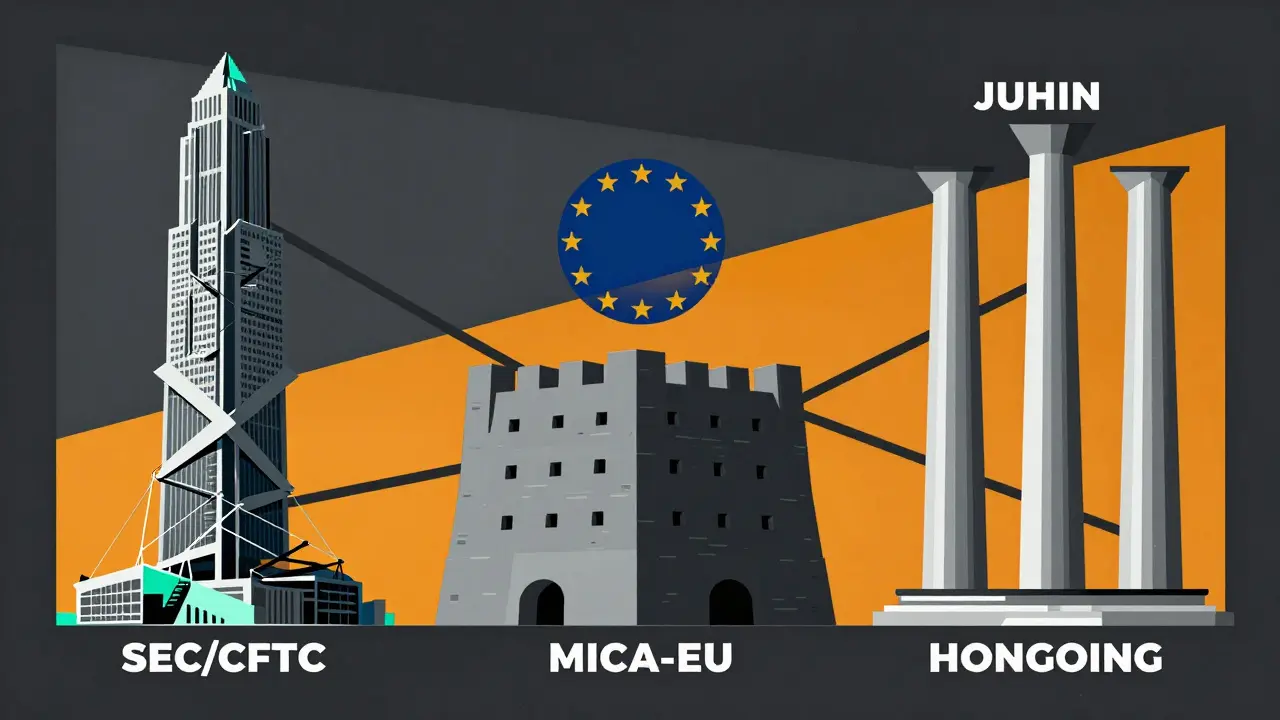
The US regulatory story in 2025 was dramatic. For years, the industry operated under "regulation by enforcement," where agencies like the Securities and Exchange Commission (SEC) is the primary federal agency responsible for enforcing securities laws in the United States would sue companies into compliance. That changed sharply in early 2025.
On January 23, 2025, an executive order established an inter-agency task force aimed at providing "regulatory clarity." By February, the SEC closed investigations into major platforms like OpenSea and Robinhood without further action. They even dismissed claims against Coinbase. Perhaps most surprisingly, the SEC announced that memecoins would no longer be considered securities. This signaled a move toward distinguishing between speculative tokens and actual investment contracts.
However, don’t mistake this for a free-for-all. Legislative progress accelerated with bills like the Stablecoin Trust Act is proposed legislation requiring federal licensing and strict reserve transparency for stablecoin issuers. If passed, this would mandate segregated reserves and audits overseen by the Federal Reserve and the Office of the Comptroller of the Currency (OCC). Meanwhile, the Financial Innovation and Technology for the 21st Century (FIT) Act proposed a dual-regulatory framework, splitting oversight between the SEC for securities-like tokens and the Commodity Futures Trading Commission (CFTC) is the federal agency regulating futures and options markets, including commodity-based digital assets for commodities.
Even with this softer tone, enforcement still bites. OKX pleaded guilty to operating an unlicensed money business in February 2025, agreeing to substantial fines. The lesson? The US is trying to build a framework, but until comprehensive federal law passes, state-level money transmitter licenses remain a minefield. You must track both federal legislative drafts and state-specific requirements.
Europe’s MiCA: The New Global Standard
While the US debated, Europe acted. The Markets in Crypto-Assets Regulation (MiCA) is a comprehensive European Union regulation establishing unified rules for crypto-asset service providers became the cornerstone of EU crypto policy in 2025. Its implementation created a complex web of compliance challenges as firms navigated new licensing requirements.
MiCA requires extensive documentation, capital reserves, and robust consumer protection measures for all crypto-asset service providers (CASPs). The phased rollout meant different rules kicked in at different times, creating a moving target for businesses. But here’s the key insight for 2026: MiCA is becoming the de facto global standard. Many non-EU countries are aligning their rules with MiCA to facilitate cross-border trade with the bloc.
If you operate in Europe, you cannot ignore MiCA. Major financial centers within the EU are competing to attract crypto businesses while strictly adhering to these rules. This means if you get licensed in one member state, you can passport that license across the EU. But if you fail the initial audit, you’re out. Staying informed here means monitoring updates from the European Banking Authority (EBA) and national competent authorities in each member state.
Asia’s Balanced Approach: Hong Kong and Singapore
Asia didn’t wait for Western consensus. In 2025, Hong Kong SAR is a special administrative region of China positioning itself as a leading digital asset hub in Asia and Singapore is a sovereign city-state known for its progressive yet strict financial regulatory framework emerged as leaders in balancing innovation with risk management.
Hong Kong introduced new licensing regimes for exchanges, covering over-the-counter trading and custody services. Regulators actively reviewed rules for crypto derivatives and lending, drafting strict stablecoin requirements. Singapore finalized its stablecoin framework, maintaining rigorous licensing for crypto firms. Both jurisdictions aim to attract international businesses while protecting investors.
For global operators, Asia offers a clear alternative to US uncertainty and EU complexity. However, the rules are strict. Singapore’s Monetary Authority (MAS) does not tolerate ambiguity. If you’re targeting Asian users, you need to understand local licensing nuances. Staying informed here involves tracking announcements from the Securities and Futures Commission (SFC) in Hong Kong and MAS in Singapore.
International Standards: FATF, BIS, and FSB
National laws matter, but international standards dictate how banks interact with crypto. The Financial Action Task Force (FATF) is the global authority on anti-money laundering and counter-terrorist financing standards remains the most critical body for compliance. Their "travel rule" guidance, updated extensively in 2025, requires exchanges to share sender and receiver information for transactions above certain thresholds.
Non-compliance with FATF recommendations can lead to a jurisdiction being placed on a "grey list," which scares away traditional banking partners. Additionally, the Bank for International Settlements (BIS) is the central bank coordination body developing frameworks for Central Bank Digital Currencies (CBDCs) and the Basel Committee on Banking Supervision (BCBS) are setting capital requirements for banks exposed to crypto assets. These bodies don’t write laws, but they influence them. When the BCBS says banks need more capital for crypto exposure, banks stop offering crypto services. That’s indirect regulation, and it’s powerful.
Practical Steps to Stay Informed in 2026
So, how do you actually keep up? Reading random tweets won’t cut it. You need a structured approach.
- Subscribe to Official Sources: Don’t rely on second-hand news. Subscribe to newsletters from the SEC, EBA, MAS, and SFC. They publish draft rules and comment periods directly.
- Monitor Legislative Databases: Use tools like Congress.gov for US bills or EUR-Lex for EU directives. Set alerts for keywords like "stablecoin," "digital asset," and "virtual currency."">
- Join Industry Associations: Groups like the Blockchain Association or the European Blockchain Association provide briefings and lobby for clearer rules. They often summarize complex legal texts into actionable insights.
- Track Enforcement Actions: Watch for lawsuits and settlements. As seen with OKX, enforcement reveals what regulators consider unacceptable behavior, even when laws are vague.
- Consult Legal Experts Regularly: Regulations change faster than your internal team can digest them. Quarterly reviews with specialized crypto counsel are essential.
Common Pitfalls to Avoid
Many businesses fail because they assume compliance is a one-time setup. It’s not. Here are common mistakes:
- Ignoring State-Level Rules in the US: Assuming federal clarity covers everything. Money transmitter licenses vary by state, and some states have stricter rules than others.
- Underestimating MiCA’s Scope: Thinking MiCA only applies to exchanges. It covers issuers, wallet providers, and even some DeFi protocols depending on interpretation.
- Neglecting Travel Rule Compliance: Assuming peer-to-peer transactions are exempt. FATF guidance is expanding, and banks will demand proof of compliance.
- Failing to Update KYC/AML Procedures: FinCEN’s 2025 proposals deemed Bitcoin and Ether as monetary instruments, triggering new reporting obligations. Your old procedures may be obsolete.
Looking Ahead: What’s Next?
The trend for late 2026 and beyond points toward greater international coordination. Cross-border transaction monitoring will become tighter. We expect more countries to adopt MiCA-like frameworks. The US may finally pass comprehensive federal legislation, particularly around stablecoins.
But the core challenge remains: regulating borderless technology with territorial laws. Decentralized finance (DeFi), NFTs, and emerging blockchain applications continue to outpace regulation. Your strategy must be adaptive. Build compliance into your product design, not as an afterthought. Stay curious, stay cautious, and stay informed.
What is MiCA and why does it matter for global crypto businesses?
MiCA (Markets in Crypto-Assets Regulation) is the EU’s comprehensive framework for crypto assets. It matters globally because many countries are aligning their regulations with MiCA to facilitate trade with Europe. Compliance includes licensing, capital reserves, and consumer protection measures.
How did US crypto regulation change in 2025?
The US shifted from "regulation by enforcement" to seeking clearer frameworks. The SEC closed several high-profile investigations and excluded memecoins from securities classification. However, legislative efforts like the Stablecoin Trust Act and FIT Act are still pending, and state-level rules remain complex.
What is the FATF travel rule?
The FATF travel rule requires virtual asset service providers to share sender and receiver information for transactions above a certain threshold. This aims to prevent money laundering and terrorist financing. Non-compliance can lead to banking restrictions.
Are Hong Kong and Singapore friendly to crypto businesses?
Yes, both jurisdictions are proactive. Hong Kong has introduced licensing for exchanges and custody services, while Singapore has a rigorous but clear framework. They balance innovation with strict investor protection and anti-money laundering requirements.
How can I stay updated on crypto regulations efficiently?
Subscribe to official regulatory bodies (SEC, EBA, MAS), monitor legislative databases, join industry associations, track enforcement actions, and consult legal experts regularly. Avoid relying solely on news media, which may lack nuance.
Comments
Zara Zaman
You think you can just ignore the rules and operate from anywhere? It’s naive. The US is tightening its grip on these digital assets because we need to protect our financial system from foreign exploitation. If you’re not following domestic laws, you’re a threat to national security. Stop pretending this is about freedom when it’s clearly about accountability.
May 14, 2026 at 04:39
Pauline Larocco71
oh i see what u mean but honestly its so hard to keep up with all these changes
i feel like every time i read something new it contradicts what i read yesterday
it makes me really anxious as someone who just wants to invest safely
maybe there should be a simpler way for regular people to understand this stuff without needing a law degree
May 14, 2026 at 23:59
Destiny Kilby
the complexity of international regulations is indeed daunting yet necessary for stability
i have observed that many founders neglect the state-level requirements in the us which leads to severe penalties later
it is crucial to maintain a structured approach to compliance rather than relying on informal advice
one must respect the legal frameworks established by bodies like the sec and eba
ignoring these guidelines is not only risky but also irresponsible towards investors
May 16, 2026 at 23:57
Jerry CUNNINGHAM SR
I appreciate the detailed breakdown of the regulatory landscape here. It is important for us to engage constructively with these evolving frameworks. For those interested in the European perspective, MiCA provides a robust template that other regions might consider adopting. Let us continue to share insights on how we can navigate these challenges together while maintaining high standards of integrity and transparency in our operations.
May 18, 2026 at 10:55
Ruben Michel
The notion that one can simply 'track' regulations as if they were stock prices is fundamentally flawed. True compliance requires an intellectual engagement with the philosophical underpinnings of each jurisdiction's approach. The uninitiated may find the distinction between the SEC's securities classification and the CFTC's commodity oversight trivial, but such ignorance reveals a lack of sophistication. One must cultivate a deep understanding of legal theory to truly master this domain.
May 20, 2026 at 00:47