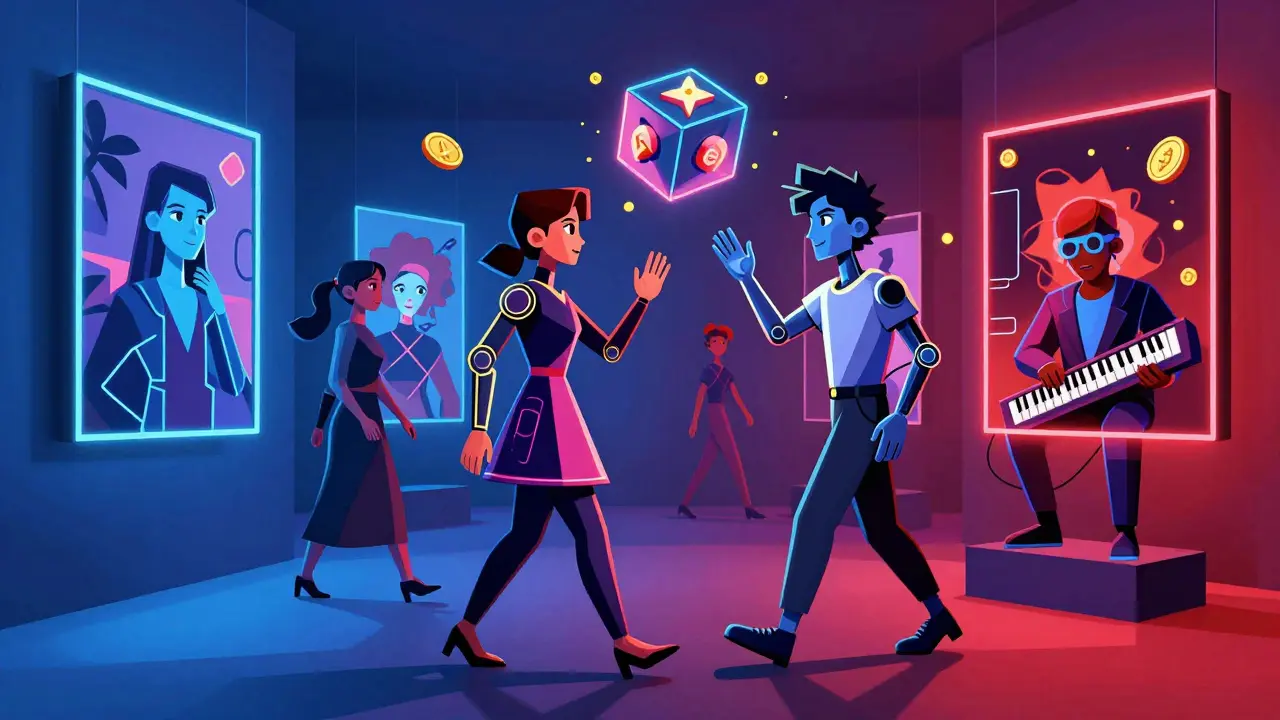
Imagine walking into a virtual art gallery where every painting is owned by someone real - not a company, not an algorithm, but a person who bought it with cryptocurrency and wears it like a jacket. You wave at a friend across the room, your avatar mimicking your real-life gesture. A musician plays a live set in the corner, and you tip them in ETH. No ads. No tracking. Just people, in a world they built together. This isn’t science fiction. It’s the blockchain metaverse - and social interaction here is fundamentally different from anything on Facebook, Instagram, or Zoom.
Avatars That Belong to You
In traditional social media, your profile is a shadow. You post, you like, you scroll - but you don’t own any of it. The platform owns your data, your identity, even your digital face. In the blockchain metaverse, your avatar isn’t just a character. It’s an NFT. That means it’s stored on a public ledger. You control it. You can sell it. You can wear it in one world and take it to another. Some users spend weeks customizing their avatars: choosing facial features, clothing, accessories, even voice modulation. These aren’t just skins. They’re digital identities with real value.One user in Decentraland bought a rare Bored Ape NFT as their avatar and later sold it for 12 ETH after appearing in a virtual fashion show. That’s not just a profile picture - that’s a business asset. And because it’s on the blockchain, the ownership history is public and unchangeable. No one can delete it. No platform can take it away.
Real-Time Social Spaces That Never Sleep
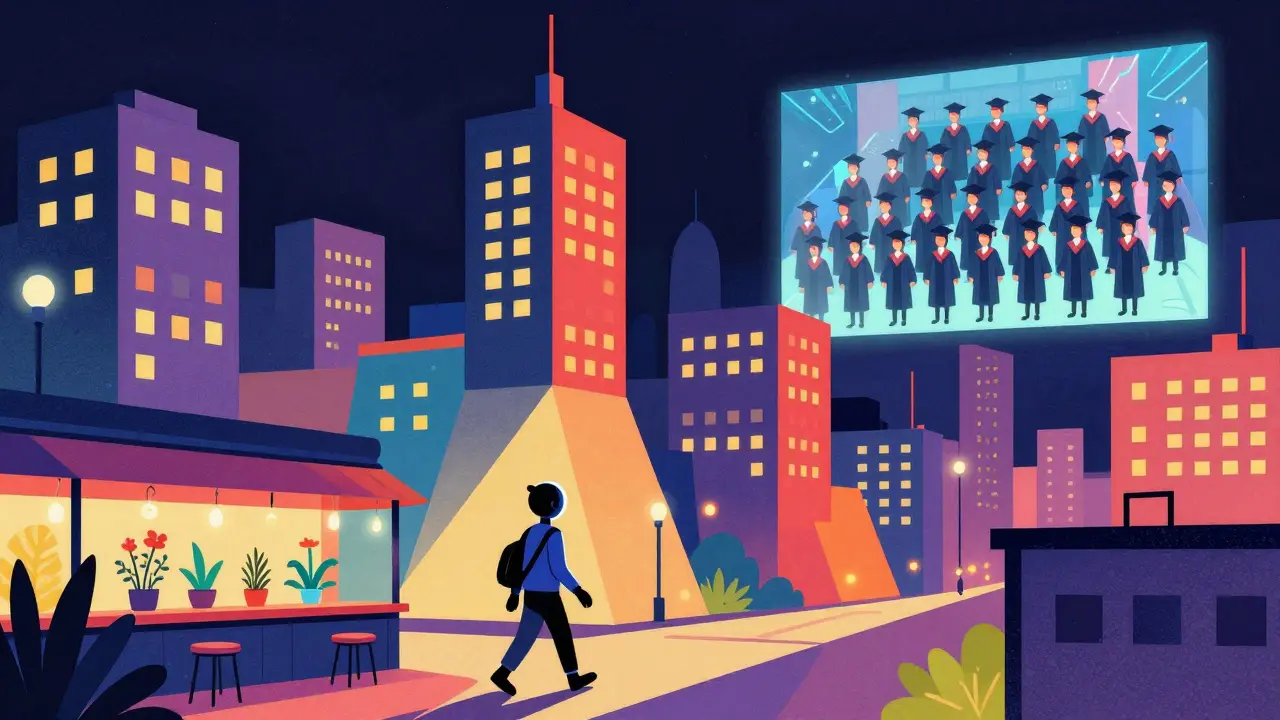
Unlike a Discord server that goes quiet after midnight, or a Zoom call that ends when the timer hits 40 minutes, blockchain metaverse environments are always on. They run on decentralized servers distributed across the globe. Even when you log off, the city you helped build keeps running. Someone else might be walking through your virtual café, admiring the mural you painted, or buying a virtual plant you designed.These spaces aren’t just for hanging out. Businesses host product launches. Artists hold concerts. Schools run virtual classes. In 2024, a university in Singapore hosted its entire graduation ceremony in The Sandbox, with 8,000 attendees using avatars. Graduates received NFT diplomas. Parents from Nigeria, Brazil, and Japan watched together - no flights, no visas, no cost beyond a VR headset.
Real-time interaction is smooth because these platforms use peer-to-peer networking and edge computing. Lag isn’t caused by a single company’s server being overloaded - it’s reduced by distributing the load. Chat is encrypted. Voice is spatial. If you’re standing next to someone in the virtual world, their voice sounds close. Walk ten steps away, and it fades. It feels real because the technology mimics how humans actually experience space.
Virtual Economies You Can Actually Live In
There’s no “play-to-win” here. It’s play-to-earn. And it’s not just for gamers.Users earn cryptocurrency by hosting events, moderating communities, designing virtual real estate, or even just being active. In Somnium Space, users get paid in CUBE tokens for helping newcomers navigate the platform. In Cryptovoxels, artists sell digital paintings as NFTs - some for thousands of dollars. One woman in Berlin turned her virtual flower shop into a full-time job, earning more than she did as a graphic designer.
These economies run on blockchain tokens specific to each platform - MANA, SAND, AXS, or custom coins. You can buy land, build a store, rent it out, or flip it. Unlike in Roblox or Fortnite, where items are locked inside the game, here your assets are yours. You can move them. Trade them. Use them across platforms if the system supports interoperability.
Interoperability is still growing, but it’s happening. Projects like Polygon ID and Chainlink are building bridges between metaverses. Soon, your avatar from Decentraland might walk into a virtual office in Spatial - and bring your NFT suit with you.
Why This Beats Traditional Social Media
Facebook and TikTok make money by selling your attention. They track your clicks, your moods, your friends, your fears - then sell that data to advertisers. There’s no escape.Blockchain metaverses are different. They’re built on open protocols. No single company owns them. You don’t need to give up your email or phone number to join. You use a wallet - like MetaMask or Phantom - and that’s it. Your identity is tied to your public key, not your personal details. You can stay anonymous. Or you can build a reputation.
There are no ads that interrupt your conversation. Instead, businesses sponsor virtual billboards, host pop-up events, or create branded spaces users can choose to visit. You’re not being sold to - you’re being invited. And if you don’t like it? You can leave. No algorithm locks you in.
Community moderation is also decentralized. Instead of one CEO deciding what speech is allowed, users vote on rules. Some platforms use DAOs (Decentralized Autonomous Organizations) to govern behavior. If someone is harassing others, the community can vote to ban them - and that ban applies across all linked worlds.
What’s Holding People Back?
It’s not the tech. It’s the friction.Setting up a crypto wallet for the first time can feel like assembling a Swiss watch blindfolded. You need to back up a 12-word phrase. You need to understand gas fees. You need to know the difference between Ethereum and Polygon. For most people, that’s too much.
High transaction costs during peak times still scare people off. Sending a simple NFT might cost $5 - or $50 - depending on network congestion. That’s not sustainable for casual social use.
VR headsets aren’t cheap. While Meta Quest 3 and Apple Vision Pro are improving, not everyone wants to wear a headset just to chat with friends. Many platforms now offer browser-based access, but the experience isn’t the same. The magic happens in 3D, with spatial audio and full-body movement.
And then there’s the learning curve. Understanding how to buy land, list an NFT, or join a DAO takes time. Most new users give up after a few days. The platforms that survive will be the ones that simplify this - not by removing blockchain, but by hiding it. Think of it like email: you don’t need to know SMTP to send a message. You just click “send.”
Where It’s Headed in 2025
The next 12 months will see three big shifts.First, AI assistants will become standard. Imagine an AI that learns your social habits - knows you prefer quiet spaces, hates loud music, and always hangs out near the art district. It suggests events, introduces you to people with similar interests, and even helps you draft messages in your avatar’s voice. This isn’t sci-fi. It’s already being tested in platforms like Gather.town and Spatial.
Second, enterprise adoption is accelerating. Companies like Walmart, Nike, and BMW are testing virtual showrooms. BMW lets customers customize a car in the metaverse, then test-drive it with friends before buying. Nike’s .SWOOSH platform lets users wear digital sneakers in multiple metaverses - and earn rewards for wearing them.
Third, regulation is catching up. The EU’s MiCA law and U.S. state-level bills are starting to define what digital ownership means legally. In 2025, you might be able to claim your NFT avatar as a personal asset in divorce court - or use it as collateral for a loan.
How to Get Started
You don’t need to be a coder. You don’t need to buy a $1,000 headset. Here’s how to dip your toes in:- Download a crypto wallet like MetaMask or Coinbase Wallet.
- Buy a small amount of ETH or MATIC (under $20) to cover gas fees.
- Visit decentraland.org or thesandbox.com in your browser.
- Create a free account - no email needed. Just connect your wallet.
- Explore. Talk to people. Visit a gallery. Attend a live concert.
- Try customizing your avatar with a free NFT from OpenSea.
Take 15 minutes. Don’t try to understand everything. Just feel it. Notice how different it is to move through a space with someone else - not as a video call, but as two figures walking side by side, looking at the same thing, reacting in real time.
This is the future of social connection - not better screens, not faster internet, but ownership, autonomy, and presence. It’s messy. It’s expensive. It’s hard. But it’s real.
Can you really make money from social interaction in the blockchain metaverse?
Yes - but not like a get-rich-quick scheme. People earn by hosting events, creating digital art, designing virtual real estate, moderating communities, or participating in play-to-earn games. Some earn a few dollars a week. Others run full-time businesses. Success comes from adding value, not just logging in.
Do I need a VR headset to use the blockchain metaverse?
No. Most platforms work on desktop browsers or mobile apps. But if you want the full experience - spatial audio, body movement, immersive environments - a VR headset like Meta Quest 3 makes a huge difference. It’s not required, but it transforms the experience from watching to being there.
Is the blockchain metaverse safe from scams?
It’s as safe as you make it. Scams exist - fake NFT drops, phishing wallets, fake events. But because everything is on the blockchain, you can verify ownership. Never share your private key. Never click links from strangers. Use trusted platforms. And remember: if it sounds too good to be true, it is. The tech is secure. The people? Not always.
Can I use my NFT avatar in different metaverses?
Not yet everywhere - but it’s getting closer. Platforms like Decentraland and The Sandbox are starting to support interoperability through standards like ERC-721 and ERC-1155. Projects like Polygon ID and Chainlink are building bridges. Soon, your avatar might work across multiple worlds - like how your email works across Gmail, Outlook, and Apple Mail.
Why is blockchain necessary for social interaction in the metaverse?
Because it gives users real ownership. Without blockchain, your avatar, your land, your art - all of it belongs to the company running the platform. They can delete it, change the rules, or shut down the server. With blockchain, you hold the keys. Your assets exist independently. That’s what makes social interaction here meaningful - you’re not just visiting a world. You’re helping build and own it.
Comments
roxanne nott
so u just traded ur privacy for a digital jacket? cool. i bet ur nft avatar pays ur rent. lol.
December 22, 2025 at 10:15
Vijay n
blockchain metaverse is just the fed preparing for digital serfdom under the guise of ownership they want you to think you control your avatar but the code is still controlled by devs with private keys and if the chain forks who owns what becomes a legal nightmare wait till the feds freeze wallets claiming terrorism financing
December 23, 2025 at 14:52
Alison Fenske
i walked into a virtual gallery last week and cried because someone had painted their dead dog with glitter and i swear i felt it in my chest like i was standing right there not watching a screen but being there with them and i dont even own a vr headset
December 23, 2025 at 22:31
Jayakanth Kesan
just tried decentraland for 20 mins. no ads no pressure just people talking and a guy playing guitar in a floating bubble. kinda nice. not sure if i wanna live there but i could visit sometimes
December 24, 2025 at 23:58
Tristan Bertles
the real win here isnt the money its the dignity. you get to show up as you not as a profile optimized for clicks. even if its just one person in a virtual room who gets you that matters more than a million likes
December 26, 2025 at 21:13
Earlene Dollie
imagine if your ex still owns your avatar and posts pics of them dancing in it while you try to move on and the whole internet sees it and you cant delete it because its on the blockchain and you paid 3 eth for it and now its your haunted digital ghost
December 28, 2025 at 16:56
Dusty Rogers
the part about spatial audio made me pause. i dont even know how to describe how real that feels. like when someone walks past you in a virtual room and their voice fades just right. its the little things that make it stick
December 30, 2025 at 06:55
Kevin Karpiak
india is already running on crypto scams and now you want us to build entire economies on it? this is how the next tulip mania starts and youll be the one begging for your nft back while the usa takes your data and your kids taxes
December 30, 2025 at 13:22
Amit Kumar
in india we dont need vr to feel presence. we sit cross legged on the floor with 12 cousins and 3 phones playing the same video and laugh till we cry. the blockchain metaverse is just the west trying to monetize what we already do for free. but hey if it helps someone feel less alone then i say welcome. just dont charge me 50 bucks to cry in your digital temple
December 30, 2025 at 17:17
Shubham Singh
you call this innovation? this is the digital equivalent of a 19th century aristocrat commissioning a portrait of themselves holding a goat while pretending to be a peasant. the only thing decentralized here is the delusion. your avatar is not your identity. it is a vanity metric wrapped in blockchain snake oil. and you paid for it. with real money. in a world where children go hungry. how noble.
December 30, 2025 at 18:25