What Exactly Is a Nonce?
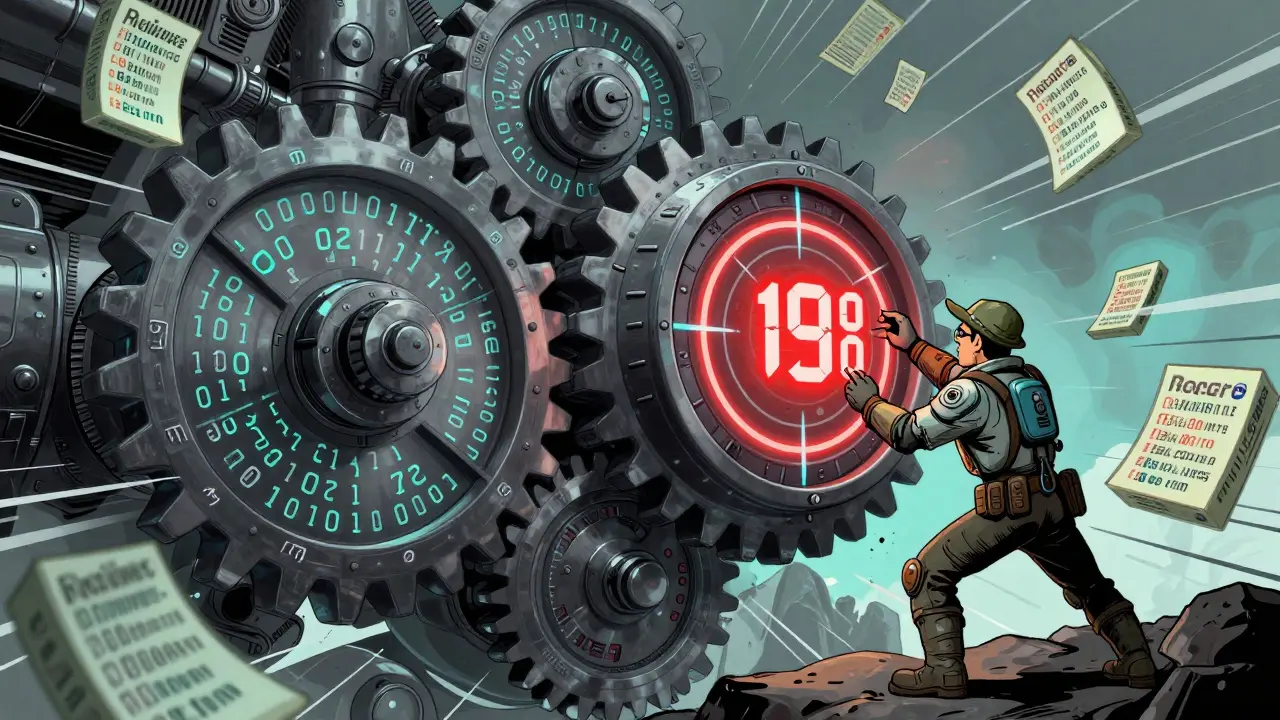
A nonce is a 32-bit number-just a random value between 0 and 4,294,967,295-that miners change over and over until they find one that makes the block’s hash meet the network’s target. It’s not magic. It’s not secret. It’s just a number you tweak until the math works out. This is the core of Bitcoin’s proof-of-work system, designed by Satoshi Nakamoto in 2008 to secure the blockchain without needing a central authority.
Think of it like rolling a die over and over until you get a six. Only here, the die has 4.3 billion sides, and you need the result to start with 19 zeros in hexadecimal. Every time you roll (change the nonce), you get a new hash. Most rolls fail. Only one in trillions works.
How Miners Build the Block Header
Miners don’t just guess nonces randomly. They start by assembling a block header with six key pieces of data:
- Version number (current Bitcoin uses version 4 or higher)
- Hash of the previous block (this links it to the chain)
- Merkle root (a digital fingerprint of all transactions in the block)
- Timestamp (current time, within a two-hour window of network time)
- Difficulty target (the number of leading zeros the hash must have)
- The nonce (the only part miners can freely change)
This header is fed into the SHA-256 algorithm-not once, but twice (double-SHA-256). The output is a 64-character hexadecimal string. If that string is smaller than the target (meaning it has enough leading zeros), the block is valid. If not, the miner changes the nonce and tries again.
Why the Nonce Isn’t Enough Anymore
Modern ASIC miners can try 300 terahashes per second. That’s 300 trillion guesses every second. With only 4.3 billion possible nonces, they burn through the entire range in less than a second. So what happens when the nonce is used up?
Miners don’t give up. They tweak other parts of the block header. The most common trick is changing the extra nonce inside the coinbase transaction-the first transaction in every block that pays the miner. This tiny change alters the Merkle root, which changes the entire block header, giving them a fresh set of 4.3 billion nonces to try. It’s like resetting the die after you’ve rolled every side.
Some miners also adjust the timestamp slightly or modify the version field using techniques like ASICBOOST. These aren’t flaws-they’re clever adaptations to the system’s limits. The original Bitcoin design didn’t expect mining to scale this fast. But the protocol didn’t break. It evolved.
The Math Behind the Target
The difficulty target isn’t fixed. It changes every 2,016 blocks-roughly every two weeks-to keep Bitcoin’s block time at 10 minutes on average. As more miners join the network, the target gets harder. As miners leave, it gets easier.
As of December 2024, the target required hashes to begin with 19 leading zeros. That’s a difficulty level of 87.16 trillion. In other words, miners must find a hash that’s less than 1 in 87 trillion possible outcomes. The odds are so low that even with 180 exahashes per second of global computing power, it still takes 10 minutes on average to find a winner.
This isn’t just about security-it’s about predictability. The system ensures blocks come out steadily, even as the network grows. No one can rush it. No one can slow it down. The math enforces the pace.
What Happens When You Find It?
When a miner finally finds a valid nonce, they broadcast the block to the network. Other nodes instantly check the hash. They don’t need to guess. They just recompute it using the same header and nonce. If it matches, they accept the block. It’s added to their copy of the blockchain. The miner gets the block reward (6.25 BTC as of 2024) plus all transaction fees in that block.
It’s a race. Thousands of miners are trying at the same time. Only one wins. The rest lose their computational effort. That’s why mining is called a lottery. The only advantage you have is more machines. More power. More electricity.
Why This System Still Works
Bitcoin’s nonce-finding mechanism isn’t elegant. It’s brute force. It’s wasteful. It uses more electricity than Argentina. But it works.
The cost of attacking Bitcoin is astronomical. To take over the network, you’d need to control more than half the global hashrate. As of December 2024, that would cost over $10 billion in hardware and $300 million a month in electricity. And even then, you couldn’t steal coins-you could only delay new blocks. The system is designed so that cheating is more expensive than playing fair.
That’s the real genius. You don’t need to trust anyone. You just need to trust the math-and the money people are willing to spend to get it right.
How Mining Has Changed Since 2009
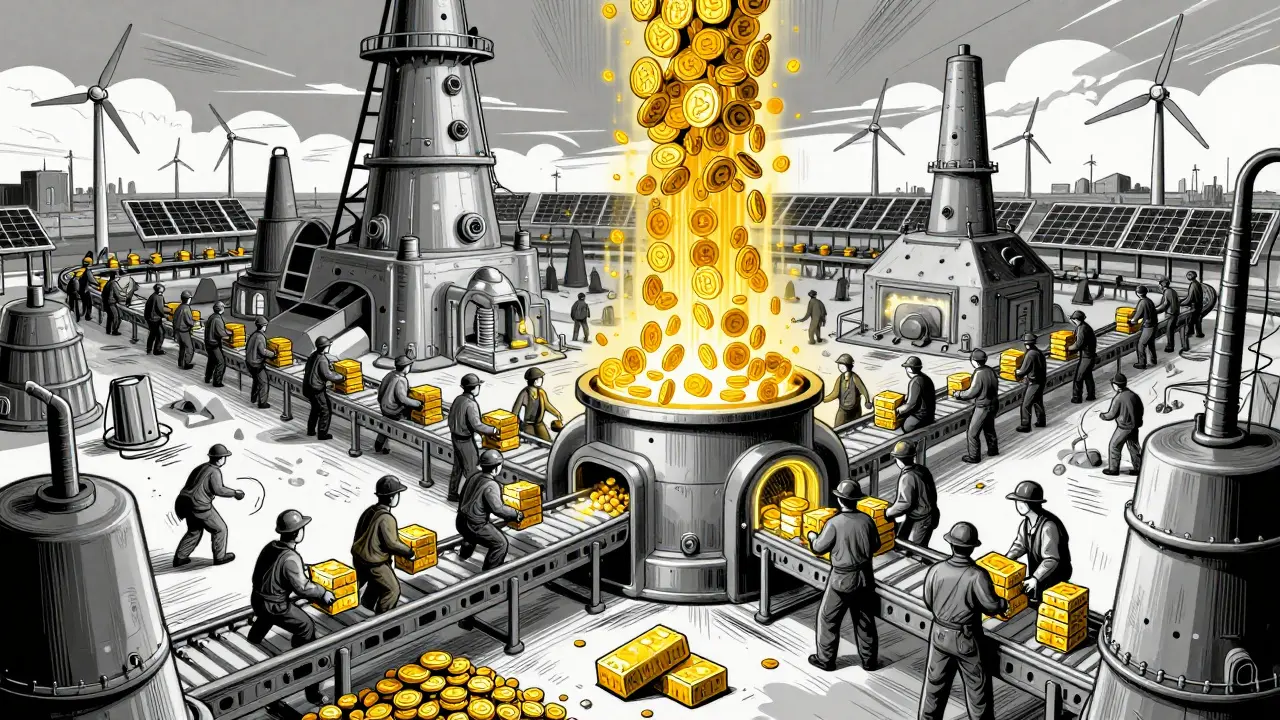
In 2009, a regular CPU could mine Bitcoin. A nonce search took minutes. Now, it takes nanoseconds. The tools have changed. The scale has exploded. But the core idea hasn’t.
Today, mining is industrial. The average home miner with a $5,000 ASIC has almost zero chance of finding a block alone. Most now join mining pools-groups that combine computing power and split rewards. F2Pool, Foundry USA, and Antpool handle over 58% of the network’s hashrate.
Even pools rely on the same nonce system. They just divide the work. One miner tries nonces 0-1 billion. Another tries 1-2 billion. They report partial solutions called “shares.” If one of them finds the full solution, the pool pays everyone based on how much work they contributed.
Is There a Better Way?
Ethereum switched to proof-of-stake in 2022, eliminating mining entirely. Cardano, Solana, and others use similar systems. They’re faster. They use less power. But they rely on validators holding large amounts of cryptocurrency. That’s a different kind of centralization.
Bitcoin’s proof-of-work is the only system where security is backed by real-world energy and hardware. No one can fake it. No one can game it without spending billions. That’s why, despite its flaws, it’s still the most trusted digital asset in the world.
What’s Next for Nonce Mining?
The Bitcoin protocol is quietly evolving. Proposals like Miner Extended Commitment Field (MECF) aim to add more entropy to the block header, reducing the need for constant extra nonce changes. Upgrades like Taproot have made transactions more complex, slightly increasing the time to calculate Merkle roots-but not enough to slow miners down.
Renewable energy is becoming the norm. Over 62% of Bitcoin mining now runs on sustainable sources, according to the Bitcoin Mining Council. Texas, with cheap wind and solar power, hosts 42% of global mining.
But the nonce remains. It’s still the key. The only thing miners change to make the hash work. And as long as Bitcoin exists, someone will keep guessing it.
What happens if a miner finds a valid nonce but the block is rejected?
If a miner finds a valid nonce but the block is rejected, it’s usually because another miner found a block first and broadcasted it to the network. Bitcoin’s rule is simple: the longest valid chain wins. Even if your block is technically correct, if it’s not on the main chain, it’s orphaned. You don’t get the reward. This is normal. Miners expect to find valid blocks that never make it into the blockchain. That’s just part of the lottery.
Can you mine Bitcoin with a regular computer today?
No. Modern Bitcoin mining requires ASIC miners-specialized hardware built only for SHA-256 hashing. A typical gaming PC might do 50 megahashes per second. An ASIC like the Antminer S21 does 335 terahashes per second-that’s 6,700 times faster. Even if you could run the software, your electricity cost would be higher than any possible reward. Solo mining with consumer hardware hasn’t been profitable since 2013.
Why does the nonce have to be 32 bits? Could it be longer?
The 32-bit nonce was chosen by Satoshi Nakamoto in 2008 because it was enough for early mining. It’s not a hard limit-it’s just the field size in the block header. When ASICs made 4.3 billion nonces useless, miners started changing the coinbase transaction’s extra nonce instead. That’s a separate field, not limited to 32 bits. So while the original nonce field is fixed, the system works around its limits. There’s no need to change it because the protocol already has a workaround.
How do mining pools help with nonce finding?
Mining pools divide the work among hundreds of thousands of miners. Instead of each miner trying all 4.3 billion nonces alone, the pool assigns each miner a unique range of nonces to check. They also lower the difficulty target for shares-so even partial solutions get rewarded. This gives small miners a steady income. Without pools, most people would never find a block in their lifetime. Pools make mining feasible for individuals, even if the odds are still stacked against them.
Do other cryptocurrencies use the same nonce system?
Some do, some don’t. Litecoin uses SHA-256 like Bitcoin, so it uses the same nonce mechanism. Ethereum used a 64-bit nonce with the Ethash algorithm before switching to proof-of-stake in 2022. Bitcoin Cash and Dogecoin also use proof-of-work with nonces. But newer coins like Cardano, Solana, and Polkadot use proof-of-stake or other consensus methods and don’t use nonces at all. The nonce is specific to proof-of-work systems.
Comments
Aaron Poole
Honestly, the nonce thing is wild when you think about it. It's just a number, but it's holding up the entire Bitcoin network. I used to mine with my GPU back in 2012, and now I just watch the stats on my phone. The fact that we're still using the same core mechanism after 15 years is insane.
February 3, 2026 at 05:05
Ramona Langthaler
this is why america should ban bitcoin mining its a waste of power and the chinese are laughing all the way to the bank
February 3, 2026 at 23:17
Sunil Srivastva
I remember when I first learned about nonces in college. My professor said it was like trying to find a specific grain of sand on a beach. Now I work with mining rigs in Bangalore, and it's literally the same concept but scaled up to a level that feels sci-fi. The extra nonce trick is genius though - real-world engineering at its best.
February 4, 2026 at 01:06
Rico Romano
Let’s be clear - this entire system is a relic. 32-bit nonce? In 2024? Anyone who still defends PoW as 'secure' is ignoring the fact that it's a brute-force brute. The real innovation is how miners patch the original design with extra nonces and ASICBOOST like it's duct tape on a spaceship. It’s not elegant. It’s not future-proof. It’s just expensive.
February 4, 2026 at 17:44
Calvin Tucker
The elegance of Bitcoin lies not in its efficiency, but in its intractability. The nonce, though seemingly trivial, functions as a cryptographic lever: infinitesimal change, exponential consequence. The system does not optimize for speed or sustainability - it optimizes for irreversibility. Energy expenditure is not a flaw; it is the signature of trustlessness. To demand better is to misunderstand the ontology of consensus.
February 5, 2026 at 17:42
mary irons
they're using our electricity to build a digital empire no one controls and soon the government will come and take it all. remember when they said the internet was just a fad? this is worse.
February 6, 2026 at 12:41
Wayne mutunga
I think it's cool how the protocol just adapted instead of breaking. The nonce was never meant to last this long, but miners found a way. Kinda like how humans figure out how to live in harsh environments. Not perfect, but it works.
February 6, 2026 at 14:59