Imagine trying to move a billion-dollar fund without talking to a CEO, board of directors, or legal team. Sounds impossible in the traditional world, right? But in the world of Decentralized Autonomous Organizations, also known as DAOs, this is just Tuesday. You might have heard the buzzword thrown around crypto Twitter, but how do these leaderless organizations actually function? Who decides where the money goes?
The short answer is: everyone who holds the tokens. But the long answer involves complex code, community debates, and automated execution. If you are looking to join a DAO or understand how they operate, you need to look past the hype and understand the mechanics. This isn't about democracy in the political sense; it's about programmable governance.
The Core Engine: Smart Contracts
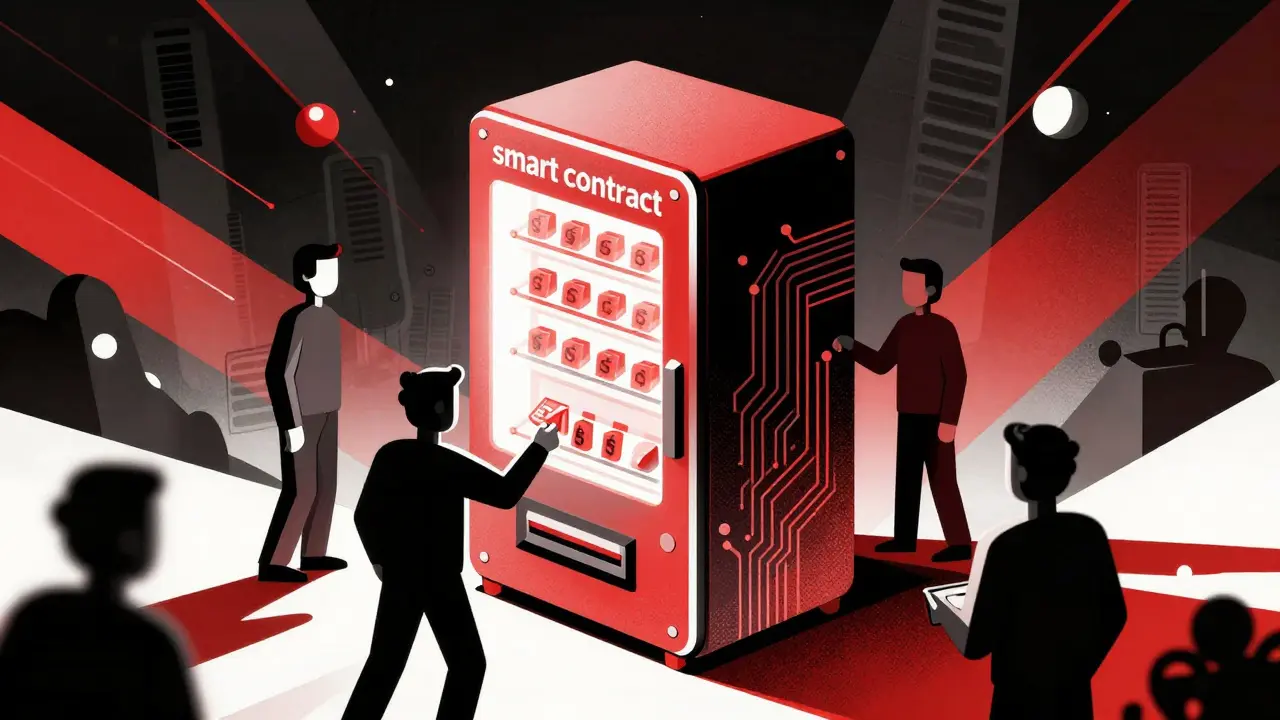
Before we talk about voting, we have to talk about the rules. In a traditional company, rules are written in bylaws and enforced by lawyers. In a DAO, rules are written in code. These are called smart contracts. Think of them as digital vending machines. You put in the correct input (a vote), and if the conditions are met, the machine dispenses the product (the action happens). There is no human manager deciding whether to give you your soda.
When a DAO is created, developers write these smart contracts to define exactly what the organization can do. They set the parameters for:
- Who is allowed to vote.
- How much each vote counts.
- What percentage of votes is needed to pass a change.
- How long the voting period lasts.
Once these rules are deployed on the blockchain, they cannot be easily changed. This creates a level of trust that doesn't exist in traditional corporations. You don't have to trust the people running the DAO; you only have to trust the code. However, if the code has a bug, there is no customer service line to call. That is why the initial setup is so critical.
The Four-Step Decision Lifecycle
So, how does an idea become reality? It follows a strict workflow. While every DAO tweaks this slightly, the general structure remains consistent across platforms like Aragon or Snapshot.
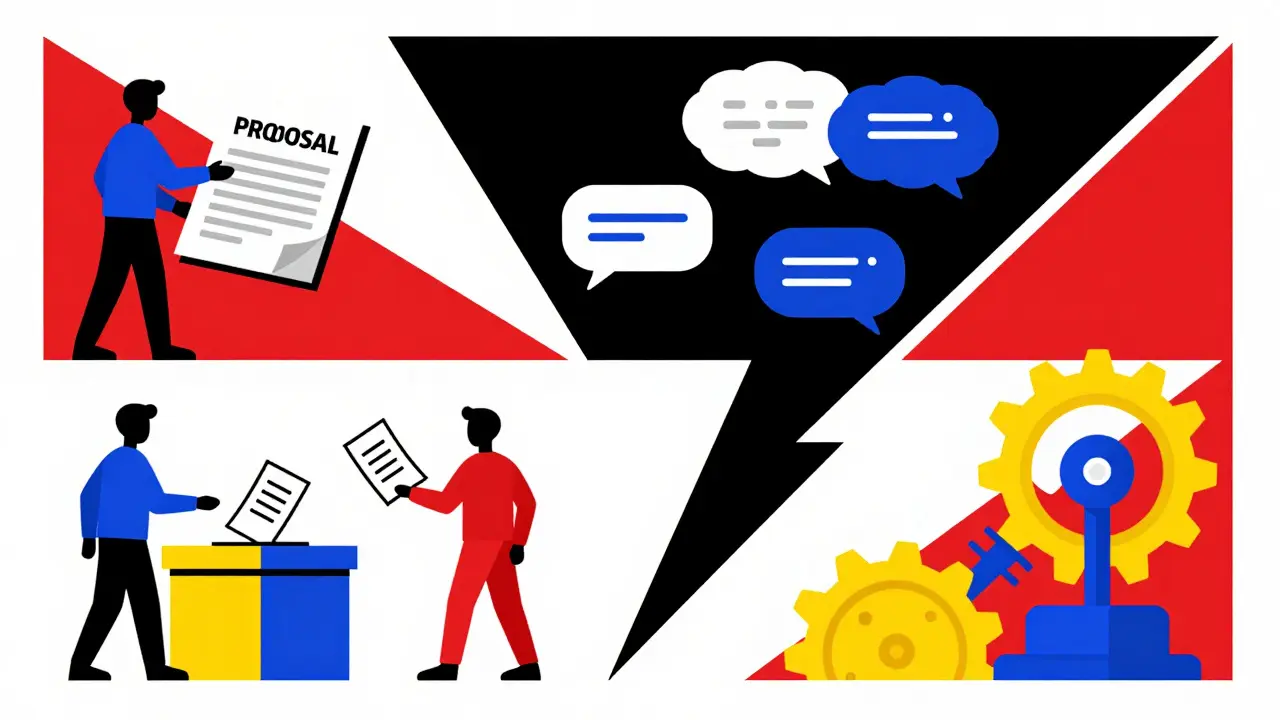
- Proposal Submission: Any member (or sometimes only members with a certain amount of tokens) can submit a proposal. This could be anything from "fund this marketing campaign" to "change the fee structure." The proposal must be clear because once it's on-chain, changing it is difficult.
- Discussion Phase: Before voting starts, there is usually a debate. This happens off-chain in forums like Discord, Telegram, or Discourse. Members argue, refine the proposal, and try to build consensus. This is where the real work happens. Voting is just the final stamp.
- Voting Period: The smart contract opens the voting window. Token holders cast their ballots. This can last anywhere from 24 hours to several days, depending on the DAO's settings.
- Execution: If the proposal passes all criteria (quorum and majority), the smart contract automatically executes the action. Funds are transferred, permissions are updated, or code is modified. No human intervention is needed.
Configuring Governance: The Rules of the Game
Not all DAOs are created equal. Some are loose communities, while others are tightly regulated funds. The difference lies in how they configure their governance parameters. According to frameworks like Aragon's, there are eight key settings that determine how democratic-or plutocratic-a DAO really is.
| Parameter | Definition | Example Value |
|---|---|---|
| Quorum | Minimum % of total tokens that must vote for the result to be valid. | 5% (Lido DAO) |
| Pass Rate | % of "Yes" votes required among those who voted. | 50%+1 (Simple Majority) or 67% (Super-majority) |
| Voting Duration | Time window for casting votes. | 3-7 days |
| Proposal Threshold | Minimum tokens needed to submit a proposal. | Varies widely |
| Voting Power | How influence is calculated. | Token-weighted (1 token = 1 vote) |
For routine decisions, like paying a developer grant, a simple majority (50% + 1 vote) is common. For critical changes, like altering the core charter or minting new tokens, many DAOs require a super-majority (two-thirds or more). This prevents a small group from hijacking the organization during low-participation periods.
Voting Mechanisms: More Than Just Yes or No
You might assume voting in a DAO is straightforward: you hold tokens, you click "yes." But it gets more nuanced. The most common method is token-weighted voting. This means if you own 1% of the tokens, you have 1% of the voting power. Critics call this plutocracy (rule by the wealthy), but proponents argue it aligns incentives-those with the most skin in the game have the most say.
However, some DAOs use alternative mechanisms to solve specific problems:
- Holographic Consensus: Used by DAOs like Moloch, this system asks voters to predict if a proposal will pass. If you predict correctly, you get rewarded with treasury tokens. If you predict wrong, you lose tokens. This encourages members to think carefully about the community's will rather than just pushing their own agenda.
- Multisig Wallets: Many DAOs use a "multisignature" wallet for urgent actions. Instead of waiting for a week-long vote, a trusted committee of 5-9 people must sign off on a transaction. This is faster but introduces centralization risk. If the committee acts maliciously, the DAO suffers.
- Delegated Voting: Similar to representative democracy, token holders can delegate their voting power to experts they trust. This helps reduce voter fatigue, as not everyone wants to research every single proposal.
Real-World Example: How Lido DAO Operates
To see this in action, let's look at Lido DAO, one of the largest DAOs by treasury size. Lido governs a liquid staking protocol worth billions. Their process is highly structured.
A proposal at Lido typically goes through a seven-day cycle. First, there is a discussion phase. Then, voting opens. Crucially, Lido uses a two-phase voting window within that week. For the first 48 hours, members can vote "for" or "against." In the final 24 hours, it becomes an "objection phase." During this time, you can still vote against, but you cannot switch from "against" to "for." This prevents last-minute manipulation where someone buys tokens at the eleventh hour to flip a vote.
Lido also requires a quorum of 5% of the total token supply to vote "yes." If only 1% of tokens vote, even if 100% of those voters say "yes," the proposal fails. This ensures that decisions reflect a significant portion of the community, not just a vocal minority.
The Challenges: Voter Apathy and Security Risks
It sounds perfect, right? Transparent, automated, democratic. So why isn't every company a DAO? Because it's hard.
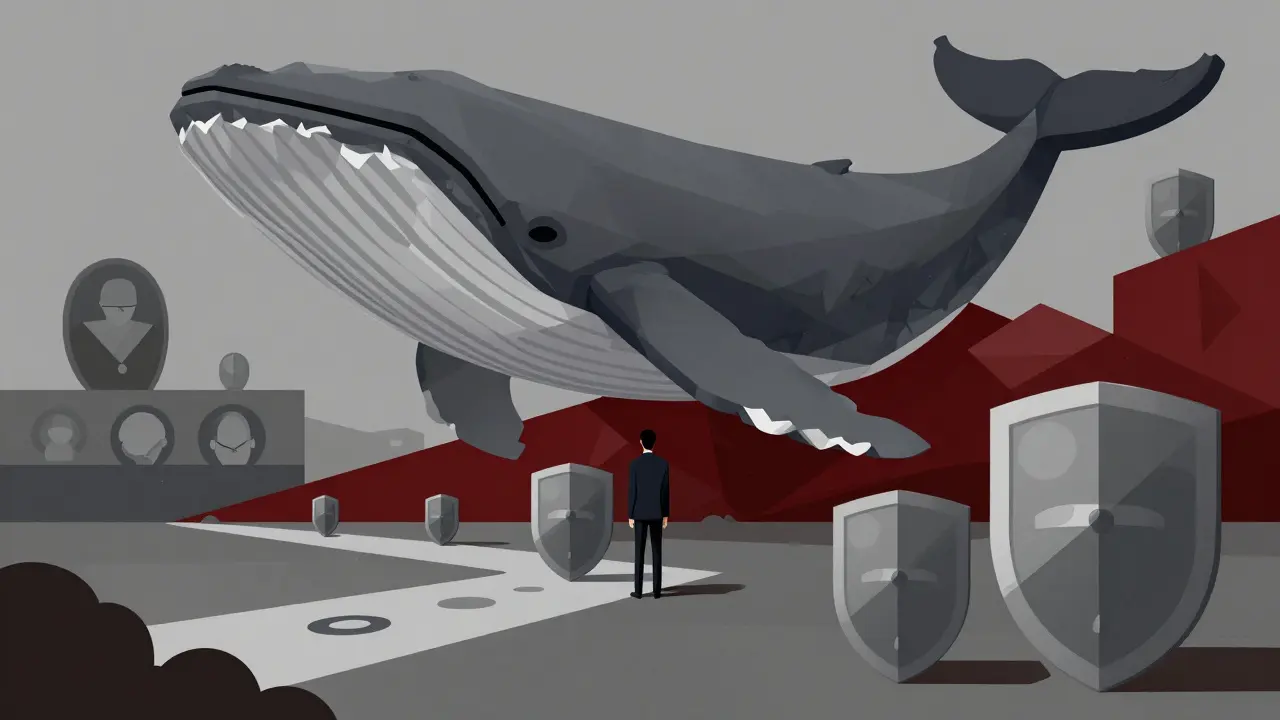
The biggest issue is voter apathy. Most token holders don't care about every proposal. They might own $100 worth of tokens and aren't willing to spend five hours reading technical documents. When participation is low, the DAO becomes vulnerable to "whales"-large holders who can sway outcomes with minimal effort. To combat this, DAOs bundle proposals together or offer rewards for voting.
Then there is security. Remember The DAO hack in 2016? It was a vulnerability in the smart contract code, not a flaw in the voting logic. But it highlighted a harsh truth: code is law, and bad code costs millions. Today, audits are standard, but risks remain. Additionally, governance attacks are possible. An attacker could borrow tokens temporarily to gain voting power, pass a malicious proposal, and then return the tokens. This is known as a "flash loan attack" on governance.
Finally, there is the problem of coordination. Getting thousands of anonymous people across different time zones to agree on anything is incredibly slow. Traditional companies can pivot in a day; DAOs might take a month. This inefficiency is the trade-off for decentralization.
Why It Matters
DAOs represent a fundamental shift in how we organize. They remove the need for intermediaries and allow global communities to collaborate without borders. While the technology is still maturing, the potential for transparent, community-owned organizations is huge. Whether you are a developer, an investor, or just curious, understanding how DAOs make decisions gives you insight into the future of digital ownership.
As these systems evolve, expect to see more hybrid models. Pure decentralization is idealistic, but practical governance often requires a mix of automated code, delegated trust, and human judgment. The best DAOs are those that find the right balance between speed and security, efficiency and inclusion.
What is a quorum in a DAO?
A quorum is the minimum percentage of total tokens that must participate in a vote for the result to be considered valid. For example, if a DAO has a 5% quorum, at least 5% of all existing tokens must vote "yes" for a proposal to pass, regardless of how many people vote "no." This prevents a small group from making decisions for the entire organization.
Can anyone submit a proposal to a DAO?
In many DAOs, yes, but some impose a "proposal threshold." This requires a user to hold a certain amount of tokens before they can submit a proposal. This prevents spam and ensures that proposers have some skin in the game. Others allow any wallet address to propose, relying on the community to ignore low-quality ideas.
What happens if a DAO proposal fails?
If a proposal fails to meet the quorum or pass rate requirements, the smart contract simply does nothing. No funds are moved, and no code is changed. The proposer may choose to revise the proposal based on feedback and resubmit it later, or abandon it entirely.
Are DAO votes anonymous?
On-chain votes are pseudonymous. Your wallet address is visible, and anyone can trace it back to your identity if you have linked your address to personal information. Off-chain voting platforms like Snapshot allow for private voting until the results are tallied, offering more privacy.
What is the difference between on-chain and off-chain voting?
On-chain voting requires users to sign transactions with their wallets, which costs gas fees (transaction fees) and takes time to confirm. It is immutable and directly triggers smart contracts. Off-chain voting (e.g., Snapshot) is free and instant because it records signatures on a cheaper layer or IPFS, but it does not automatically execute actions. It serves as a signal of intent before on-chain execution.