
Imagine a world where the rules of money are written in stone-or rather, in code-and cannot be changed by any government or bank. That is the reality of block rewards is the amount of cryptocurrency given to a miner or validator for successfully adding a new block of transactions to the blockchain. This mechanism is the heartbeat of a network's economy, deciding exactly how many new coins enter the market and when. While central banks print money based on economic whims, blockchains use a mathematical schedule to fight inflation and create scarcity.
For anyone trying to understand why Bitcoin is often called "digital gold," the answer lies in how these rewards interact with the total supply. If rewards stay high, inflation rises; as rewards drop, the asset becomes scarcer. But this creates a high-stakes balancing act: if the rewards disappear too quickly, who will be left to keep the network secure?
The Engine of Digital Monetary Policy
In traditional finance, inflation happens when a central bank increases the money supply, often lowering the purchasing power of your savings. In the world of Bitcoin, the inflation rate is not a decision made in a boardroom; it is an algorithmic certainty. When Satoshi Nakamoto launched the network in 2009, he built in a system where miners are paid in newly minted coins to solve complex puzzles. This process, known as Proof-of-Work (PoW), ensures that new coins are distributed fairly in exchange for actual computational energy.
The most critical part of this policy is the fixed cap. Bitcoin will never have more than 21 million coins. Because the block rewards decrease over time, the rate at which we approach that cap slows down. This creates a transparent, predictable inflation schedule that allows investors to plan years in advance, a level of certainty that simply doesn't exist with fiat currencies.
Understanding the Halving: The Inflation Killer
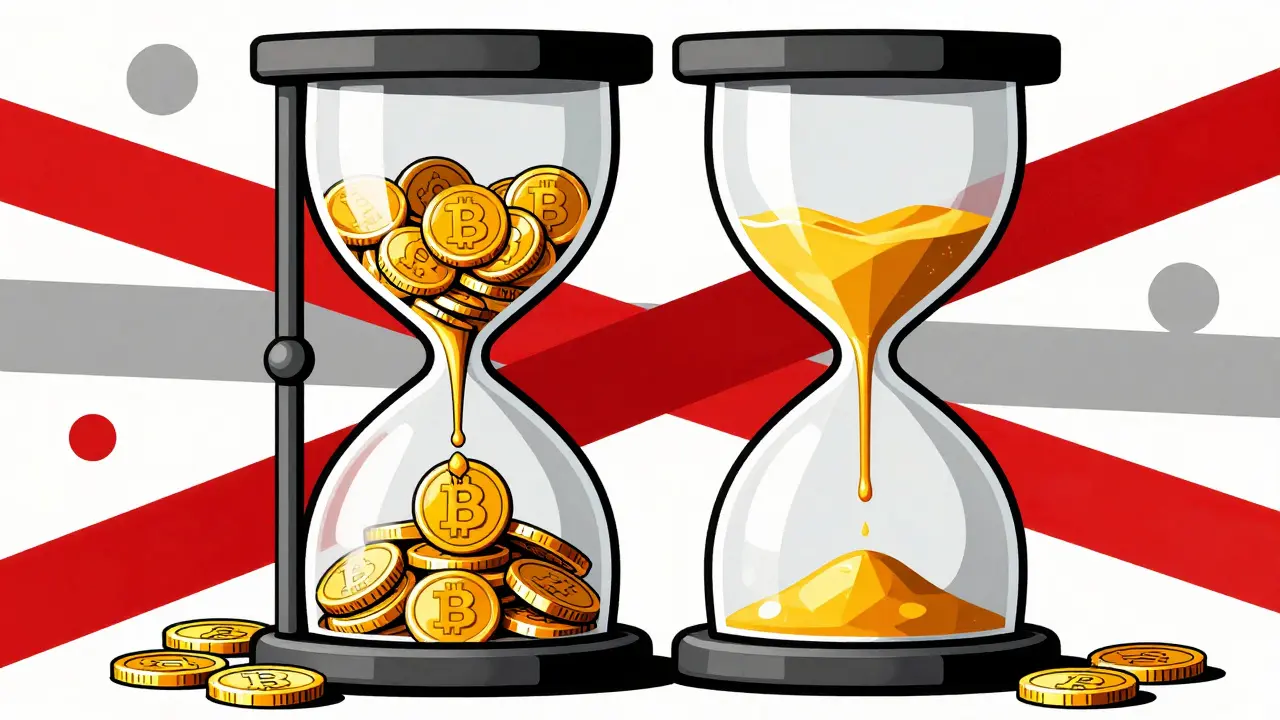
The most dramatic tool used to control inflation is the Halving. Every 210,000 blocks-roughly every four years-the block reward is cut exactly in half. This is a hard-coded event that creates a supply shock, reducing the number of new coins hitting the market.
Let's look at how this has played out in real-time. In 2009, the reward was 50 BTC per block. By 2012, it dropped to 25, then to 12.5 in 2016, and 6.25 in 2020. The most recent halving on April 19, 2024, slashed the reward again to 3.125 BTC. To put this in perspective, Bitcoin's annual inflation rate was about 2.03% in 2023 but plummeted to roughly 1.01% immediately after the 2024 event. This mathematical precision is why many institutional investors view the asset as a hedge against the unpredictable inflation of traditional currencies.
| Event / Year | Block Reward | Approx. Annual Inflation | Primary Effect |
|---|---|---|---|
| Launch (2009) | 50 BTC | High (>50%) | Rapid distribution of coins |
| 1st Halving (2012) | 25 BTC | Moderate | Initial scarcity signal |
| 2nd Halving (2016) | 12.5 BTC | Low | Increased institutional interest |
| 3rd Halving (2020) | 6.25 BTC | ~2% | Store of value narrative grows |
| 4th Halving (2024) | 3.125 BTC | ~1% | Extreme scarcity relative to demand |
Comparing Different Models of Emission
Not every cryptocurrency follows the "halving" path. Depending on the goal of the network-whether it's to be a store of value or a utility tool-the block reward structure varies wildly.
Ethereum provides a great contrast. After "The Merge" in September 2022, it moved to Proof-of-Stake (PoS). Instead of miners spending electricity, validators stake their coins. Ethereum doesn't have a fixed supply cap like Bitcoin; instead, it uses a dynamic issuance model. Combined with a mechanism that "burns" (destroys) a portion of transaction fees, Ethereum can actually become deflationary if network activity is high enough.
Then there is Monero, which uses a "tail emission" model. Unlike Bitcoin, where the reward eventually hits zero, Monero maintains a permanent, low reward (currently about 0.6 XMR per minute). This ensures that there is always an incentive for miners to secure the network, maintaining a constant, very low inflation rate of around 1%.
The Security Paradox: When Rewards Vanish
Here is the tricky part: if block rewards keep dropping, what stops miners from just quitting? If the reward becomes too small to cover the cost of electricity, the Hashrate-the total computational power securing the network-could drop, making the blockchain vulnerable to attacks.
The industry's bet is on transaction fees. As the block reward fades, Transaction Fees must take over as the primary incentive. We already see this happening. After the 2024 halving, daily transaction fees jumped by over 80% as users fought for limited space in the blocks. However, the math is daunting. Some analysts suggest that by 2040, transaction fees might need to average $50 per transfer to keep miners profitable. If the network doesn't scale its utility or throughput, it could face a security crisis.
Practical Implications for Users and Miners
If you're a casual holder, the impact of block rewards is mostly felt in price volatility around halving events. But for those running the hardware, it's a matter of survival. Small-scale mining operations often struggle post-halving. In 2020, nearly 38% of small miners disappeared within six months because they didn't account for the 50% revenue drop.
To navigate this, professional operations now use advanced modeling tools. They track "realized inflation," which accounts for coins that are lost forever (due to forgotten keys), giving a more accurate picture of the circulating supply than the theoretical inflation rate. For the average person, the lesson is simple: the scarcity created by reducing block rewards is the primary reason these assets have value, but it also makes the network's long-term security dependent on its actual use as a payment system.
Does a halving always mean the price will go up?
Not necessarily. While halving reduces the new supply (which is fundamentally bullish), the market often "prices in" the event months in advance. The price action depends more on overall demand and macroeconomic conditions than the halving event itself.
What happens when the block reward reaches zero?
Once the final coin is mined (expected around 2140 for Bitcoin), miners will be compensated entirely through transaction fees. The network's security will then rely on the volume and value of transactions being processed.
Why is a fixed supply better than a central bank's policy?
Predictability. With a fixed supply and programmed reward cuts, there is no "surprise" money printing. This prevents the sudden devaluation of the currency that often happens when central banks print money to manage national debt.
Can block rewards be changed by the community?
Technically, yes, but it requires a hard fork. This would mean a vast majority of miners, nodes, and exchanges would have to agree to the change. Because the scarcity is the main value proposition of Bitcoin, such a change is highly unlikely.
How do Proof-of-Stake rewards differ from PoW rewards?
PoW rewards pay for computational work (energy), whereas PoS rewards pay for locking up capital (staking). PoS systems generally have more flexible inflation models and don't rely on energy-intensive mining to secure the network.
Next Steps for Navigating Reward Cycles
Depending on your role in the ecosystem, your strategy should differ:
- For Investors: Focus on the "Stock-to-Flow" ratio. As block rewards drop, this ratio increases, typically signaling that the asset is becoming more like a rare commodity and less like a currency.
- For Miners: Prioritize energy efficiency. As rewards halve, your margin for error disappears. Switching to the latest hardware or sourcing cheaper electricity becomes the only way to stay profitable.
- For Developers: Explore Layer 2 solutions like the Lightning Network. By moving small transactions off the main chain, the network can maintain high utility while keeping the main chain's security intact as rewards dwindle.
Comments
Greg Reynolds
Transaction fees won't magically fix the security paradox because most users will just move to a cheaper L2 and the main chain will become a ghost town for everything except whale transfers.
April 23, 2026 at 20:08
Alex Wan
Oh goodness, the sheer magnitude of this throughtful explnation is simply breath-taking! It is truly a magnifiscent breakdown of the economic engine driving these assets forward and I feel we are all better for it! Such brilliance in simplification!!
April 24, 2026 at 10:16
Ali Tate
imagine trusting some code written by a ghost while the US treasury just prints trillions of dollars of fake paper money lol
absolute clown show if you think any other coin can touch the dominance of the dollar backed by the most powerful military on the planet
this whole scarcity game is just a digital playground for people who can't handle real power dynamics
April 25, 2026 at 14:39
Larry Yang
the analysis is basic at best and completely overlooks the systemic risk of hashrate centralization which is just... charmingly naive
honestly the whole premise of treating a digital token as gold is a total delusion for the masses who can't read a balance sheet
it is just a fancy way of saying we are all gambling on a mathematical clock that will eventually run out of juice
the obsession with the halving is basically a religious cult at this point and the lack of nuance regarding liquidity is honestly depressing
nobody actually cares about the security paradox until the first major 51 percent attack happens and then everyone will pretend they warned us
the math is only daunting if you're not paying attention to how the whales actually manipulate the spot price during these events
it is a circle jerk of a system that rewards the early adopters and punishes the latecomers who think they found a secret hedge
the whole notion of a store of value is laughable when the volatility is this insane
i find it amusing that people think an algorithmic certainty is better than a human decision when the algorithm is designed to eventually kill the incentive for the very people keeping it alive
it is a self-destruct mechanism disguised as a monetary policy
absolutely pathetic that this passes for financial insight in some circles
the real world does not work in blocks of 210,000
the lack of actual utility outside of speculation is the real inflation killer
everyone is just waiting for the next pump and dump while pretending it is a hedge against the fed
what a joke
April 27, 2026 at 13:54
Doc Coyle
It is simply wrong to ignore the ethical cost of Proof-of-Work energy consumption while praising the math.
April 28, 2026 at 06:05
Clair Geary
love how this breaks down the different models it makes the whole thing feel way more accessible for folks just starting out
the bit about Monero is such a cool twist on the scarcity narrative
April 28, 2026 at 19:25
Findlay Duncan Lyon
Brilliant summary! Very clear.
April 29, 2026 at 09:01
Sarah Ingrams
its just a bit scary to think about the miners losing everything after a halving
April 29, 2026 at 15:44