
Blockchain social media isn’t just a buzzword anymore - it’s changing how people share, earn, and own their online presence.
By 2026, over 20 million people are actively using decentralized social platforms. That’s not a huge number compared to Instagram’s 2 billion, but it’s growing fast - and it’s not just for crypto fans anymore. These platforms let you own your content, get paid directly from followers, and escape algorithm-driven feeds that push outrage instead of meaning. The old model - where platforms like Facebook or Twitter profit from your posts while you get nothing - is cracking. Blockchain social media, or SocialFi, is stepping in to fix it.
How it works: Your data, your rules
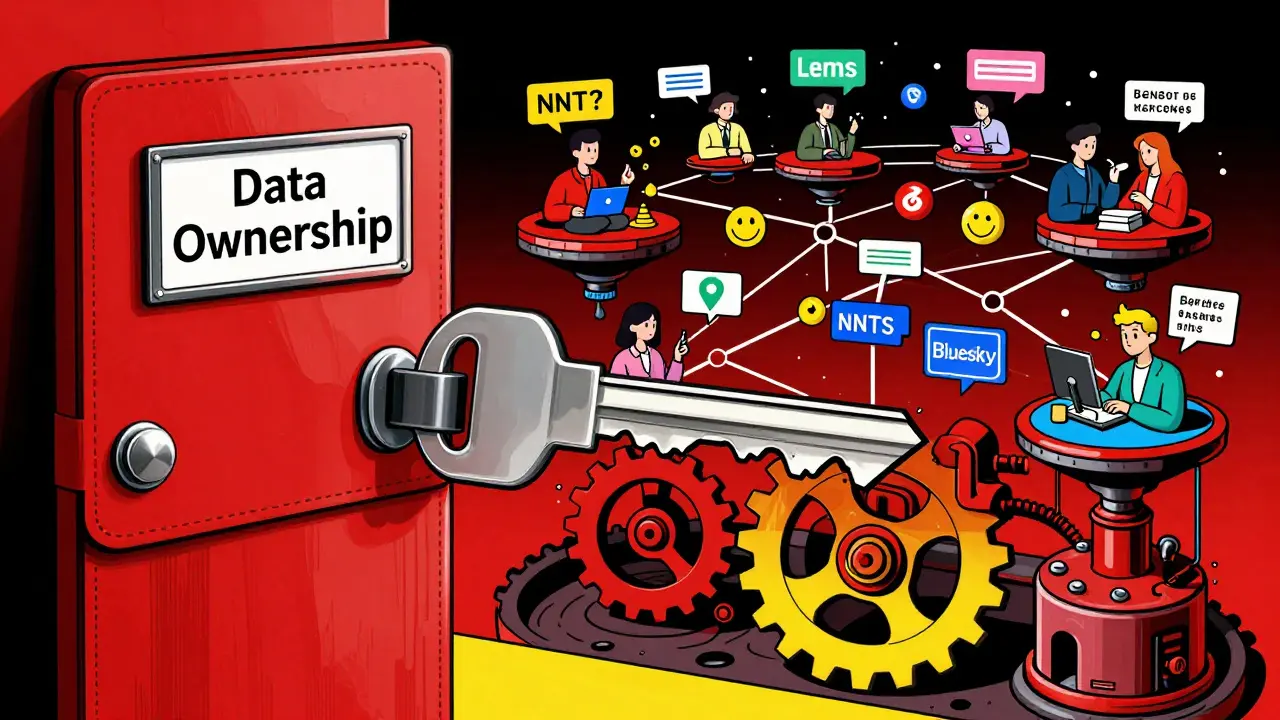
Traditional social media treats your profile like a rental apartment. You live there, post photos, build followers, but the landlord (the company) owns the building. They can change the rules, delete your account, or sell your data without asking. Blockchain social media flips that. Your identity, your posts, your followers - all stored on a public ledger. Think of it like owning a house instead of renting. You control the keys. No company can shut you down unless you lose them.
This isn’t theoretical. Platforms like Lens Protocol a decentralized social graph built on Ethereum that turns profiles, posts, and follows into NFTs let you take your entire social network from one app to another. Want to switch from Lenster (a Lens-based app) to Phaver? You just log in with your wallet. Your followers, your posts, your likes - all move with you. That’s impossible on Instagram or TikTok.
Who’s winning right now?
Not every blockchain social platform is the same. Some focus on speed, others on ease of use, and a few on pure decentralization. Here are the big players as of early 2026:
| Platform | Blockchain | Active Users | Key Feature | Drawback |
|---|---|---|---|---|
| Lens Protocol | Ethereum (Lens Network L2) | 5.1 million | Composable social graph - use your profile across 60+ apps | Still requires crypto wallet; gas fees spike during high traffic |
| Farcaster | Ethereum + IPFS | 4.8 million | Warpcast app feels like Twitter but owned by users | Only works with Ethereum wallets - excludes non-crypto users |
| Bluesky | AT Protocol (federated) | 12 million | Simple, familiar interface; email sign-up; customizable feeds | Not fully decentralized - central team controls core infrastructure |
| Hive Blockchain | Hive (PoS) | 1.4 million | Zero fees, 3-second transactions, easy for beginners | Smaller ecosystem; fewer apps built on it |
| Diamond App | DeSo | 680,000 | Creator coins - each user has their own token | Complex tokenomics; 47% of users report wallet issues |
Bluesky stands out because it doesn’t require a crypto wallet. You can sign up with email, and it still uses a decentralized protocol. That’s why it hit 12 million users - more than the rest combined. But it’s not fully decentralized. The team behind it still controls the core servers. Lens and Farcaster are more radical: your identity lives on the blockchain, not in a company’s database. That’s powerful - but harder to use.

How creators are actually making money
The promise of blockchain social media isn’t just freedom - it’s income. On traditional platforms, creators get pennies. Instagram pays 1-3% of ad revenue to top creators. On Lens Protocol, a photographer named @NFTArtistJen earned $8,500 in December 2024 from collectors buying NFTs of her posts. That’s not a fluke. Another user on Farcaster, a poet named @PoeticMind, made $3,100 in tips from 1,200 followers in one month - all in crypto, no middleman.
Platforms like Diamond App let users create their own tokens. If you follow someone, you can buy their token. If they grow popular, the token’s value rises. You profit. They profit. It’s like owning a piece of their brand. But this also has risks. Friend.Tech, which lets users trade shares of influencers, got shut down temporarily in late 2024 after the SEC flagged it as a potential unregistered security. That’s the dark side: regulation is catching up.
The biggest problem: Usability
Here’s the truth no one wants to admit: most people won’t use blockchain social media if it requires a seed phrase, gas fees, and three different wallets.
A January 2025 study by 8Seneca found that 78% of people who tried to join a SocialFi platform quit at the wallet setup step. The average user spends 8 hours just learning how to connect their wallet, fund it with ETH or HIVE, and understand what a “collectible” is. Compare that to Instagram - you download the app, sign up with your email, and start posting. No friction.
That’s why Bluesky’s email login and Lens Protocol’s new fiat on-ramp (launched in January 2025) are game-changers. Now, you can buy crypto with a credit card inside the app. You don’t need to know what a wallet is. You just post, get paid, and keep going. That’s how it spreads - not through crypto blogs, but through regular people who just want to share their life without being exploited.
What’s next? The 2026 roadmap
By mid-2026, three major shifts are happening:
- Unified wallets - Apps like Backpack Exchange now let you manage all your SocialFi profiles in one place. No more juggling 3 wallets.
- Fiat payouts - Platforms like Lens and Farcaster now let creators cash out earnings directly to PayPal or bank accounts. No more crypto volatility headaches.
- AI moderation - Instead of relying on human moderators (who are overwhelmed), platforms are using AI trained on community rules. It’s not perfect, but it’s reducing spam by 60%.
Even more important: interoperability. Right now, if you’re on Lens, you can’t follow someone on Farcaster. But in 2026, W3C’s new Decentralized Identity standard will let profiles talk across platforms. Your follower count on Lens might show up on Farcaster. Your reputation moves with you. That’s the real win - not just owning your data, but letting it travel.
The road ahead: Will this replace Instagram?
No. Not yet. And maybe never. Instagram isn’t going anywhere. But blockchain social media doesn’t need to replace it. It just needs to carve out a space for people who want to be paid, not tracked. For artists, writers, podcasters, and small creators who are tired of begging for visibility.
The numbers tell the story. In 2024, the entire SocialFi market was worth $1.2 billion. By 2026, it’s projected to hit $3.4 billion. That’s still 1.6% of the $207 billion traditional social media market. But look at who’s moving: 47 Fortune 500 companies are now testing Lens Protocol for internal communication. Universities are using it for academic sharing. A 19-year-old in Manila earns more from her Lens posts than she does from her part-time job.
That’s the real future. Not a world without Instagram. A world where you have a choice. Where your voice isn’t owned. Where your effort doesn’t vanish into a corporate black hole. That’s what blockchain social media is building - slowly, messily, but surely.
Can I use blockchain social media without crypto?
Yes - but only on some platforms. Bluesky lets you sign up with email and doesn’t require crypto at all. Lens Protocol and Farcaster still need a wallet. However, new tools now let you buy crypto inside the app using a credit card, so you don’t need to understand wallets to get started. You can post, earn, and cash out without ever touching a seed phrase.
Is blockchain social media safe if I lose my wallet?
No - and that’s the biggest risk. If you lose your private key or seed phrase, you lose everything: your profile, your followers, your earnings. There’s no reset button. Unlike Instagram, where you can recover your account with email, blockchain platforms are designed to be irreversible. That’s why new tools now offer backup options - like encrypted cloud backups tied to your phone or email - but they’re still optional. Always back up your keys.
Do I need to pay gas fees to post?
On most platforms, no. Lens Protocol launched its own Layer 2 blockchain in late 2024, slashing gas fees to $0.0001 per post - effectively free. Hive Blockchain has always been fee-free. Farcaster uses a system called “sponsorship” where apps pay for your transactions. You don’t pay. Only if you’re using a legacy Ethereum app might you see a fee - and even then, it’s usually under 10 cents.
Can I earn real money on blockchain social media?
Absolutely. Creators on Lens Protocol, Farcaster, and Diamond App regularly earn $1,000 to $10,000 per month from tips, NFT sales, and creator tokens. One user on Farcaster made $18,000 in 2025 from a single viral post that was turned into a collectible. But it’s not magic - you still need to post consistently, engage with your audience, and build trust. The difference? You keep 90% of the revenue. On Instagram, you’d get less than 5%.
Is blockchain social media legal?
It’s complicated. Platforms like Bluesky and Lens Protocol are legal because they don’t sell shares or tokens tied to future profits. But platforms like Friend.Tech, which let users trade shares of influencers, are under investigation by the SEC. In the U.S., if a token acts like an investment, it’s considered a security - and that’s illegal without registration. Most platforms are now avoiding that model. Stick to platforms that offer tips, collectibles, or tokens for engagement - not speculation.
Which platform should I try first?
If you’re new, start with Bluesky. It’s free, familiar, and doesn’t require crypto. If you want to earn money and don’t mind a wallet, try Lens Protocol with the Lenster app. It’s the most open, has the most apps, and the lowest fees. Avoid Diamond App or Friend.Tech until you understand tokens - they’re powerful but risky for beginners.
Final thought: This isn’t about tech - it’s about power
Blockchain social media isn’t just a new app. It’s a shift in who controls the internet. For too long, platforms took our attention, sold our data, and kept the money. Now, we’re starting to take it back. Not with protests or petitions - but by building something better. One post. One tip. One follower at a time.
Comments
Shannon Holliday
OMG this is literally the future 😭 I just switched to Lens Protocol and now my art actually makes money?? Like I posted a sketch of my cat and someone paid me 0.02 ETH for it?? I didn’t even know I had fans 😍✨
February 27, 2026 at 14:42
Jeremy buttoncollector
Y’know, the ontological underpinnings of decentralized sociality are fundamentally a post-capitalist reconfiguration of the Habermasian public sphere, wherein subjectivity is no longer commodified via algorithmic surveillance capitalism, but rather expropriated through sovereign cryptographic identity-though the epistemic hegemony of Ethereum’s L2 infrastructure still reproduces a neo-liberal modal of value extraction, even if it’s ‘permissionless.’
Also, gas fees still suck. And why is everyone pretending ‘fiat on-ramp’ is a solution when you’re still just onboarding people into a Ponzi-adjacent token economy? 🤔
March 1, 2026 at 06:40
Michelle Xu
As someone who’s helped 12 friends set up their first wallets, I can tell you: the real breakthrough isn’t the tech-it’s the UX. Lens Protocol’s new credit-card-to-crypto flow is a game-changer. No more confusing seed phrases. Just post, get paid, cash out to PayPal. It’s that simple.
And yes, Bluesky’s email login is genius for newcomers. You don’t need to be a crypto bro to care about owning your voice. I’ve got my 72-year-old mom posting book reviews on Lens now. She doesn’t know what an NFT is-but she knows she’s finally getting paid for her thoughts. That’s power.
Just remember: backup your keys. Always. I’ve seen too many people lose everything because they thought ‘I’ll just screenshot it’… and then their phone died.
Also-seriously, try Lens + Lenster. The app feels like Twitter, but you’re the owner. No ads. No shadowbans. Just real connection. It’s beautiful.
March 2, 2026 at 04:35
Ryan Burk
LMAO this whole post is just crypto bro fanfiction. You think people care about ‘owning their data’? Most folks just want to post cat videos without getting banned. Blockchain social media is a glorified tax scam with extra steps.
And don’t get me started on ‘creator coins.’ That’s just a pyramid scheme with a blockchain sticker on it. Diamond App? 47% wallet issues? Yeah, because it’s a dumpster fire. Stop selling snake oil.
Bluesky isn’t decentralized-it’s Twitter with a new logo. And you’re all pretending this isn’t just another ‘get rich quick’ scheme for early adopters who already had money. Wake up.
March 3, 2026 at 20:45
Amanda Markwick
I love how this conversation is unfolding. Jeremy, you’re overthinking it-and Ryan, you’re being cynical for the sake of being cynical.
But Shannon? You’re the future. That cat sketch? That’s the heartbeat of this movement. Not the tech specs. Not the tokenomics. Not even the money.
It’s a 19-year-old in Manila earning more from her posts than her job. It’s a grandmother sharing poetry and getting paid in crypto she doesn’t understand but trusts. It’s a photographer in Kenya selling prints directly to fans in Berlin-no middleman, no gatekeeper.
Blockchain social media isn’t about replacing Instagram. It’s about giving people who’ve been ignored, exploited, or silenced a place where their voice isn’t just heard-it’s valued.
And yeah, the UX needs to be smoother. The fees need to stay low. The onboarding needs to be idiot-proof.
But we’re getting there. Slowly. Messily. Humanly.
Keep posting. Keep tipping. Keep believing. This isn’t a tech revolution-it’s a quiet, powerful reclamation.
March 4, 2026 at 00:16