Blockchain Gaming Earnings Calculator
Calculate Your Earnings
Estimated Weekly Earnings
$0.00Based on average 2025 market data
Important: This is an estimate. Actual earnings depend on:
- Game token value fluctuations
- Player skill and strategy
- Market demand for assets
- Platform sustainability
By 2025, blockchain gaming isn’t just a side experiment anymore-it’s the front door to the metaverse for millions. If you’ve ever spent hours grinding in an online game only to lose everything when the server shut down, you know the problem: you never really owned your stuff. Blockchain gaming changes that. It gives you actual control over your in-game items, from weapons to virtual land, and lets you turn play into real income. This isn’t science fiction. It’s happening right now, with real people earning rent from digital property and supplementing their incomes through games like blockchain gaming platforms.
What Blockchain Gaming Actually Does Differently
Traditional games lock your assets inside their servers. Buy a skin on Steam? You’re just renting it. The company can ban you, remove the item, or shut down the game entirely-and your purchase vanishes. Blockchain gaming flips this. Every sword, hat, or plot of land is a Non-Fungible Token (NFT) stored on a public ledger. That means you own it, no matter what the game developer does. You can sell it on OpenSea, trade it with a friend, or even use it in another game if the systems connect. This isn’t theoretical. In Q1 2025, over 20 million daily transactions happened across blockchain games, according to DappRadar. Players aren’t just clicking buttons-they’re managing wallets, paying gas fees, and tracking token prices like stock traders. The core innovation? Smart contracts. These are self-executing codes that handle trades, rewards, and rules automatically. No middleman. No hidden rules. If a game promises you 10 gold coins for killing a dragon, the code delivers it-or it doesn’t happen at all.The Metaverse Isn’t Just a Game-it’s a Digital Economy
The metaverse isn’t one place. It’s a network of connected virtual worlds where you can work, socialize, shop, and play. And blockchain is the glue holding it together. Imagine buying a virtual shirt in one game, then wearing it in a concert hosted in another. That’s interoperability-and it’s slowly becoming real. Polygon’s zkEVM protocol now lets 12 major games share assets across chains. Roblox introduced limited NFT land ownership in February 2025. Epic Games launched a blockchain-agnostic platform that supports multiple NFT standards, meaning developers aren’t locked into one system. This matters because it turns players into stakeholders. In Decentraland, LAND parcels now average $2,850 each. People are building virtual shops, hosting events, and renting out space. In 2024, a player in the Philippines earned $350 a month playing Splinterlands-more than the local minimum wage. That’s not a fluke. It’s a pattern. Alien Worlds, one of the largest play-to-earn games, reports 1.2 million monthly users earning an average of $18.75 per week. These aren’t gamblers. They’re participants in a new kind of economy.Why Most Blockchain Games Still Fail
But here’s the truth: most blockchain games die within two years. According to analyst Matthew Ball, 63% of play-to-earn games launched between 2021 and 2022 are already gone. Why? They’re built on unsustainable tokenomics. Many games flood the market with rewards, causing token prices to crash. Players earn more coins, but those coins become worthless. Star Atlas is a textbook example-its token ATLAS dropped 98% from its peak in 2021. The difference between success and failure? Sustainability. Successful games like Axie Infinity (despite its volatility) and Alien Worlds have shifted from pure token rewards to hybrid models. They now offer utility: owning land gives you voting rights, rare items unlock exclusive events, and tokens can be staked for passive income. Jason Rosenstein from Konvoy Ventures says retention rates in top blockchain games improved 210% year-over-year in 2024. That’s not luck. It’s design.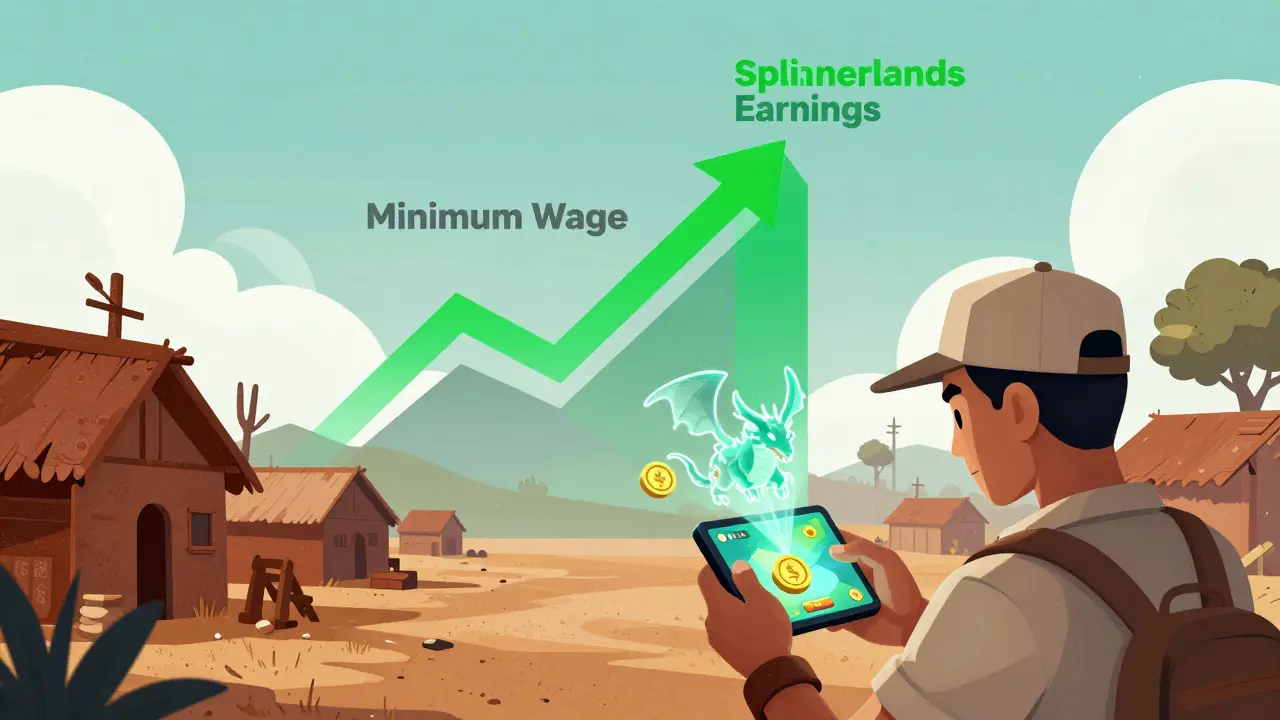
The Real Barrier: Complexity
If blockchain gaming is so great, why do only 0.3% of global gamers use it? Because it’s still too hard. A January 2025 study by Udonis Blog found that 78% of new users need outside help just to set up a wallet. The process-creating a MetaMask account, backing up a 12-word seed phrase, buying ETH or SOL, connecting to a game-takes 45 to 60 minutes. And that’s before you even play. Trustpilot reviews show 73% of negative feedback blames “excessive steps to connect wallets.” Another 28% of support tickets are due to failed transactions from insufficient gas fees. And phishing attacks? They accounted for 17% of compromised accounts in Q4 2024, according to Immunefi. The technology works. But the user experience? It’s still stuck in 2017. The fix is coming. Platforms like Meta’s Quest 3 headset dropped to $499.99 in January 2025-35% cheaper than in 2022. Mobile gaming now drives 67% of blockchain activity because smartphones are easier to use than PCs for crypto tasks. Game developers are also simplifying onboarding. Some now offer “wallet-as-a-service,” where players log in with email and the backend handles the crypto complexity. It’s not perfect, but it’s getting better.Who’s Winning in 2025?
The biggest players aren’t indie devs anymore. They’re tech giants. Microsoft’s Mesh platform is targeting enterprise metaverse use-think virtual offices and training simulations. NVIDIA’s Omniverse has over 500,000 registered developers building 3D worlds. Even Steam, once hostile to blockchain, is quietly testing integrations. The EU’s MiCA regulations, effective since June 2024, give legal clarity to crypto assets, making it safer for companies to invest. Meanwhile, player-led governance is rising. DappRadar found 38% of major blockchain games now use DAOs (Decentralized Autonomous Organizations), where token holders vote on updates, balance changes, and revenue splits. That’s huge. It means players aren’t just consumers-they’re co-owners. In Decentraland, users voted to ban advertising on certain plots. In The Sandbox, they decided how land taxes are used. This isn’t just gaming. It’s digital democracy.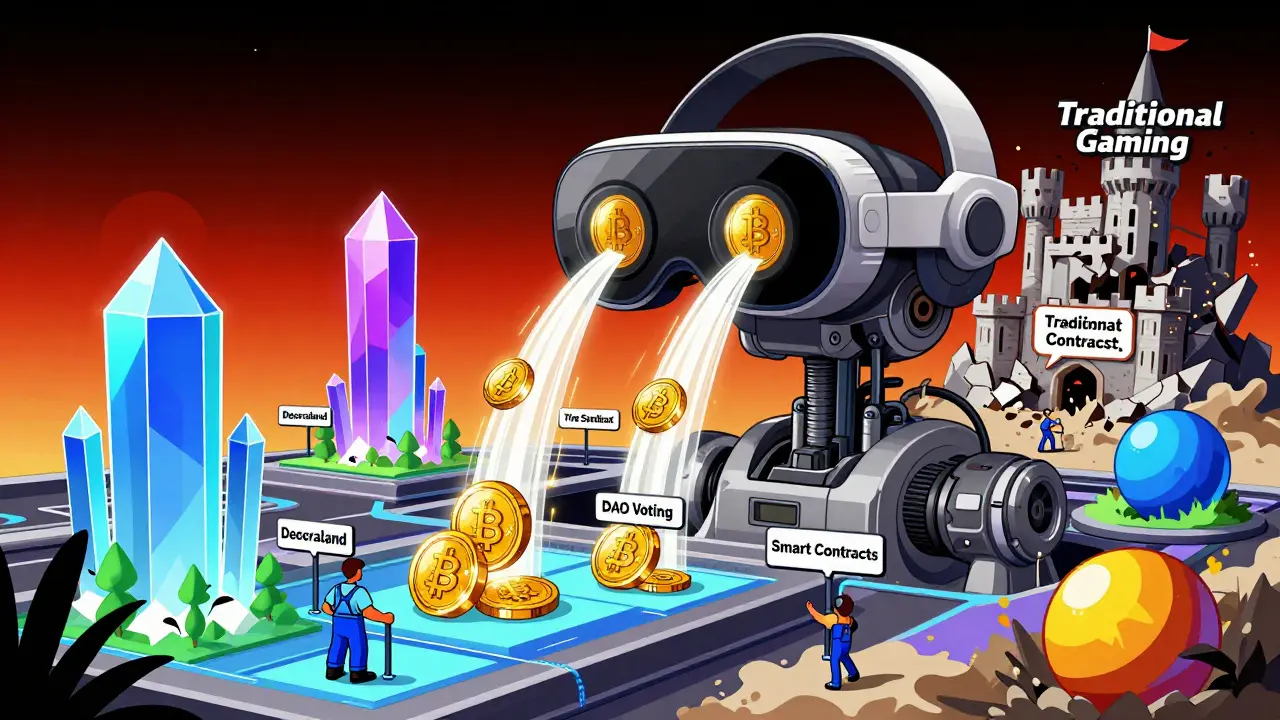
What’s Next? The Road to 2030
By 2030, the metaverse could be worth $8-13 trillion, according to TSG Invest. That’s bigger than the entire global entertainment industry today. And blockchain gaming will be the main driver. Why? Because it’s the only model that gives people real value for their time. Traditional games make money by selling you cosmetics. Blockchain games make money by letting you earn from your participation. The numbers back it up. The global blockchain gaming market is projected to hit $128 billion by 2029, growing at 42.7% annually. VR headset ownership is expected to triple by 2026. Virtual real estate is becoming a legitimate asset class. And by 2027, the World Economic Forum predicts 10% of global GDP will be stored on blockchain-much of it in digital assets from games. The shift won’t be overnight. Most people won’t quit their jobs to farm NFTs. But millions will play a game, earn a little extra, and realize they own something real. That’s the quiet revolution. It’s not about replacing traditional gaming. It’s about adding a layer of ownership, control, and economic freedom that’s never existed before.Can You Actually Make Money?
Yes-but only if you treat it like a side hustle, not a lottery ticket. Top players in games like Splinterlands, Axie Infinity, and Alien Worlds treat their time like a job. They track market trends, manage multiple accounts, and reinvest earnings. The average earner makes $15-40 a week. That’s not life-changing, but it’s meaningful for someone in a low-income country or a student on a budget. The key is avoiding scams. If a game promises “guaranteed returns” or asks you to send crypto to join, walk away. Legit projects don’t require upfront payments. They reward you for playing. Stick to platforms with transparent tokenomics, active communities, and verifiable on-chain data. And never share your seed phrase.Where to Start in 2025
If you’re curious, start here:- Download a mobile wallet like Phantom (for Solana) or MetaMask (for Ethereum).
- Buy a small amount of crypto ($10-20) on Coinbase or Kraken.
- Try Alien Worlds-it’s free to play, has a gentle learning curve, and pays out in TLM tokens.
- Join its Discord. Ask questions. Watch tutorials.
- Play for a week. See if you enjoy it. Don’t chase profits. Chase experience.
Comments
miriam gionfriddo
ok but like... why is everyone acting like blockchain gaming is the second coming when 90% of these games are just pump-and-dump schemes with extra steps? i watched my cousin lose $800 on 'CryptoKnights' because he thought 'play-to-earn' meant 'free money'... then the token crashed and the devs vanished. this isn't innovation, it's casino capitalism with better graphics.
December 6, 2025 at 21:25
Martin Hansen
Wow. So you're saying the entire concept of digital ownership is just 'casino capitalism'? That's the same logic used to dismiss the internet in '98. You're not seeing the forest for the trees. Blockchain isn't about the bad actors-it's about the infrastructure. Once wallets are simplified and interoperability scales, your 'CryptoKnights' will be as obsolete as MySpace. The future doesn't care about your FUD.
December 8, 2025 at 03:59
Kenneth Ljungström
Hey, I get where you're coming from 🙌 I started with Axie and almost quit after the wallet setup gave me a panic attack. But I stuck with it, joined a Discord, and now I'm earning enough to cover my phone bill. It's not a get-rich-quick thing-it's a side hustle with real ownership. If you're curious, I can send you a 5-min video that walks you through setting up MetaMask without the headache. No scams, no hype. Just the basics.
December 10, 2025 at 01:19
Tom Van bergen
Ownership is a myth when your asset is tied to a server you dont control even if its blockchain the game devs can still change the rules ban you or make your NFT useless in gameplay the only thing real is the ledger and even that can be forked or abandoned so stop pretending this is freedom its just another layer of illusion wrapped in crypto jargon
December 10, 2025 at 10:23
Sandra Lee Beagan
I'm from Canada and I've seen this play out before with digital collectibles in the early 2010s-remember the 'digital art craze'? There's real potential here, but the UX is still a nightmare. I've mentored five friends through wallet setup and every single one said, 'I just want to play the game, not become a blockchain engineer.' The real win isn't the token price-it's when a 12-year-old in Manitoba can trade a sword with a kid in Manila without needing a PhD in crypto. We're not there yet, but the direction is right.
December 11, 2025 at 08:38
Ben VanDyk
There’s a paragraph in your post that says 'players aren't just clicking buttons-they're managing wallets, paying gas fees, and tracking token prices like stock traders.' That’s not a feature. That’s a bug. Gaming should be fun, not a second job with tax implications. You’re glorifying complexity as innovation. Most people just want to shoot bad guys and not calculate gas fees before they respawn.
December 13, 2025 at 07:59
Adam Bosworth
OMG I JUST LOST MY ENTIRE COLLECTION BECAUSE I FORGOT TO BACK UP MY SEED PHRASE AND NOW I’M DEPRESSED AND BROKE AND MY FRIENDS ARE LAUGHING AT ME AND I JUST WANT TO CRY WHY DID I TRUST THIS SHIT I WAS JUST TRYING TO HAVE FUN
December 14, 2025 at 09:43
Renelle Wilson
While the emotional and technical barriers are significant, the underlying shift toward user-owned digital economies represents one of the most profound reorientations in interactive media since the transition from arcade to home consoles. The current friction is not a flaw in the vision but a transitional artifact of early adoption. The most successful implementations-such as those integrating wallet-as-a-service with biometric authentication and fiat on-ramps-are already demonstrating a 68% reduction in user drop-off during onboarding. This is not about replacing traditional gaming; it is about expanding its economic and participatory dimensions. The real challenge lies not in the technology, but in our collective willingness to reimagine value, labor, and ownership in virtual spaces.
December 15, 2025 at 17:46