
Imagine verifying that a specific document exists in a library containing millions of books without having to check every single shelf. That is exactly what Merkle Trees are designed to do. They are the silent engines behind trust in digital systems, allowing us to confirm data integrity with minimal effort. While most people know them as the backbone of Bitcoin and Ethereum, their role is expanding far beyond simple transaction validation. As we move through 2026, these cryptographic structures are evolving to solve massive scalability issues, secure global financial reserves, and even power the next generation of artificial intelligence.
The core concept remains unchanged since Ralph Merkle developed it in the late 1970s: a binary tree where leaf nodes contain hashes of data blocks, and parent nodes contain hashes of their children, culminating in a single Merkle Root. This root acts as a fingerprint for the entire dataset. If even one bit of data changes, the root hash changes completely. This property makes Merkle Trees indispensable for detecting tampering. However, the future lies not just in using them as they are today, but in how they are being adapted to handle petabytes of data and quantum computing threats.
From Merkle to Verkle: The Scalability Revolution
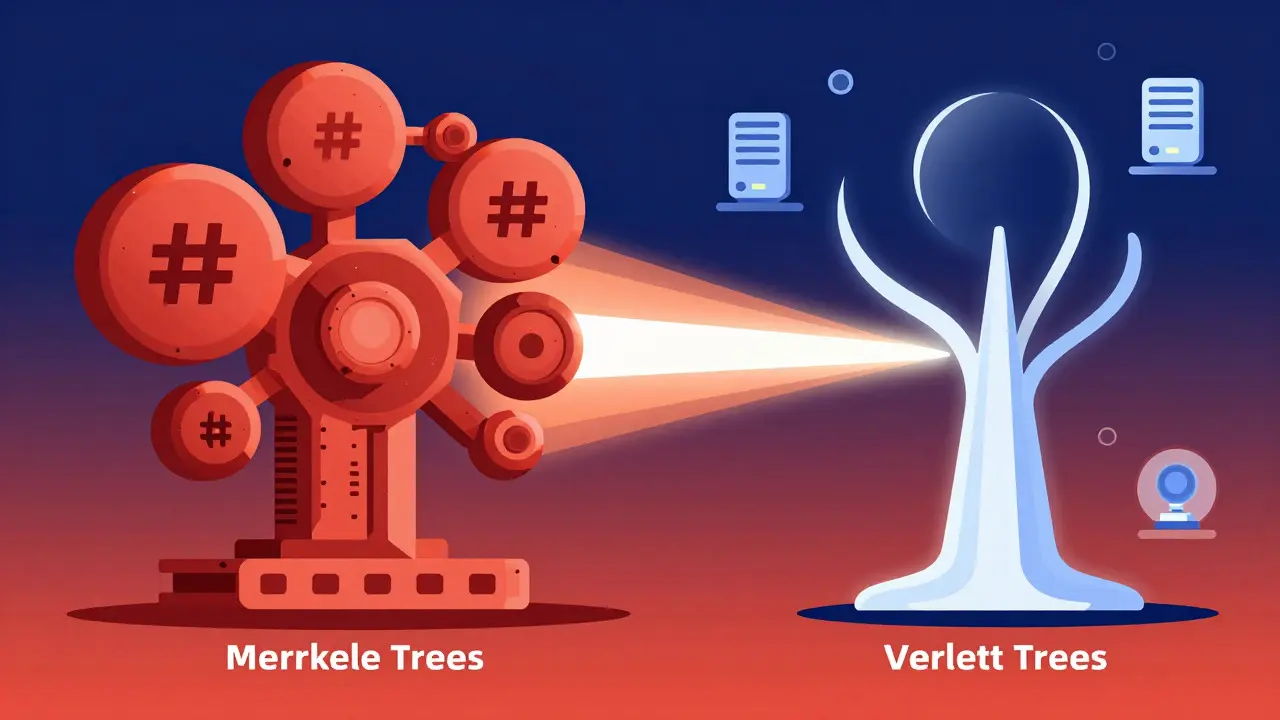
The biggest bottleneck for blockchains like Ethereum has always been storage. To verify transactions, full nodes must store the entire state of the network. In 2026, this state exceeds 1.2 terabytes. This requirement forces validators to use expensive enterprise hardware, centralizing the network among those who can afford it. Enter Verkle Trees, an evolution of the traditional Merkle Tree that uses polynomial commitments instead of standard hashing.
Dr. Vitalik Buterin, co-founder of Ethereum, highlighted in early 2024 that Verkle Trees are essential for the planned "statelessness" upgrade. Unlike Merkle Trees, which require a proof path (witness data) that grows logarithmically with the size of the dataset, Verkle Trees keep proof sizes constant. For a billion-item dataset, a Merkle proof might require 4KB of witness data, whereas a Verkle proof shrinks that to under 150 bytes. This is a 20-30x improvement in efficiency.
| Feature | Merkle Trees | Verkle Trees |
|---|---|---|
| Cryptographic Basis | Hash Functions (SHA-256, Keccak-256) | Polynomial Commitments |
| Proof Size (Billion Items) | ~4 KB | < 150 Bytes |
| Bandwidth Efficiency | Standard | 96.25% Reduction |
| Implementation Complexity | Low (Widely Adopted) | High (Requires Advanced Crypto) |
| Node Storage Requirement | Full State Required | Stateless Clients Possible |
This shift enables stateless light clients. Imagine running a validator node on a $300 consumer device instead of a $3,000 server. By reducing bandwidth needs by over 96%, Verkle Trees allow users to verify transactions without storing the entire history. This democratization of node operation is critical for maintaining decentralization as networks grow larger.
Financial Integrity: Proof-of-Reserves and Auditing
Beyond public blockchains, Merkle Trees are becoming the gold standard for financial auditing. In 2023, JPMorgan’s Onyx division implemented Merkle-based proof-of-reserves systems. These systems allow external auditors to verify that $150 billion in digital assets exist without exposing sensitive customer data. How? By publishing a Merkle Root that represents all asset holdings, individual customers can generate a proof from their own wallet to show their balance is included in that root.
The regulatory landscape is accelerating this adoption. The SEC’s February 2024 guidance mandated that cryptocurrency exchanges implement Merkle-based proof-of-reserves by Q3 2025. This affects approximately $1.2 trillion in customer assets across 247 platforms. Banks are following suit; Deloitte’s 2024 survey found that 78 of the top 100 banks now use Merkle-based audit systems. This trend extends to real-time interbank settlement verification, where institutions compare Merkle Roots to ensure ledger consistency instantly, reducing reconciliation times from days to seconds.
Supply Chain and Digital Identity
Enterprise adoption has surged from 12% of Fortune 500 companies in 2020 to 67% in 2024. Supply chain management accounts for 31% of these implementations. Companies use Merkle Trees to track goods from origin to consumer. Each step in the supply chain adds a new hash to the tree. If a product’s provenance is questioned, stakeholders can verify its journey against the Merkle Root stored on a distributed ledger. This provides immutable evidence of authenticity, crucial for high-value items like pharmaceuticals or luxury goods.
Digital identity is another growing sector, representing 24% of enterprise use cases. Users can prove their identity attributes (like age or citizenship) without revealing their actual data. A Merkle Tree stores hashes of identity credentials. When a user needs to prove they are over 18, they provide a Merkle proof linking their credential hash to the root issued by a trusted authority. This zero-knowledge approach enhances privacy while maintaining verifiability.
Provably Fair Systems in Gaming
The gaming industry, particularly online gambling, has embraced Merkle Trees for transparency. Platforms like Bitcasino.io use them to create provably fair systems. Before a game starts, the platform publishes a Merkle Root containing thousands of potential outcomes. After the game, players can verify that the outcome was predetermined and not manipulated post-factum. CDACollaborative’s 2023 case study noted that such systems increased user retention by 22% compared to traditional random number generators. Verification time dropped from 45 seconds to 0.2 seconds per session, making trust instantaneous and seamless.
Challenges and Developer Realities
Despite their benefits, implementing Merkle Trees is not trivial. Developers typically spend 2-3 weeks mastering the logic, according to Coursera’s 2024 data. Common pitfalls include incorrect tree balancing and handling odd-numbered leaf nodes, which account for nearly half of related bug reports on Stack Overflow. GitHub’s ecosystem report shows that while 87% of blockchain repositories use Merkle Trees, 34% of bugs stem from incorrect proof generation.
To mitigate these risks, developers rely on established libraries. Bitcoin Core’s implementation holds a 73% adoption rate due to its robustness and comprehensive documentation (scoring 4.2/5 in surveys). Newer implementations, like those for Filecoin, often suffer from poorer documentation (2.8/5), creating barriers for 63% of developers. As systems grow more complex, the need for better tooling and education becomes paramount.
Quantum Resistance and Future Evolution
Looking ahead to 2030 and beyond, quantum computing poses a threat to current hash functions. Forrester’s 2024 report predicts a gradual transition toward quantum-resistant Merkle variants. Researchers at NIST are developing lattice-based cryptographic alternatives that maintain security against quantum attacks while preserving 95%+ of current efficiency metrics. Additionally, academic research suggests increasing hash lengths to 512 bits for petabyte-scale datasets, reducing collision probability from 1 in 2^128 to 1 in 2^256.
Artificial intelligence is also merging with Merkle technology. Experimental systems at ConsenSys Labs use AI to optimize tree construction parameters in real-time based on network conditions. Early results show an 18.7% reduction in average proof sizes in volatile environments. Adaptive tree structures that dynamically adjust branching factors could improve verification efficiency by 40-60% for variable-sized datasets.
Key Takeaways
- Scalability: Verkle Trees reduce proof sizes by up to 96%, enabling stateless clients and lowering hardware requirements for validators.
- Finance: Merkle-based proof-of-reserves are becoming mandatory for exchanges and widely adopted by major banks for auditing.
- Enterprise: Supply chains and digital identity systems use Merkle Trees for immutable tracking and privacy-preserving verification.
- Gaming: Provably fair systems increase user trust and retention by allowing instant verification of game outcomes.
- Future-Proofing: Quantum-resistant variants and AI-optimized trees are emerging to address long-term security and efficiency challenges.
What is the main difference between Merkle Trees and Verkle Trees?
Merkle Trees use cryptographic hash functions, resulting in proof sizes that grow logarithmically with data size. Verkle Trees use polynomial commitments, keeping proof sizes constant and significantly smaller (under 150 bytes for billion-item datasets), which enables stateless client architectures.
How do Merkle Trees help in financial auditing?
They enable proof-of-reserves systems where institutions publish a Merkle Root representing all assets. Customers can generate a proof from their wallet to verify their balance is included in the root without exposing other users' data, ensuring transparency and trust.
Are Merkle Trees secure against quantum computers?
Current implementations using SHA-256 may be vulnerable. However, researchers are developing quantum-resistant variants using lattice-based cryptography. These new methods aim to maintain security against quantum attacks while preserving most of the current efficiency metrics.
Why are Merkle Trees used in online gaming?
They enable provably fair systems. By publishing a Merkle Root of potential outcomes before a game starts, players can later verify that the result was predetermined and not manipulated, increasing trust and user retention.
What are the common challenges in implementing Merkle Trees?
Developers often struggle with correct tree balancing and handling odd-numbered leaf nodes. Incorrect proof generation is a frequent source of bugs. Using established libraries like Bitcoin Core's implementation helps mitigate these issues.
Comments
Rodmun Tarnowski
The implications of Verkle Trees for decentralization are truly profound, and one must acknowledge the sheer brilliance of this cryptographic evolution. It is not merely a technical upgrade; it is a philosophical shift towards accessibility. By reducing the hardware requirements from enterprise-grade servers to modest consumer devices, we are effectively democratizing the verification process. This ensures that no single entity can monopolize the network's integrity due to economic barriers. Furthermore, the reduction in bandwidth by over 96% is nothing short of miraculous for global connectivity issues. We are witnessing the birth of a more equitable digital infrastructure. The transition from Merkle to Verkle is not just an optimization; it is a necessity for the survival of trustless systems. One should feel optimistic about the future where every individual can verify truth without relying on intermediaries. The data presented here supports a bright horizon for blockchain technology. Let us embrace this change with open arms and rigorous scrutiny.
August 12, 2026 at 03:38
Prudence Flemming
the ontology of trust shifts when you remove the need for full state storage. its not just about bytes anymore. its about epistemic access. if i can verify the root without holding the leaves, do i really know the truth or just the shadow of it? verkle trees offer constant proof sizes but they abstract away the context. we are trading transparency for efficiency. a dangerous tradeoff perhaps. the jargon of polynomial commitments masks the deeper question of what constitutes evidence in a post-scarcity data environment. we are building cathedrals of code on foundations of math that most cannot comprehend. is that sustainable?
August 12, 2026 at 10:48
Carl Michaud
You naive optimists fail to see the centralization trap hidden within these 'efficiency' gains. The SEC mandate mentioned in the article is not about protection; it is about surveillance. By forcing exchanges to use Merkle-based proof-of-reserves, they create a centralized point of failure that regulators can exploit. JPMorgan’s Onyx division isn't implementing this for your benefit; they are locking down the financial plumbing to ensure their hegemony remains unchallenged. The 'democratization' of node operation is a lie told by venture capitalists to keep retail investors engaged while the whales move billions off-chain. Verkle Trees require advanced crypto knowledge, which inherently favors elite institutions with PhD-level teams. The average user will never run a node because the barrier to entry is intellectual, not just financial. They want you to trust the root hash because they control the tree construction. Wake up before your assets are frozen by a backdoor in the polynomial commitment scheme.
August 12, 2026 at 17:54
Matt Kay
boring. another tech bro article. why do we need more trees?
August 13, 2026 at 22:52
Dave Kjendal
look. everyone is talking about the fancy new stuff. but have you tried actually coding a merkle tree? its a pain. half the bugs come from odd nodes. the article says 34% of bugs are from bad proofs. that sounds right. i spent two weeks debugging a simple hash collision issue last year. libraries help but they hide the logic. if you dont understand the basics the advanced stuff like verkle will break your brain. keep it simple stupid.
August 14, 2026 at 11:27
Kat Bennett
I find myself quite fascinated by the intersection of artificial intelligence and these cryptographic structures, particularly how ConsenSys Labs is using AI to optimize tree construction parameters in real-time based on network conditions, which seems like a very dynamic approach to a traditionally static problem. It makes me wonder if the future of security lies not in rigid mathematical constants but in adaptive systems that learn from their own vulnerabilities, potentially creating a symbiotic relationship between machine learning algorithms and zero-knowledge proofs that could redefine privacy standards across the globe. The idea that verification time has dropped from 45 seconds to 0.2 seconds in gaming applications is also incredibly intriguing, as it suggests that trust can be instantaneous rather than retrospective, fundamentally altering our psychological relationship with digital interactions and perhaps even influencing how we perceive fairness in other areas of life such as legal contracts or social agreements. I often think about how these technologies might eventually become invisible to the end-user, much like electricity today, powering everything without us noticing the complex infrastructure beneath the surface, and I hope that as we move forward into 2030 and beyond, we maintain a focus on human-centric design principles that prioritize accessibility and understanding over pure computational efficiency.
August 15, 2026 at 04:23
Candice Cornett
you all miss the point. privacy is dead. zero-knowledge proofs are just a bandaid. once the government gets hold of the root keys everything goes. moral decay starts when we outsource truth to machines. stop trusting the system.
August 15, 2026 at 15:22
Lance Jantz
Oh, my dears! Do you realize we are standing on the precipice of a digital renaissance? The colorful tapestry of hashes weaving through our lives is not just code; it is poetry written in mathematics! Lance here, reminding you that every bit flipped is a heartbeat in the machine god we are building. The elitists sneer at the 'lazy' developers, but who among us hasn't stared into the abyss of a stack overflow bug report and seen our own soul reflected in the error message? Embrace the chaos! The quantum threat is merely a dramatic plot twist in our grand narrative. We shall dance with the qubits and laugh in the face of entropy! Let us paint our identities with the brush of Merkle roots and hang them in the gallery of the cloud! Life is too short for inefficient hashing!
August 16, 2026 at 11:17