
Connecting your wallet to a decentralized finance platform should feel like opening a new door, not walking into a maze. Flamingo Finance is a multi-protocol DeFi platform that aggregates swaps, vaults, perpetual contracts, and lending into a single interface across multiple blockchains including Neo and zkSync. It promises the convenience of a centralized exchange with the self-custody benefits of Web3. But does it deliver on that promise, or is it just another shiny dashboard hiding liquidity issues?
In this review, we cut through the marketing hype. We look at the actual user experience, the real risks associated with the FLM token, and whether Flamingo Finance fits your specific trading style in 2026. If you are looking for deep liquidity and institutional-grade stability, this might not be your first stop. If you want an all-in-one dashboard for yield farming and cross-chain swaps without jumping between five different apps, keep reading.
What Is Flamingo Finance and How Does It Work?
Flamingo Finance launched in 2020 on the Neo blockchain. Since then, it has expanded to include zkSync and other EVM-compatible chains. The core idea is simple: instead of using Uniswap for swaps, Aave for lending, and GMX for perps, you do everything inside Flamingo.
The platform operates as a non-custodial protocol. This means you never send your funds to Flamingo’s servers. You connect a wallet like MetaMask or NeoLine, and smart contracts handle the rest. The interface hides the complexity of interacting with multiple chains. For example, when you swap tokens, the system automatically routes your transaction through the most efficient path available, whether that is on Neo N3 or zkSync.
The ecosystem revolves around six main modules:
- Swap: An automated market maker (AMM) for exchanging tokens.
- Vault: Yield aggregation strategies that aim to maximize returns from various DeFi protocols.
- Perp: Perpetual futures contracts for leveraged trading.
- Lending: Borrowing and lending assets, often using the synthetic stablecoin FUSD.
- FUSD: A synthetic stablecoin pegged to the US dollar, used as collateral and settlement asset within the ecosystem.
- DAO Governance: Voting rights for holders of the FLM token.
This "one-stop-shop" model saves time. However, it also means you are trusting one team’s integration of these complex financial products. If the bridge fails or the smart contract has a bug, your access to funds across all these modules could be impacted simultaneously.
User Experience: Easy Setup, Complex Reality
Getting started with Flamingo Finance is straightforward if you already have a crypto wallet. There is no email sign-up, no KYC (Know Your Customer) verification, and no password to remember. You simply visit the site, click "Connect Wallet," and approve the connection. Most users report being able to execute their first transaction within 15 to 20 minutes.
The dashboard is clean and intuitive. Unlike many DeFi interfaces that look like code editors, Flamingo uses familiar charts and buttons. You can see your portfolio balance, active positions, and yield earnings in one place. This design choice lowers the barrier to entry for retail investors who find traditional DeFi tools intimidating.
However, the simplicity ends once you start digging into the details. Because Flamingo operates on multiple chains, fees and execution times vary significantly. A swap on Neo N3 might cost fractions of a cent and settle in seconds. The same swap on zkSync or Ethereum side-chains can incur higher gas fees and longer wait times during network congestion. Users often complain about inconsistent yields. One Reddit user noted expecting a 20% APY in a vault but seeing only 5% after accounting for gas fees and slippage.
Support is community-driven. The official Telegram group has over 12,500 members, and Discord hosts around 8,300 active users. But response times for technical issues average 12 to 24 hours. If you are stuck with locked funds or a failed transaction, you are largely on your own until a community member or developer chimes in.
Security and Trust: The Red Flags You Need to Know
Security in DeFi is not about trust; it is about code audits and track records. Flamingo Finance has shown resilience in some areas. During the npm supply chain compromises in May 2025, many projects suffered breaches. Flamingo remained unaffected because its architecture does not rely on direct EVM transfer flows for core operations, avoiding the specific vectors exploited by the malware.
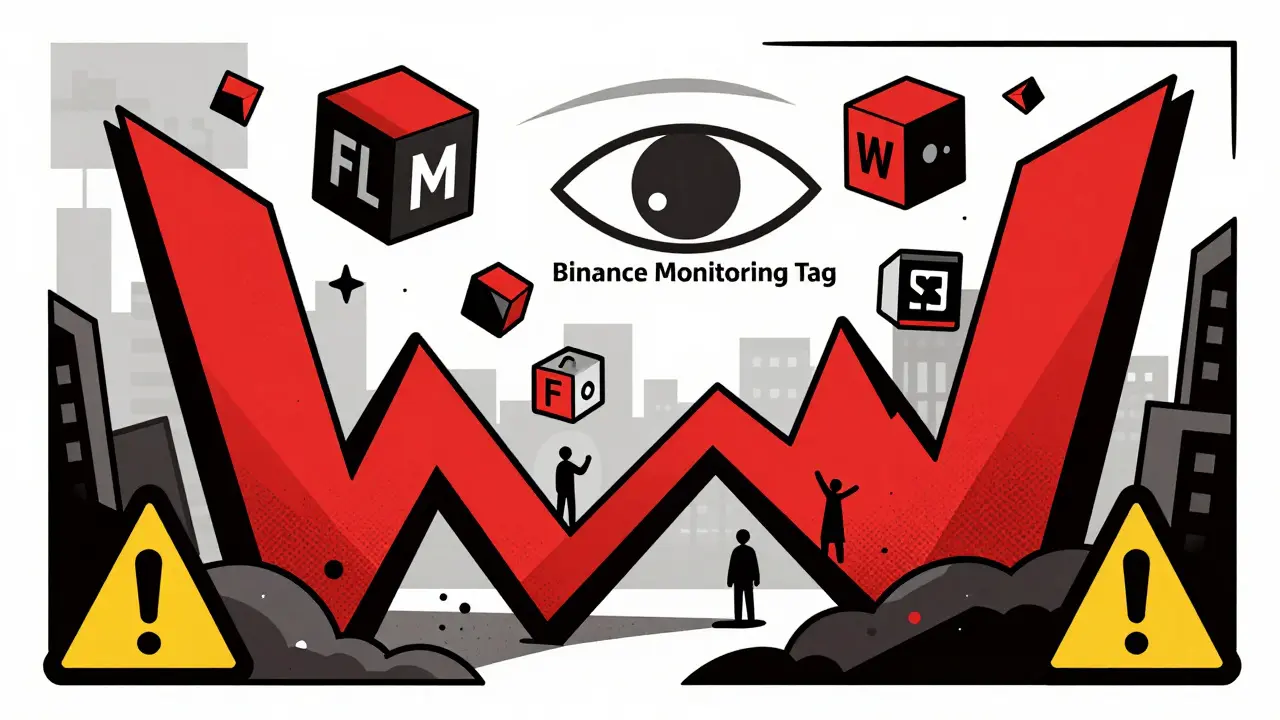
Despite this win, significant red flags persist. In April 2025, Binance placed a "Monitoring Tag" on the FLM token. This tag indicates that the exchange is reviewing the token for potential delisting due to concerns about liquidity, transparency, or regulatory compliance. Delisting from a major exchange like Binance can drastically reduce a token’s liquidity and price stability.
Furthermore, the synthetic stablecoin FUSD operates in a regulatory gray area. Following the U.S. SEC’s February 2025 guidance on algorithmic stablecoins, platforms issuing unbacked stablecoins face increased scrutiny. While FUSD is pegged to the dollar, its backing mechanisms and reserve transparency are less clear than those of fully regulated stablecoins like USDC or USDT.
Always remember: in DeFi, you are responsible for your own security. Use a hardware wallet for large holdings, never share your seed phrase, and verify contract addresses directly from official sources before interacting with any dApp.
FLM Token Economics and Price Outlook
The FLM token serves two primary functions: governance and fee discounts. Holders vote on protocol upgrades, new asset listings, and treasury management. Using FLM for transactions can reduce fees, incentivizing users to hold the token rather than sell it immediately.
As of mid-2025, FLM traded around $0.0364 with a market capitalization of approximately $19.7 million. This places it far behind industry giants. For context, Uniswap’s market cap exceeded $4 billion during the same period. Flamingo’s total value locked (TVL) was around $23.5 million, ranking it #147 among DeFi protocols according to DeFi Llama data.
Price predictions for FLM are highly contradictory. Algorithmic models from CoinCodex forecast a bearish trend, suggesting a drop to $0.01957 by November 2025. Conversely, CoinLore’s model predicts a surge to $0.1249 in 2025, representing a 514% increase. Long-term projections are even more volatile, with some analysts suggesting a potential rise to $1.45 over ten years, while others warn of continued decline.
This divergence highlights the speculative nature of small-cap DeFi tokens. FLM’s price is heavily influenced by broader market sentiment, liquidity changes, and project announcements rather than fundamental revenue streams. Investors should treat FLM as a high-risk asset suitable only for capital they can afford to lose entirely.
| Feature | Flamingo Finance | Uniswap | Aave |
|---|---|---|---|
| Primary Focus | All-in-One DeFi Suite | Decentralized Swaps | Lending & Borrowing |
| Supported Chains | Neo, zkSync, others | Ethereum, Polygon, Arbitrum, etc. | Ethereum, Avalanche, Optimism, etc. |
| Market Cap (May 2025) | ~$19.7 Million | ~$4 Billion+ | ~$2 Billion+ |
| User Onboarding | Wallet Connect Only | Wallet Connect Only | Wallet Connect Only |
| Liquidity Depth | Low to Medium | Very High | Very High |
| Risk Level | High (Small Cap, Multi-chain) | Medium (Established) | Medium (Established) |

Who Should Use Flamingo Finance?
Flamingo Finance is not for everyone. It suits specific types of users who prioritize convenience and diversification over deep liquidity and brand recognition.
Consider Flamingo if:
- You are an experienced DeFi user comfortable with managing wallet connections and understanding gas fees.
- You want to experiment with yield farming across multiple chains without switching interfaces.
- You believe in the long-term potential of the Neo ecosystem and want early exposure to its top protocols.
- You are willing to accept higher risk for potentially higher rewards in a smaller market cap project.
Avoid Flamingo if:
- You are a beginner unfamiliar with concepts like impermanent loss, slippage, and smart contract risk.
- You need deep liquidity for large trades (over $10,000), as slippage will likely eat into your profits.
- You prefer established, audited platforms with massive TVL and proven track records like Uniswap or Aave.
- You are uncomfortable with the regulatory uncertainty surrounding synthetic stablecoins like FUSD.
Final Verdict: Proceed with Caution
Flamingo Finance offers a compelling vision of a unified DeFi experience. Its multi-chain approach and intuitive interface solve real pain points for users tired of juggling multiple apps. The successful navigation of the 2025 npm supply chain attack demonstrates competent engineering practices.
However, the risks are substantial. The Binance monitoring tag, low liquidity compared to competitors, and contradictory price forecasts signal volatility and uncertainty. The platform’s reliance on a small market cap makes it vulnerable to market swings and whale manipulation.
If you decide to use Flamingo Finance, start small. Treat it as a laboratory for testing strategies rather than a primary vault for your savings. Diversify your DeFi activities across larger, more liquid protocols to mitigate risk. Stay updated on their Q3 2025 roadmap updates regarding tokenomics revamps and new chain integrations, as these developments could significantly impact the platform’s viability.
Is Flamingo Finance safe to use?
Flamingo Finance is non-custodial, meaning you control your keys, which reduces the risk of exchange hacks. However, smart contract risks always exist. The platform survived the 2025 npm supply chain attacks, showing architectural strength. Yet, the Binance Monitoring Tag on FLM raises concerns about long-term stability and liquidity. Always use a hardware wallet and never invest more than you can afford to lose.
What is the FLM token used for?
The FLM token is the native governance token of Flamingo Finance. Holders can vote on protocol upgrades, fee structures, and new asset listings. Additionally, using FLM for transactions may provide fee discounts. It does not represent equity in a company but rather utility within the protocol.
How does Flamingo Finance compare to Uniswap?
Uniswap is a specialized swap protocol with massive liquidity and a huge market cap. Flamingo Finance is an all-in-one suite offering swaps, lending, perps, and vaults. Flamingo is better for users who want variety in one interface, but Uniswap is superior for executing large trades with minimal slippage due to deeper liquidity.
Why did Binance put a monitoring tag on FLM?
In April 2025, Binance placed a monitoring tag on FLM, indicating a review for potential delisting. This usually happens due to concerns about liquidity, transparency, or regulatory compliance. It signals that the exchange is cautious about the token’s future and advises users to exercise caution.
Can I use Flamingo Finance without KYC?
Yes. Flamingo Finance is a decentralized protocol. You do not need to provide personal identification or undergo KYC checks. You only need a compatible crypto wallet like MetaMask or NeoLine to connect and start using the platform.
What is FUSD and is it stable?
FUSD is a synthetic stablecoin pegged to the US dollar within the Flamingo ecosystem. It is used for lending, borrowing, and trading. However, unlike fully backed stablecoins, its stability depends on the protocol’s algorithms and collateral reserves. Regulatory scrutiny on such coins has increased, adding risk.
Comments
Eric Scheinberg
The integration of Neo and zkSync is a fascinating architectural choice that deserves deeper scrutiny regarding cross-chain atomicity. While the convenience of a unified interface is undeniable, the reliance on bridges introduces significant attack vectors that are often overlooked by retail users. One must consider the implications of smart contract risk when aggregating multiple protocols under a single governance token. The recent npm supply chain incident highlighted how fragile these dependencies can be even for seemingly robust platforms. It is imperative to evaluate whether the security audits provided cover all potential failure points in the bridging mechanism. Users should not assume that non-custodial status equates to absolute safety against code exploits. The lack of deep liquidity compared to established giants like Uniswap remains a critical weakness for any serious trader. I would recommend conducting thorough due diligence on the reserve transparency of FUSD before committing substantial capital. The regulatory gray area surrounding synthetic stablecoins poses an existential threat that cannot be ignored. We must approach such innovations with cautious optimism rather than blind enthusiasm.
June 10, 2026 at 20:08
pankaj chawla
I completely agree with the assessment of the risks involved here. The Binance monitoring tag is a massive red flag that signals underlying issues with liquidity or compliance. Many projects fail to address these concerns until it is too late for early investors. The discrepancy between algorithmic price predictions further underscores the speculative nature of this token. It is not wise to rely on such volatile assets for long-term wealth preservation. Instead, one should focus on protocols with proven track records and deep liquidity pools. Flamingo might offer novelty but it lacks the stability required for institutional adoption. The yield farming opportunities may seem attractive initially but they often come with hidden costs in slippage and gas fees. We need more transparency from the development team regarding their roadmap and security measures. Until then, caution is the only sensible approach for any rational investor.
June 12, 2026 at 01:37
Jessica Lane
It is quite intriguing how the platform attempts to simplify complex DeFi interactions for retail users. However, the simplicity often masks the underlying complexities that can lead to significant financial losses if misunderstood. The user experience seems polished but does it truly educate users about the risks they are taking? I wonder if the community support is sufficient to handle technical issues during periods of high volatility. The average response time of twelve hours seems inadequate for urgent matters involving locked funds. Perhaps there is room for improvement in their customer service infrastructure. The comparison table clearly shows where Flamingo stands relative to industry leaders. It is important to recognize that being different does not always mean being better. Users must weigh the benefits of convenience against the drawbacks of lower liquidity and higher risk.
June 14, 2026 at 01:01
Charles Pawlikowski
another overhyped scam waiting to happen :/ why do people keep falling for these fake promises of easy money ?? the binance tag should have been enough warning for anyone with half a brain .. these guys are just trying to rug pull the unwashed masses .. stay away from this trash unless you want to lose everything you own .. typical crypto bro nonsense wrapped up in pretty charts .. i bet the devs are already cashing out while you read this garbage review .. dont be a sucker !!
June 14, 2026 at 11:58
Andrea Burd
ugh another generic review copy pasted from somewhere else probably .. the writing is so pretentious and boring nobody wants to read all that fluff about 'architectural choices' .. just tell us if we can make money or not .. also your spelling mistakes are showing eric .. maybe stick to simpler topics next time .. this whole defi space is getting ridiculous with all these new platforms popping up every week .. who has time to research each one properly .. i just want passive income without reading pages of warnings .. typical elitist take really ..
June 14, 2026 at 16:58
Akeem Whittaker
The critique regarding the lack of educational resources is valid and needs addressing immediately. Users entering the ecosystem must understand the mechanics of impermanent loss and bridge risks fully. Asserting that the platform is safe without proper knowledge transfer is irresponsible marketing. We need clear documentation that explains the technical nuances in accessible language. The community forums should be moderated more effectively to prevent misinformation spread. Additionally, the fee structure needs greater transparency to avoid surprising users with high slippage costs. Without these improvements, trust will continue to erode among potential adopters. The project must prioritize user education alongside technological innovation to survive in this competitive landscape. Ignoring these fundamental aspects will likely lead to its eventual decline.
June 16, 2026 at 12:39
Manish Prajapat
One must contemplate the philosophical implications of centralized interfaces managing decentralized assets. Does the aggregation of services create a false sense of security for the uninformed participant? The tension between usability and sovereignty remains unresolved in current designs. Flamingo represents an attempt to bridge this gap yet it introduces new points of centralization through its governance model. The reliance on a single token for both utility and governance creates conflicts of interest that could undermine decentralization goals. We should question whether true freedom exists when access depends on holding specific speculative assets. The market dynamics suggest that concentration of power persists despite rhetorical commitments to openness. Perhaps the solution lies in modular architectures rather than monolithic suites. Only time will reveal if this approach fosters genuine empowerment or merely convenient captivity.
June 17, 2026 at 09:35