
FBAR Crypto Calculator
Use this calculator to determine if you need to file an FBAR for your cryptocurrency accounts in 2025 based on current regulations. Enter details for each foreign crypto account you hold.
Add Your Crypto Account
FBAR Filing Assessment
Important Note: Even if you're not legally required to file, many tax professionals recommend filing an FBAR for your crypto accounts due to upcoming regulatory changes. The IRS may impose retroactive penalties if you wait for new rules to take effect.
If you hold cryptocurrency on a foreign exchange and your total balance crossed $10,000 at any point in 2025, you might be required to file an FBAR. It’s not optional. It’s not a suggestion. It’s a legal obligation enforced by the U.S. government - and the penalties for ignoring it can be brutal.
What Exactly Is an FBAR?
FBAR stands for Foreign Bank and Financial Account Report. It’s not a tax form. It’s a report filed with FinCEN, a branch of the U.S. Treasury, to track money held overseas. You must file FinCEN Form 114 if, at any time during the calendar year, the combined value of all your foreign financial accounts exceeded $10,000. That’s not per account. That’s the total of everything you own abroad - bank accounts, investment accounts, and yes, cryptocurrency accounts under certain conditions.The deadline is April 15, but you automatically get an extension to October 15. No paperwork needed to get it. Just file by then.
Crypto Accounts and the $10,000 Rule
Here’s where it gets messy. In 2020, FinCEN issued a notice saying foreign cryptocurrency accounts aren’t reportable on FBAR - unless they also hold traditional money like euros, yen, or dollars. That means if you only hold Bitcoin, Ethereum, or Solana on Binance, KuCoin, or Kraken (outside the U.S.), you’re technically not required to report them under current rules.But here’s the catch: if your account holds both crypto and fiat currency - say, $5,000 in ETH and $7,000 in EUR - you’re now in the clear for reporting. That hybrid account triggers the FBAR requirement. The $10,000 threshold applies to the total value of all reportable assets in that account, not just the crypto.
And don’t assume your crypto balance is safe just because it’s on a "decentralized" platform. If the exchange is based outside the U.S. and you have control over the private keys or withdrawal rights, it counts as a foreign financial account. That includes platforms like Bybit, Bitstamp, or even crypto wallets linked to foreign custodians.
Who Has to File?
You’re required to file if you’re a U.S. person - that includes citizens, green card holders, and residents who meet the substantial presence test - and you had a financial interest in or signature authority over any foreign account that hit $10,000 at any time in 2025.Financial interest means you own the account, or you’re the beneficiary of a trust or corporation that owns it. Signature authority means you can control withdrawals or transfers, even if you don’t own the money. So if you’re a co-signer on a crypto wallet with a friend in Germany, and you can move funds, you may need to report it.
It doesn’t matter if you didn’t sell, trade, or cash out. The mere existence of the balance above $10,000 triggers the requirement. Even if your Bitcoin was worth $12,000 on June 3rd and dropped to $8,000 the next day, you still had to report it.
The Big Gray Area: Should You Report Anyway?
Many tax pros - especially those who specialize in crypto - say you should file even if you’re not legally required to. Why? Because FinCEN has said they’re working on new rules to include crypto as a reportable asset. They’ve been hinting at this for years. In 2025, it’s not a matter of if, but when.Think of it like this: if you’re holding $15,000 in crypto on Binance.com and you wait for the rule change, you could be hit with retroactive penalties for not reporting in 2023, 2024, and 2025. Penalties for willful non-compliance can reach $100,000 or 50% of the account balance - whichever is higher. For non-willful violations, it’s $10,000 per violation. That’s per year, per account.
Conservative filers - the kind who work with firms like CoinLedger or CryptoTaxCalculator - recommend filing even for pure crypto accounts. It’s not required now, but it’s a shield against future audits. If you’ve kept records and filed voluntarily, the IRS is far more likely to treat you as cooperative, not careless.

How to Calculate Your Crypto Balance
You can’t just look at your wallet balance and guess. You need the highest value in U.S. dollars for each account during the year.For example:
- On January 15, your ETH balance was worth $8,000
- On March 22, it spiked to $14,500
- On November 10, it dropped to $6,200
You report $14,500 - the peak value. Even if you only held that high for one day, that’s the number that matters.
Use tools like Koinly, CoinTracker, or even a detailed spreadsheet with daily price data from CoinGecko or CoinMarketCap. Don’t rely on exchange statements - they don’t always show accurate historical values. You need the exact USD equivalent on the day your balance peaked.
What If You Have Multiple Accounts?
Add them all up. If you have $4,000 on Binance, $3,500 on KuCoin, and $3,000 on Bitstamp, your total is $10,500. You’re required to file. It doesn’t matter that no single account hit $10,000. The rule is about the aggregate value of all your foreign accounts.And yes - you have to list each one separately on FinCEN Form 114. Name the exchange, the country it’s based in, and the account number (if available). Some exchanges don’t give you account numbers. In that case, use your email or user ID, and note that it’s a crypto account. Be specific. Don’t write "crypto wallet." Write "Binance.com, Singapore, User ID: abc123."
How to File
You file electronically through the BSA E-Filing System. No paper forms. No exceptions. You can file yourself, or hire a tax professional who’s registered as a BSA E-Filer. Most accountants aren’t set up for this - you need someone who’s trained in FinCEN reporting.The form asks for:
- Your personal info (name, SSN, address)
- Details for each foreign account: institution name, country, account number
- The maximum value of each account in USD during the year
- Whether you have signature authority
It takes about 15-30 minutes to complete if you have your records ready. No payment. No fee. Just accuracy.
What Happens If You Don’t File?
The IRS and FinCEN are getting serious. They’ve been cross-referencing data from U.S.-based exchanges like Coinbase and Kraken with foreign exchange data. They know who’s holding crypto overseas. They know the balances. They’re building case files.If you didn’t file and they catch you:
- Non-willful violation: $10,000 per year, per account
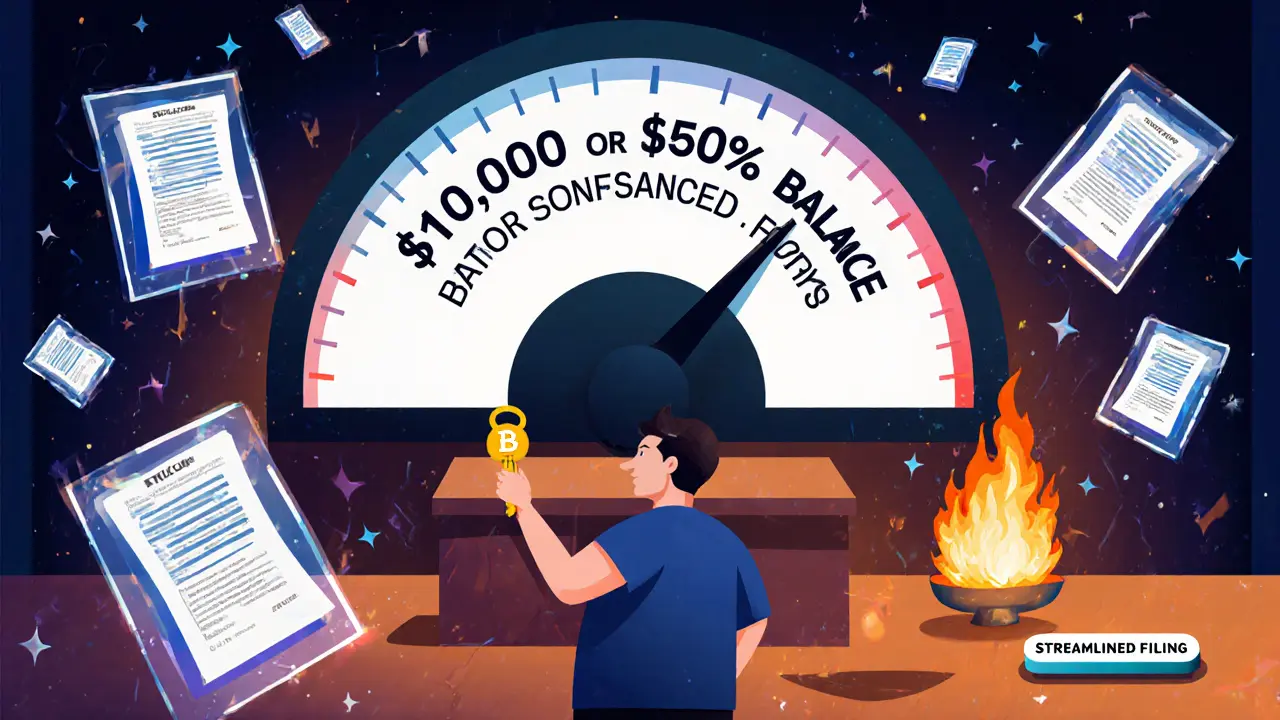
- Willful violation: up to $100,000 or 50% of the account balance - whichever is higher
There’s no statute of limitations for FBAR violations. That means if you never filed for 2020, 2021, 2022, 2023, and 2024 - and you’re caught in 2025 - you could owe $50,000 in penalties. That’s not a hypothetical. It’s happened.
There’s a relief program called the Streamlined Filing Compliance Procedures, but it only works if you’re not under audit. If you’ve been contacted by the IRS, you’re out of luck.
What’s Coming Next?
FinCEN has signaled it will soon require FBAR reporting for all foreign crypto accounts - even pure ones. The Infrastructure Investment and Jobs Act of 2021 already gave them the authority. The proposed rule changes are expected to go into effect in 2026 or early 2027.That means if you wait until 2026 to file, you might be forced to report 2023, 2024, and 2025 retroactively. That’s why tax experts say: file now, even if you’re not required. It’s not about being perfect today. It’s about protecting yourself tomorrow.
What You Should Do Right Now
1. List every foreign crypto account you’ve held in 2025 - even if you closed it. Include exchanges, wallets with foreign custodians, and DeFi platforms with overseas entities. 2. Calculate the peak value of each in USD during the year. Use reliable price data. 3. Add them all up. If the total is $10,000 or more, you need to file. 4. Even if you’re under $10,000, keep detailed records. You’ll need them if the rules change. 5. File by October 15, 2025 - or sooner if you’re feeling cautious.If you’re unsure, hire a crypto-savvy CPA or tax attorney. Don’t trust a general accountant. This isn’t standard tax stuff. It’s a niche compliance area with real legal risk.
Do I have to file an FBAR if I only hold crypto on a foreign exchange?
Currently, if your account holds only cryptocurrency and no fiat currency (like USD, EUR, or JPY), you’re not legally required to file an FBAR under FinCEN Notice 2020-2. But many tax professionals advise filing anyway because new rules are expected soon, and retroactive penalties could apply. If your account holds any fiat money along with crypto, you must file.
What if my crypto balance went over $10,000 for just one day?
Yes, you still have to file. The FBAR rule is based on the highest value your foreign accounts reached at any point during the year - even if it was for one hour. If your Bitcoin hit $12,000 on July 5 and then dropped to $8,000 the next day, you report $12,000.
Can I file an FBAR myself, or do I need a professional?
You can file yourself using the BSA E-Filing System. But if you have multiple accounts, complex holdings, or mixed fiat/crypto balances, it’s safer to use a CPA or attorney registered as a BSA E-Filer. Most regular tax preparers aren’t trained for this.
What happens if I didn’t file for past years?
If you’ve never filed and you’re not under audit, you can use the IRS Streamlined Filing Compliance Procedures to catch up with reduced or no penalties. But if the IRS has already contacted you, you’re no longer eligible. The best time to fix it was yesterday - the second-best time is now.
Are U.S.-based exchanges like Coinbase subject to FBAR?
No. FBAR only applies to accounts held with financial institutions outside the United States. Coinbase, Kraken, and Gemini are U.S.-based, so their accounts don’t count. But if you moved your crypto to a foreign wallet or exchange - even temporarily - that’s reportable.
Comments
Ankit Varshney
Just wanted to say thanks for laying this out so clearly. I’ve been ignoring this whole FBAR thing thinking crypto was exempt, but now I realize how risky that is. I’ve got accounts on Binance and Bybit - time to dig up my old transaction records.
November 29, 2025 at 03:16
Marsha Enright
You’re not alone. I spent 3 months panic-researching this last year after my CPA dropped the bomb. Use Koinly - it auto-pulls exchange data and flags peak values. Saved my sanity.
November 30, 2025 at 11:47
Ann Ellsworth
Frankly, the fact that FinCEN hasn’t yet codified crypto as a reportable asset under FBAR is a glaring regulatory lacuna - a deliberate loophole exploited by those who misunderstand the spirit of the law. The $10,000 aggregate threshold was never intended to be circumvented by asset-class arbitrage. This isn’t tax evasion; it’s structural noncompliance dressed in blockchain semantics. And yes, I’ve filed for my pure-crypto holdings since 2023 - not because I’m legally required, but because ethical fiduciary duty trumps technical loopholes.
December 1, 2025 at 19:04
Ziv Kruger
What does ‘ownership’ even mean in DeFi? If I hold ETH in a wallet with a foreign custodian but I control the keys… is that a financial account? Or is it just… me holding digital property? The law hasn’t caught up to the concept of self-custody. We’re being asked to report ghosts.
December 3, 2025 at 11:43
Catherine Williams
For anyone reading this and feeling overwhelmed - you’re not broken. This system is broken. But you can still protect yourself. Start with one account. One peak value. One day. You don’t need to fix everything at once. Just start. I’ve helped 17 people file last year - all of them terrified. All of them relieved after. You’ve got this.
December 5, 2025 at 01:43
Paul McNair
As someone who’s lived in India for 12 years and still files U.S. taxes - this hits different. I’ve got accounts on WazirX, KuCoin, and Bitget. The U.S. expects me to track every dollar I’ve ever touched abroad, while my local bank doesn’t even ask for my passport. It’s absurd. But I file anyway. Because the alternative is worse. And yes - I use my email as the account number. They’ve accepted it before.
December 6, 2025 at 16:48
Mohamed Haybe
Why should Indians pay for American bureaucracy? We use foreign exchanges because U.S. exchanges are overregulated and slow. Now they want us to report our crypto like it’s a Swiss bank account? Screw that. The U.S. doesn’t own my money just because I was born there. Let them catch me first. I’ve got better things to do than fill out forms for a government that taxes me on income I never see.
December 7, 2025 at 03:33
Sharmishtha Sohoni
Peak value = highest USD price in the year. Got it. What if I traded daily? Do I need hourly data?
December 9, 2025 at 01:06
Marsha Enright
Nope. Daily is enough. Even if you traded 100 times a day, just find the highest closing price for that day. Tools like Koinly do this automatically. No need to go insane.
December 10, 2025 at 18:15
Heather Hartman
Just filed my FBAR yesterday - pure crypto, $12k peak on Binance. Felt weird. But I’m not risking $100k because I was hoping the rules would disappear. Better to be the person who over-complied than the one who got crushed by a retroactive audit. You’re not paranoid - you’re prepared.
December 11, 2025 at 20:54