You’ve probably forgotten a password this week. Maybe you reset it, then forgot the new one, or got locked out because of two-factor authentication issues. It’s frustrating, but it’s also a symptom of a broken system. For decades, we’ve relied on centralized companies to manage our identities. They store our data, they verify who we are, and when they get hacked, our information goes with them. In 2022 alone, there were over 4,000 data breaches exposing billions of records.
Enter Decentralized Identifiers (DIDs). This is not just another tech buzzword; it’s a fundamental shift in how digital identity works. Instead of a company owning your profile, you own it. You control it. And you can prove who you are without handing over your entire life story to every website you visit.
What Exactly Is a DID?
To understand the use cases, you first need to know what you’re dealing with. A Decentralized Identifier is a type of identifier defined by the World Wide Web Consortium (W3C). Think of it as a digital passport number that lives on a decentralized network, like a blockchain, rather than in a central database owned by Google or Facebook.
The magic happens through three main components working together:
- The DID itself: A unique string (like
did:ethr:0x123...) that points to your public key. It’s immutable and under your control. - Verifiable Credentials (VCs): These are digital versions of real-world documents. Your driver’s license, university diploma, or even a professional certification becomes a cryptographically signed file stored on your device.
- Digital Identity Wallets: Apps like Microsoft Authenticator or Trust Wallet act as vaults for these credentials. You hold the keys, literally.
As of mid-2024, there are over 250 million DIDs created globally. The system allows for selective disclosure. If a bar wants to check if you’re 21, you can prove you are without showing your name, address, or ID number. You just send a cryptographic proof that says "Yes, I am over 21." That’s privacy built into the architecture.
Top DID Use Cases Across Industries
The potential applications are vast, but some sectors are already seeing real-world results. Here is where DIDs are making the biggest impact right now.
1. Government and Public Services
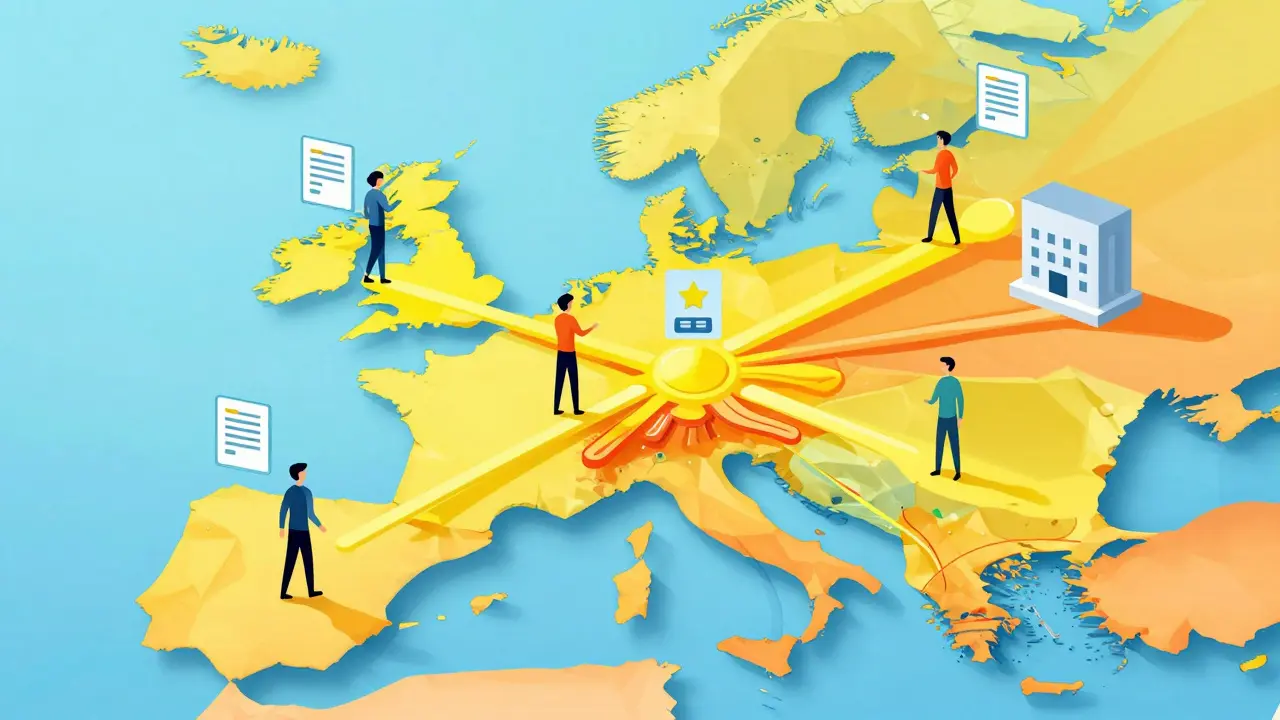
Governments are early adopters because they deal with massive amounts of sensitive citizen data. The European Union’s European Blockchain Services Infrastructure (EBSI) is a prime example. By May 2024, EBSI was processing nearly 50,000 verifications daily across 27 member states. Citizens can cross borders using digital credentials that are instantly verified, cutting down verification times from days to minutes.
In the United States, the State of Colorado launched a DID-based driver’s license system in June 2024. Within months, 150,000 active users were accessing services digitally. This reduces fraud, streamlines bureaucracy, and gives citizens ownership of their government-issued IDs.
2. Financial Services and Banking
Banks hate fraud. Identity theft costs the industry billions annually. With DIDs, Know Your Customer (KYC) processes become faster and cheaper. Instead of uploading photos of your passport and utility bills to every bank you open an account with, you create a verified credential once. You then share that credential selectively with new institutions.
JPMorgan Chase has piloted AI-integrated DID systems for identity verification. Mastercard’s Identity Check Mobile, deployed in 32 countries with 8.7 million users, uses similar principles. The result? Verification accuracy jumps to 99.998%, compared to roughly 87% for traditional knowledge-based methods (like answering security questions).
3. Healthcare
Imagine visiting a specialist and having to re-enter your medical history from scratch. Or worse, waiting hours for records to be faxed between hospitals. With DID-based health credentials, patients control their medical data. They grant temporary access to doctors via their digital wallet. This improves patient safety, reduces administrative overhead, and ensures data integrity since the records are cryptographically signed by issuing providers.
4. Education and Professional Certification
Universities are starting to issue diplomas as Verifiable Credentials. No more calling registrars to confirm graduation dates. Employers can instantly verify degrees without contacting the school. This is particularly useful for freelancers and gig workers who need to prove skills quickly to clients. Platforms like LinkedIn are exploring integrations to allow users to pin verified credentials directly to their profiles.
| Feature | Traditional Centralized Systems | Decentralized Identifiers (DID) |
|---|---|---|
| Data Ownership | Owned by service provider (e.g., Google, Bank) | Owned by the user |
| Security Model | Centralized honeypots (high breach risk) | Distributed ledger (no single point of failure) |
| Verification Speed | 2-3 business days (manual checks) | Under 2 minutes (cryptographic proof) |
| Privacy Control | All-or-nothing sharing | Selective disclosure (zero-knowledge proofs) |
| Interoperability | Siloed systems | Cross-platform (W3C standard) |
Why Businesses Are Switching Now
You might wonder why companies haven’t all switched yet. The truth is, adoption is growing but still nascent. Only 12% of Fortune 500 companies had adopted DID solutions as of early 2024, compared to 78% for traditional identity management. However, the momentum is shifting due to three key factors:
- Regulatory Pressure: Regulations like the EU’s eIDAS 2.0 (effective September 2024) mandate support for verifiable credentials in public services. Compliance is no longer optional for many enterprises.
- Cost Savings: Identity fraud costs global businesses tens of billions annually. Dr. Christopher Allen estimates that decentralized identity could reduce fraud losses by $50 billion annually by 2027.
- User Demand: Consumers are increasingly aware of data privacy. A system that eliminates password fatigue and reduces breach risks is highly attractive.
The market reflects this shift. The global decentralized identity market reached $1.84 billion in 2023 and is projected to hit $12.73 billion by 2028. Venture capital poured $1.2 billion into the sector in 2023 alone, with major players like Polygon ID and Spruce ID raising hundreds of millions.
Challenges and Realities
It’s not all smooth sailing. Implementing DIDs comes with hurdles that organizations must navigate carefully.
Interoperability Issues: While W3C standards exist, different DID methods (like did:ethr for Ethereum or did:key) don’t always talk to each other seamlessly. Cross-compatibility sits at around 65% between leading frameworks. This means a credential issued on one platform might not be easily readable by another.
User Experience (UX) Friction: Managing private keys is hard for non-technical users. If you lose your seed phrase, you lose your identity. Current recovery mechanisms, like social recovery, help, but the learning curve remains steep. MIT studies show non-technical users need 35-40 hours of training to achieve proficiency, compared to 12 hours for traditional Single Sign-On (SSO) systems.
Scalability: During peak usage, verification times can increase by 300%. While average verification takes 387 milliseconds, high-volume scenarios require robust infrastructure to handle the load.
Legal Conflicts: GDPR’s "right to be forgotten" clashes with the immutable nature of blockchains. How do you delete data that is permanently recorded? Solutions involve storing only hashes on-chain and keeping personal data off-chain, but legal clarity is still evolving.

How to Get Started with DIDs
If you’re an individual, getting started is easy. Download a reputable digital identity wallet like Microsoft Authenticator or Trust Wallet. Look for services that offer "Sign in with DID" options. Start small-use it for logging into apps that support it, rather than replacing your primary banking login immediately.
For businesses, the path is more complex. The Linux Foundation recommends a 12-16 week deployment timeline. Key steps include:
- Audit Current Identity Flows: Identify where manual verification or third-party data sharing creates bottlenecks or risks.
- Choose a DID Method: Select a method compatible with your existing tech stack (e.g., Hyperledger Indy, Sovrin, or Microsoft ION).
- Pilot with Low-Risk Use Cases: Start with employee onboarding or customer KYC before moving to core financial transactions.
- Invest in User Education: Provide clear guides for managing keys and recovering accounts. Don’t assume technical literacy.
The Future of Digital Identity
We are standing at the edge of a new era. By 2027, Gartner predicts 40% of large enterprises will implement DID-based solutions. We’re also looking at quantum-resistant DID methods arriving around 2026-2027, ensuring long-term security against future computing threats.
The goal isn’t just better security; it’s sovereignty. It’s about returning control to the individual. When you walk into a store, you decide what to show. When you log into a site, you decide what to share. DIDs make that possible. The technology is here, the standards are set, and the adoption is accelerating. The question isn’t whether decentralized identity will take over, but how quickly you’ll adapt to it.
Is DID technology safe from hackers?
Yes, significantly safer than traditional systems. Since DIDs eliminate centralized databases (honeypots), there is no single target for attackers to breach. As of 2024, decentralized implementations have recorded zero major breaches. However, security depends on user behavior; losing your private keys or falling for phishing scams can still compromise your access.
What happens if I lose my DID wallet?
If you lose your private keys without a backup, you lose access to your identity. Most modern wallets use "social recovery" mechanisms, allowing trusted contacts to help restore access. Always write down your seed phrase securely and consider multi-signature setups for critical identities.
Can I use DIDs for everyday shopping?
Not yet universally. While some merchants accept DID logins, mainstream retail integration is still in early stages. You may encounter friction if a site doesn’t support decentralized login protocols. Adoption is growing, especially in fintech and government services, but widespread consumer retail use is expected to mature by 2027.
How does DID differ from a regular username/password?
A username/password is controlled by the service provider. They store it, they can reset it, and they can leak it. A DID is controlled by you. It exists on a decentralized network, and you prove your identity using cryptography rather than sharing a secret password. You also get selective disclosure, meaning you can prove facts (like age) without revealing underlying data.
Are DIDs legally recognized?
Increasingly yes. The EU’s eIDAS 2.0 regulation mandates support for verifiable credentials. Many US states are following suit with digital ID laws. However, international recognition varies. Always check local regulations if using DIDs for official legal or financial transactions.
Comments
Eric Braddock
Wake up sheeple. This isn't about privacy, it's about the Great Reset's digital leash. They want to put every single one of you on a blockchain so they can track your movements, your purchases, and your thoughts in real-time. The 'decentralized' part is a lie designed to make you feel safe while they consolidate total control through backdoors in the cryptographic protocols. You think you own your data? No. You are the product, and now they're selling your soul to the highest bidder via smart contracts. The EU eIDAS 2.0 is just the tip of the iceberg for global surveillance capitalism. Don't let them steal your identity because they'll replace it with a government-issued digital shackle that you can't remove.
July 2, 2026 at 03:48
Nick G
I must respectfully disagree with the rather alarmist perspective presented above, as I believe we should approach this technological evolution with an open mind and a spirit of collaborative understanding. While it is true that centralized systems have historically failed us, leading to significant breaches of trust and personal security, the proposed solution of Decentralized Identifiers offers a profound opportunity for individuals to reclaim their autonomy in the digital sphere. Imagine a world where your educational credentials, medical records, and financial history are not siloed within corporate databases but are securely held by you, accessible only when you choose to share them. This shift towards user sovereignty aligns beautifully with our growing cultural emphasis on individual rights and privacy. Of course, there are challenges, such as the learning curve associated with managing private keys, but these are hurdles we can overcome through education and community support. We must not let fear dictate our response to innovation; instead, we should engage in thoughtful dialogue about how best to implement these systems in a way that benefits everyone, ensuring that no one is left behind in this transition towards a more equitable digital future.
July 2, 2026 at 09:40
Johan Otto
Boring. Another tech bro fantasy. I tried setting up a wallet once and lost my seed phrase in like five minutes. Now I'm locked out of my own life. Good luck to you all.
July 3, 2026 at 01:36
Anuj Kashyap
The irony is palpable here 🙃. We spend decades building complex bureaucratic moats around our identities, only to be told that the solution is to become your own bank, your own registrar, and your own security firm. It’s philosophically sound, perhaps, but practically absurd for the average person who just wants to buy coffee without proving their entire lineage to a barista. The concept of 'sovereignty' is lovely in theory, but in practice, it just means shifting the burden of failure from the corporation to the user. If I lose my key, I don't get a password reset email; I get existential dread. 😂
July 4, 2026 at 01:36
Tracy Marshall
i find it deeply troubling that people are so eager to hand over their biometric data to these unregulated entities under the guise of 'convenience'. the moral implications are staggering. we are essentially creating a system where your worth is determined by your verifiable credentials rather than your humanity. this is a slippery slope towards a caste system based on digital verification status. do we really want a society where you can't access basic services if your wallet app glitches? the lack of empathy in these tech solutions is glaring (
July 4, 2026 at 14:10
Guy Davis
its just another way for big corp to spy on u. why should i trust microsoft or google with my keys? they cant even keep my emails safe. this whole thing is a scam to sell ur data for more money. dont fall for it.
July 5, 2026 at 10:56
Jessie Smith
Oh please. The masses will never grasp the nuance of zero-knowledge proofs. They want magic buttons, not sovereignty. It's pathetic really. But then again, expecting the general public to understand cryptography is like expecting them to understand art. They just want to click 'login' and forget about it. So yes, let them keep their passwords and their breaches. It suits their intellectual capacity perfectly. The elite will use DIDs quietly while the rest of you argue about seed phrases on reddit. Typical.
July 6, 2026 at 02:29