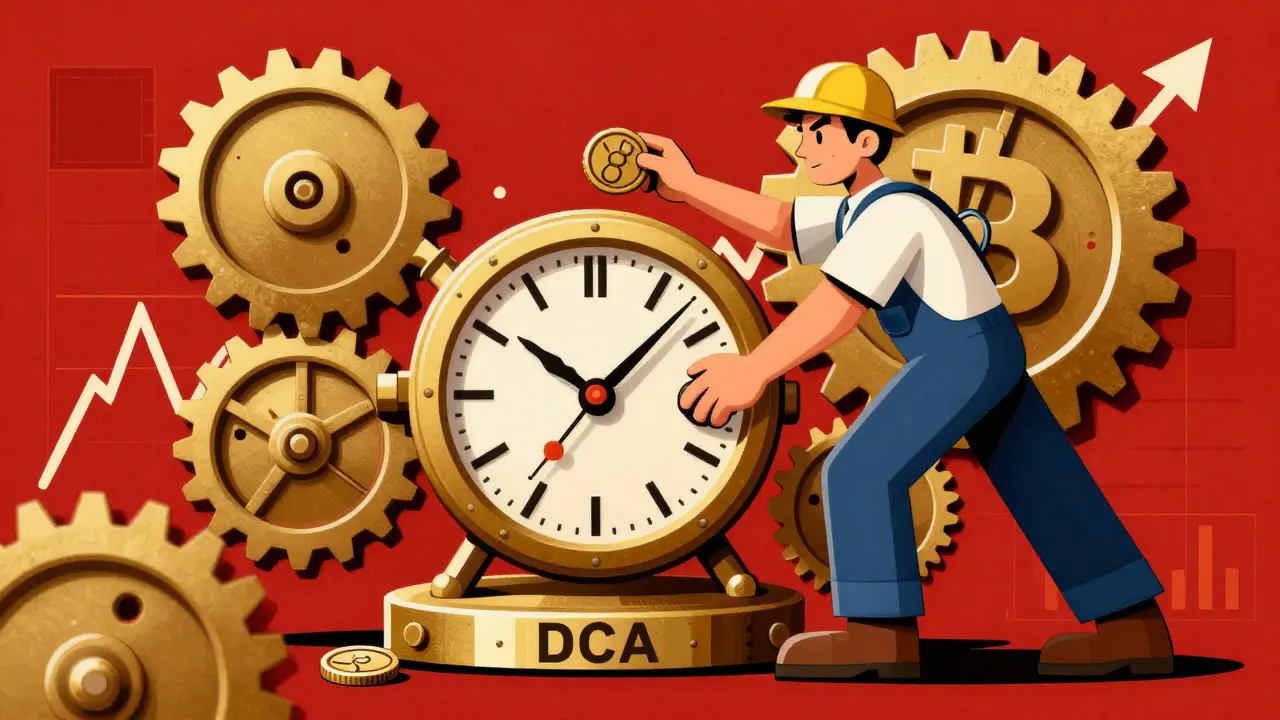
When you're buying crypto, timing the market feels like trying to catch a falling knife. One day, Bitcoin is surging. The next, it’s down 30%. It’s tempting to wait for the "perfect" moment to invest - but that moment rarely comes. That’s where dollar-cost averaging (DCA) steps in. Instead of betting everything on one price, you spread your investment over time. Buy $100 every week. Or $500 every month. No matter if the price is up or down. And over time, this simple habit changes everything.
How DCA Works in a Bull Market
In a bull market, prices climb steadily. Bitcoin might go from $30,000 to $70,000 over 18 months. If you dumped $10,000 in all at once at $30,000, you’d get about 0.33 BTC. But if you used DCA - say, $1,000 per month - you’d buy less as the price rises. At $40,000, you’d get 0.025 BTC. At $50,000, only 0.02 BTC. By the end, your average cost per coin might be $45,000. That’s higher than if you’d bought at the bottom.But here’s the catch: bull markets last longer. Historical data from Russell Investments shows that since 1930, the average bull market ran for 51 months. Bear markets? Just 15. That means even if you pay more per coin during the climb, you’re still sitting on gains for way longer. And those gains compound. Over 51 months, a 175% average increase more than wipes out the higher average cost from earlier buys.
Think of it like this: if you bought $500 worth of Ethereum every month from January 2023 to December 2024, you’d have bought at prices ranging from $1,200 to $4,100. Your average cost? Around $2,800. Even if you started at the high end, the long climb means you’re still way ahead. DCA in a bull market doesn’t maximize your buys - but it keeps you in the game. And that’s the point.
How DCA Works in a Bear Market
Bear markets are where DCA shines. Prices drop. Fear spreads. Everyone’s selling. But if you’re buying $500 every week, you’re getting more coins for the same money. When Ethereum drops from $3,000 to $1,500, your $500 buys twice as much. When it hits $1,000, you’re buying three times as much. Your average cost per coin drops fast.Charles Schwab’s research shows that during the 2020 crypto crash - which lasted just 33 days - investors who kept buying saw their portfolios rebound faster than those who waited. Those who held cash for even one month after the bottom missed out on 47% of the recovery in the first year. Those who kept DCAing? They gained 83% over three years.
Historical patterns confirm this. The 2018 bear market saw Bitcoin drop from $20,000 to $3,200. People who DCA’d through that period ended up with an average cost near $8,000. When Bitcoin hit $60,000 in 2021? They were sitting on a 650% return. The same pattern held in 2014, 2011, and even during the 2008-2009 Bitcoin birth period. The lower your average cost, the more profit you unlock when the next bull run starts.
DCA vs Lump-Sum Investing: The Real Comparison
Some say, "Why not just wait for a crash and invest it all at once?" That sounds smart - until you realize how often you’re wrong.From 1970 to 2024, there were seven bear markets where markets dropped 20% or more. Only one lasted longer than six months. Most recovery spikes happened in the first 30-60 days. If you waited for "confirmation" that the bottom was in, you missed the biggest gains.
Here’s the data: if you invested $10,000 all at once at the start of a bull market, you’d do better than DCA in about 66% of cases. But here’s the twist - you’d have to guess the right start date. And if you waited even one month? Your returns dropped by 20-30%. If you waited six months? You’d lose over half your potential gains.
DCA doesn’t always win on paper. But it wins on consistency. It doesn’t require perfect timing. It doesn’t need you to predict the future. It just needs you to show up. And that’s why Fidelity calls it a "behavioral shield" - it stops you from selling in panic or freezing in fear.
Psychology Matters More Than Price
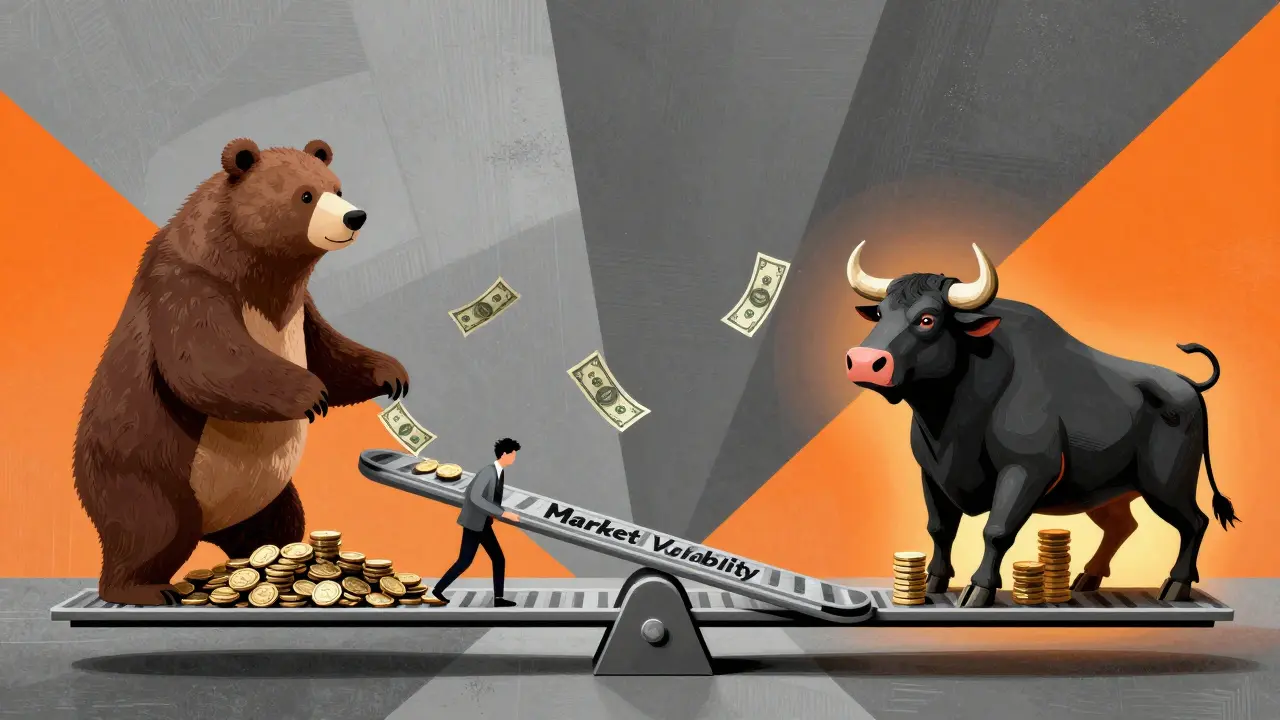
The biggest enemy of crypto investors isn’t volatility. It’s emotion. When prices drop 40%, your brain screams: "Sell!" When they spike 100% in a week, it yells: "Buy now or miss out!" DCA removes both.Studies from Fidelity and Merrill Lynch show that investors who try to time the market underperform by 2-5% per year on average. Why? They sell low. They buy high. They get scared out of their positions - and then sit on the sidelines too long. DCA forces you to keep buying, no matter what. It turns fear into routine.
And that routine matters more than you think. In 2022, Bitcoin fell from $69,000 to $16,000. Thousands of people panicked and sold. But those who kept DCAing? They bought 3x more Bitcoin at $16,000 than they did at $69,000. By the time it hit $40,000 in 2024, those investors had already accumulated more than double the coins they’d owned at the peak.
Real-World DCA Strategy: How to Set It Up
You don’t need a fancy app. You don’t need to be a trader. Just three things:- Choose one asset: Bitcoin, Ethereum, or a trusted crypto index fund. Stick with it.
- Decide your amount: $50, $100, $200 - whatever you can afford without stress.
- Set a schedule: Weekly or monthly. Automate it. Use your exchange’s recurring buy feature - Coinbase, Kraken, or Binance all offer it.
Most platforms let you schedule recurring buys with a single click. No more thinking. No more second-guessing. You’re locked in. And that’s the whole point.
Pro tip: Don’t change your amount based on price. If Bitcoin crashes, don’t double down. If it surges, don’t cut back. Stay steady. The magic is in the consistency.
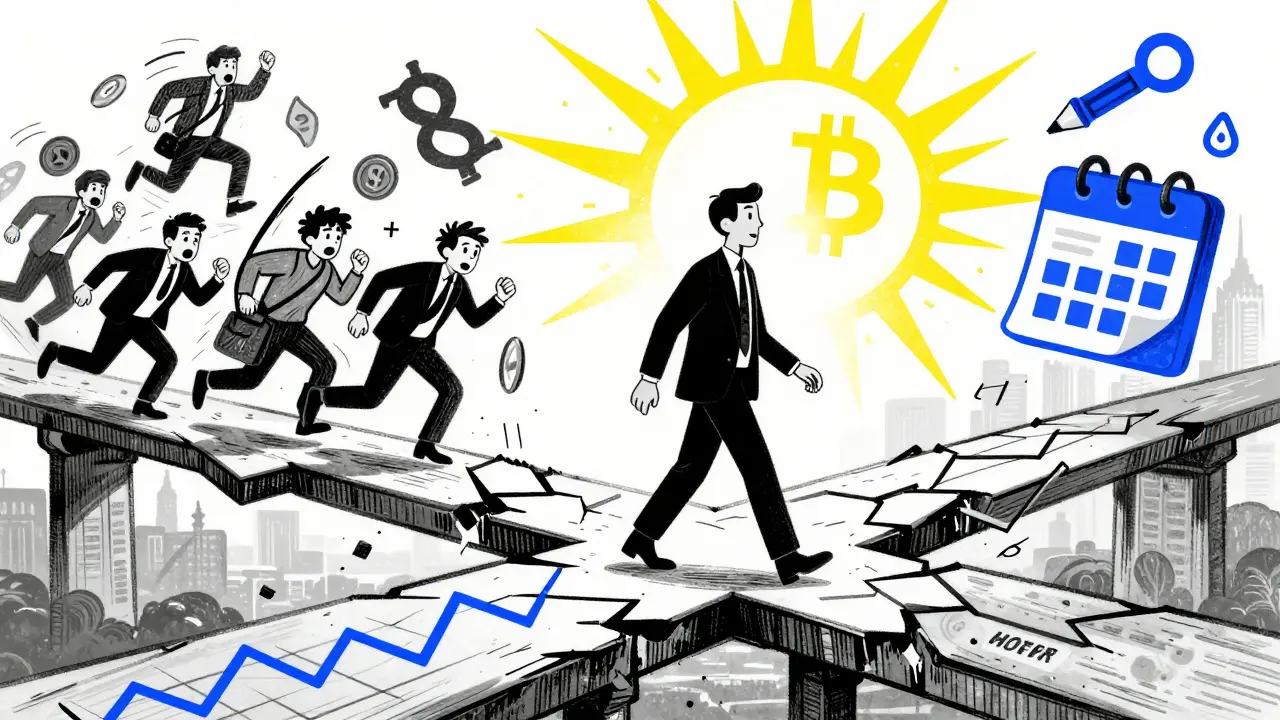
Who Should Use DCA - And Who Shouldn’t
DCA isn’t for everyone. But it’s perfect for most.Best for:
- Long-term investors (5+ years)
- People with steady income
- Those who feel anxious about crypto volatility
- Anyone who doesn’t want to monitor charts daily
Not ideal for:
- People needing money in the next 1-2 years
- Those who can’t afford to lose capital
- Traders trying to profit from short-term swings
If you’re saving for a house in 2027? Maybe skip crypto altogether. But if you’re building wealth over a decade? DCA is one of the safest, most effective tools you have.
What History Teaches Us
Since Bitcoin’s creation, there have been four major bear markets. Each one ended with a new all-time high. Each one wiped out 70-80% of the previous peak. And each time, those who kept buying came out ahead.The 2011 crash? Bitcoin dropped from $30 to $2. DCA investors kept buying. By 2013, they were up 10,000%.
The 2014-2015 crash? Bitcoin fell from $1,200 to $200. DCA buyers doubled their holdings. By 2017, they were millionaires.
Even the 2022 crash - the deepest in crypto history - didn’t stop the trend. Those who stuck with DCA entered 2024 with more coins than ever before. And when Bitcoin hit $73,000 in early 2025? Their average cost was under $20,000.
History doesn’t repeat. But it rhymes. And the pattern is clear: markets go down. Then they go way up. DCA lets you ride the upswing - no matter where you started.
Final Thought: It’s Not About Timing. It’s About Showing Up.
No one can predict the next bear market. No one can say exactly when Bitcoin will hit $100,000. But we do know this: bull markets last longer than bear markets. And every single time, the market recovers.DCA doesn’t promise the highest returns. But it guarantees you won’t miss the next big move. It removes fear. It replaces guesswork with action. And in crypto - where volatility is the norm - that’s worth more than any timing strategy.
Set it. Forget it. Let time do the work.
Is DCA better than lump-sum investing in crypto?
DCA rarely gives you the absolute highest return - but it’s far more reliable. Lump-sum investing wins about two-thirds of the time if you pick the perfect entry point. But since no one can predict the bottom, most people miss it. DCA removes the need to guess. It works whether the market is rising, falling, or sideways. For most people, the peace of mind and consistency outweigh the small edge lump-sum might offer.
Should I DCA during a bear market or wait for the bottom?
Don’t wait. Bear markets are when DCA works best - because prices are low. The bottom is invisible until after it happens. By the time you see a 20% rally, you’ve already missed the biggest gains. Historical data shows that 70% of recoveries happen in the first 60 days. If you wait for "confirmation," you’re already behind. DCA lets you buy cheap without trying to time it.
How often should I DCA - weekly or monthly?
Monthly is fine for most people. Weekly can smooth out volatility a bit more, but the difference is small. What matters more is consistency. If you can’t stick to weekly, go monthly. The goal isn’t to optimize timing - it’s to avoid emotional decisions. Pick a schedule you can maintain for years.
Can DCA protect me from losing money in crypto?
DCA doesn’t prevent losses - it reduces risk over time. If you invest $10,000 today and Bitcoin crashes 50%, you still lose $5,000. But if you DCA $500/month over 20 months, you’re buying at lower prices along the way. Your average cost drops, so when the market recovers, you’re positioned to profit sooner. It’s not a shield against loss - it’s a tool to recover faster.
What if I start DCAing right before a crash?
That’s exactly when DCA shines. If you start buying just before a crash, you’re getting more coins for your money as prices fall. Even if the market drops 60%, your average cost stays low. And when the next bull market begins - and it always does - you’re already ahead of those who waited to invest. The timing doesn’t matter. The consistency does.
Comments
Brad Zenner
Been DCAing BTC since 2020. Started at $8k, kept buying through the $20k crash, the 2022 dump, everything. My average cost is $14,200. Today? I’m sitting on 2.1 BTC. Didn’t get rich overnight. Didn’t even think about it most days. Just kept clicking "buy". That’s it.
People overcomplicate this. You don’t need to time it. You just need to show up.
And yeah - I didn’t sell when it hit $73k. I just kept buying. Now I’ve got more than I did at the peak. Funny how that works.
March 24, 2026 at 14:41
Tony Phillips
Love this breakdown. Especially the part about bull markets lasting 51 months on average. That’s the real secret.
I used to think DCA was for beginners. Then I realized - it’s for people who want to actually *keep* their money. I’ve seen too many friends cash out at the top… then watch it go 3x higher. DCA doesn’t make you a genius. It just keeps you in the game.
Set it and forget it. Your future self will thank you.
March 25, 2026 at 08:28
YANG YUE
Here’s the zen of DCA: you’re not buying Bitcoin. You’re buying freedom.
Freedom from the anxiety of "should I buy now?" Freedom from the shame of "I sold too early." Freedom from the paralysis of waiting for the perfect moment - which, spoiler alert, doesn’t exist.
Every dollar you DCA is a tiny act of rebellion against chaos. Against the noise. Against the fear-mongering headlines.
It’s not an investment strategy. It’s a meditation. A daily "no" to panic. A daily "yes" to patience.
And in a world that rewards speed, the slowest move is the one that wins.
March 26, 2026 at 19:49
Anna Lee
OMG YES I’VE BEEN DCAING ETH SINCE 2021 AND I JUST BOUGHT MORE AT $3200 I’M SO HAPPY RN!!!
March 28, 2026 at 09:36
Shana Brown
Shoutout to the people who think they’re "waiting for the bottom".
Here’s the thing - the bottom doesn’t have a sign. It doesn’t wave at you. It doesn’t say "hey, I’m here!"
I waited 3 months in 2022 thinking "it’ll bounce soon." Meanwhile, my DCA friends bought 3x more than me at $16k.
By the time Bitcoin hit $30k? I was still watching. They were already reaping.
Don’t wait. Just start. Even $20/week. It adds up.
You don’t need to be rich. You just need to be consistent. 💪
March 28, 2026 at 17:07