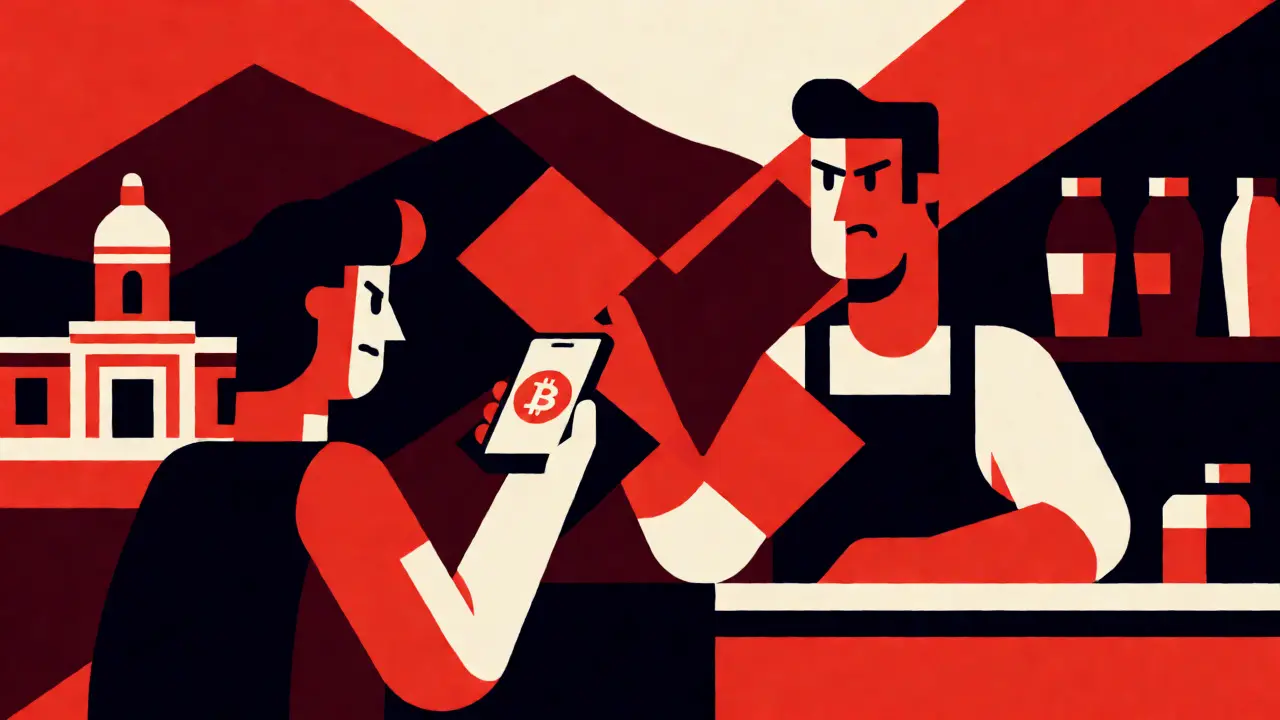
Imagine trying to buy a cup of coffee with Bitcoin in Quito. You pull out your phone, open your wallet, and try to pay the barista. In most countries, this might work. In Ecuador, it’s a legal gray zone that gets you nowhere fast. While you won’t go to jail for owning Bitcoin or Ethereum, using them to buy goods is strictly prohibited. The Central Bank of Ecuador (BCE) has made its stance clear: digital currencies are not legal tender. This creates a tricky environment for anyone looking to navigate the world of digital assets in a dollarized economy.
The Legal Landscape: Not Banned, But Blocked
Let’s cut through the noise. Is cryptocurrency illegal in Ecuador? Technically, no. You can buy, sell, and hold crypto. However, the regulations are designed so that you cannot use it as money. The Organic Monetary and Financial Code, specifically Article 94, bars any alternative currency to the US dollar, which has been Ecuador’s official currency since 2000. The BCE issued a strong statement in August 2024 reiterating that cryptocurrencies are "not an authorized means of payment."
This distinction matters. If you trade crypto on an international platform like Binance, you’re operating in a private capacity. But if you try to use those funds to pay a local vendor, you’re stepping outside the law. The Superintendency of Banks (SB) actively monitors this. They maintain a list of unauthorized entities, meaning major global exchanges don’t have licenses to operate locally. This forces users into informal channels, often relying on peer-to-peer (P2P) trades or offshore platforms.
Why Banks Say No
If you’ve ever tried to link your bank account to a crypto exchange, you know the frustration. In Ecuador, banks, insurers, and payment processors are legally mandated to refuse crypto-related transactions. It’s not just a policy choice; it’s a regulatory requirement. Card acquirers flag crypto purchases as high-risk, leading to frequent declines on credit and debit cards.
This banking blockade stems from a desire to protect monetary stability. Since Ecuador uses the US dollar, there’s no central bank ability to print money or adjust interest rates independently. The BCE fears that widespread crypto adoption could undermine this dollarization by introducing volatility or facilitating capital flight. Consequently, traditional financial institutions block transfers to known crypto wallets, forcing users to find creative workarounds, such as cash deposits or third-party services.
Taxation: The Hidden Cost
Just because you can’t spend it doesn’t mean you don’t owe taxes on it. The Internal Revenue Service (SRI) treats realized gains from cryptocurrency sales as Ecuador-source income. For individuals, this means progressive tax rates up to 35%. For companies, the rate is fixed at 25%.
Here’s the catch: reporting these gains can be complex. There isn’t a streamlined process for declaring crypto profits like there is for stock dividends. Most users rely on manual tracking, which increases the risk of errors during audits. If you’re trading frequently, keep meticulous records of every transaction date, amount, and exchange rate used. Failing to report these gains can lead to penalties, even if the asset itself wasn’t used for daily payments.

Mining and Infrastructure Challenges
You might think mining is a way around the spending restrictions. After all, you’re generating new coins, not buying them. Mining isn’t explicitly banned, but practical barriers make it nearly impossible to scale. First, electricity costs are high, averaging $0.145 per kWh in 2024-about 23% above the Latin American average. Second, the power grid suffers from frequent outages, averaging 14.7 hours of downtime per month in some regions.
Add in a 35% import duty on computing equipment, and the math doesn’t add up for large-scale operations. Most mining activity remains small-scale, concentrated in residential areas in Quito’s suburbs or the coastal lowlands. According to data from June 2024, Ecuador’s total hash rate represents less than 0.0001% of the global capacity. It’s a hobbyist market, not an industrial one.
Comparison with Neighboring Countries
To understand how restrictive Ecuador’s approach is, look at its neighbors. While Ecuador maintains a prohibition on usage, other nations are moving toward regulation.
| Country | Legal Status | Payment Use | Regulatory Framework |
|---|---|---|---|
| Ecuador | Legal to own/trade | Prohibited | No licensing framework |
| Paraguay | Legal | Allowed | Registration required (2022 Law) |
| Mexico | Virtual Asset | Limited | Fintech Law (2018) requires licenses |
| Peru | Legal | Allowed | VASP registration (2025) |
Paraguay allows crypto payments under a 2022 law that mandates anti-money laundering compliance. Mexico classifies crypto as virtual assets under its Fintech Law, requiring specific licenses for service providers. Peru recently moved to require Virtual Asset Service Providers (VASPs) to register with its Financial Intelligence Unit. Ecuador stands out by offering no formal pathway for businesses to enter the market, pushing activity underground rather than regulating it.

The Role of Remittances
One area where crypto shines despite restrictions is remittances. Ecuador receives approximately $3.8 billion annually in remittances, accounting for 8.5% of its GDP. Traditional fees average 6.3%, well above the UN’s target of 3%. Stablecoins like USDT and Bitcoin offer a cheaper alternative, especially for families sending money from abroad.
However, the final mile problem persists. Receiving crypto is easy; converting it to cash without triggering bank flags is hard. Many users rely on informal Over-the-Counter (OTC) desks or P2P networks. These channels charge premiums, often 5-7% higher than global prices, eating into the savings. Despite this, surveys indicate that 68% of Ecuadorian crypto users utilize digital assets primarily for receiving funds from family members overseas.
Future Outlook: CBDCs and Potential Changes
Is change coming? The BCE has explored developing a retail Central Bank Digital Currency (CBDC) pegged 1:1 to the US dollar. This would modernize small payments without abandoning dollarization. As of late 2024, no launch date was confirmed, but discussions continue.
Meanwhile, pressure is mounting from fintech startups. A 2024 survey found that 78% of local fintechs would develop crypto services if a regulatory framework existed. Experts predict potential shifts by 2026, driven by the need for financial inclusion. With only 50% of adults having bank accounts, prohibiting innovative financial tools contradicts broader economic goals. Until then, users must navigate a landscape defined by caution, limited options, and strict adherence to the rule that crypto is an asset, not money.
Is Bitcoin legal in Ecuador?
Yes, owning and trading Bitcoin is legal. However, it is not recognized as legal tender, meaning you cannot legally use it to settle debts or pay for goods and services within the country.
Can I use my bank card to buy crypto in Ecuador?
It is difficult. Most local banks and payment processors block transactions related to cryptocurrency exchanges due to regulatory restrictions. Users often resort to peer-to-peer methods or cash-based OTC desks.
Do I have to pay taxes on crypto gains in Ecuador?
Yes. Realized gains from selling cryptocurrency are considered Ecuador-source income. Individuals face progressive tax rates up to 35%, while corporations are taxed at 25%.
Are there any licensed crypto exchanges in Ecuador?
No domestic exchange holds an official license to operate within the formal financial system. Users typically access global platforms like Binance or OKX via offshore APIs or P2P networks.
Why does Ecuador restrict cryptocurrency?
The primary reason is to protect monetary stability in a dollarized economy. The Central Bank fears that unregulated crypto adoption could undermine the US dollar's status and facilitate capital flight.
Comments
Jennifer Brosnan
Oh, please. The entire premise of this article is a masterclass in missing the point because you are all too busy worshipping at the altar of fiat currency to realize that "legal tender" is just a collective hallucination enforced by state violence. You talk about the Central Bank of Ecuador like it’s some benevolent guardian of stability, but let’s be honest: they are terrified because their monopoly on debt issuance is slipping away from them. It’s not about monetary stability; it’s about control. If people could transact freely without the BCE’s permission, who would need their useless intermediaries? You’re describing a system where the government decides what has value, and if that doesn’t scream authoritarian overreach, I don’t know what does. They block banks not because crypto is volatile-gold is volatile, stocks are volatile-but because it bypasses their ability to surveil every single transaction. It’s paranoia dressed up as economic policy. And the taxation part? Ha! Taxing gains on an asset you aren’t allowed to use as money is like taxing someone for owning a car they aren’t allowed to drive. It’s absurd. The real issue isn’t that Bitcoin is illegal tender; it’s that the current system is legally mandated fraud. You’re so focused on the technicalities of Article 94 that you miss the forest for the trees. The tree is dead. The forest is burning. And you’re arguing about whether the smoke counts as legal property.
September 3, 2026 at 16:55
Finlay Samms
I think there's a lot of nuance here that gets lost when we get too angry about it 😊. While the restrictions are definitely frustrating for users trying to navigate the P2P landscape, looking at the broader context of dollarization makes sense from a macroeconomic perspective 📉. It’s hard to argue with the fear of capital flight when your country literally can't print its own money to cushion shocks. Maybe it’s not just about control, but survival? 💭 Still, the tax complexity sounds like a nightmare for regular folks trying to do the right thing. Hope things get clearer soon! 🙏
September 4, 2026 at 17:29
Rachel Leet
The fundamental misunderstanding lies in conflating utility with legality. Money is not merely a medium of exchange; it is a store of value and a unit of account, concepts that require social consensus backed by institutional trust. By prohibiting usage while permitting ownership, Ecuador creates a paradoxical state where the asset exists ontologically but lacks functional reality in the local economy. This is not mere bureaucratic inefficiency; it is a deliberate philosophical stance against the dematerialization of value. When you remove the ability to settle debts, you strip the currency of its primary purpose, rendering it a speculative toy rather than a monetary instrument. The comparison to neighboring countries fails to account for the unique fragility of a fully dollarized economy, where the absence of a lender of last resort makes any volatility potentially existential. Thus, the restriction is not a hindrance to innovation but a protective barrier against systemic collapse caused by unregulated speculative flows. One must understand that true financial sovereignty requires the ability to define what constitutes money, and in doing so, the state asserts its primacy over private digital ledgers. To ignore this power dynamic is to misunderstand the nature of the state itself.
September 5, 2026 at 20:12
Sheryl Nelsen Hutton
I appreciate the balanced view presented here, especially regarding the remittance angle which often gets overlooked in these regulatory debates. It seems that the friction costs associated with OTC desks and P2P networks create a significant barrier to entry for the average user, effectively negating the theoretical efficiency gains of blockchain technology. From a systems thinking perspective, the prohibition on banking integration forces a bifurcation of the market into formal and informal sectors, which exacerbates information asymmetry and increases counterparty risk for individuals relying on stablecoins for family support. It is interesting to consider how the lack of VASP licensing prevents the development of robust compliance frameworks that could otherwise mitigate the concerns of the Superintendency of Banks regarding anti-money laundering protocols. Perhaps the solution lies not in immediate legalization of payments but in the gradual introduction of sandbox environments where fintech startups can test interoperability with traditional rails without triggering full regulatory scrutiny. This approach might allow for empirical data collection on actual impact rather than relying on theoretical fears of capital flight. Ultimately, the goal should be financial inclusion, and if current regulations hinder that more than they help stability, then the status quo is unsustainable. We need to move beyond binary arguments of ban versus freedom and explore hybrid models that respect both monetary sovereignty and technological innovation. The path forward requires patience and nuanced policy design rather than reactive prohibitions.
September 6, 2026 at 17:26
adam veikkanen
You are assuming the BCE cares about your convenience. They care about solvency. End of story.
September 8, 2026 at 04:21