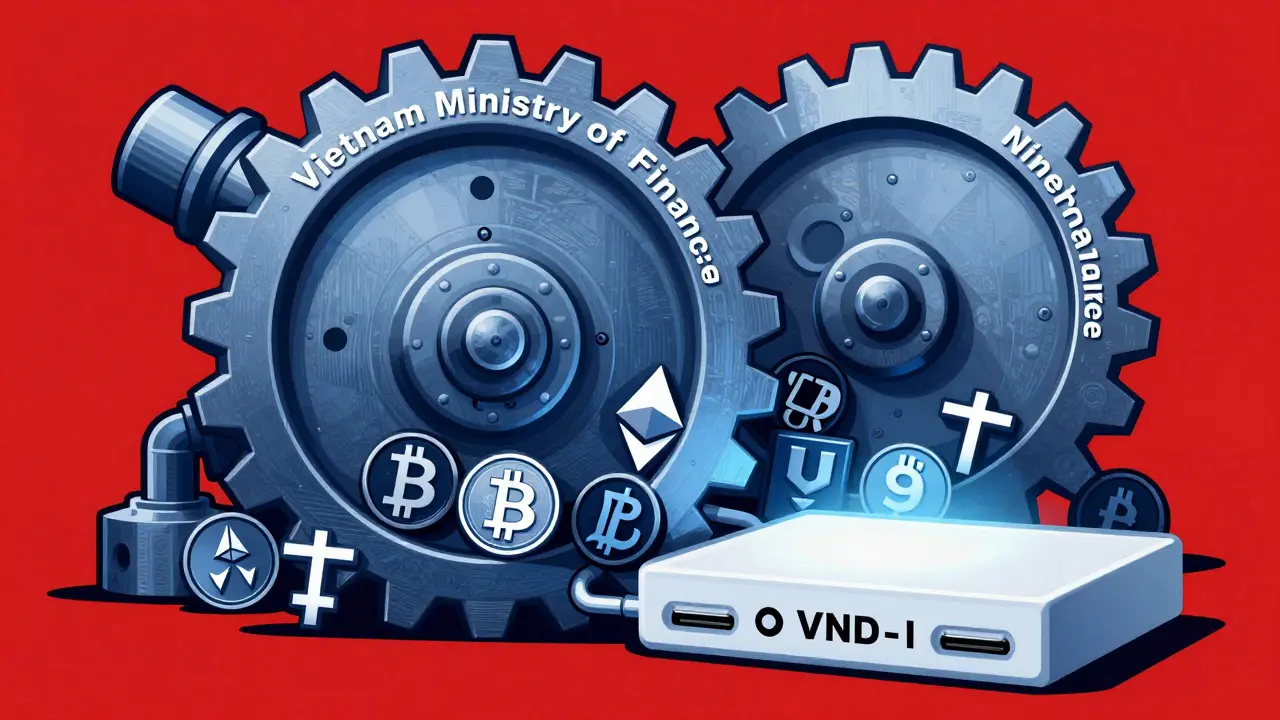
Before September 2025, buying Bitcoin or sending Ethereum to a friend in Vietnam was a legal gray zone. You could do it, but no one knew exactly how the government would react. That changed with Resolution No. 05/2025/NQ-CP, signed on September 9, 2025, and the Digital Technology Industry Law passed in June 2025. Now, Vietnam has one of the clearest, most restrictive crypto frameworks in Southeast Asia-and the difference between crypto trading and crypto payment is the key to staying legal.
Trading Crypto in Vietnam: It’s Not What You Think
You can’t just open a Binance account and start trading. Under the new rules, all crypto trading must happen on platforms licensed by Vietnam’s Ministry of Finance. And those licenses aren’t easy to get. A company needs at least 10 trillion VND-around $379 million-in capital. Sixty-five percent of that must come from institutional investors, not retail traders. Foreign companies can own no more than 49% of the platform. That means only big, well-funded Vietnamese financial firms will be allowed to run exchanges. The system doesn’t just control who runs the exchanges-it controls how you trade. Every transaction must be done in Vietnamese dong (VND). If you want to buy Ethereum, you deposit VND. If you sell Bitcoin, you get VND back. There’s no direct crypto-to-crypto trading allowed on licensed platforms. This isn’t about convenience-it’s about control. The government wants to track every dollar flowing in and out of digital assets. The six-month grace period after the first license is issued (expected early 2026) gives users time to move. After that, using any unlicensed exchange is illegal. For the estimated 20 million crypto users in Vietnam, that means choosing between a regulated, restricted platform or risking fines or worse.Payment With Crypto: The Big Unknown
Here’s where things get murky. The law says crypto can be used for payment-but it doesn’t say how, when, or under what conditions. You won’t find a single line in Resolution 05/2025/NQ-CP that says: “You can pay for coffee with Bitcoin.” Or: “Businesses must accept crypto as payment.” The mandatory VND pairing rule creates a natural barrier. If every trade must convert to VND, then using crypto directly to pay for goods or services becomes technically difficult. Imagine trying to pay your landlord with Ethereum. You’d need to sell it on a licensed exchange first, wait for the VND to settle, then transfer it to your landlord. That’s not payment-it’s a two-step financial transaction. There’s no mention of peer-to-peer crypto payments either. Can you send Dogecoin to your cousin in Ho Chi Minh City? The law doesn’t say you can’t. But it doesn’t say you can, either. That silence is intentional. The government is holding back on payment use cases until it figures out how to monitor them without triggering money laundering risks. For now, businesses that accept crypto for goods or services are operating in legal limbo. If you run a small shop and take USDT as payment, you’re not breaking any explicit rule-but you’re also not protected by any law. If a dispute arises, courts won’t recognize crypto as legal tender. You’re on your own.What Counts as a Crypto Asset?
To understand the rules, you need to know what’s even being regulated. The Digital Technology Industry Law defines three types of digital assets:- Virtual assets-like in-game coins or loyalty points
- Crypto assets-Bitcoin, Ethereum, stablecoins, and other decentralized digital tokens
- Other digital assets-NFTs, utility tokens, and blockchain-based credentials

Why the VND-Only Rule Matters
The requirement that all trades go through Vietnamese dong isn’t just a technical detail. It’s the core of Vietnam’s entire strategy. By forcing every transaction through the national currency, the government keeps control over capital flows. It can track how much money is entering and leaving the crypto market. It can freeze accounts if suspicious activity is detected. It can tax gains by linking them to VND conversions. This approach is the opposite of what you see in places like the U.S. or Singapore, where crypto-to-crypto trading is common and stablecoins are used for payments. Vietnam isn’t trying to be innovative-it’s trying to be safe. The $379 million capital requirement and the VND-only rule are both designed to make it nearly impossible for small players or foreign operators to enter the market. It’s also why crypto mining isn’t mentioned in the law. Mining doesn’t involve trading or payments-it’s just creating new tokens. The government hasn’t decided whether to allow it, ban it, or regulate it. That silence tells you everything: mining is too unpredictable to include in the current framework.What Happens After January 1, 2026?
That’s the date the Digital Technology Industry Law fully takes effect. After that:- Only licensed platforms can offer crypto trading
- All trades must be in VND
- Unlicensed exchanges are illegal for Vietnamese users
- Crypto assets are legally recognized as property
- Payments with crypto remain legally undefined
What Should You Do?
If you’re a trader: switch to a licensed platform as soon as one opens. Don’t wait until the six-month grace period ends. You don’t want to be caught using an unlicensed exchange after January 2026. If you’re a business: don’t start accepting crypto as payment yet. There’s no legal protection. If a customer disputes a transaction, you can’t go to court and say, “They paid me in Bitcoin.” The law won’t back you up. If you’re a regular user: understand that crypto in Vietnam is no longer a tool for freedom or innovation. It’s a controlled asset. You can own it. You can trade it-within strict limits. But you can’t use it like money. The government isn’t trying to kill crypto. It’s trying to cage it. And for now, the cage has very specific rules.Can I use Bitcoin to pay for goods in Vietnam?
No, not legally. While the law doesn’t explicitly ban crypto payments, it requires all crypto transactions to go through Vietnamese dong (VND) on licensed platforms. There are no rules allowing direct crypto-to-goods transactions. Using crypto to pay for services or products puts you in a legal gray area with no protection from courts or regulators.
Is it illegal to trade crypto on Binance or KuCoin in Vietnam?
Yes, after the six-month grace period following the first licensed exchange launch (expected in early 2026). The law bans Vietnamese users from trading on unlicensed platforms. Using foreign exchanges after that point could lead to administrative penalties or criminal charges. Only Ministry of Finance-licensed platforms are legal.
Do I have to pay taxes on crypto profits in Vietnam?
Not yet. The Ministry of Finance has not released official tax rules for crypto. However, since all trades must be in VND, your gains will be recorded in Vietnamese currency, making it easier for authorities to track and tax later. Expect tax guidance before January 1, 2026.
Can I mine Bitcoin in Vietnam?
The law does not mention mining at all. It’s not banned, but it’s also not regulated or recognized. Mining operates in legal limbo. The government has not indicated whether it will allow, restrict, or tax mining activities in the future.
Can I inherit cryptocurrency in Vietnam?
Yes. The Digital Technology Industry Law explicitly recognizes crypto assets as legal property. You can own, transfer, and inherit them like any other asset. This is a major shift from past years, when crypto was treated as a gray-market item with no legal standing.
Are stablecoins like USDT allowed in Vietnam?
Yes, but only as crypto assets under the new law. You can trade them on licensed platforms, but only for Vietnamese dong. You cannot use USDT to pay for goods or send it peer-to-peer without converting it to VND first. Stablecoins are treated the same as Bitcoin or Ethereum under the rules.
Comments
Isha Kaur
So I’ve been following this whole Vietnam crypto thing since last year and honestly it’s one of the most thoughtful regulatory approaches I’ve seen in Asia. They’re not trying to ban it, they’re trying to domesticate it-like taming a wild horse instead of shooting it. The VND-only rule is genius really, because it keeps capital flight in check while still letting people participate. I know a lot of folks think this is oppressive, but if you’ve ever seen how unregulated crypto exchanges blew up in places like Nigeria or Turkey, you realize this is damage control with dignity. Plus, the fact that they’re treating crypto as property and not currency? That’s legally elegant. It avoids all the mess of trying to make Bitcoin legal tender while still giving people ownership rights. I’m curious how they’ll handle inheritance disputes though-imagine a family arguing over a wallet seed phrase in probate court. That’s going to be wild.
Also, the NFT exemption is smart. People are gonna buy digital art like crazy, and if they’re not subject to the same trading rules, it creates a safe sandbox for innovation. Meanwhile, trading platforms will be so locked down that only state-aligned financial giants can run them. It’s basically a state-backed crypto cartel, but at least it’s transparent about it. No shady offshore exchanges hiding behind VPNs. I respect that.
And mining being ignored? That’s the quietest power move ever. They’re saying, ‘We don’t care if you mine, but we won’t protect you if you get caught with a rig in your garage.’ Classic Vietnamese pragmatism. No fanfare, just silence. I think this model will spread. Other countries are gonna look at Vietnam and say, ‘Wait, you didn’t have to go full crypto libertarian or full authoritarian-you just made it boring and bureaucratic, and it actually worked.’
December 5, 2025 at 13:03
Glenn Jones
THIS IS A DISASTER. WHY IS EVERYONE ACTING LIKE THIS IS SOME KIND OF ‘SMART’ REGULATION?? THEY’RE CREATING A STATE MONOPOLY ON CRYPTO AND CALLING IT ‘SECURITY’ LOL. YOU THINK THE GOVERNMENT ISN’T GOING TO USE THESE LICENSED PLATFORMS TO TRACK EVERY SINGLE WALLET ADDRESS, EVERY TRANSFER, EVERY PROFIT? THEY’RE BUILDING A DIGITAL SURVEILLANCE NETWORK UNDER THE GUISE OF ‘FINANCIAL STABILITY.’
AND DON’T EVEN GET ME STARTED ON THE VND-ONLY RULE. THAT’S NOT CONTROL, THAT’S ECONOMIC SLAVERY. YOU WANT TO BUY ETH? YOU GOTTA CONVERT YOUR VND FIRST? SO IF I WANT TO SWAP BTC FOR ETH, I HAVE TO GO THROUGH A GOVERNMENT-CONTROLLED EXCHANGE, SELL MY BTC FOR VND, WAIT FOR SETTLEMENT, THEN BUY ETH? THAT’S NOT A MARKET, THAT’S A TRAFFIC JAM RUN BY THE BUREAUCRACY.
AND WHAT ABOUT THE 49% FOREIGN OWNERSHIP LIMIT? THAT’S JUST A WAY TO KEEP OUT COMPETITION AND LET THE VIETNAMESE ELITE RAKE IN THE PROFITS. THIS ISN’T REGULATION-IT’S CORPORATE COLONIALISM WITH A BUREAUCRATIC FACE. I’M SICK OF THESE ‘PRAGMATIC’ COUNTRIES THAT SAY THEY’RE ‘OPEN’ BUT ACTUALLY JUST WANT TO MONOPOLIZE EVERYTHING. CRYPTO WAS SUPPOSED TO BE FREE. NOW IT’S JUST ANOTHER TAXABLE GOVERNMENT SERVICE. I’M OUT.
AND DON’T EVEN TELL ME ABOUT ‘INHERITANCE RIGHTS’-IF THE GOVERNMENT CAN FREEZE YOUR ACCOUNT TOMORROW, YOUR ‘PROPERTY’ IS JUST A DIGITAL POST-IT NOTE. THIS ISN’T LAW. THIS IS A PRISON WITH A USER MANUAL.
December 6, 2025 at 00:16
Richard T
Just to clarify something I think a lot of people are missing-the law doesn’t say crypto payments are illegal, it just doesn’t say they’re legal. That’s a huge distinction. It’s not a ban, it’s a pause. The government is waiting to see how people behave before writing rules. That’s actually pretty standard in emerging tech regulation. Look at how the U.S. handled fintech in the early 2010s-regulators sat back, watched, then came in with guidance, not laws.
And the VND-only trading rule? It’s not about stopping people from trading. It’s about stopping money laundering. If you can trade ETH for BTC directly, you can move value across borders without touching any bank system. That’s a nightmare for anti-money laundering enforcement. By forcing every trade through VND, they’re forcing every transaction to leave a paper trail. That’s not oppression, that’s basic financial hygiene.
Also, the fact that they’re treating crypto as property and not currency? That’s the right call. You don’t need to make Bitcoin legal tender to let people own it. You just need to recognize it as something you can inherit, sell, or gift. That’s what they did. Simple. Clean. No drama.
And mining being unmentioned? That’s not an oversight. That’s a signal. They’re saying, ‘We don’t care if you run a miner in your basement, but don’t expect us to help you if the power grid collapses because you’re using 30% of Hanoi’s electricity.’ That’s not regulation-it’s common sense.
December 6, 2025 at 15:33
jonathan dunlow
Look, I know it feels scary when the government steps in, but let’s be real-this is the best-case scenario for most people in Vietnam who just want to invest without getting scammed. Remember 2021? Everyone was buying Dogecoin from random Telegram groups, losing everything, and then blaming the government when it blew up. This law isn’t about stopping freedom-it’s about stopping exploitation.
Imagine you’re a mom in Da Nang who saved up 100 million VND to send her kid to college. She hears ‘Bitcoin is the future’ and puts it all into some unregulated exchange. Two months later, the platform vanishes. No recourse. No legal protection. No justice.
This law gives her a choice: trade on a platform that has to have $379 million in capital, that’s audited, that’s regulated, that’s accountable. That’s not a cage-it’s a safety net. And the VND-only rule? That’s just preventing people from using crypto to bypass currency controls. It’s not about control-it’s about stability.
And if you’re a business owner? Don’t panic. Just wait. The government is watching. When they see that people are actually using crypto to pay for goods, they’ll write the rules. But until then? Don’t risk your shop. Be patient. This isn’t the end of crypto-it’s the beginning of a more responsible one.
And yes, inheritance is legal now. That’s huge. For years, if you died with crypto, your family had no idea how to access it. Now? It’s treated like a house or a car. That’s progress. This isn’t a crackdown. It’s a coming-of-age moment for crypto in Southeast Asia. We should be cheering this, not crying about it.
December 8, 2025 at 15:27
Stanley Wong
I think people are reading too much into the silence on payments. The government isn’t banning crypto payments, they’re just not ready to define them yet. That’s not a flaw-it’s a feature. If they tried to write rules for crypto payments now, they’d get it wrong. They’d either overregulate and kill innovation or underregulate and open the door to fraud. So they’re doing what smart regulators do: observe first, legislate later.
The VND requirement is actually kind of beautiful. It means every crypto transaction has to go through the banking system. That means the central bank can see the flow. That means they can detect suspicious patterns. That means they can eventually tax it fairly. That’s not control, that’s responsibility.
And the fact that they’re allowing inheritance? That’s a quiet revolution. For years, crypto was this ghost asset-nobody knew what to do with it if you died. Now it’s real property. That’s huge for families. That’s human.
Also, the 49% foreign ownership cap? That’s not protectionism. That’s sustainability. If foreign firms owned 100% of the exchanges, they’d pull out in a crisis and leave Vietnamese users stranded. This way, the platform has skin in the game. Local investors are on the hook. That’s good governance.
And mining? They’re not ignoring it. They’re just letting it happen organically. If it becomes a problem, they’ll act. If it stays small, they’ll leave it alone. That’s not laziness. That’s wisdom.
This isn’t a cage. It’s a garden. They’re planting seeds. They’re not trying to kill crypto. They’re trying to make it grow without choking the soil around it.
December 8, 2025 at 16:44
Brooke Schmalbach
This is the most boring, bureaucratic, soul-crushing crypto regulation I’ve ever seen and I’ve seen a lot.
December 10, 2025 at 16:17