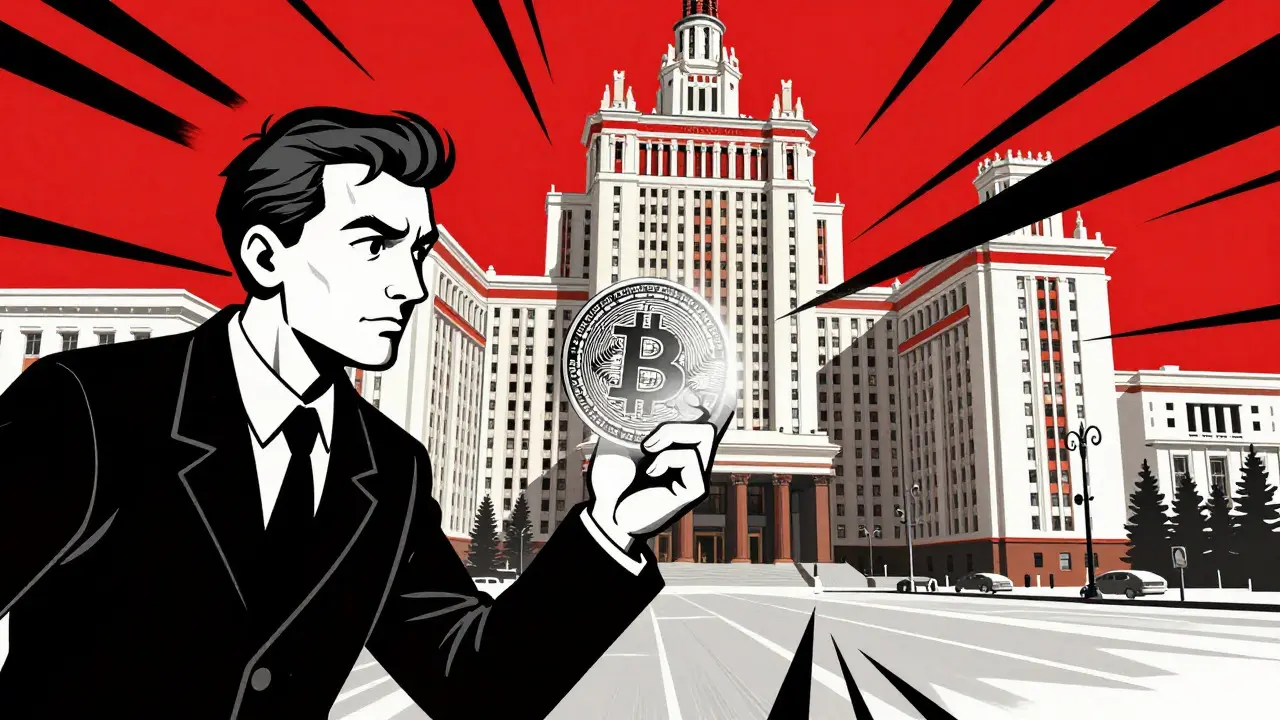
Imagine trying to buy coffee with Bitcoin in Moscow. You’d get arrested-or at least fined heavily. But imagine a Russian oil company selling barrels to an Asian partner using crypto to bypass Western sanctions. That transaction is not only allowed; it’s practically encouraged. This contradiction defines the legal status of cryptocurrencies in Russia as we move through 2026.
If you are looking for a simple yes-or-no answer, you won’t find one. The reality is a complex, two-tiered system designed to protect the state while letting the wealthy and corporations play in the global market. For the average person, crypto remains largely a gray area. For the elite and big business, it is a regulated tool. And looming over all of this is the government’s own competitor: the digital ruble.
The Core Rule: Own It, Don’t Spend It
To understand where things stand today, you have to look back at the foundational law passed in early 2021: the "On Digital Financial Assets" (DFA) act. This legislation was a game-changer because it finally gave legal weight to tokenized assets. However, it deliberately left out decentralized cryptocurrencies like Bitcoin or Ethereum from its core definition.
Instead, Russia classified these digital coins as "digital rights." What does that mean for you? It means owning cryptocurrency is legal. You can hold Bitcoin in your wallet just fine. But here is the catch: using it as money is illegal.
- Ownership: Legal. You can buy, hold, and sell crypto assets.
- Domestic Payments: Illegal. You cannot pay for goods or services within Russia using crypto. The Russian ruble is the sole legal tender.
- Mining: Legal. Mining operations were legalized under earlier laws classifying crypto as monetary substitutes, provided they follow energy and tax regulations.
This distinction creates a strange daily life for Russian crypto users. You might trade Bitcoin on an exchange, but when you want to cash out to spend on groceries, you must convert it back to rubles first. If you try to swipe a crypto card at a store, you are violating federal law.
The Elite Club: Experimental Legal Regime
While regular citizens are restricted, the government opened a door for the ultra-wealthy and large corporations. In late 2025, following proposals from the Bank of Russia, a three-year experimental legal regime came into effect. This framework allows specific transactions involving cryptocurrency, but only for those who meet strict criteria.
The goal? To help Russian businesses navigate international trade amidst heavy Western sanctions. By allowing crypto settlements abroad, companies can keep moving goods without relying on SWIFT or US dollars.
| Investor Type | Requirements | Permitted Activities |
|---|---|---|
| Individuals | Investments/deposits > ₽100 million AND annual income > ₽50 million | Crypto transactions, derivatives, access to regulated exchanges |
| Companies | Must meet existing "qualified investor" standards under Russian law | International settlements, hedging via derivatives |
| Ordinary Citizens | N/A (Do not qualify) | Ownership only; no direct trading on regulated platforms |
In May 2025, the Central Bank of Russia (CBR) authorized financial firms to offer cryptocurrency derivatives to these highly qualified investors. This isn't about buying Bitcoin directly anymore; it's about sophisticated financial instruments linked to crypto prices. The Russian Treasury even recommended easing some requirements in September 2025 to broaden access, signaling a slight shift toward liberalization for the rich.

The Government’s Rival: The Digital Ruble
Why is the Central Bank so hesitant to let Bitcoin flourish domestically? Because they are building their own version. The digital ruble is not a cryptocurrency in the decentralized sense. It is a Central Bank Digital Currency (CBDC), meaning it is issued and controlled entirely by the state.
Legislation signed by President Putin in July 2025 set the stage for the public launch of the digital ruble in September 2026. This timeline is crucial. As we approach that date, expect increased pressure on private cryptocurrencies. The government wants the digital ruble to be the primary method for domestic digital payments.
The CBR has been vocal about this. They view private cryptos as "money surrogates" that threaten the ruble’s sovereignty. Their argument is simple: if everyone uses Bitcoin, the central bank loses control over monetary policy. The digital ruble solves this by offering the speed of blockchain with the security of the state.
Sanctions, Trade, and the $40 Billion Underground
Despite the restrictions, crypto usage in Russia is booming. According to the 2025 report by the Russian Association of Cryptoeconomics, Artificial Intelligence, and Blockchain, the number of crypto users in Russia has grown by 15% annually since 2021. The total value of crypto held by Russians now exceeds $40 billion.
Where does this volume come from? Two main sources:
- International Trade: In 2025 alone, crypto-facilitated international trade reached 1 trillion rubles. Companies use Bitcoin and other stablecoins to pay foreign suppliers and receive payments, effectively bypassing frozen assets and blocked banking channels.
- Underground Adoption: Ordinary Russians, excluded from the formal "qualified investor" clubs, still trade crypto through peer-to-peer (P2P) platforms and offshore exchanges. This operates in a legal gray area-technically not prohibited if done privately, but risky if it looks like unlicensed financial activity.
This dual economy highlights the tension in Russian policy. On one hand, the state needs crypto to survive economically under sanctions. On the other hand, it fears losing control of its financial system. The result is a selective blindness: the government turns a blind eye to P2P trading among citizens while strictly regulating institutional flows.

Risks and Regulatory Tightening
Don’t mistake the growth in user numbers for a free-for-all. The regulatory environment is tightening, not loosening, for the general public. Recent legislative amendments targeting financial fraud have inadvertently-and perhaps intentionally-cracked down on informal crypto trading activities.
The Central Bank of Russia maintains a stern warning: private cryptocurrencies are volatile, unguaranteed, and risky. They emphasize that investors must acknowledge the risk of complete loss. There is no insurance fund for your Bitcoin if an exchange collapses or gets hacked.
Furthermore, the prohibition on domestic settlements remains absolute. If a business tries to accept crypto for local sales outside the experimental regime, they face liability. The government is clear: the ruble, physical or digital, is king within Russian borders.
What Comes Next?
As we move further into 2026, several trends are emerging. First, the launch of the digital ruble will likely force many everyday users away from crypto for daily payments. Second, the experimental regime for qualified investors may expand if the Treasury’s recommendations are fully adopted. We could see lower thresholds for "especially qualified" status, allowing more middle-class professionals to legally trade derivatives.
However, comprehensive legislation specifically for decentralized currencies like Bitcoin is still pending. Until then, the current patchwork of laws-the DFA act, the experimental regime, and the CBDC rules-will govern the space. For most people, this means continuing to treat crypto as a speculative asset to be held, rather than a currency to be spent.
Is it legal to own Bitcoin in Russia in 2026?
Yes, owning cryptocurrency is legal in Russia. The 2021 "On Digital Financial Assets" law recognizes crypto as a "digital right," allowing individuals and companies to hold these assets. However, ownership does not grant the right to use them as payment for goods and services within the country.
Can I use crypto to pay for groceries or rent in Russia?
No. Using cryptocurrency for domestic settlements is prohibited. The Russian ruble is the only legal tender. Businesses caught accepting crypto for local transactions risk fines and legal liability, unless they operate under the specific experimental legal regime for international trade, which does not apply to retail consumer goods.
Who qualifies as an "especially qualified investor" for crypto trading?
Under the 2025 experimental regime, individuals must demonstrate investments or deposits exceeding ₽100 million and an annual income exceeding ₽50 million. Companies must meet existing qualified investor standards. These high thresholds restrict access primarily to the wealthy elite and large corporations.
When will the digital ruble launch?
The public implementation of the digital ruble is scheduled to commence in September 2026. This Central Bank Digital Currency (CBDC) is intended to become the primary form of domestic digital payment, potentially reducing the need for private cryptocurrencies in everyday transactions.
Is crypto mining legal in Russia?
Yes, cryptocurrency mining is legal. It was legalized under earlier legislation that classified crypto as monetary substitutes. Miners must comply with energy consumption regulations and pay taxes, but there is no ban on the activity itself.
How much crypto do Russians hold?
According to the 2025 report by the Russian Association of Cryptoeconomics, the total market value of cryptocurrencies held by Russians exceeds $40 billion. User adoption has grown by approximately 15% annually since 2021, driven by both investment interest and the need to bypass capital controls.