Crypto Exchange Access Checker
Check Exchange Availability
How It Works
This tool shows which centralized (CEX) and decentralized (DEX) exchanges are available in your country, based on regulatory restrictions and payment methods. Remember: DEXs require you to already own crypto, while CEXs offer fiat on-ramps.
Your Crypto Exchange Options
Centralized Exchanges (CEX)
- Cexes require KYC and offer fiat on-ramps
- Most CEXs block users from restricted countries
- Regulatory compliance varies by country
Decentralized Exchanges (DEX)
- DEXs don't require KYC or location verification
- May require you to already own crypto
- Regulatory pressure is increasing on DEXs
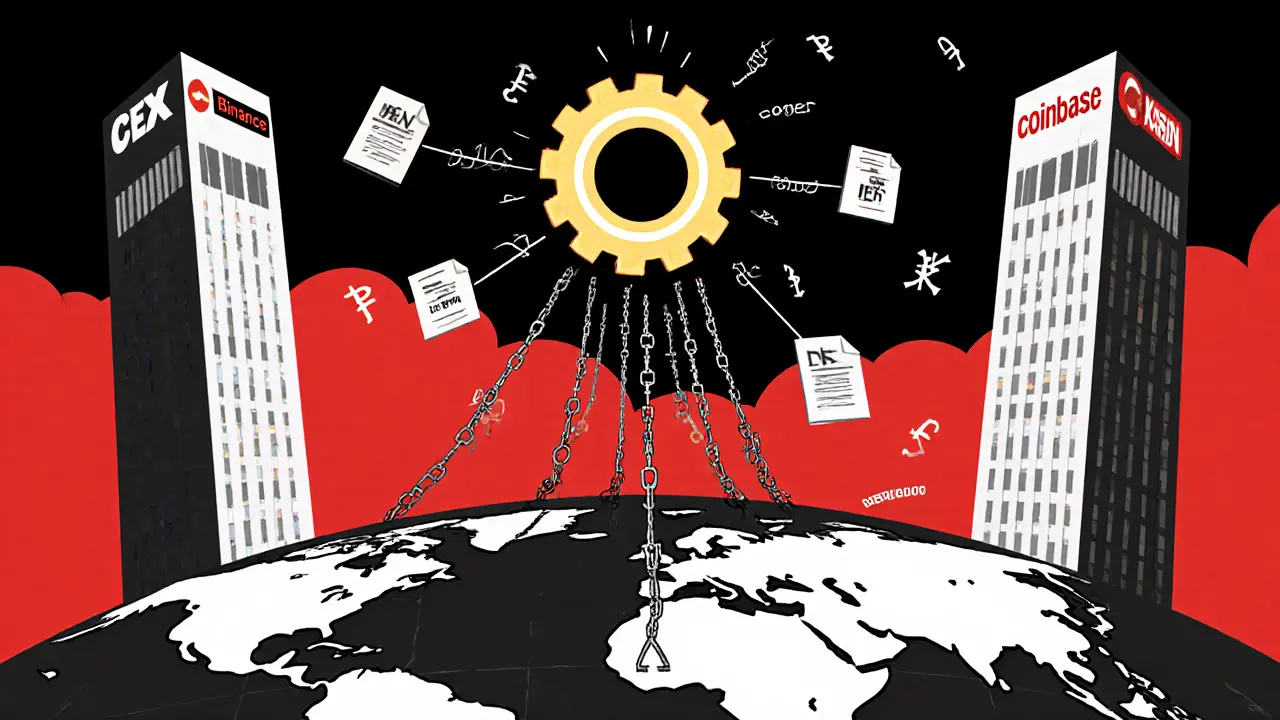
If you’ve ever tried to trade crypto and got blocked by a message like "This service isn’t available in your country," you know how messy global crypto access can be. It’s not just about internet speed or language-it’s about where you live. Two types of exchanges handle this differently: centralized exchanges (CEX) and decentralized exchanges (DEX). One locks you out based on your address. The other lets you trade anonymously-but that’s changing fast.
Why CEXs Block Users by Country
Centralized exchanges like Binance, Coinbase, and Kraken act like banks. They need licenses. They report to governments. They follow anti-money laundering rules. That means if you’re in a country where crypto is banned-or even just tightly controlled-they’ll block you.It’s not random. If you’re in the U.S., you can trade Bitcoin on Coinbase, but you can’t trade derivatives. In Nigeria, you can buy crypto, but you can’t deposit fiat via local banks because of Central Bank restrictions. In Russia, some exchanges stopped supporting ruble deposits after sanctions. In Iran, users rely on peer-to-peer trades because CEXs won’t serve them directly.
These blocks aren’t just suggestions. CEXs use your IP address, bank details, and KYC documents to confirm your location. Upload a U.S. driver’s license? You’re locked into U.S. rules. Try to log in from Turkey with a U.S. ID? You’ll get suspended. Some platforms even require proof of residence-utility bills, tax IDs, or notarized letters.
The result? A patchwork of access. You can trade ETH on Kraken in Canada but not in Singapore. You can buy BTC on Binance.US but not on Binance.com if you’re in the U.S. It’s confusing, inconsistent, and often feels arbitrary.
How DEXs Bypass Geographic Rules-For Now
Decentralized exchanges like Uniswap, SushiSwap, and PancakeSwap don’t care where you live. No ID. No address verification. No forms. Just connect your wallet-MetaMask, Trust Wallet, Ledger-and start trading.That’s because DEXs run on smart contracts. They’re code on the blockchain, not companies with offices and legal teams. There’s no central server to shut down. No CEO to subpoena. No bank account to freeze. If you have crypto in your wallet, you can trade it on a DEX from almost anywhere-even in countries where crypto is illegal.
Take Venezuela, for example. Hyperinflation crushed the bolívar. People turned to crypto. Many used DEXs to swap stablecoins like USDT for goods or send money abroad. No bank needed. No exchange approval required. Same in Argentina, Lebanon, or Nigeria, where banking systems are unstable or restricted.
But here’s the catch: DEXs don’t let you buy crypto with dollars or euros. You need crypto first. So if your country blocks crypto purchases entirely-like China does-you’re stuck. You can’t get in unless you already own Bitcoin or Ethereum through a peer-to-peer market, a friend, or a VPN-backed CEX.
The Regulatory Pushback: DEXs Aren’t Immune Anymore
For years, DEXs operated in a gray zone. Regulators couldn’t touch them because there was no company to sue. But that’s changing.In 2024, the U.S. SEC started targeting DEXs that offered token sales without registration. In 2025, the EU’s MiCA regulation required DEXs to implement "reasonable measures" to prevent access from restricted jurisdictions. That doesn’t mean they’re doing KYC-but it does mean they’re starting to block IPs from banned countries.
Uniswap and PancakeSwap still don’t ask for ID. But now, some DEX interfaces detect your location and hide certain tokens or trading pairs if you’re in a restricted region. It’s not perfect. You can still bypass it with a VPN. But the trend is clear: regulators are forcing DEXs to play by the rules-or face legal consequences.
Some DEXs are even building geo-filters into their smart contracts. Projects like Curve and dYdX now have on-chain location checks using IP-based geolocation proxies. It’s not blockchain-native-but it’s happening.
Fiat On-Ramps: The Real Geography Lock
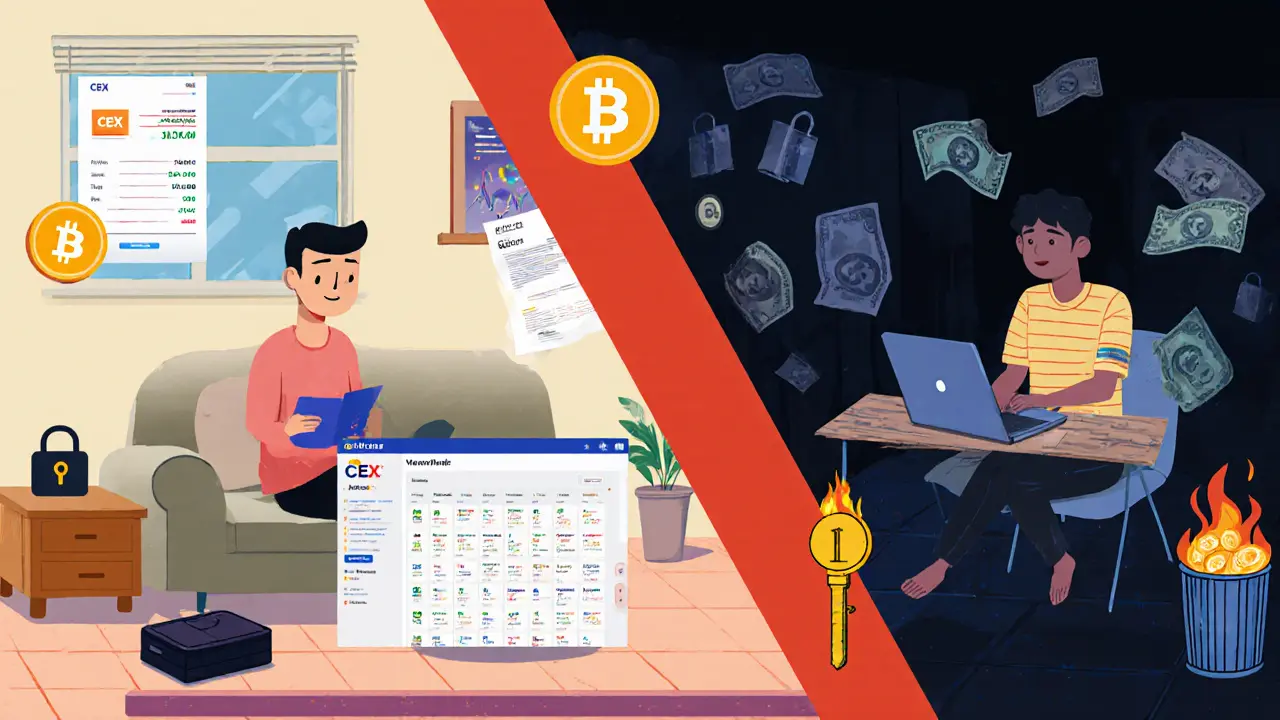
Here’s the hidden truth: the biggest geographic barrier isn’t the exchange-it’s the bank.CEXs make it easy to buy crypto with a credit card or bank transfer. But only if your country has a banking relationship with that exchange. Coinbase supports SEPA transfers in 30+ European countries. Binance supports PayID in Australia. But in Brazil, only a few CEXs can connect to local payment processors. In South Africa, you can’t use credit cards on most platforms due to banking restrictions.
DEXs don’t offer fiat on-ramps at all. That means you need to get crypto another way-through a P2P platform like LocalBitcoins, a peer-to-peer Telegram group, or a CEX that works in your country. If your country bans those too, you’re locked out.
So while DEXs seem more open, they rely on CEXs or P2P markets to get you in the door. That’s the real choke point.
Security Trade-Offs: Who Controls Your Money?
When you use a CEX, you give up control for convenience. Your coins sit on their servers. They freeze accounts. They freeze funds. They comply with court orders. If your country bans crypto, they’ll hand over your data-and your coins.With a DEX, you control everything. No one can freeze your wallet. No government can demand your keys. But that also means if you send crypto to the wrong address, or lose your seed phrase, there’s no customer service to call. No refund. No appeal.
And here’s the twist: even if you use a DEX, you’re still subject to your country’s laws. In the U.S., the IRS taxes crypto trades. In Germany, you pay capital gains tax after one year. In India, you pay 30% tax on every trade. The DEX doesn’t report to the government-but you still have to.
So while DEXs offer anonymity, they don’t offer legal immunity.
Who Wins? It Depends on Where You Live
If you’re in the U.S., Canada, or most of Western Europe: CEXs are easier. They’re regulated, insured (sometimes), and support bank deposits. You get customer support. You get tax reports. You get peace of mind.If you’re in Nigeria, Venezuela, or Ukraine: DEXs are survival tools. You bypass broken banks. You avoid government crackdowns. You trade without asking permission.
If you’re in China or Russia: Neither works well. CEXs are banned. DEXs are risky. You rely on offshore wallets, crypto ATMs, or hidden P2P networks.
The truth? There’s no perfect solution. CEXs are safe but restricted. DEXs are open but risky. And regulators are closing the gaps on both.
What’s Next? The End of Crypto’s Wild West
Five years ago, you could trade crypto from anywhere. Today, geography matters more than ever. Governments are catching up. Tools like blockchain analytics, IP tracking, and wallet tagging are making anonymity harder.Soon, even DEXs may require some form of location verification-just not in the way CEXs do. Imagine a DEX that lets you trade only if your wallet has been active for 6 months and has no ties to sanctioned addresses. That’s not science fiction-it’s what regulators are building.
For now, the best strategy is simple: know your local laws. Use a CEX if you need fiat access and legal protection. Use a DEX if you need privacy and control. But always assume your activity is visible. And never assume you’re untouchable.
Can I use a DEX if my country bans crypto?
Yes, technically. DEXs don’t require ID or location verification, so you can connect your wallet and trade even in countries where crypto is illegal. But you still need to get crypto first-usually through P2P or a CEX that works in your region. Also, your local government can still track your wallet activity, and using crypto may carry legal risks.
Why can’t I access Binance in the U.S.?
Binance.com is blocked in the U.S. because it doesn’t have the required licenses from U.S. regulators like the SEC or FinCEN. Instead, Binance operates Binance.US, a separate platform with fewer trading pairs and stricter rules. If you try to access Binance.com from a U.S. IP, you’ll be redirected or blocked.
Do DEXs report to tax authorities?
No, DEXs don’t report to tax authorities. They have no user accounts, no KYC, and no financial records to share. But you’re still legally required to report your crypto trades to your country’s tax agency-like the IRS in the U.S. or HMRC in the UK. Tools like Koinly or CoinTracker can help track your transactions for tax purposes.
Can I use a VPN to bypass CEX restrictions?
You can, but it’s risky. Most CEXs detect and ban VPN usage. If you’re caught using a VPN to access a platform you’re not allowed to use, your account can be frozen or permanently suspended. Some users do it to access trading pairs or lower fees-but you lose customer support, insurance, and legal protection if something goes wrong.
Are DEXs safer than CEXs?
It depends. DEXs are safer from hacks and government seizures because you control your keys. But they’re riskier from scams, smart contract bugs, and user error. Over $2 billion was lost to DeFi exploits in 2024. CEXs have insurance and recovery options-but they can also freeze your funds. Neither is fully safe. You’re trading control for convenience.
Comments
Nancy Sunshine
It’s wild how much geography dictates your crypto experience. I live in the U.S. and take for granted that I can buy ETH with my bank account - but for someone in Nigeria, that’s a luxury they have to fight for. The real issue isn’t the tech - it’s the banking infrastructure that’s stuck in the 20th century.
November 29, 2025 at 23:57
Ann Ellsworth
Let’s be real - DEXs aren’t ‘free’ - they’re just unregulated. And unregulated means rug pulls, flash loan exploits, and 1000x losses on tokens with no liquidity. The SEC’s creeping into DEXs isn’t tyranny - it’s damage control. You want autonomy? Fine. But don’t cry when your portfolio evaporates because you clicked ‘approve’ on a contract written by someone named ‘CryptoKing77’.
November 30, 2025 at 19:54
Alan Brandon Rivera León
My cousin in Ukraine used Uniswap to send USDT to her mom in Poland during the worst of the war. No bank. No paperwork. Just a wallet and a Wi-Fi connection. That’s not freedom - that’s survival. And yeah, maybe one day DEXs will geo-block users. But until then, they’re the last open door for people who’ve been locked out by every other system.
CEXs are convenient, sure. But convenience isn’t the same as justice.
December 2, 2025 at 07:47
Christy Whitaker
Everyone acts like DEXs are some magical loophole, but let’s not pretend people in Venezuela aren’t getting scammed daily. You think they’re trading ETH because they love DeFi? No - they’re trading because their salaries are worth less than a cup of coffee. And now you’re telling me they should just ‘hold their keys’? Sweetheart, they don’t even have a phone charger that works.
December 3, 2025 at 00:17
Ankit Varshney
India’s 30% tax on every trade makes DEXs useless for most. You can’t trade small amounts profitably when every swap costs you a third in taxes. CEXs at least let you consolidate gains and report once. DEXs? You’re drowning in paperwork.
December 4, 2025 at 02:21