You’ve probably heard the pitch: buy a carbon offset, plant a tree somewhere in Peru, and call it a day. But here’s the dirty secret of the traditional voluntary carbon market: double counting, opaque pricing, and a lack of trust are rampant. A single tonne of CO2 might be sold three times because different brokers didn’t talk to each other. Enter Carbon Credit Blockchain Projects. These aren’t just buzzwords; they’re digital ledgers that turn messy paper certificates into transparent, tradable tokens. If you’re trying to figure out if this tech actually works or if it’s just another crypto bubble, you’re in the right place. We’re breaking down how platforms like Toucan Protocol and KlimaDAO are rewriting the rules of climate finance.
The Problem With Old-School Carbon Credits
Before we get into the blockchain fix, let’s look at what’s broken. The current system relies on centralized registries-think of them as giant, slow-moving databases managed by entities like Verra or Gold Standard. When a project, say a wind farm in Texas, generates a credit, it gets registered there. But once that credit enters the secondary market, things get fuzzy. Brokers trade these credits bilaterally (one-on-one deals), often without public visibility. This creates two major headaches: liquidity issues and greenwashing risks. You can’t easily sell a partial credit, and verifying that your credit hasn’t been retired already requires digging through PDFs and emails. It’s clunky, expensive, and ripe for fraud. Blockchain steps in not to replace the environmental science, but to fix the plumbing of the financial transaction layer.
Toucan Protocol: The Gateway to On-Chain Carbon
If you want to understand where this space started, look at Toucan Protocol. Launched in late 2021, Toucan was the first major infrastructure to bridge traditional carbon registries with blockchain networks, specifically Ethereum and Polygon. Their core innovation? Turning verified carbon credits into Tokenized CO2 (TCO2). These are semi-fungible ERC-20 tokens. "Semi-fungible" sounds technical, but it just means each token carries its unique DNA-like where it came from and when it was issued-but can still be traded like any other crypto asset.
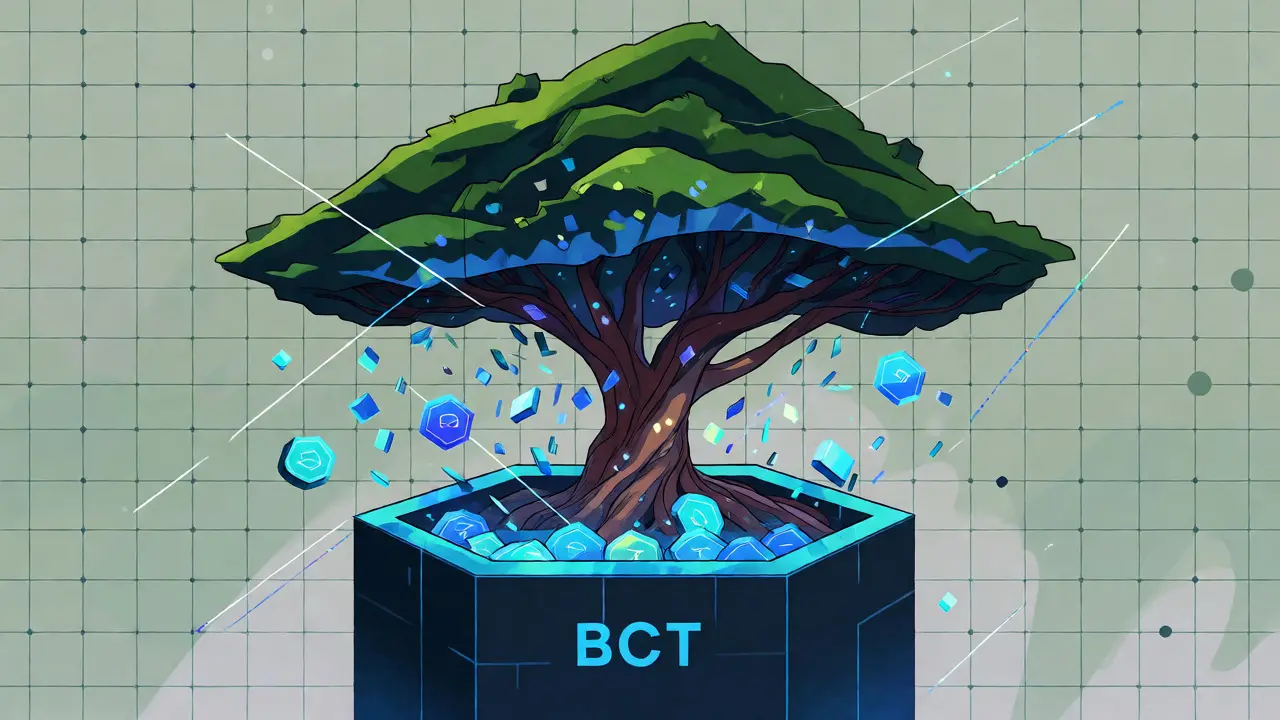
Toucan created pools to make trading easier. The most famous is the Base Carbon Tonne (BCT). Think of BCT as a basket of various high-quality carbon credits. Instead of buying one specific credit from a forestry project in Brazil, you buy a fraction of this pool. This solves the liquidity problem instantly. Within six months of launch, Toucan had tokenized over 20 million tonnes of carbon. That’s massive volume for a new tech. However, it wasn’t all smooth sailing. Early on, some low-quality "junk" credits got swept into the pools, leading to registry bans and quality control debates. It was a painful lesson: blockchain ensures transparency, but it doesn’t automatically guarantee environmental integrity.
KlimaDAO and the Rise of DeFi Carbon
Once credits were on-chain, someone had to build a marketplace around them. That’s where KlimaDAO comes in. Operating as the liquidity hub for on-chain carbon, KlimaDAO uses smart contracts to automate buying, selling, and retiring credits. They manage a portfolio worth millions, heavily relying on the BCT pool created by Toucan. Why does this matter? Because it introduces DeFi (Decentralized Finance) mechanics to climate action. You can lend your carbon tokens, earn yield, or use them as collateral in other apps. This composability means a developer can build an app that automatically buys carbon every time you stream music, integrating sustainability directly into user behavior without manual intervention.
Klima’s model also attempts to stabilize prices. By holding a reserve of carbon assets, they aim to reduce the volatility that scares off corporate buyers. While critics argue that DAO governance can be chaotic, the data shows real engagement. Thousands of users interact with Klima’s dashboard daily, tracking retirement rates and price movements in real-time-a stark contrast to the quarterly reports of traditional markets.
Beyond Tokenization: ACX and Puro.Earth
Not every project focuses on swapping existing credits. Some are building entirely new rails. AirCarbon Exchange (ACX), backed by Singapore’s government, takes a hybrid approach. They use blockchain to create immutable records of ownership while maintaining strict compliance with international standards. ACX isn’t about wild speculation; it’s about institutional-grade settlement. Banks and large corporations use ACX to trade renewable energy certificates and carbon credits with reduced counterparty risk. The technology prevents double counting by locking assets in custody before trading, ensuring that what you buy is truly yours.
Then there’s Puro.Earth, which targets a specific niche: engineered carbon removals. Unlike forest offsets that can burn down or decay, Puro focuses on durable solutions like biochar and mineralization. Major players like Microsoft and Shopify have used Puro’s platform to purchase these high-integrity credits. By using blockchain verification, Puro provides an audit trail that proves the carbon is stored permanently. This addresses one of the biggest criticisms of the old market: that many offsets were dubious or temporary.
| Platform | Primary Function | Key Asset Type | Best For |
|---|---|---|---|
| Toucan Protocol | Tokenization & Bridging | TCO2 / BCT / NCT | Developers & DeFi Users |
| KlimaDAO | Liquidity & Governance | BCT Pool | Speculators & Liquidity Providers |
| AirCarbon Exchange | Institutional Trading | Digital Certificates | Banks & Corporates |
| Puro.Earth | Removal Verification | Biochar/Mineralization | High-Integrity Buyers |
How It Actually Works: From Tree to Token
So, how do you go from a physical tree to a digital token? It’s a multi-step process involving both off-chain verification and on-chain minting. First, a project developer gets their carbon reduction verified by a standard body like Verra. Once verified, the credit is issued in the traditional registry. Next, the developer bridges this credit to a blockchain protocol like Toucan. This involves "retiring" the credit in the old registry so it can’t be sold twice, then minting a corresponding token on-chain. This token retains metadata about the project’s location, type, and vintage year. Finally, the token enters a decentralized exchange (DEX) where anyone can buy, sell, or hold it. When a company wants to claim an offset, they "burn" (destroy) the token, recording the retirement on the blockchain forever.
The Hurdles: Quality Control and Regulation
Don’t let the shiny tech fool you-this space has serious growing pains. The biggest issue remains quality. Just because a credit is on a blockchain doesn’t mean it represents a genuine environmental benefit. In 2022, investigations revealed that many forestry projects had exaggerated their impact. Blockchain made these flaws visible, causing price crashes for certain credit types. Platforms are now responding by creating stricter filters. For example, newer pools exclude older, lower-quality vintages. Another challenge is regulation. Governments are still figuring out how to treat these tokens. Are they securities? Commodities? Carbon units? Until frameworks solidify, institutional adoption moves slower than the hype suggests. Also, energy consumption is a concern. While Proof-of-Stake blockchains like Polygon (used by Toucan) are energy-efficient, the broader crypto narrative still faces scrutiny regarding its own carbon footprint.
Why This Matters for Your Wallet and the Planet
If you’re an investor, this sector offers exposure to climate tech with high growth potential. If you’re a consumer, it means more transparent ways to offset your travel or shopping habits. Companies are increasingly required to report ESG (Environmental, Social, and Governance) metrics. Automated, blockchain-based tools allow them to do this efficiently. For instance, a fintech app could integrate an API from Carbonmark to offer instant carbon offsetting for every transaction. This reduces friction and makes sustainability accessible to millions who wouldn’t otherwise engage with complex carbon markets.
What is a tokenized carbon credit?
A tokenized carbon credit is a digital representation of a verified carbon offset recorded on a blockchain. It allows for fractional ownership, easy trading, and transparent tracking of the credit's lifecycle from issuance to retirement.
Is buying carbon credits on blockchain safe from scams?
Blockchain reduces technical fraud like double-spending because the ledger is public and immutable. However, it does not eliminate "greenwashing." You must still verify the underlying environmental quality of the project behind the token.
Which blockchain is best for carbon credits?
Polygon and Ethereum are currently the most popular due to their robust DeFi ecosystems and lower energy usage compared to Bitcoin. Other chains like Celo and Algorand are also gaining traction for their focus on sustainability.
Can I retire my carbon credits myself?
Yes. Most platforms allow you to burn your tokens via a smart contract. This action permanently removes the credit from circulation and records the retirement on-chain, providing proof for your personal or corporate sustainability reports.
What happened to Toucan Protocol's early problems?
Early versions included low-quality credits, leading to price drops and registry restrictions. The protocol has since updated its methodology to include higher-quality standards and better filtering mechanisms to restore market confidence.
Next Steps for Getting Involved
If you’re curious, start small. Explore the dashboards of KlimaDAO or Toucan to see real-time data. Don’t jump in blindly; check the vintage year of the credits you’re looking at. Newer credits generally command higher prices because they’re less likely to be "stale." Keep an eye on regulatory news, especially from the EU and US, as clear guidelines will likely trigger the next wave of mainstream adoption. The intersection of climate and code is messy right now, but it’s moving fast. Whether you’re here for the tech or the planet, keeping your finger on the pulse of these projects is essential.
Comments
Marc Kennedy
honestly this is exactly the kind of transparency we need. i've been tracking bct for a while and seeing the liquidity improve is wild. keep building! 🌱
September 26, 2026 at 06:14
vanessa bulos
Oh, please.
We are collectively hallucinating that a distributed ledger fixes the fundamental arrogance of capitalism. You can tokenize the air all you want, but until you stop burning fossil fuels at an industrial scale, these digital tokens are just expensive placebo pills for the guilt-ridden elite.
The entire premise is flawed because it commodifies nature rather than respecting it as intrinsic. We are creating a casino where the house always wins and the planet loses, wrapped in pretty smart contracts and DAO governance theater.
It’s lazy criticism to think code solves ethics. It doesn’t. It just makes the exploitation more efficient and harder to trace when you’re not paying attention.
September 27, 2026 at 18:03
Charlotte Owen
While the sentiment about corporate guilt is valid, dismissing the infrastructure ignores the actual mechanics of market failure. The issue isn't just ethical; it's informational asymmetry. Without immutable records, verification costs prohibit small-scale participation, which concentrates power in large brokers who benefit from opacity.
Tokenization reduces transaction costs and enables fractional ownership, which democratizes access to carbon markets. This isn't about replacing environmental science with code; it's about creating a settlement layer that prevents double-counting-a problem that has plagued voluntary markets for decades due to poor registry interoperability.
Critiquing the tech without acknowledging the specific inefficiencies it addresses misses the point of why institutional players like Microsoft are engaging with platforms like Puro.Earth. They aren't buying into hype; they're buying audit trails that their ESG auditors actually accept.
If you ignore the plumbing, you're just shouting into the void while the market moves on without your moral blessing.
September 29, 2026 at 08:59
Harmony Davidson
i saw toucan get banned by verra... did they fix it?? or is it still sketchy??? i feel like big banks are gonna crush this whole thing anyway....
also what about the energy usage??? isn't crypto bad for the earth?? i read somewhere that polygon is green but i don't trust them!!! 😰😰
September 30, 2026 at 17:40
Justine Jones
Polygon uses Proof-of-Stake so energy use is negligible compared to PoW chains like Bitcoin. Toucan updated their methodology to filter out low-quality credits after the initial backlash. It’s much stricter now.
October 2, 2026 at 04:31