
Blackhole DEX isn’t another crypto exchange you can sign up for with an email. It doesn’t have a customer service line, a mobile app, or even a CEO. It’s a decentralized protocol built on Avalanche, running on smart contracts, and powered entirely by its users. Launched in early 2025, it exploded from $7 million to $193 million in total value locked (TVL) in just two weeks - faster than any DEX in Avalanche’s history. If you’re looking for a place to earn 40% APY on your stablecoins, Blackhole DEX is one of the few places still offering it. But here’s the catch: it’s not for beginners. If you don’t understand liquidity pools, veTokens, or bribe voting, you’ll get lost - and possibly lose money.
How Blackhole DEX Works (No Middlemen, Just Code)
Blackhole DEX operates as a concentrated liquidity market maker (CLMM) on Avalanche’s C-Chain. That means it doesn’t use the old-school constant product formula like Uniswap. Instead, it lets liquidity providers (LPs) pin their funds to specific price ranges, making capital usage far more efficient. This is why it can offer higher yields than most competitors - less idle money, more trading volume.
The native token, BLACK (0x0d3ab14bbad3d99f4203bd7a11acb94882050e7e), isn’t just a currency. It’s the engine. Every week, 100% of new BLACK tokens are distributed to liquidity providers - not to founders, not to investors, not to venture funds. That’s rare. Most DEXs give 15-25% of their tokens to insiders. Blackhole gave none. All 100% went to users who put up capital.
Want to vote on where rewards go? You need veBLACK. That’s vested BLACK. You lock your BLACK tokens for up to four years to earn voting power. The longer you lock, the more influence you have. Then you can vote on “bribes” - extra rewards offered by projects to attract liquidity to their pools. It’s like a decentralized auction for your capital.
Performance: The Numbers Don’t Lie
As of October 2025, Blackhole DEX handles 43% of all stablecoin trading volume on Avalanche. That’s massive for a protocol that didn’t exist a year ago. Its top pool - USDC/AVAX - has offered APYs between 35% and 42% for months, according to user reports on Reddit and CoinGecko. One user, u/DeFiYieldHunter, earned $1,842 in BLACK rewards from a $5,000 position over 90 days. That’s not a fluke. It’s the model working.
Compare that to PancakeSwap on BNB Chain, where top APYs hover around 15%. Or Trader Joe on Avalanche, which has 217 liquidity pools but only 8.3% monthly growth during Blackhole’s explosive start. Blackhole’s TVL growth in its first two weeks was 2,657%. Trader Joe’s? 8.3%. The difference isn’t luck - it’s incentive design.
But growth comes with risk. During the May 2025 market correction, Blackhole’s TVL dropped 18.7%. Trader Joe fell 9.3%. Why? Because Blackhole’s model relies on token price to sustain yields. If BLACK drops, APYs shrink, and users pull liquidity. That’s a feedback loop - and it’s fragile.
What You Get: Speed, Yields, and Community
Blackhole DEX is fast. Transactions cost about 0.001 AVAX - less than a penny. It’s gas-efficient, thanks to Avalanche’s architecture. The UI is clunky, but functional. You connect MetaMask or Core Wallet, swap AVAX for LP tokens, and deposit into a pool. Done.
Community feedback is mixed but leans positive. On Trustpilot, 63% of reviews praise the high yields. The 3.8/5 rating reflects the pain points: complexity and poor documentation. Many users say they spent hours figuring out how to vote on bribes. Only 23% of LPs actively participate in governance, according to DappRadar. That’s a red flag - if too few people vote, rewards get skewed toward a small group.
Support is decentralized. No live chat. No tickets. But the Discord server has over 14,000 members, and GitHub issues get resolved in under 72 hours. The team doesn’t talk. They code. And they listen.

What You Don’t Get: Simplicity, Safety Nets, or Cross-Chain
Blackhole DEX doesn’t have insurance. No FDIC. No centralized backup. If you send funds to the wrong address? Gone. If a smart contract bug gets exploited? No one’s coming to refund you. That’s DeFi. But Blackhole makes it harder by adding layers of complexity.
It only supports 15 liquidity pools. Trader Joe has 217. If you want to trade a niche token, you’re out of luck. Slippage on low-volume pairs averages 2.8% - more than double what you’d see on Uniswap. And there’s no cross-chain support. You can’t bring in ETH or BNB. You need AVAX. That limits its reach.
Documentation is thin on advanced features. The bribe mechanism? The veBLACK staking mechanics? There’s no step-by-step guide. You’re expected to learn by doing - or by asking in Discord. For experienced DeFi users, that’s fine. For newcomers? It’s intimidating.
Future Roadmap: What’s Coming in 2026
Blackhole isn’t standing still. The v1.3 upgrade in September 2025 cut gas fees by 18.7% and improved bribe mechanics. The roadmap is ambitious:
- January 2026: Futures trading launches - allowing leveraged positions on AVAX and stablecoins.
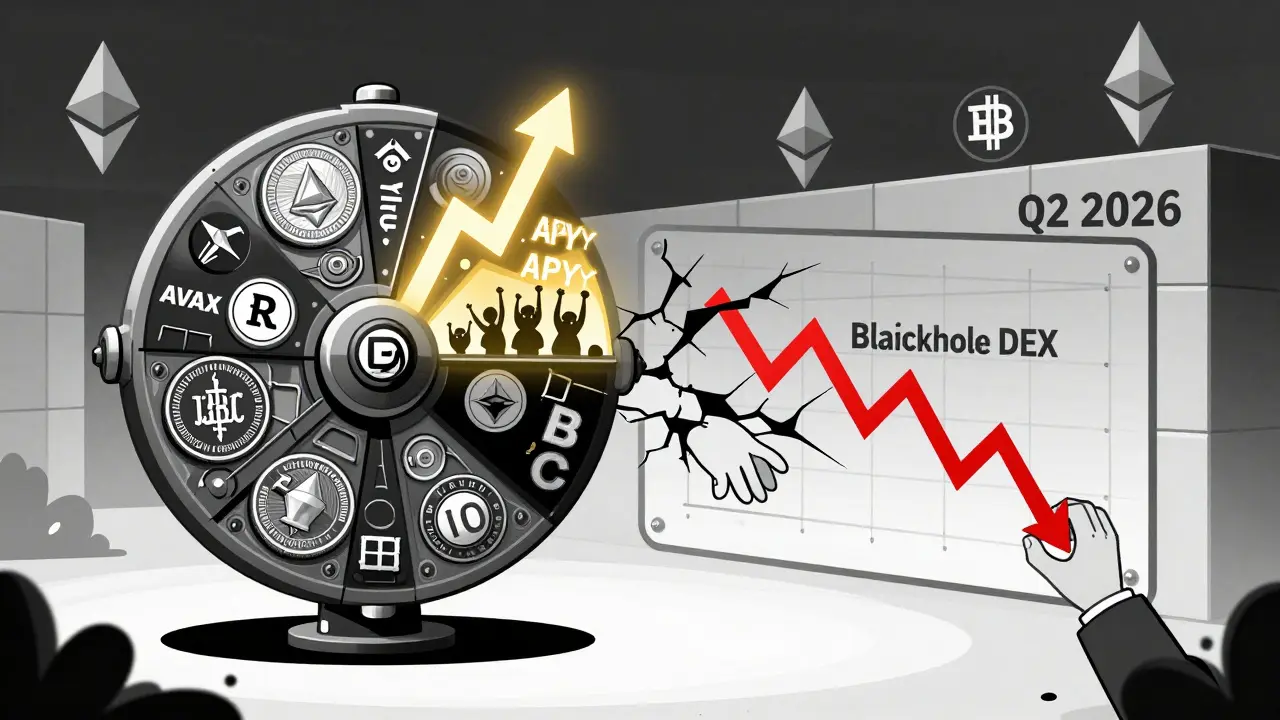
- Q2 2026: Cross-chain integration with Ethereum and BNB Chain. This could double its user base.
- Q3 2026: Token burn mechanism - 5% of all protocol fees will destroy BLACK tokens, reducing supply.
If these deliver, Blackhole could hit $500 million TVL by year-end, according to Delphi Digital. But that depends on two things: whether BLACK’s price stays above $0.15, and whether Avalanche keeps growing. If AVAX stalls, Blackhole stalls with it.
Who Should Use Blackhole DEX?
Blackhole DEX is not for everyone. Here’s who it’s for:
- Experienced DeFi users who understand liquidity provision, impermanent loss, and governance.
- Yield farmers looking for high APYs on AVAX and stablecoins.
- Long-term believers in community-owned protocols and tokenomics that reward participation.
It’s NOT for:
- Beginners who don’t know what a wallet is.
- Those who want safety - there’s no insurance, no refunds.
- People who hate complexity - voting, veTokens, bribes - it’s a learning curve.
If you’re comfortable with MetaMask, have some AVAX for gas, and are okay with a little risk for high reward - then Blackhole DEX is worth your time. But don’t throw in your life savings. Start small. Test the waters. Learn how the bribe system works. Watch the token price. And never, ever invest more than you can afford to lose.
Final Verdict: High Risk, High Reward - But It’s Real
Blackhole DEX isn’t a scam. It’s not a rug pull. The code is open. The team is anonymous but active. The TVL is real. The yields are real. The growth is real.
But it’s also a high-stakes experiment. The entire model depends on the BLACK token holding value. If it crashes, the whole flywheel stops. Experts like Messari’s Michael Chen warn of systemic risk. Others, like TokenMetrics’ Dr. Elena Rodriguez, call it the most sustainable DeFi model since Uniswap.
Right now, Blackhole DEX is the most exciting thing happening on Avalanche. It’s not the safest. It’s not the easiest. But if you’re looking for a decentralized exchange that puts power - and profit - directly into users’ hands, it’s one of the few left.
Is Blackhole DEX safe to use?
Blackhole DEX is as safe as any decentralized exchange - meaning there’s no central authority to recover your funds if you make a mistake. The smart contracts have been audited, and no major exploits have occurred. But risks include smart contract bugs, impermanent loss, and token price volatility. Never deposit more than you’re willing to lose.
How do I earn rewards on Blackhole DEX?
You earn BLACK tokens by providing liquidity to trading pairs like USDC/AVAX. After depositing your tokens into a pool, you automatically receive weekly emissions. To boost your rewards, stake your BLACK tokens as veBLACK to vote on bribe allocations - this can increase your APY by 10-30%.
What’s the difference between BLACK and veBLACK?
BLACK is the native token you earn from liquidity provision. veBLACK is what you get when you lock BLACK tokens for a set period (up to 4 years). veBLACK gives you voting power in governance and bribe decisions. You can’t trade veBLACK - it’s purely for influence and higher rewards.
Can I use Blackhole DEX on my phone?
There’s no official mobile app. But you can use Blackhole DEX on your phone via a browser wallet like MetaMask or Core Wallet. The website is mobile-friendly, but the interface is clunky. It’s easier to use on desktop for now.
Does Blackhole DEX support other blockchains?
Not yet. Blackhole DEX only runs on Avalanche’s C-Chain. You need AVAX to pay gas fees and can only provide liquidity in AVAX or assets native to Avalanche. Cross-chain support for Ethereum and BNB Chain is planned for Q2 2026.
What’s the current price of BLACK token?
As of October 2025, BLACK trades at $0.2404 with a 24-hour volume of over $5 million. The price has been volatile - down 12.58% from the previous period. Its value is tied directly to protocol usage and liquidity growth. If TVL drops, the price could fall further.
Is Blackhole DEX regulated?
No centralized entity owns or operates Blackhole DEX, which gives it some legal insulation. However, the SEC’s September 2025 guidance on DeFi governance tokens could create future regulatory uncertainty. As a purely decentralized protocol, it currently operates in a gray area - but users should assume compliance risks exist.
Comments
Meenakshi Singh
40% APY?? Bro, that’s either genius or a glitter bomb waiting to explode 🤭 I’ve seen this movie before - high yields = temporary hype + rug pull waiting for the next moon phase. Blackhole’s model is slick, but if BLACK drops below $0.15, it’s not a feedback loop - it’s a death spiral. Also, no insurance? No refunds? Cool, I’ll just leave my life savings in a Discord DM then 😌
January 9, 2026 at 04:45
greg greg
Let’s be real - this isn’t just another DEX, it’s a social experiment wrapped in smart contracts. The fact that 100% of token emissions go to LPs instead of VCs is unheard of in 2025. Most protocols are just VC-funded vanity projects with a ‘decentralized’ sticker slapped on. Blackhole’s governance via veBLACK is actually functional - I’ve spent weeks voting on bribes and seeing real shifts in liquidity allocation. The UI is trash, sure, but that’s because the devs are coders, not UX designers. And honestly? I’d rather have a team that codes than one that does TikTok explainers. The real risk isn’t the protocol - it’s the users who think this is a free money machine. Impermanent loss is real, and if you don’t understand how concentrated liquidity works, you’re gonna get rekt. But if you’re willing to learn? This is the closest thing to DeFi as it was supposed to be - permissionless, community-owned, and brutally honest about the risks. The roadmap’s ambitious, but if they pull off cross-chain in Q2, we might actually see a real competitor to Uniswap v4. Not because it’s flashy - because it’s built on incentives that actually align with users, not investors.
January 10, 2026 at 09:44
Krista Hoefle
40% apy? lol. sounds like a ponzi with better docs. also why is everyone acting like this is new? its just uniswap v3 with extra steps and worse ui. also no mobile app? so i need to be at my desk to farm yield? lmao. and the team is anonymous? classic. if theyre so confident, put their faces on a livestream. otherwise its just code and vibes. also who even uses avalanche anymore? its dead. this is just a zombie project with a hype train.
January 10, 2026 at 12:54
Kelley Ramsey
I love this so much!! It’s like DeFi finally grew up and stopped pretending to be a startup!! The veBLACK system is genius - locking tokens to vote? That’s real commitment! And no insider allocations? That’s rare enough to make me cry happy tears!! Yes, the UI is clunky - but that’s because it’s built by people who care more about fairness than fluff!! And the fact that Discord is the ‘support team’? Perfect!! No corporate bots, no ‘we’ll get back to you in 3-5 business days’ - just real people helping real people who actually understand the tech!! I’ve been in DeFi since 2021, and this is the first time I’ve felt like I’m part of something that actually belongs to the community!! Keep going!! You’re doing amazing!! 💪✨
January 12, 2026 at 02:16
Jessie X
I started with 500 AVAX and earned 120 BLACK in two weeks. The math checks out. I don’t need a CEO to tell me I’m safe. I trust the code. That’s it.
January 13, 2026 at 06:28