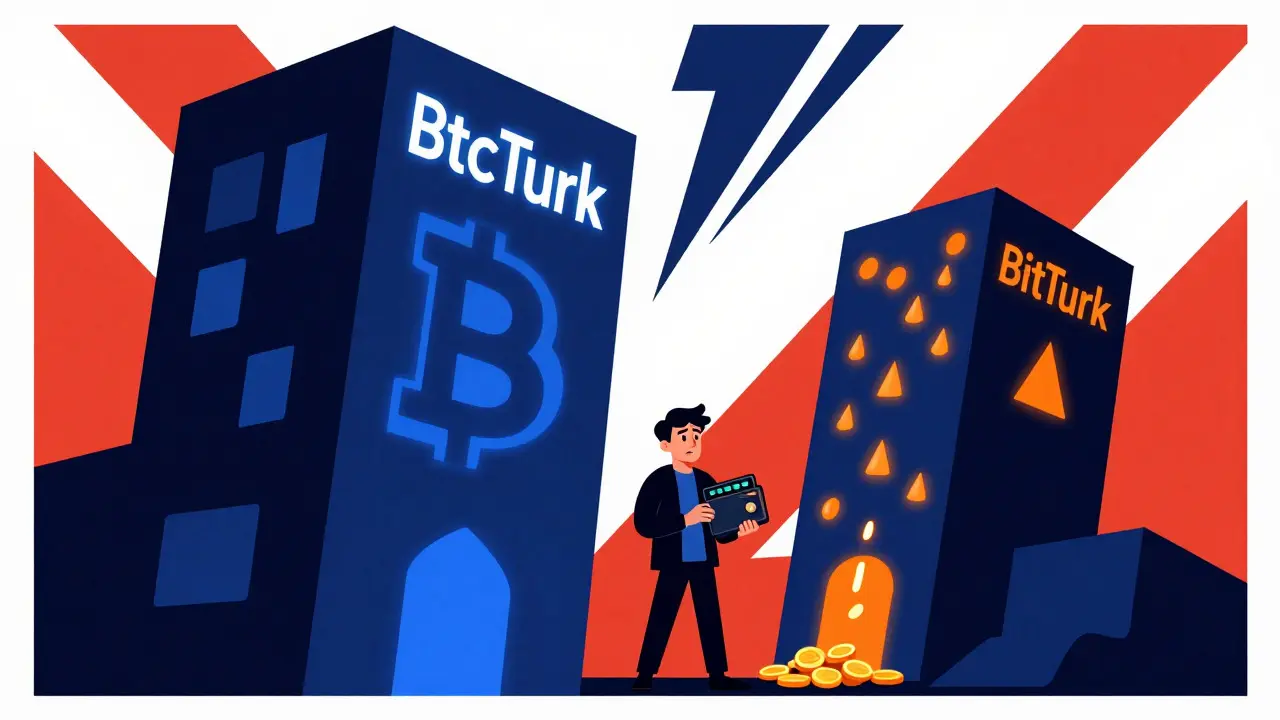
There is a dangerous trap waiting for anyone searching for crypto exchanges in Turkey right now. You type in "BitTurk" and land on a site that looks professional, promises low fees, and claims to be the "first Turkey crypto money exchange." But before you deposit your hard-earned savings, you need to know one critical fact: BitTurk is not the same as BtcTurk, the giant that dominates the local market. In fact, BitTurk operates in a regulatory gray zone that could leave your funds vulnerable if things go wrong. This review breaks down exactly what BitTurk is, who it serves, and whether it deserves a spot in your portfolio in 2026.
The Confusion That Could Cost You Money
If you have been trading crypto in Turkey for more than a year, you likely know BtcTurk. Founded in 2013, BtcTurk is the established leader with over 100 cryptocurrencies and massive liquidity. However, BitTurk, launched in 2017, has positioned itself as a challenger with a nearly identical name. This similarity isn't just a marketing tactic; it creates genuine risk. Users often mistake one for the other, leading to phishing attempts or accidental deposits into the wrong platform. The domain difference is subtle but vital: BtcTurk uses btturk.com (or its verified variants), while BitTurk uses bitturk.com. Always double-check the URL before entering your wallet keys.
Why does this distinction matter? Because BtcTurk is widely recognized as a major player, whereas BitTurk has a much smaller footprint. As of late 2025, major data aggregators like CoinGecko and CoinMarketCap do not list BitTurk's trading volumes prominently, suggesting its activity level is significantly lower than its competitor. If you are looking for deep order books and instant execution on large trades, you might find BitTurk's liquidity insufficient compared to the giants.
Regulatory Status: The Elephant in the Room
In January 2025, Turkey's Capital Markets Board (SPK) tightened its rules, requiring all crypto exchanges to obtain specific operation licenses. This was a massive shift from the previous loose environment. BtcTurk adapted quickly, securing its status as a licensed operator. BitTurk, however, remains conspicuously absent from the SPK's official list of licensed operators as of mid-2026. Does this mean it is illegal? Not necessarily, but it means it is operating without the explicit government backing that protects users in case of insolvency or fraud. For an average user, this lack of regulatory oversight is the biggest red flag. If BitTurk were to disappear tomorrow, your legal recourse would be far weaker than if you held assets on a fully compliant exchange.

Features and User Experience
On paper, BitTurk offers a standard suite of features found in modern exchanges. It supports major blockchain networks including Bitcoin, Ethereum, Ripple, and Chainlink. The platform provides API access for algorithmic traders, which is a nice touch for those who want to automate their strategies. The interface is available on web, iOS, Android, and desktop platforms, ensuring you can trade from almost any device. Customer support is advertised as 24/7, which is essential when dealing with volatile digital assets. However, user reports suggest that while the English interface exists, it feels machine-translated, potentially causing confusion for non-Turkish speakers regarding fee structures or withdrawal limits.
- Liquidity: Lower than BtcTurk; slippage may occur on large orders.
- Fees: Advertised as low, but specific schedules are rarely published clearly.
- Security: Claims robust security with 2FA, but lacks third-party audit reports.
- Asset Variety: Limited compared to global competitors; focuses on major caps.
Security and Transparency Check
Every exchange claims to be secure, but proof matters. BitTurk mentions Google Authenticator integration for two-factor authentication, which is a basic requirement, not a differentiator. What is missing? There are no public cold storage percentages, no insurance fund details, and no recent third-party security audits. In contrast, top-tier exchanges regularly publish Proof of Reserves and undergo independent security reviews. Without these transparency metrics, you are essentially trusting the platform's word. Given the small size of the operation, the risk of internal errors or hacks without adequate backup reserves is higher. Always keep only what you plan to trade immediately on the exchange and store the rest in a hardware wallet.
| Feature | BitTurk | BtcTurk |
|---|---|---|
| Founded | 2017 | 2013 |
| SPK Licensed (2025+) | No (Unverified) | Yes |
| Market Share | <2% | ~85% (Domestic) |
| Cryptocurrencies | Limited set | 100+ |
| Primary Audience | Niche/Novice | Mainstream/Institutional |
Who Should Use BitTurk?
Honestly, very few people should choose BitTurk as their primary exchange in 2026. It might appeal to Turkish residents who prefer a localized interface and don't mind the regulatory ambiguity. However, for international users or anyone serious about asset preservation, the risks outweigh the benefits. The lack of clear fee documentation and the potential language barriers make it a poor choice for beginners. If you are already using BtcTurk or a global giant like Binance, there is little reason to switch to BitTurk unless you are specifically testing its API for development purposes. The survival probability for unlicensed exchanges in emerging markets is dropping, and BitTurk hasn't shown signs of catching up to regulatory standards recently.
Final Verdict
BitTurk is a functional but risky platform. It works, it connects to blockchains, and it allows you to trade. But it lacks the safety net of regulation, the depth of liquidity, and the transparency of the market leaders. In a landscape where scams and shutdowns are common, why take the chance on an unverified entity when regulated alternatives exist? Stick to exchanges with proven track records and clear legal standing. If you must use BitTurk, treat it like a casino: only put in money you can afford to lose, and never forget to withdraw your profits to a private wallet.
Is BitTurk the same as BtcTurk?
No, they are completely separate companies. BtcTurk was founded in 2013 and is the dominant, licensed exchange in Turkey. BitTurk was founded in 2017 and is a smaller, less regulated platform. Be careful not to confuse the two domains.
Is BitTurk safe for long-term storage of crypto?
It is not recommended for long-term storage due to its unregulated status and lack of published security audits. For long-term holding, always use a hardware wallet or a highly regulated exchange with Proof of Reserves.
Can international users easily sign up for BitTurk?
While technically possible, international users may face barriers such as strict ID verification requirements and language hurdles. Support responses for non-Turkish speakers have been reported as slow.
What are the trading fees on BitTurk?
Exact fee schedules are not consistently published in authoritative sources. While they advertise low commissions, you should verify the current maker/taker fees directly on the platform before executing large trades.
Does BitTurk have a mobile app?
Yes, BitTurk offers native applications for iPhone, iPad, Android, and desktop platforms, allowing users to manage their accounts on the go.