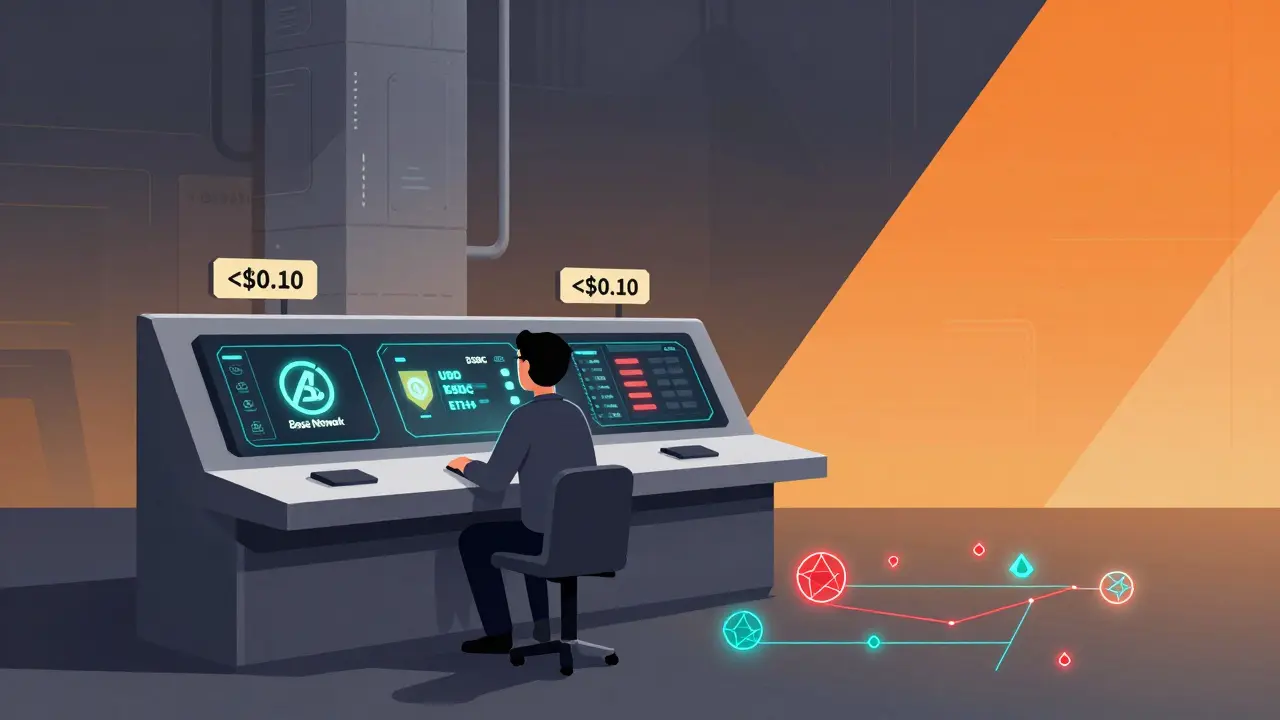
BaseSwap isn't another DeFi platform trying to copy Uniswap. It’s built for one thing: trading tokens on the Base Network. Launched in 2023 alongside Base itself, it’s the original liquidity hub for Coinbase’s Ethereum Layer 2. If you’re trading Base-native coins like ETH, USDC, or BASE, BaseSwap offers some of the lowest fees you’ll find anywhere. But if you want broad token choices, strong token utility, or easy access - you’ll hit walls fast.
How BaseSwap Works (And Why It’s Different)
BaseSwap runs as a decentralized exchange (DEX) on Base Network. That means no central server. No KYC. No deposits to a company. You connect your wallet - usually MetaMask set up for Base - and trade directly with liquidity pools. Every swap happens on-chain, recorded publicly. This is pure DeFi: you control your keys, you pay the gas fees, and you take the risk. Base Network’s secret sauce? It’s built on Ethereum but cuts transaction costs by 10 to 100 times. BaseSwap leans into that. While Uniswap on Ethereum might cost $5 to swap, BaseSwap often costs under $0.10. That’s why traders who stick to Base tokens love it. Slashdot users report swapping $10,000 worth of USDC to ETH for under $2 in fees - something nearly impossible on Ethereum mainnet. But here’s the catch: BaseSwap only works on Base. If you want to trade Solana tokens, Polygon coins, or even tokens from other EVM chains like Arbitrum, you’re out of luck. It’s not a multi-chain DEX. It’s a single-chain specialist.What You Can Trade
BaseSwap supports 23 cryptocurrencies and 27 trading pairs. That’s it. Compare that to PancakeSwap (over 1,000 tokens) or Uniswap (500+). BaseSwap’s list is tight: mostly stablecoins, Base’s own BASE token, a few DeFi tokens native to the ecosystem like WETH and USDC, and some lesser-known projects built on Base. You won’t find Bitcoin, Dogecoin, Solana, or even major Ethereum tokens like AAVE or MKR. If you’re looking for a one-stop shop for all your crypto, BaseSwap isn’t it. But if you’re deep into the Base ecosystem - say, farming yield on a new Base-native DeFi project - then this is your only real option.The BSWAP Token: A Puzzle
Every DEX has its own token. BaseSwap’s is BSWAP. But here’s where things get strange. CoinMarketCap says there are 10 million BSWAP tokens in existence. But it also says the circulating supply is zero. That’s not a typo. There are 107,500 wallet addresses that hold BSWAP - yet none of those tokens are moving. No one’s trading them. No one’s staking them. No one’s using them to vote or earn rewards. The token exists, but it doesn’t function. Some users think it’s a placeholder. Others suspect the team hasn’t activated the utility yet. Either way, holding BSWAP doesn’t get you fee discounts, governance rights, or yield. It’s just a balance in your wallet. That’s a red flag. Tokens need utility to hold value. Without it, they’re just speculative assets - and right now, BSWAP has almost no trading volume ($1,629.87 in 24 hours as of May 2025). That’s less than some meme coins on Solana.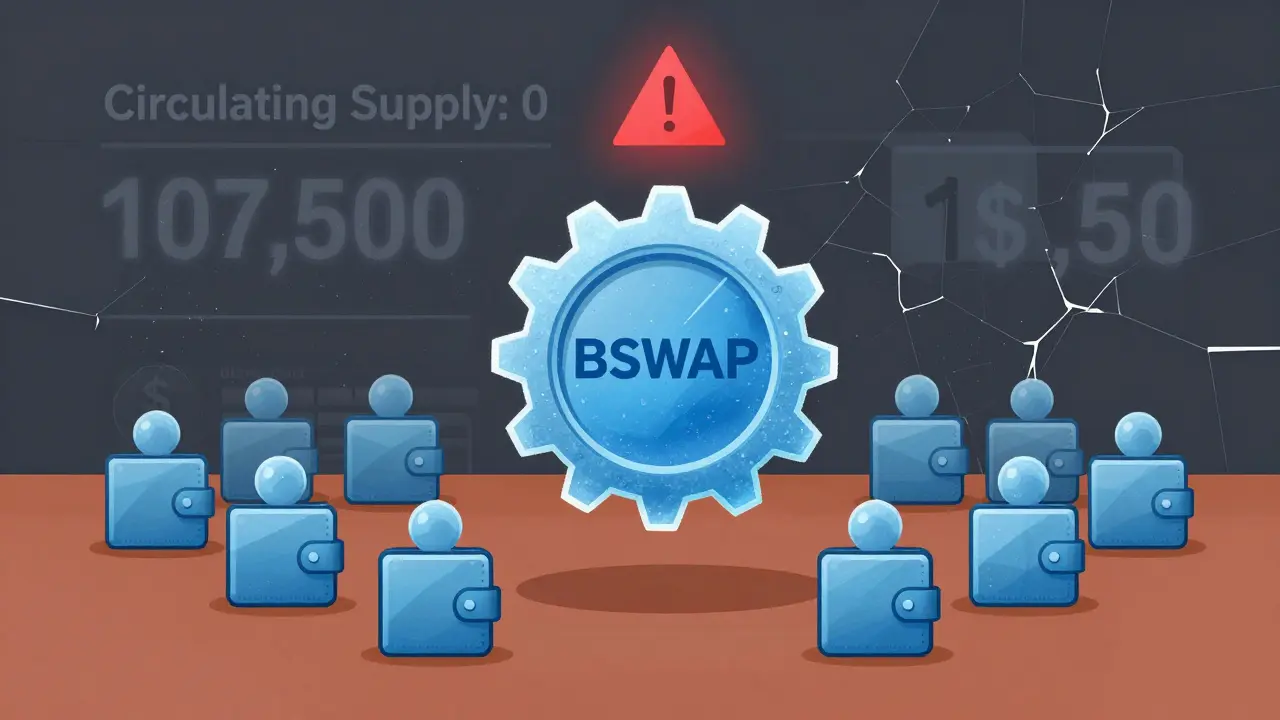
Performance and Traffic
BaseSwap has processed over $4.9 billion in total trading volume since launch. That’s not tiny. But most of that came from a few big stablecoin pairs. Daily volume hovers around $940,000 - decent for a niche DEX, but tiny compared to Uniswap’s $10 billion+ daily volume. Traffic stats tell another story. FxVerify shows only 11,597 organic monthly visits. That’s less than a mid-sized crypto blog. For a platform claiming 120,000 unique holders, that’s a huge disconnect. Most users aren’t visiting the site. They’re just using it when they need to swap tokens - and then leaving. The interface is clean, but basic. No video tutorials. No chat support. No help center. If you get stuck connecting your wallet or bridging assets, you’re on your own. Reddit and Discord are your only lifelines.Pros and Cons
- Pros: Extremely low fees on Base Network, deep liquidity for Base-native tokens, no KYC, built on Coinbase-backed infrastructure, early mover advantage on Base.
- Cons: Only 23 tokens supported, BSWAP token has zero utility and zero circulating supply, no fiat onramps, no customer support, limited documentation, occasional front-running during volatility, high learning curve for beginners.
Who Should Use BaseSwap?
You should use BaseSwap if:- You’re already trading on Base Network and want the cheapest swaps possible.
- You’re farming yield on Base-native DeFi projects and need to swap between their tokens.
- You don’t care about token utility - you just want to move assets quickly and cheaply.
- You want to trade Bitcoin, Solana, or other major coins.
- You expect your token (BSWAP) to have real value or utility.
- You’re new to crypto and need hand-holding or video guides.
- You’re worried about taxes - BaseSwap doesn’t track them, and the IRS sees every transaction.
Tax and Legal Risks
Here’s something no one talks about enough: taxes. BaseSwap doesn’t report to anyone. It doesn’t send you a 1099. It doesn’t calculate your gains. That’s not a feature - it’s a liability. Every trade you make on BaseSwap is on the public blockchain. The IRS can see it. Blockpit.io warns users that failing to report these trades can lead to audits and penalties. If you’re in the U.S., you’re legally required to report every swap, even if it’s just USDC for ETH. BaseSwap gives you zero help. You need to track every transaction yourself - manually - using tools like Koinly or CoinTracker. There’s also a legal gray zone. The SEC hasn’t targeted BaseSwap yet. But if they decide BSWAP’s revenue-sharing claims make it a security, the whole platform could be at risk. That’s not likely tomorrow - but it’s not impossible.Final Verdict
BaseSwap is like a specialty tool: perfect for one job, useless for everything else. If you’re deep in the Base ecosystem and want the lowest fees possible, it’s unbeatable. The infrastructure is solid. The speed is fast. The cost is dirt cheap. But if you’re looking for a full-service crypto exchange - with broad token options, a working token economy, or user-friendly support - you’re better off elsewhere. The BSWAP token’s zero circulating supply is a glaring red flag. The lack of liquidity for anything beyond stablecoin pairs limits its usefulness. And the tax burden falls entirely on you. BaseSwap isn’t broken. It’s narrow. And for now, that’s enough for its niche. But if the Base Network grows, BaseSwap will need to evolve - or get left behind by Uniswap, which now supports Base too.Is BaseSwap safe to use?
Yes, but only if you understand what "decentralized" means. BaseSwap runs on Base Network, which inherits Ethereum’s security. Your funds aren’t held by a company. But you’re responsible for everything: wallet security, transaction accuracy, and tax reporting. There’s no customer service. If you send funds to the wrong address, there’s no way to get them back.
Can I buy crypto with fiat on BaseSwap?
No. BaseSwap is a decentralized exchange - it only accepts crypto. You need to buy crypto on a centralized exchange like Coinbase or Kraken first, then bridge it to Base Network using their official bridge before you can trade on BaseSwap.
Why is the BSWAP token worth nothing?
Because it has no utility. There’s no staking, no governance, no fee discounts, and no burning mechanism. Even though 107,500 wallets hold it, none of those tokens are being traded or used. Without a reason to hold or use it, the token has no value - and that’s why its 24-hour trading volume is under $2,000.
How does BaseSwap compare to Uniswap on Base?
Uniswap has more liquidity and supports more tokens. But BaseSwap was the first DEX on Base and still has slightly lower fees for some pairs. Uniswap is the default choice for most users because it’s familiar and works everywhere. BaseSwap is better only if you’re focused on Base-native tokens and want the absolute lowest cost.
Do I need to pay taxes on BaseSwap trades?
Yes. Every swap on BaseSwap is recorded on the public blockchain. The IRS and other tax authorities can track these transactions. You’re legally required to report capital gains or losses from every trade. BaseSwap doesn’t help you with this - you need to use crypto tax software to import your transaction history manually.
What wallets work with BaseSwap?
Any wallet that supports the Base Network. MetaMask is the most common. You need to add Base Network manually to your wallet (using RPC details from base.org) before connecting. Wallets like Coinbase Wallet, Rabby, and Frame also work. If your wallet doesn’t support Base, you can’t use BaseSwap.
Is BaseSwap better than PancakeSwap?
Only if you’re trading Base Network tokens. PancakeSwap supports over 1,000 tokens across multiple chains and has active token utility (staking, farming, voting). BaseSwap supports only 23 tokens, all on one chain, with zero token utility. For most users, PancakeSwap is far more useful - unless you’re specifically focused on Base.
Next Steps
If you’re considering BaseSwap:- Make sure you’re already using Base Network. If not, skip it.
- Connect your wallet - preferably MetaMask configured for Base.
- Bridge ETH or USDC from Ethereum mainnet to Base using Coinbase’s official bridge.
- Only swap tokens you understand. Avoid illiquid pairs.
- Track every transaction in a crypto tax tool.
- Don’t expect BSWAP to do anything for you.
Comments
Cameron Pearce Macfarlane
BaseSwap is a joke. Only 23 tokens? That's not a DEX, that's a glorified wallet with a swap button. I've seen meme coins on Solana with more utility than BSWAP. And don't even get me started on the 'zero circulating supply' thing. If your token doesn't do anything, why does it exist? Just to look pretty in your wallet like a digital baseball card? Pathetic.
March 2, 2026 at 04:09
Elizabeth Smith
People act like low fees are some kind of miracle but they forget that crypto was supposed to be about freedom not just cheap trades. You're trading on a Coinbase-backed chain so you're already surrendering to centralization. And now you're happy because you saved 90 cents on a swap? This isn't innovation this is complacency. We're becoming a generation of crypto peasants who think efficiency is virtue.
March 3, 2026 at 06:14
Robert Kromberg
I get where the criticism is coming from but I think BaseSwap is doing exactly what it set out to do. It's not trying to be Uniswap. It's trying to be the best possible tool for Base Network users. If you're already in the ecosystem and you need to swap USDC for BASE or WETH, it's the cheapest and fastest option. The BSWAP token might be useless now but maybe that's intentional - maybe they're waiting for the right moment to activate it. Don't write off something just because it's narrow. Sometimes specialization wins.
March 4, 2026 at 00:29
Daisy Boliaan
OMG I CANNOT BELIEVE PEOPLE ARE STILL DEFENDING THIS THING. BASESWAP IS A TRAP. YOU THINK YOU'RE BEING DECENTRALIZED BUT YOU'RE JUST STUCK ON A COINBASE BRANDED BLOCKCHAIN WITH A TOKEN THAT'S WORTHLESS AND NO SUPPORT. I SWAPPED MY ETH ON HERE ONCE AND THEN I HAD TO SPEND THREE HOURS ON REDDIT JUST TO FIGURE OUT HOW TO BRIDGE BACK. AND THEN I GOT TAXED ON IT BECAUSE IRS IS WATCHING. THIS ISN'T WEB3 THIS IS WEB2 WITH A BLOCKCHAIN LAYER ON TOP AND I'M SO OVER IT.
March 4, 2026 at 16:17
Nicki Casey
The fundamental flaw in BaseSwap's design is not its tokenomics, nor its limited token list, but its implicit endorsement of a corporate-backed Layer 2 infrastructure. Coinbase, as a regulated entity under U.S. financial law, holds a fiduciary responsibility to its users that inherently contradicts the decentralization ethos of DeFi. By relying on Base Network - which is essentially a permissioned Ethereum sidechain with centralized sequencers and a corporate governance model - BaseSwap creates a false impression of autonomy. The absence of BSWAP utility is not an oversight; it is a strategic delay to avoid triggering securities classification under Howey Test criteria. This platform is a regulatory sandbox, not a decentralized exchange.
March 5, 2026 at 02:47
maya keta
ok but like the BSWAP token is literally a ghost. 107k wallets holding it and zero volume? that’s not a bug that’s a feature of a project that never got off the ground. and the fact that the dev team didn’t even bother to burn half the supply or add staking? smh. i’ve used pancakeswap for years and even their worst token has at least a farming pool. base swap is like a startup that launched with a landing page and then ghosted everyone. also no fiat onramp? bro i just want to buy eth with my bank account not go through 5 bridges and 3 wallets just to swap two tokens. this isn’t web3 this is web2.5 with extra steps.
March 5, 2026 at 18:06
Curtis Dunnett-Jones
While the current state of BaseSwap presents significant limitations, particularly regarding token utility and user experience, it is imperative to recognize the foundational infrastructure it provides. The Base Network, under the stewardship of Coinbase, offers unparalleled scalability and transactional efficiency within the Ethereum ecosystem. For users deeply embedded in this ecosystem, the fee structure is not merely advantageous - it is transformative. The absence of immediate token utility does not negate the long-term potential of the platform. Strategic development, not premature dismissal, is the appropriate response. The tax burden, while burdensome, is a universal reality of blockchain activity - not a defect of the exchange.
March 6, 2026 at 03:29
Sean Logue
Honestly? I use BaseSwap every time I need to swap between Base tokens. It’s fast, it’s cheap, and I don’t have to think about it. BSWAP? Yeah, it’s useless. But I don’t care. I’m not here for governance. I’m here to move USDC to a new yield farm. I’ve tried Uniswap on Base - it’s fine, but BaseSwap is just a hair faster. And yeah, I track my taxes manually. I’m not new to crypto. I know what I’m doing. Don’t overcomplicate it. Sometimes a tool doesn’t need to be everything to be perfect for what you need.
March 7, 2026 at 11:50