BaFin Crypto License Checker
Is Your Crypto Business Required to Get a BaFin License?
This interactive tool helps you determine if your business needs BaFin authorization based on your specific crypto activities in Germany. Follow the steps to get a clear assessment.
What type of crypto services do you provide?
Do you actively target German customers?
What is your business structure?
Results
Germany doesn’t ban cryptocurrency. It regulates it. And if you’re running a crypto business in or targeting German customers, BaFin is the authority you can’t ignore. Unlike places where crypto operates in legal gray zones, Germany has built a clear, enforceable system - one that’s now fully aligned with the EU’s Markets in Crypto-Assets Regulation (MiCAR). This isn’t about stopping innovation. It’s about making sure it’s safe, transparent, and accountable.
What BaFin Actually Controls
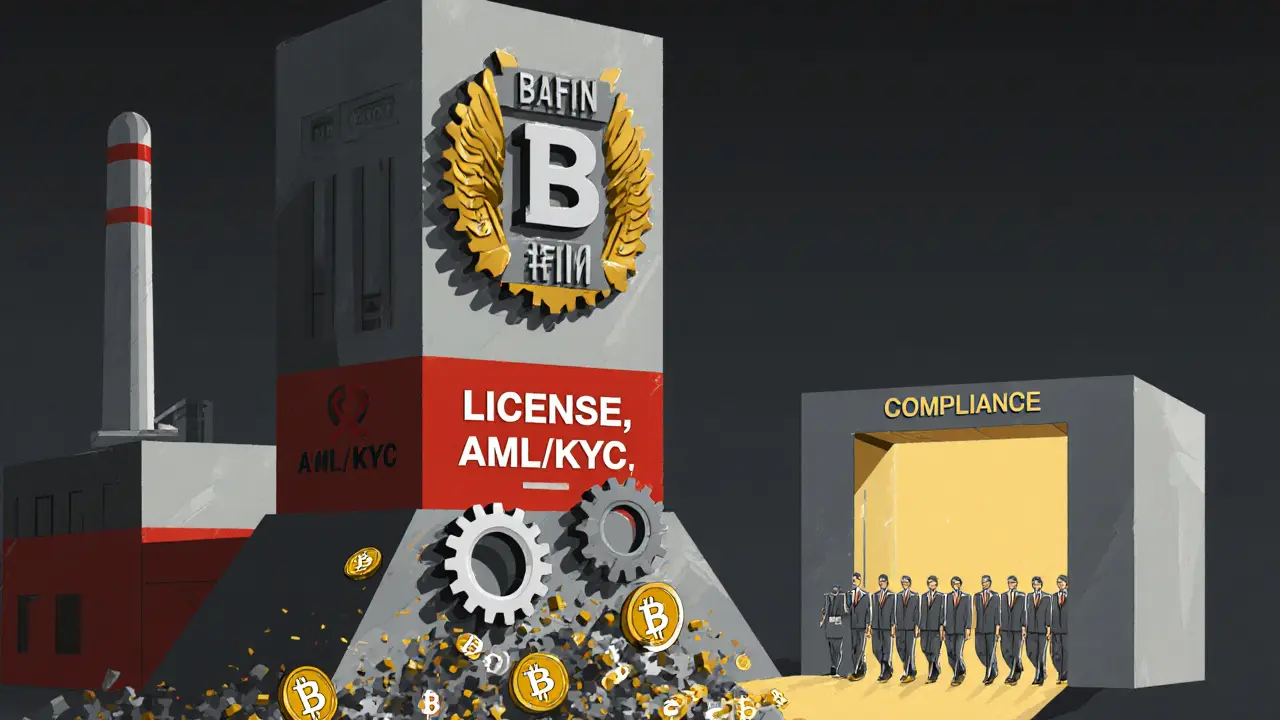
BaFin, short for Bundesanstalt für Finanzdienstleistungsaufsicht, is Germany’s federal financial supervisor. It doesn’t just watch banks - it oversees every crypto service provider operating in the country. That includes exchanges, custody providers, trading platforms, and even firms issuing new tokens. Under the German Banking Act (KWG), crypto assets like Bitcoin, stablecoins, and security tokens are treated as financial instruments. That means if you’re offering services tied to them, you need BaFin’s approval. You can’t just start a crypto exchange and hope for the best. You need a license. The same goes for crypto custody - storing digital assets for others. That’s now a standalone regulated activity. Since 2020, over 150 companies have applied for custody licenses. More than 90 got approved by early 2025. That’s not a backlog. That’s a functioning system.What You Must Do to Get Licensed
Getting licensed isn’t a formality. It’s a full audit of your business. BaFin looks at five things:- Organizational structure - Do you have clear roles? Is compliance built into your operations?
- Financial resources - You need enough capital to cover risks. For custody services, minimum equity is €125,000.
- IT security - Cold storage, multi-signature wallets, penetration testing. You must prove your systems can’t be hacked easily.
- AML/KYC procedures - You must verify every customer’s identity and track every transaction.
- White papers - If you’re launching a new token, you must submit a detailed document explaining the project, risks, and tokenomics to BaFin before going public.
The Travel Rule: Tracking Every Crypto Transfer
One of the strictest rules is the crypto transfer regulation (KryptoWTransferV). It enforces the Financial Action Task Force’s (FATF) “travel rule.” That means every time someone sends €1,000 or more in crypto, you must collect and send this data:- Name and address of the sender
- Account or wallet ID of the sender
- Name and address of the recipient
- Account or wallet ID of the recipient
When You Don’t Need a License
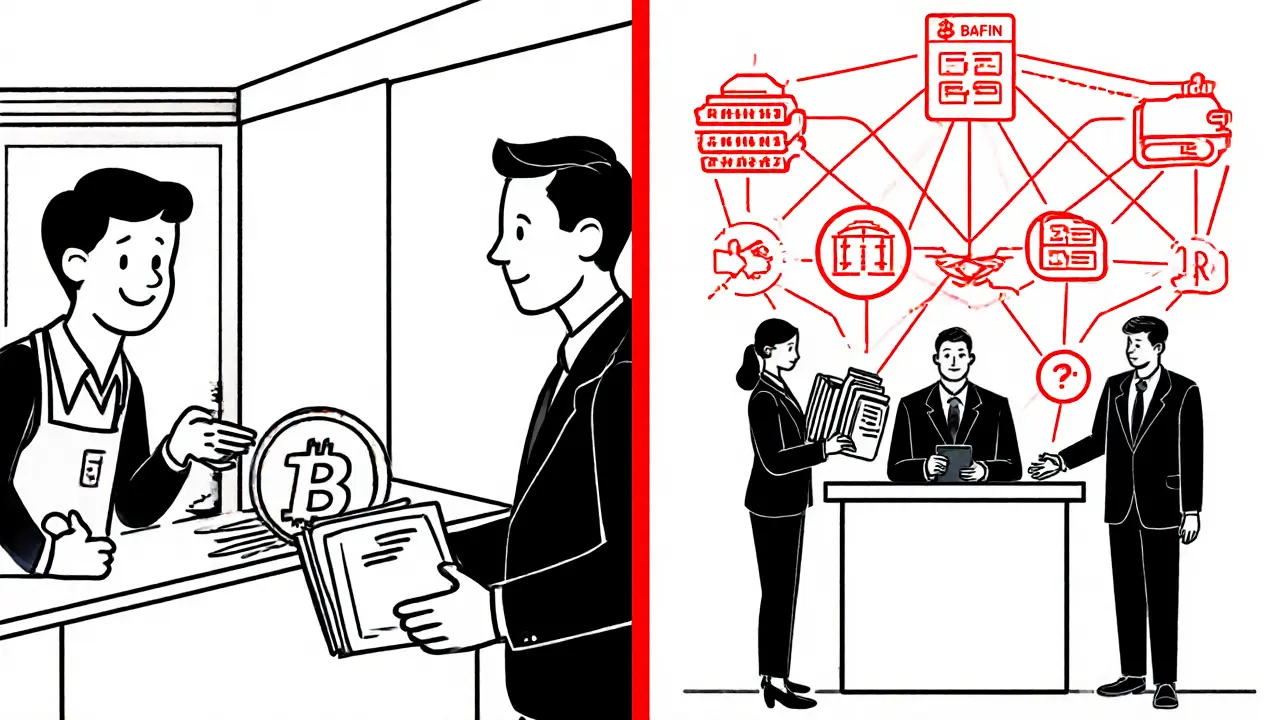
Not every crypto activity triggers regulation. If you’re a shop owner who accepts Bitcoin as payment for a product, you’re fine. You’re not offering a financial service. You’re selling goods. But here’s the trap: if you start buying crypto regularly to resell it - even just a few times a month - and you advertise it online, BaFin may classify you as a proprietary trader under Section 1(1a) No. 4 of the KWG. That requires a license. Same with mining pools. If you run a pool that collects fees from miners and distributes rewards, you’re acting like a financial intermediary. That’s regulated. Individual miners? Not regulated. But if you’re pooling resources and managing payouts, you’re crossing into financial services territory.What Happened in 2025: Enforcement in Action
BaFin isn’t just handing out licenses. It’s shutting down bad actors. On June 25, 2025, BaFin ordered Ethena GmbH to stop operating its USDe stablecoin in Germany. Why? The project didn’t meet MiCAR’s transparency or reserve requirements. Token holders had until August 6, 2025, to redeem their tokens through a court-appointed administrator. No refunds. No delays. Just a clean shutdown. That wasn’t an isolated case. In February 2025, BaFin issued warnings to five unlicensed DeFi platforms that were offering yield-generating services to German users. These platforms claimed they were “decentralized” and therefore outside regulation. BaFin’s response: “If you market to Germans, you’re subject to German law.” Meanwhile, the Federal Ministry of Finance updated tax rules. Crypto is now officially called “crypto assets,” not “virtual currencies.” Staking rewards are treated differently depending on whether they’re active (you’re running a node) or passive (you’re delegating). DeFi income must now be reported with transaction logs and daily market valuations. No more guessing.Who’s Targeted - Even If You’re Not in Germany
You don’t have to be based in Germany to fall under BaFin’s reach. If you’re a U.S.-based exchange and you actively target German customers - through German-language websites, ads on Facebook targeting Berlin, or support in German - BaFin considers you operating in Germany. The rule is simple: if you’re trying to attract German users, you need a license. Passive access - like a German citizen stumbling on your website - doesn’t count. But if you’re marketing to them? That’s a red flag. This is why many non-EU crypto firms now avoid the German market entirely. The cost and complexity of compliance outweigh the potential customer base. But for those who stay, the payoff is legitimacy. BaFin-approved firms are trusted by banks, institutional investors, and even traditional financial partners.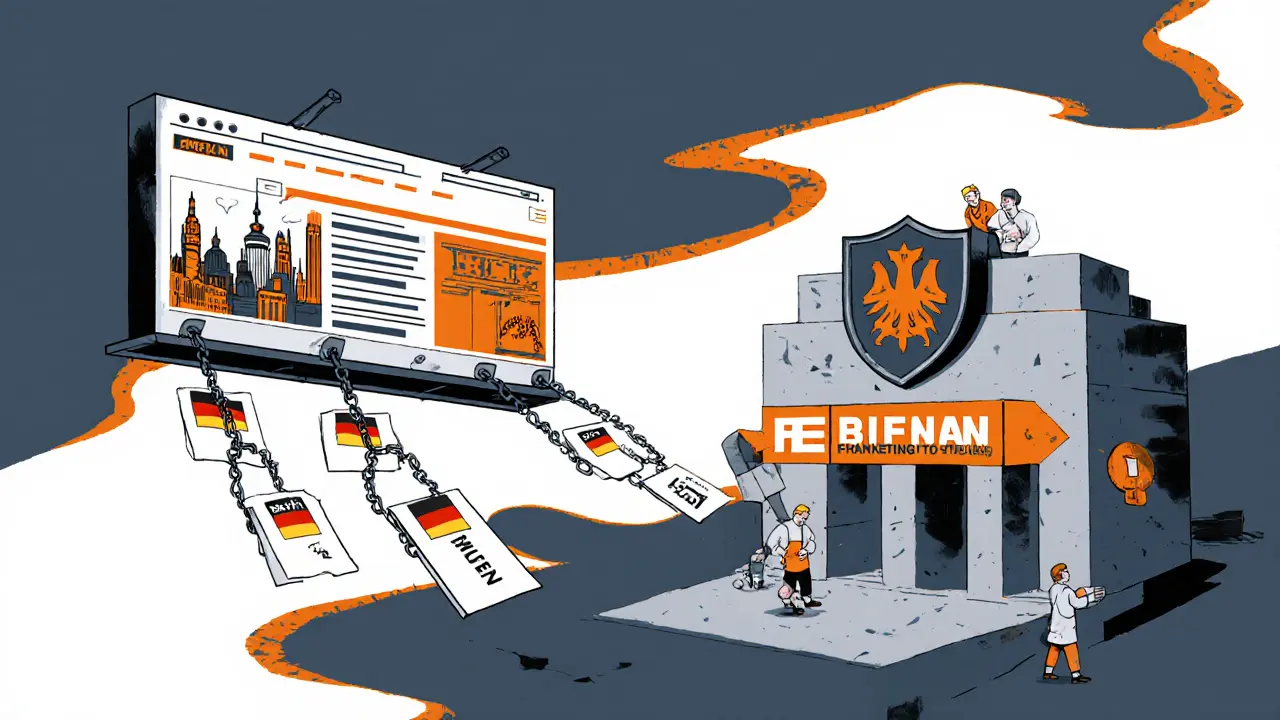
The Bigger Picture: Why Germany Leads in Crypto Regulation
Germany’s approach isn’t about control. It’s about clarity. Other countries have bans, delays, or vague guidelines. Germany says: “Here’s what’s allowed. Here’s how to do it legally. Here’s what happens if you don’t.” That’s why major players like Coinbase and Bitpanda chose Frankfurt as their EU hub. They didn’t pick Luxembourg or Ireland. They picked Germany because the rules are predictable. The enforcement is consistent. And the penalties are clear. MiCAR, which fully took effect in June 2025, didn’t replace German law - it absorbed it. BaFin’s existing rules became the foundation. That’s rare in the EU. Most countries had to overhaul their systems. Germany already had one.What You Should Do Now
If you’re running a crypto business:- Map out every service you offer. Are you custody, trading, staking, or issuing tokens?
- Check if any of those fall under KWG’s definition of financial services.
- If yes, start your BaFin application. The forms are public on their website.
- Get your IT security audit done. Use certified providers.
- Implement full AML/KYC with travel rule compliance. Don’t wait until you’re asked.
- Stop using unlicensed payment processors to convert crypto to euros.
What’s Next
By the end of 2025, all existing crypto licenses under German law will expire. Companies must reapply under MiCAR. BaFin has said it will not extend deadlines. No more grandfathering. If you haven’t applied by December 31, 2025, you’re operating illegally. The message is clear: Germany is open for crypto - but only if you play by the rules.Is cryptocurrency legal in Germany?
Yes, cryptocurrency is fully legal in Germany. It’s not banned or restricted. But any business offering crypto services - like trading, custody, or exchange - must be licensed by BaFin. Individuals can buy, hold, and use crypto without a license, as long as they’re not operating a business.
Do I need a BaFin license to accept crypto payments as a business?
No, if you’re simply accepting crypto as payment for goods or services, you don’t need a license. But if you use a third-party payment processor that converts your crypto to euros, and that processor isn’t licensed by BaFin, you could be held liable. Make sure your payment provider is authorized.
What’s the difference between active and passive staking under German tax law?
Active staking means you’re running your own validator node or directly participating in consensus. Passive staking means you delegate your coins to a third party, like an exchange or staking pool. Active staking rewards are treated as business income. Passive staking rewards are considered private income and may be taxed differently depending on holding periods and amounts.
Can a U.S.-based crypto company serve German customers without a BaFin license?
Only if they’re truly passive. If the company markets to Germans - using German language, targeting German IP addresses, offering customer support in German - BaFin considers that active service provision in Germany. That requires a license. Simply having German users visit your site isn’t enough. But advertising to them is.
What happens if I don’t get a BaFin license when I need one?
You risk criminal charges, fines up to €5 million, and forced shutdown. BaFin can freeze assets, block domain names, and refer cases to prosecutors. In 2025, BaFin shut down multiple unlicensed DeFi platforms and ordered the winding-up of Ethena GmbH’s operations in Germany. Non-compliance is treated as a serious financial crime.
How long does it take to get a BaFin crypto license?
In 2024, applications took 12-18 months. As of 2025, with MiCAR in force and streamlined procedures, well-prepared applicants can receive approval in 4-6 months. Speed depends on how complete your application is - especially your IT security documentation and AML procedures.
Do I need a license to mine cryptocurrency in Germany?
Individual miners don’t need a license. But if you run a mining pool that collects fees, distributes rewards, or manages multiple miners’ assets, BaFin considers that a financial service. That requires a license. Most solo miners are fine. Pool operators are not.
What’s the minimum capital required for a crypto custody license?
For crypto custody services, BaFin requires a minimum equity of €125,000. This is separate from operational costs. You must prove this capital is permanently available and not tied up in other investments. It’s meant to protect customer assets in case of insolvency.
Comments
Nancy Sunshine
Germany’s approach is actually the gold standard for crypto regulation. No hand-waving, no vague ‘we’re watching’ vibes - just clear rules, real accountability, and enforcement that doesn’t wait for a crisis. MiCAR didn’t change Germany’s game; it just gave it a European stamp. Other countries are still arguing about whether crypto is money or not. Germany already moved on.
November 29, 2025 at 01:54
Ann Ellsworth
Let’s be real - if you’re a US-based firm and you’re even *thinking* about targeting German users without a license, you’re either delusional or actively trying to get fined into oblivion. BaFin doesn’t play. They’ve got the legal teeth, the bureaucratic stamina, and the EU backing. Your ‘we’re decentralized’ excuse? Deleted. Your ‘we don’t know who’s on the other side’ defense? Invalid. Welcome to 2025.
November 30, 2025 at 06:30
Christy Whitaker
I used to think crypto was freedom. Now I see it’s just another corporate cage with more paperwork. They want me to prove my wallet security? Submit white papers? Track every damn transfer? It’s not regulation - it’s surveillance with a compliance badge. And don’t get me started on staking being taxed differently based on whether you’re ‘active’ or ‘passive.’ Who decided that? A bureaucrat with a spreadsheet?
December 1, 2025 at 16:30
Ziv Kruger
They call it regulation. I call it the death of anonymity. Not because crypto should be anonymous - but because the moment you require identity on every transfer above €1000, you’re not building a financial system. You’re building a ledger of human behavior. And once that exists, it’s never erased. Germany didn’t just regulate crypto. They digitized trust. And now we’re all paying for it.
December 2, 2025 at 08:27
Heather Hartman
Just wanted to say - if you’re a small shop owner accepting Bitcoin, don’t panic. You’re fine. Seriously. BaFin isn’t coming for your coffee stand. Focus on using a licensed processor. That’s the only thing that matters. Keep it simple. You’re doing great.
December 4, 2025 at 04:28
Alan Brandon Rivera León
I’ve worked with crypto firms in Berlin and Frankfurt. The licensing process is brutal - but once you’re through, it’s like walking into a bank that actually trusts you. Banks here will open accounts for BaFin-approved firms. Insurers will cover them. Investors show up without asking 20 questions. It’s not sexy. But it’s real. The US is still stuck in ‘regulatory sandboxes’ while Germany builds actual infrastructure. We’re falling behind.
And yeah, the travel rule is a pain. But if you’re handling €1000+ transfers, you owe your users transparency. This isn’t censorship. It’s responsibility.
December 4, 2025 at 20:59
Ankit Varshney
Miners don’t need a license. Pool operators do. That’s the line. Simple. Clear. No gray. This is how regulation should work - not by punishing individuals, but by holding systems accountable. Germany gets it.
December 5, 2025 at 14:30