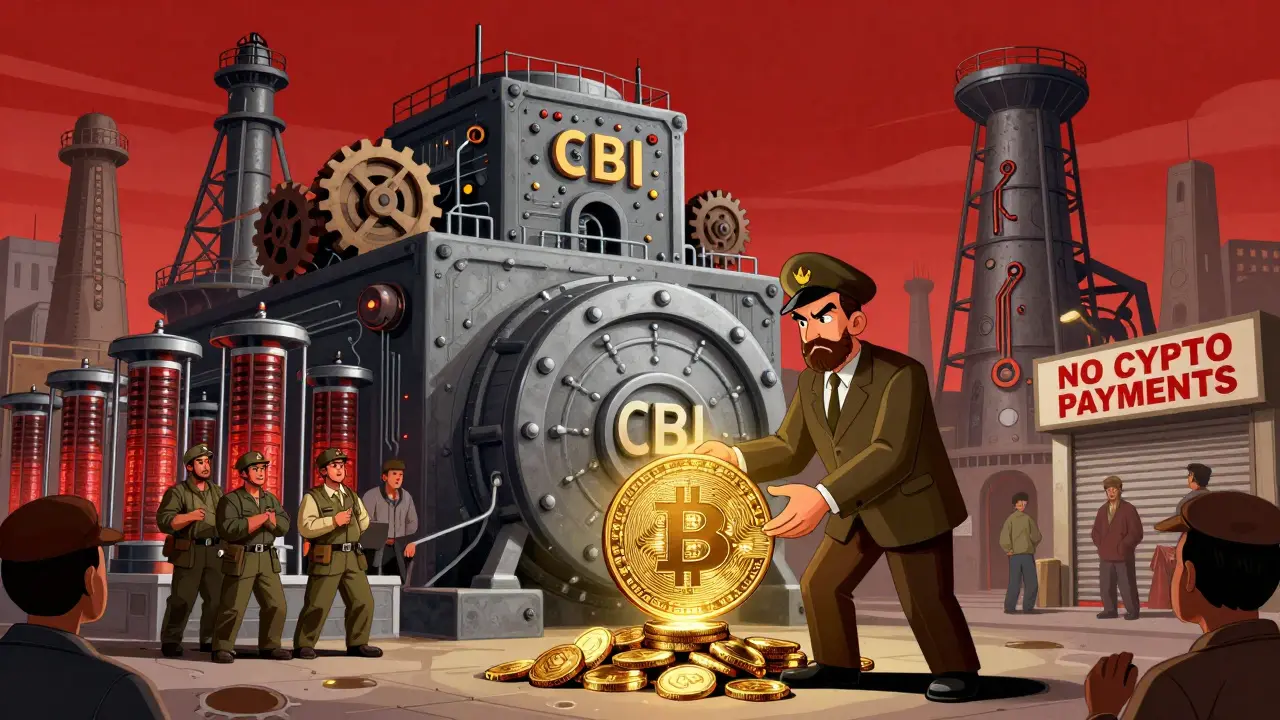
Can you use Bitcoin or Ethereum to pay for groceries, rent, or services in Iran? The short answer is: not really - not directly, not legally, and not without serious oversight. While Iran is one of the world’s top cryptocurrency mining nations, crypto payments for everyday transactions are tightly controlled, heavily monitored, and mostly blocked for regular users. The government doesn’t outright ban crypto - it just makes it nearly impossible to use it like money.
Miners Are Legal. Buyers Are Not.
Iran lets people mine Bitcoin and other cryptocurrencies. In fact, it’s one of the biggest mining hubs on the planet, responsible for about 4.5% of global hash power. Why? Because electricity is cheap, and the government wants a cut. Since 2019, miners have been required to get licenses from the Ministry of Industry, Mine and Trade. They must use approved hardware, pay government-set electricity rates, and sell all their mined coins directly to the Central Bank of Iran (CBI). That’s not a suggestion - it’s a rule. And it’s how Iran turns crypto into hard currency without letting the public touch it. But here’s the twist: miners can’t spend their Bitcoin. They can’t use it to buy a car, pay a freelancer, or order food online. The government takes their coins, converts them to rials, and puts the money into state coffers. Meanwhile, regular Iranians are stuck with a currency that lost over 80% of its value since 2020. So why not just use crypto themselves? Because the state won’t let them.Payment Gateways Are Shut Down - Except for the Ones the Government Controls
On December 27, 2024, the Central Bank of Iran shut down every cryptocurrency-to-rial payment gateway in the country. That meant apps like Nobitex and Digifin couldn’t let users turn Bitcoin into Iranian rials anymore. Overnight, buying crypto with your bank account became impossible. The move was meant to stop capital flight and protect the rial from further collapse. But by January 2025, things changed - just a little. The CBI started unblocking exchanges, but only if they used the government’s own API system. That means every transaction, every user ID, every IP address, every amount - all of it flows directly to the Central Bank. No privacy. No anonymity. No freedom. These licensed exchanges are the only legal way to trade crypto for rials, and even then, you need to pass strict KYC checks. You can’t just sign up with a fake name and start trading.Advertising Crypto Is Now a Crime
In February 2025, Iran went further. It banned all cryptocurrency advertising - online and offline. No YouTube videos. No Instagram posts. No billboards. No flyers in Tehran cafes. No sponsored tweets from crypto influencers. This isn’t just about controlling the market - it’s about controlling the narrative. The government doesn’t want people thinking crypto is a solution to inflation. It wants people to believe the digital rial is the only way forward. The ban is unusually strict. Even foreign crypto platforms that try to market to Iranians are blocked. VPNs are common in Iran, but even those can’t help you see ads for Binance or Coinbase anymore. The message is clear: crypto is a tool for the state, not the people.
Can You Pay for Something with Bitcoin? Technically, Yes. Practically, No.
There are no official stores in Iran that accept Bitcoin as payment. No restaurants, no online retailers, no taxi services. Even if a shop owner wanted to accept crypto, they’d need a licensed payment gateway - and none are available to the public. The only platforms allowed to process crypto-to-rial trades are the ones owned or monitored by the Central Bank. And those aren’t designed for spending. They’re designed for conversion - and surveillance. Some Iranians use peer-to-peer (P2P) platforms like LocalBitcoins or Paxful to trade crypto for cash. But even that’s risky. The government monitors P2P activity. If you’re caught trading outside approved channels, you could face fines, account freezes, or worse. In late 2024, authorities raided dozens of illegal mining farms and arrested operators. The same crackdown is creeping into trading.Why Does Iran Even Allow Mining If It Bans Payments?
It’s a paradox - but a calculated one. Iran is under heavy international sanctions. Western banks won’t process its payments. Foreign currency is hard to get. Crypto mining gives the state a way to earn dollars without touching the global financial system. Miners produce Bitcoin. The government buys it. Then it sells that Bitcoin on international markets for hard currency. It’s a backdoor to the global economy. At the same time, letting citizens freely use crypto would weaken the rial even more. If people could easily convert their savings into Bitcoin, the rial would collapse faster. So the state allows mining - but locks down spending. It’s a way to extract value from crypto without letting the public escape the system.The Digital Rial Is the Real Goal
Iran isn’t trying to become a crypto nation. It’s trying to become a digital state - on its own terms. The Central Bank is developing a Central Bank Digital Currency (CBDC) called the "Rial Currency." Unlike Bitcoin, this isn’t decentralized. It’s fully controlled by the government. Every transaction is tracked. Every balance is visible. You can’t mine it. You can’t hide it. You can’t use it to bypass sanctions. The digital rial is already being tested on Kish Island, a free-trade zone where tourists and foreign businesses operate. The goal? Replace cash, reduce dollar dependence, and create a payment system that can’t be blocked by the U.S. or Europe. But unlike crypto, this system gives the government total control. If you buy something with the digital rial, the state knows exactly what you bought, when, and from whom.
Comments
Rishav Ranjan
Iran lets miners keep the electricity but takes the Bitcoin. Classic.
December 19, 2025 at 23:07
Steve B
One cannot help but observe the paradox inherent in state-controlled digital sovereignty: the very technology designed for liberation is being weaponized as an instrument of fiscal control. The irony is not lost on those who remember the fall of the gold standard.
December 20, 2025 at 02:44
Dusty Rogers
This is the most brutal example of crypto being turned into a state revenue tool. Not freedom. Not innovation. Just extraction. And the people? They’re stuck watching their savings vanish while the government buys Bitcoin with their power bills.
December 20, 2025 at 08:20
Mmathapelo Ndlovu
It’s heartbreaking, really. 💔 People are using crypto not to rebel, but to survive. They’re not trying to overthrow the system-they’re just trying to keep their kids fed. The government’s digital rial isn’t progress. It’s a cage with a shiny interface. 🤕
December 22, 2025 at 05:01
Tyler Porter
Miners get fined if they don’t sell to the state. Buyers get arrested if they trade without permission. And yet... people still do it. Why? Because when your money loses 80% of its value... you do what you gotta do. It’s not a choice. It’s survival.
December 22, 2025 at 06:55
Earlene Dollie
So the state mines Bitcoin, takes it, sells it for dollars... and then tells people to use the digital rial? 😭 The drama! The betrayal! The sheer, beautiful, terrifying hypocrisy!
December 22, 2025 at 12:44
Kevin Karpiak
Iran shouldn’t even be mining. They’re just stealing global energy for a sanctions loophole. Let the rial collapse. Let them starve. The U.S. didn’t build this system for them to game it.
December 22, 2025 at 14:21
Amit Kumar
Bro, I’ve seen this in India too-government lets crypto mining happen in rural areas with cheap power, then bans retail use. But here’s the twist: Iranians are smarter. They’re using P2P, cold wallets, and Telegram bots to keep their savings alive. The state thinks it’s in control? Nah. People are building parallel economies under their noses. 🔥
December 23, 2025 at 22:59
Helen Pieracacos
Oh wow, so the government is like... ‘You can mine Bitcoin, but you can’t buy coffee with it.’ That’s not a policy. That’s a sitcom. 🤡
December 24, 2025 at 07:51